
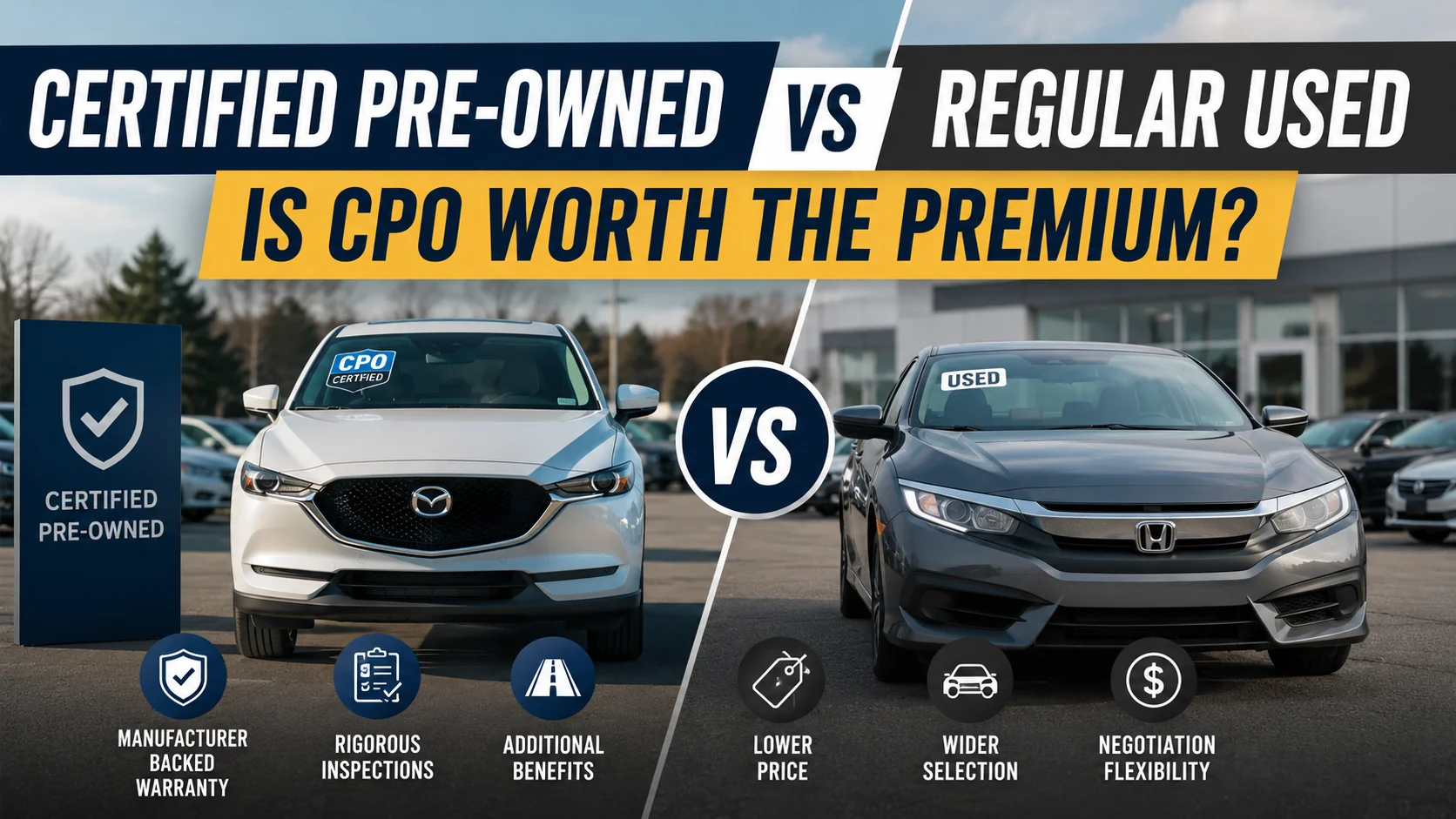
Certified Pre-Owned vs Regular Used: Is CPO Worth the Premium?
In this article
- What "Certified Pre-Owned" Actually Means
- Manufacturer-Backed CPO Programs
- Dealer-Certified Programs
- The CPO Premium: What You're Actually Paying
- When CPO Is Worth the Premium
- Newer Luxury Vehicles with Complex Electronics
- Buyers Who Cannot Self-Insure Against Repairs
- Low-Mileage, Near-New Vehicles
- When CPO Is Not Worth the Premium
- Proven Reliable Models with Strong Track Records
- Higher-Mileage Vehicles Approaching Program Limits
- When You Can Get an Independent Inspection and Third-Party Warranty
- How Independent Dealers Offer Comparable Value
- Third-Party Warranty Programs
- Pre-Sale Reconditioning
- AMVIC Protection
- Extended Warranty Comparison: CPO vs. Aftermarket
- Total Cost Analysis Over 5 Years
- Financing CPO vs. Non-CPO Vehicles
- Questions to Ask Before Paying the CPO Premium
- The Verdict: A Framework for the Decision
- Related Buyer Guides
- Compare and Apply
Check Your Options in 3 Minutes
No credit impact. All credit situations welcome.
★★★★★ 114+ Google Reviews · AMVIC Licensed · Free Delivery 300km
You've found two similar vehicles: a 2021 Toyota RAV4 at a franchise dealer marketed as "Certified Pre-Owned" for $36,500, and what looks like an identical unit at an independent dealer for $33,000. The CPO badge costs $3,500 more. Is it worth it? The answer depends almost entirely on what that certification actually means for that specific vehicle — and "certified pre-owned" means very different things depending on who's doing the certifying.
This post cuts through the marketing and gives you a practical framework for evaluating CPO programs versus regular used vehicles. There are situations where CPO genuinely earns its premium. There are also situations where you're paying thousands of dollars for a sticker, a folder of paper, and the comfort of a familiar logo.
See what you pre-qualify for
Three quick answers — soft check, no commitment.
What "Certified Pre-Owned" Actually Means
The term "certified pre-owned" has no universal legal definition in Canada. Any dealer, anywhere, can technically call any vehicle "certified." What matters is who is backing the certification and what it actually includes.
Manufacturer-Backed CPO Programs
The gold standard is manufacturer-backed certification — Toyota Certified Used Vehicles, Honda Certified Pre-Owned, Ford Blue Advantage, and similar programs run by the OEM itself. These programs typically include:
- A multi-point inspection (ranging from 100 to 200+ points depending on the manufacturer)
- Any required reconditioning to bring the vehicle up to manufacturer standards
- An extension of the original factory warranty or a new manufacturer-backed warranty
- Roadside assistance coverage
- A vehicle history report (CarFax or equivalent)
Crucially, manufacturer CPO programs are only available at franchised dealerships selling that brand, and vehicles must typically be less than 6-8 years old with fewer than 100,000–130,000 km. The warranty backing is directly from the manufacturer — if the vehicle breaks down, the claim goes through the same system as a new car warranty claim.
Dealer-Certified Programs
Below manufacturer CPO sits the dealer-certified category. These are inspection programs designed and administered by the dealership itself, often backed by a third-party warranty company rather than a manufacturer. The quality of these programs varies enormously. A reputable dealer with a thorough inspection process and a strong third-party warranty company can offer genuine value. A less scrupulous dealer might apply a sticker and a modest markup with little backing behind it.
When a dealer advertises "certified" vehicles without a manufacturer's name attached, always ask specifically: what does the certification include, who backs the warranty, what are the exclusions, and where can you get warranty work done?
Key question to ask every time: "Is this manufacturer-certified, or dealer-certified?" The answer fundamentally changes the value proposition.
The CPO Premium: What You're Actually Paying
CPO vehicles typically command a premium of $2,000 to $5,000 over comparable non-certified used vehicles. On luxury vehicles, that spread can be wider. Let's look at what components of that premium are paying for real value versus perceived security.
| CPO Component | Real Value | Typical Cost If Purchased Separately |
|---|---|---|
| Multi-point inspection | Moderate — confirms condition but is dealer-done, not independent | $150–250 (independent mechanic) |
| Reconditioning | High — vehicle is brought to standard before sale | Varies widely ($0–$3,000+) |
| Extended warranty | High for complex/luxury vehicles; lower for reliable brands | $1,500–3,000 for comparable third-party coverage |
| Roadside assistance | Low — available separately for $80–150/year | $80–150/year |
| Vehicle history report | Low — available for $40–60 directly | $40–60 |
| Peace of mind premium | Subjective — real psychological value for some buyers | Not quantifiable |
The math suggests the concrete components of a manufacturer CPO program — inspection, reconditioning, warranty — are worth somewhere between $1,500 and $3,500, depending on what reconditioning was performed and the robustness of the warranty terms. When the CPO premium exceeds that range, you're paying for brand comfort more than tangible protection.
When CPO Is Worth the Premium
There are genuinely strong arguments for CPO in specific situations.
Newer Luxury Vehicles with Complex Electronics
This is where manufacturer CPO earns its money most clearly. A used BMW X3 or Audi Q5 at 2-3 years old represents a vehicle with sophisticated electronics, air suspension systems, and powertrains that can generate expensive repair bills. The manufacturer-backed warranty on a CPO luxury vehicle covers these systems with the same claim process as the original warranty. For a vehicle where a single electronic module can cost $3,000–8,000 to replace, that coverage has real dollar value — and the reconditioning requirement means any existing faults must be repaired before certification.
Buyers Who Cannot Self-Insure Against Repairs
If an unexpected $2,000 repair would create genuine financial hardship, a robust CPO warranty has value beyond what a spreadsheet shows. The certainty of capped repair costs for the warranty period is worth something to buyers who can't absorb variance. This is a real consideration — not everyone is in a position to treat repair costs as a manageable variable.
Low-Mileage, Near-New Vehicles
CPO makes the most sense when the vehicle is young enough that the manufacturer warranty can extend meaningfully — say, a 2022 model in early 2026, where CPO might extend factory coverage to 2029 or 2030. As vehicles age and accumulated kilometres approach program limits, the warranty term shrinks and the value proposition weakens.
When CPO Is Not Worth the Premium
Proven Reliable Models with Strong Track Records
The irony of CPO is that the vehicles most likely to be sold with a CPO designation from a trusted manufacturer — Toyota, Honda, Mazda — are also the vehicles least likely to need warranty coverage. A certified Toyota RAV4 at 60,000 km is statistically quite unlikely to generate a major warranty claim in the first 2-3 years of ownership. You're paying for protection against an outcome that rarely materializes on these models.
This doesn't mean the vehicle isn't worth buying — it almost certainly is. But the CPO premium on a reliably engineered vehicle is harder to justify than the same premium on a complex European crossover.
Higher-Mileage Vehicles Approaching Program Limits
If a CPO vehicle has 95,000 km and the program's mileage limit is 130,000 km, the effective warranty coverage is limited to the next 35,000 km of driving. At typical Alberta driving distances of 20,000–25,000 km per year, that's less than two years of coverage. Compare the cost of the CPO premium to the cost of a standalone third-party warranty for the same period.
When You Can Get an Independent Inspection and Third-Party Warranty
This is where independent dealers can genuinely level the playing field. A $200 pre-purchase inspection from an independent mechanic gives you an objective assessment of the vehicle's condition — arguably more objective than a dealer-performed inspection, since the mechanic has no interest in selling you the vehicle. Pair that with a comprehensive third-party warranty from a reputable provider, and you've replicated the core protective elements of CPO for a fraction of the premium.
Our used car warranty guide for Alberta covers the major third-party warranty providers, what to look for in warranty terms, and the questions you need to ask before buying any extended coverage.
How Independent Dealers Offer Comparable Value
A common misconception is that buying from an independent dealer means buying without any protection. That's not accurate. Reputable independent dealers — AMVIC-licensed in Alberta — can offer protection layers that approach or match manufacturer CPO programs in practice.
Third-Party Warranty Programs
Independent dealers have access to the same warranty companies that back many dealer-certified programs. Providers like Lubrico, Global Warranty, and similar companies offer coverage plans that can be structured to match the term and mileage limits of manufacturer CPO programs. The key is reading the exclusions carefully — a warranty that excludes electronics, seals, and wear items is nearly useless on a modern vehicle.
Pre-Sale Reconditioning
Reputable independent dealers recondition their inventory as a matter of basic practice — not because a manufacturer requires it, but because their reputation depends on it. The difference is that reconditioning at an independent dealer isn't standardized by a manufacturer's checklist. This is why asking specific questions about what has been inspected, replaced, and serviced on the specific vehicle matters.
AMVIC Protection
In Alberta, all licensed vehicle dealers — independent and franchise — are regulated by AMVIC (Alberta Motor Vehicle Industry Council). AMVIC provides a compensation fund for consumers who suffer losses due to dealer misconduct and enforces mandatory disclosure requirements. Buying from an AMVIC-licensed dealer provides a baseline of consumer protection regardless of whether the vehicle carries a CPO badge.
Extended Warranty Comparison: CPO vs. Aftermarket
The warranty is the most substantive component of any CPO program. Here's how manufacturer CPO warranties typically compare to quality aftermarket options:
| Feature | Manufacturer CPO Warranty | Quality Third-Party Warranty |
|---|---|---|
| Coverage scope | Comprehensive — manufacturer defines what's included | Varies by plan; read exclusions carefully |
| Claim location | Any authorized dealer for that brand | Any licensed repair facility (often) |
| Claim process | Streamlined through manufacturer | Requires pre-authorization from warranty company |
| Deductible | $0–$300 typical | $0–$500 typical |
| Transferability | Usually transferable to next owner | Often transferable — adds resale value |
| Cost (standalone) | Bundled into CPO premium ($2,000–5,000+) | $1,200–2,500 for comparable term/mileage |
| Dispute resolution | Manufacturer or dealer | Third-party company; AMVIC if dispute arises |
The manufacturer CPO warranty wins on simplicity and claim process. The aftermarket warranty wins on cost when purchased separately. The practical gap between them narrows significantly when you're comparing quality aftermarket coverage to manufacturer CPO — the frictionless claim experience of CPO is real, but it's worth perhaps $500–800 in convenience premium, not $3,000.
Total Cost Analysis Over 5 Years
Let's run a realistic five-year cost comparison between a manufacturer-CPO vehicle and the equivalent non-CPO vehicle with third-party warranty, using a 2021 mid-size SUV as the example.
| Cost Item | CPO Vehicle | Non-CPO + Aftermarket Warranty |
|---|---|---|
| Purchase price | $36,500 | $33,000 |
| Pre-purchase inspection | $0 (included in CPO) | $200 |
| Third-party warranty (5yr/100K km) | $0 (included in CPO) | $2,000 |
| Vehicle history report | $0 (included in CPO) | $50 |
| Total all-in cost | $36,500 | $35,250 |
| Difference | CPO costs $1,250 more for similar protection |
In this scenario, the CPO premium has narrowed to about $1,250 for the convenience and confidence of manufacturer backing. For many buyers — especially those buying a complex vehicle or one where peace of mind has real value — that's a defensible number. For buyers who've done their homework and found a well-maintained non-CPO unit, that $1,250 represents real money saved.
Use the payment calculator to model the biweekly payment difference between these price points. On a 72-month term at current rates, a $3,500 price difference translates to roughly $30–35 biweekly — meaningful over six years but not dramatic.
Financing CPO vs. Non-CPO Vehicles
One area where CPO can create an indirect advantage: financing. Some lenders offer preferential rates on manufacturer-certified vehicles, treating them similarly to newer vehicles in their underwriting. The logic is that the certification process reduces unknown mechanical risk, which reduces lender exposure.
In practice, the rate difference is modest — often 0.5% to 1% — and doesn't always apply, depending on the lender and the applicant's credit profile. But it's worth asking about when you're comparing financing options. Our dealership financing vs. bank loan comparison covers how rate competition works in practice and where multi-lender dealerships have an advantage over single-source financing.
For buyers concerned about protecting their financing investment, GAP insurance is relevant regardless of whether a vehicle is CPO or not. If you finance a vehicle and its market value drops below your loan balance, GAP covers the difference in a total loss. It's a separate consideration from the warranty question but often comes up in the same conversation.
Questions to Ask Before Paying the CPO Premium
Whether you're evaluating a manufacturer CPO program or a dealer-certified vehicle, these questions sharpen the decision:
- Is this manufacturer-backed or dealer-backed certification? If dealer-backed, who is the warranty company and what is their claims history?
- What specific items were inspected and what was replaced? Ask for the actual inspection report, not just assurance that an inspection occurred.
- What are the warranty exclusions? Request the warranty document and read the exclusions section. "Wear items," "electronics," and "pre-existing conditions" clauses can hollow out coverage significantly.
- Where can I get warranty work done? Manufacturer CPO: any authorized dealer. Some third-party warranties restrict you to specific shops or require pre-authorization that can slow repairs.
- Is the warranty transferable if I sell? Transferable warranties add resale value.
- What is the deductible per claim? A $500 deductible on a $600 repair makes the warranty nearly useless for smaller issues.
- What would this vehicle cost without the CPO designation? If you can find a comparable non-certified unit and price the protection components separately, you have a real comparison.
The Verdict: A Framework for the Decision
CPO is worth the premium when:
- The vehicle is a European luxury model with complex, expensive electronics
- The certification is manufacturer-backed with genuine comprehensive coverage
- The vehicle is young enough that the warranty term is meaningful (2+ years remaining)
- The premium is $2,500 or less above a comparable non-CPO unit
- You value the frictionless claim process and predictable ownership costs above all else
CPO is not worth the premium when:
- The vehicle is a reliably engineered Japanese model with a strong service history
- The certification is dealer-backed without a named, reputable warranty company
- The vehicle is approaching the mileage limits of the CPO program
- The premium exceeds $3,500 and you're willing to do a pre-purchase inspection and source third-party coverage
- The same protection can be assembled for significantly less through independent channels
If you're evaluating a used vehicle and want an honest read on whether the CPO premium makes sense for that specific unit, bring us the details. We work with buyers across Calgary and the surrounding area and regularly help people think through these comparisons without any stake in which direction they go. When you're ready to move forward — CPO or not — explore your financing options with us. We work with all credit situations, and our multi-lender model means 15+ lenders compete for your business rather than you taking whatever rate one institution offers.
For more context on the used car buying process, the trade-in appraisal guide gives you useful perspective on how dealers evaluate vehicles — which is the same framework that informs what reconditioning actually costs and why CPO premiums are priced the way they are. And if you're comparing a used vehicle purchase against a lease return, our inspection checklist applies equally to CPO and non-CPO units — certification doesn't replace your own due diligence.
Compare and Apply
- Bad Credit Financing — Complete Guide — Alberta's subprime auto financing guide
Financing Resources
Related Articles

Ready to Find Your Vehicle?
Browse our inventory or apply for financing. All credit situations welcome.
★★★★★ 114+ Google Reviews · AMVIC Licensed · Free Delivery 300km