
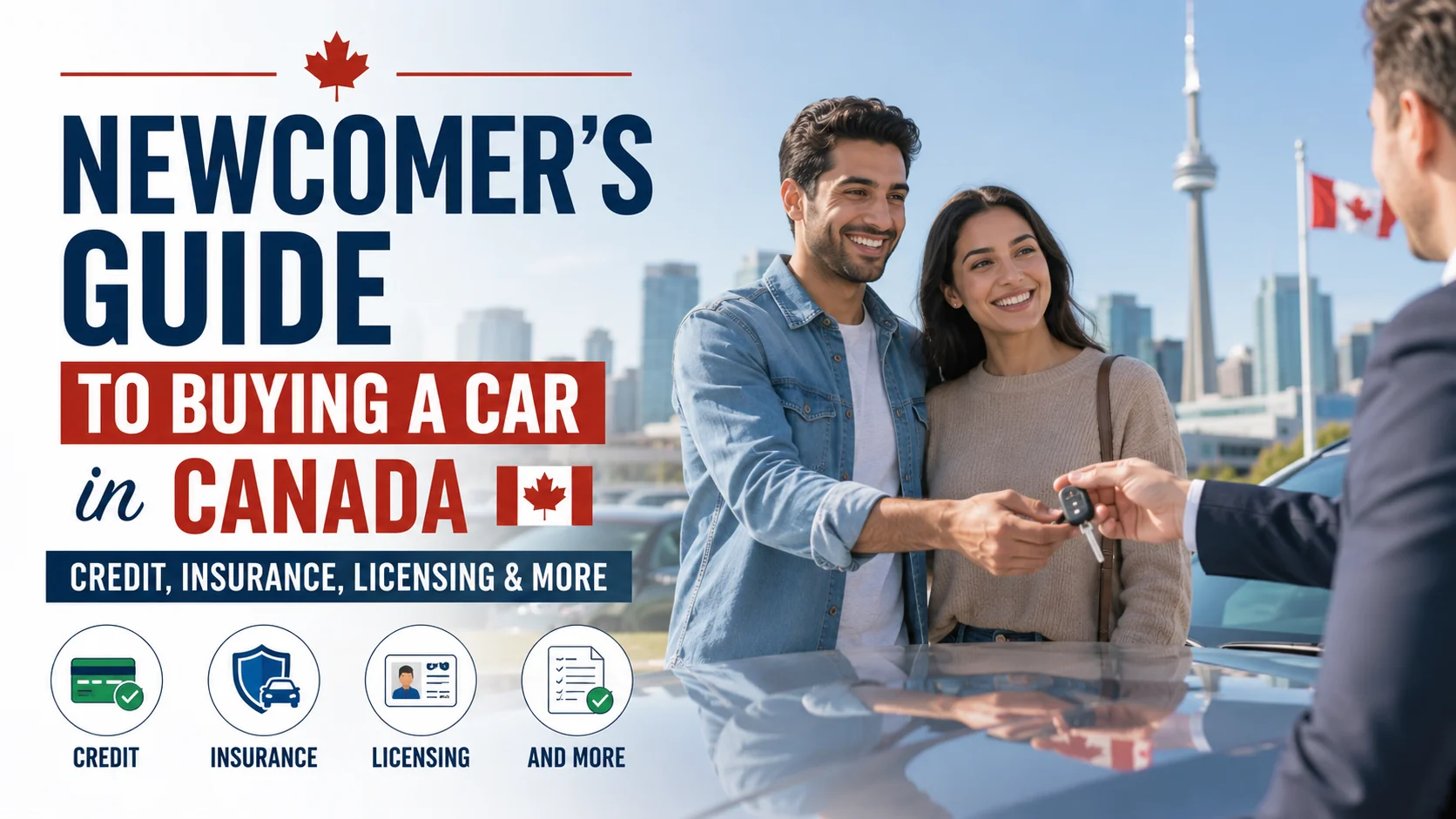
Newcomer's Guide to Buying a Car in Canada: Credit, Insurance, Licensing & More
In this article
- A Newcomer's Complete Guide to Buying a Car in Canada
- Step 1: Get Your Alberta Driver's Licence
- Step 2: Start Building Your Canadian Credit History Immediately
- Step 3: Understand Your Financing Options
- Step 4: Get Car Insurance in Alberta
- Step 5: Register Your Vehicle in Alberta
- Alberta-Specific Tips for Newcomers
- Ready to Get Started?
- Related Buyer Guides
- Compare and Apply
Check Your Options in 3 Minutes
No credit impact. All credit situations welcome.
★★★★★ 114+ Google Reviews · AMVIC Licensed · Free Delivery 300km
A Newcomer's Complete Guide to Buying a Car in Canada
Moving to Canada is exciting, overwhelming, and full of firsts. One of the biggest practical challenges for many newcomers is buying a car — especially if you've settled in Alberta, where public transit outside of Calgary and Edmonton is limited. If you're living in Airdrie, Cochrane, Okotoks, Chestermere, or any of the communities surrounding Calgary, a vehicle isn't a luxury. It's how you get to work, how you get groceries, and how you participate in daily life.
This guide walks you through the entire process of buying a car in Canada as a newcomer, from getting your licence to building credit to understanding your financing options. It's written specifically for people who are new to the Canadian system and may not have an established credit history here.
Step 1: Get Your Alberta Driver's Licence
Before you can register or insure a car in Alberta, you need a valid driver's licence. Alberta has a Graduated Driver Licensing (GDL) program, but newcomers with driving experience from their home country may be able to skip some or all of the graduated steps.
What you need to know:
- Visit any Alberta registry office to start the process — bring your current foreign licence, passport, and proof of Alberta residency
- Some countries have reciprocal agreements with Alberta that allow direct licence exchange without road tests
- Countries with full exchange agreements include the United States, United Kingdom, Australia, Germany, Japan, South Korea, Austria, Belgium, France, Switzerland, and others — check the Alberta government website for the current list
- If your country doesn't have a reciprocal agreement, you'll need to pass a knowledge test and one or two road tests
- An International Driving Permit (IDP) can be used temporarily but is not a permanent solution — you must obtain an Alberta licence within 90 days of establishing residency
- The knowledge test is available in multiple languages at some registry offices — ask when booking
Cost to budget for: Licence exchange or new licence application fees range from $20-$95 depending on the process. Road tests, if required, cost approximately $75-$150 each.
Step 2: Start Building Your Canadian Credit History Immediately
This is the single most important financial step you can take as a newcomer, and the sooner you start, the better. Canadian lenders use credit scores from Equifax and TransUnion to make lending decisions. Without a Canadian credit history, you have what's called a "thin file" — and that makes financing a vehicle more challenging, though not impossible.
How to start building credit right away:
- Open a Canadian bank account: Do this within your first week. Major banks like RBC, TD, BMO, Scotiabank, and CIBC all have newcomer banking programs with fee waivers and special offers for the first year
- Get a secured credit card: You deposit $500-$1,000 as collateral, and the bank issues you a credit card with that amount as your limit. Use it for small purchases — groceries, gas, a streaming subscription — and pay the full balance every month. This gets reported to the credit bureaus and starts building your score immediately
- Apply for a newcomer credit card: Several Canadian banks offer unsecured credit cards specifically designed for newcomers with no Canadian credit history. These have lower limits but don't require a deposit
- Get a cell phone plan in your name: Canadian telecom companies (Telus, Rogers, Bell) report to credit bureaus. A postpaid plan that you pay on time every month actively builds your credit file
- Pay everything on time, every time: Payment history is the single largest factor in your credit score — roughly 35% of the total. One missed payment can set you back months of progress
Timeline expectations: Most newcomers can build enough credit history to qualify for a car loan within 3-6 months of arriving in Canada. Some specialized lenders will work with you even sooner if you have proof of employment and a reasonable down payment.
Step 3: Understand Your Financing Options
As a newcomer, you have more options than you might expect:
Newcomer auto loan programs: Many Canadian lenders have specific programs for newcomers and immigrants. These programs consider your employment status, income, down payment, and sometimes your international credit history — rather than relying solely on a Canadian credit score. At Shift Happens Auto Sales in Airdrie, we work with lenders who specialize in exactly these situations.
What lenders typically require from newcomers:
- Proof of permanent residency, work permit, or valid immigration status
- Proof of income — pay stubs, employment letter, or a signed job offer letter
- A down payment, typically 10-20% of the vehicle price
- Proof of Alberta residency — utility bill, lease agreement, or bank statement with your address
- Personal or professional references in Canada (usually 2-3 contacts)
Other financing paths:
- Cash purchase: If you have savings, buying outright avoids financing entirely. However, even if you can afford to pay cash, consider putting some down and financing the rest — making consistent loan payments is one of the fastest ways to build a strong Canadian credit history
- Co-signer: If you have a family member or friend with established Canadian credit willing to co-sign, this can significantly improve your approval odds and interest rate
- Larger down payment: A bigger down payment reduces the lender's risk and can offset a thin credit file. If you can put 20-30% down, your financing options expand considerably
Step 4: Get Car Insurance in Alberta
In Alberta, you must have valid car insurance before you can register a vehicle. Alberta uses a private insurance system, meaning you shop for insurance from private companies rather than a government provider (unlike British Columbia or Saskatchewan).
What newcomers should know about Alberta car insurance:
- Minimum required coverage is $200,000 third-party liability, but most insurers and financial advisors strongly recommend at least $1,000,000 — the premium difference is often modest
- Your insurance history from your home country may count — ask the broker directly. Some Canadian insurers will recognize your claims-free driving record from abroad, which can meaningfully lower your premium
- Get quotes from multiple companies, or work with an insurance broker who can shop multiple insurers on your behalf
- Winter tires can earn you a discount with some Alberta insurers
- New-to-Canada drivers typically pay higher premiums initially — this decreases as you build a Canadian driving and insurance history
- If you're financing through a lender, collision and comprehensive coverage will be required
Step 5: Register Your Vehicle in Alberta
Once you've purchased a car and have insurance in place, you need to register it at an Alberta registry office.
What you need to bring:
- Bill of sale from the dealership
- Proof of insurance (your pink card)
- Valid Alberta driver's licence
- Payment for registration fees (approximately $80-$100 annually)
If you're buying from a dealership like Shift Happens Auto Sales, we typically handle the registration paperwork for you. It's one less thing to navigate when you're already managing dozens of details of settling into a new country.
Important note: Alberta has no provincial sales tax (PST). You only pay the 5% federal GST on vehicle purchases. This is a significant advantage compared to Ontario (13% HST), British Columbia (7% PST + 5% GST), or Quebec (9.975% QST + 5% GST). On a $25,000 vehicle, that's a savings of $2,000 or more compared to most other provinces.
Alberta-Specific Tips for Newcomers
- Winter driving is a skill you need to learn: If you're from a country without harsh winters, invest in a winter driving course before your first Alberta winter. Many driving schools in Calgary and Airdrie offer winter-specific programs. The roads here from November through March are a different driving environment entirely
- Block heaters are essential: Your car needs a block heater for Alberta winters. Most used vehicles sold in Alberta already have one installed — verify that it works. Plug it in when temperatures drop below -15°C to ensure reliable cold starts
- Winter tires matter more than AWD: Good winter tires on a front-wheel-drive car will outperform all-season tires on an all-wheel-drive vehicle every time. Budget $600-$1,200 for a set of winter tires — they're not optional here
- The Alberta Advantage: No PST means cheaper vehicle purchases. No vehicle safety inspections for in-province sales (unlike Ontario). Lower overall cost of vehicle ownership compared to most Canadian provinces
- AMA (Alberta Motor Association): Consider a membership. Similar to AAA in the US, AMA provides roadside assistance, travel discounts, and advocacy for Alberta drivers. The roadside assistance alone is worth it during your first winter
Ready to Get Started?
At Shift Happens Auto Sales in Airdrie, we work with all credit situations — including newcomers with no Canadian credit history. We've helped many new Canadians get into reliable vehicles with financing that fits their situation. Whether you arrived in Canada last week or last year, come talk to us about your options. We're located just north of Calgary on Highway 2, and we're here to help you get mobile in your new home.
Compare and Apply
- Complete Bad Credit Car Buying Guide (Alberta) — complete bad credit car buying guide
See what you pre-qualify for
Three quick answers — soft check, no commitment.
Financing Resources
Related Articles
Ready to Find Your Vehicle?
Browse our inventory or apply for financing. All credit situations welcome.
★★★★★ 114+ Google Reviews · AMVIC Licensed · Free Delivery 300km