
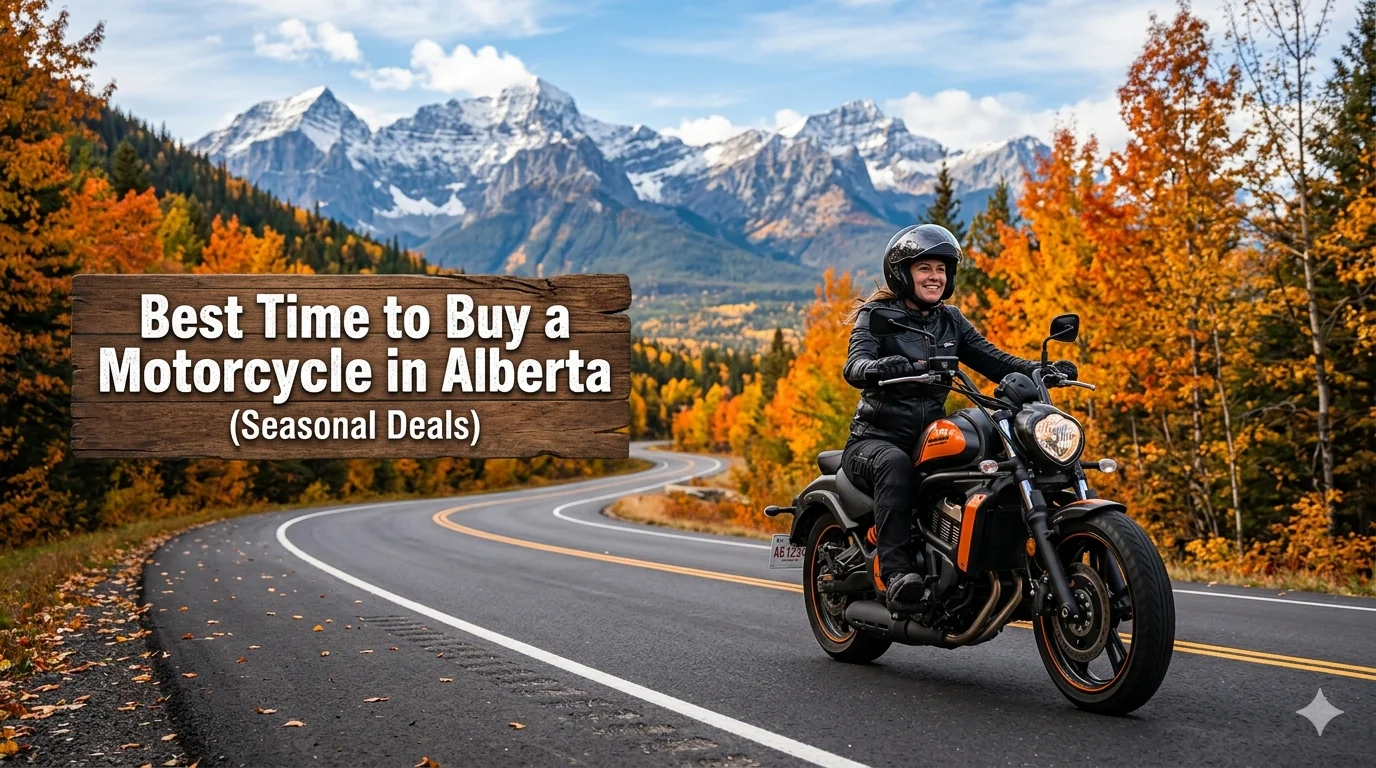
Best Time to Buy a Motorcycle in Alberta (Seasonal Deals)
In this article
- Alberta's Motorcycle Buying Calendar
- How to Negotiate During Off-Season
- Storage: Buying in Winter Doesn't Mean Riding in Winter
- Winterizing a Newly Purchased Motorcycle
- Insurance Timing: Don't Pay for Months You're Not Riding
- Sport Bikes, Cruisers, and Adventure Bikes: Seasonal Pricing Differences
- Alberta's Riding Season: Making the Most of Your Window
- How Financing Works for Seasonal Vehicles
- First-Time Motorcycle Buyers in Alberta: Additional Considerations
- Ready to Buy? Here's Your Off-Season Action Plan
- Related Buyer Guides
- Compare and Apply
Check Your Options in 3 Minutes
No credit impact. All credit situations welcome.
★★★★★ 118+ Google Reviews · AMVIC Licensed · Free Delivery 300km
Every spring in Alberta, the same scene plays out: the snow melts, the Rockies start looking inviting again, and everyone who spent February watching YouTube motorcycle videos calls a dealership on the same weekend. Prices spike. Inventory tightens. The leverage shifts entirely to the seller. If you've been there — if you've paid full asking price for a bike in April because you just couldn't wait — you know the feeling of watching the same model sell for $2,000 less in November. Timing a motorcycle purchase in Alberta isn't complicated, but most buyers get it exactly backwards.
See what you pre-qualify for
Three quick answers — soft check, no commitment.
Alberta's Motorcycle Buying Calendar
To understand when to buy, you first need to understand when Albertans ride. The practical riding season here runs from roughly May through September, with October being borderline depending on the year and the rider's tolerance for cold. Some die-hards keep going into November, but the combination of cold temperatures, wet roads, and frost in the Rockies makes October the last reliable month for most riders.
The best months to buy a motorcycle in Alberta — measured by price, inventory, and negotiating leverage — are October through February. The worst months are April and May. The gap between those time windows can mean thousands of dollars on the same bike. Here's what drives that pattern:
- October: Dealers know the season is ending. Sellers who want cash before storage season become motivated. First real deals appear.
- November: Demand drops sharply. Dealerships want to reduce floor plan financing costs. Best inventory selection of the off-season — bikes haven't sat as long.
- December–January: Lowest prices of the year, but inventory is thinner. Sellers are highly motivated. Banks are competing for loan business in a slow period.
- February: Prices start ticking up as spring anticipation builds. Still good deals, but the window is closing.
- March: The tide turns. Spring buyers enter the market. Prices start climbing.
- April–May: Peak demand. Peak prices. Lowest negotiating leverage of the year.
The pattern holds for both private sales and dealer sales, though the magnitude differs. Private sellers are often more reactive to seasons — someone who bought a bike in May, rode it through summer, and is selling in October is often genuinely motivated. They know winter is coming and they don't want to store and insure a bike they're not riding. That motivation translates to real room on price.
How to Negotiate During Off-Season
Walking into a motorcycle negotiation in November with a clean pre-approval letter and a willingness to close quickly puts you in a fundamentally different position than a spring buyer who's competing with three other people for the same bike. Here's the practical approach:
- Know your financing before you walk in. Sellers — both private and dealer — respond very differently to a buyer who says "I'm pre-approved for $15,000 and I can close this week" versus "I'd need to figure out financing." The certainty of a deal has value that you can exchange for price flexibility. Our motorcycle financing page covers how to get pre-approved before you start shopping.
- Research what the same bike sold for in spring. Cycle Trader, Facebook Marketplace, and Kijiji all have listing histories. If you can show a seller that this exact model sold for $2,500 more in April, you have a data point that's hard to argue with. The seasonal delta is real and widely understood in the market.
- Offer a quick close in exchange for a price reduction. "I can have the money in your account by Friday" is more compelling in November than in May. Sellers who are storing a bike all winter and paying insurance have a strong incentive to close before December. Use that leverage directly.
- Don't fixate on a single bike. The off-season buyer's power comes partly from patience. If one seller won't move on price, there will be another similar bike available. In the spring, that calculus reverses — there might be one of what you want in your area and six buyers looking.
- Be realistic about condition. Off-season bikes have sometimes sat for months before listing. A pre-purchase inspection by a trusted mechanic is even more important for off-season purchases than spring ones — not because off-season bikes are worse, but because the storage conditions vary and it may have been longer since the bike ran.
Real example: A mid-range used cruiser that lists at $9,500 in May might realistically sell for $7,800–$8,200 in November. On a financed purchase with a $1,500–$1,700 saving translated to lower principal, that's roughly $15–17 less per biweekly payment over 60 months — money you can put toward better riding gear or your first season's maintenance.
Storage: Buying in Winter Doesn't Mean Riding in Winter
The obvious objection to off-season buying is: why pay for something you can't use? It's a reasonable question, and the answer depends on your storage situation and your financing timeline.
If you have a garage or covered storage, buying in November means you've locked in your price and your financing rate before the spring rush. When May rolls around, you're riding — not still shopping, not competing for the bike you want, not paying spring prices. The three or four months of "wasted" ownership cost you the insurance for that period (more on that in a moment) but save you thousands on purchase price.
If you don't have covered storage, the equation changes slightly. You'll need to either find paid storage — which typically runs $150–300/month in the Calgary/Airdrie area for indoor motorcycle storage — or factor in the cost of an outdoor cover and battery tender. Even with storage costs, the off-season price saving often still wins. A $1,500 saving on purchase price covers 5-10 months of paid storage at most facilities.
For your first winter of ownership, our motorcycle pre-season checklist covers everything you need to do in spring to bring a stored bike back to road-ready condition. It's not complicated, but there are specific steps — fuel stabilizer, battery, tire pressure, fluids — that matter after a long storage period.
Winterizing a Newly Purchased Motorcycle
If you buy in October or November and plan to store immediately, here's the practical sequence:
- Add fuel stabilizer to a full tank, run the engine for 10 minutes to distribute it through the system
- Change the oil — old oil contains combustion byproducts that can cause corrosion during long storage
- Check and adjust tire pressure (tires lose pressure in cold)
- Connect a battery tender (a standard charger will overcharge; a maintenance tender maintains the proper voltage)
- Wash and wax the bike, particularly the chain and any chrome components, to prevent corrosion
- Cover with a breathable motorcycle cover if stored indoors, or a waterproof cover if stored outside
A bike that's properly winterized before storage will start reliably in May without drama. A bike that was just parked in the garage may not.
Insurance Timing: Don't Pay for Months You're Not Riding
Alberta allows motorcycle owners to suspend coverage during the off-season and reinstate it in spring. This is one of the most underused cost-saving tools available to Alberta riders. A full coverage policy for a motorcycle might run $1,200–$2,400 annually in Alberta depending on your profile, bike value, and driving record. Suspending comprehensive coverage during the storage months — while keeping comprehensive coverage for theft and fire — reduces that cost substantially.
Contact your insurance broker before you buy and discuss the suspension option. The specifics vary by provider, but the general structure is: you drop collision and liability (you're not riding), keep comprehensive (still protects against theft and fire), and restart full coverage in spring. Some insurers require 30 days' notice for suspension, so plan ahead rather than trying to do it on the last riding day of October.
If you're financing the motorcycle, your lender will require comprehensive coverage throughout the loan term — that doesn't go away. But the liability and collision components can typically be suspended, which is where the meaningful savings are.
Sport Bikes, Cruisers, and Adventure Bikes: Seasonal Pricing Differences
Not all motorcycle categories follow the same seasonal pricing pattern. The delta is largest for sport bikes and smallest for adventure bikes. Here's why:
Sport bikes see the sharpest spring demand spikes because they appeal heavily to younger buyers who tend to make more impulsive, season-driven purchasing decisions. A sport bike that was listed at $8,000 all winter might attract four inquiries in April when the weather breaks. The off-season discount on sport bikes is often 15-25% compared to spring asking prices.
Cruisers — think Harley-Davidson, Indian, vintage-styled bikes — have a broader buyer demographic that includes more patient, deliberate buyers. The seasonal delta is still real but smaller, typically 10-18%. Used Harley-Davidson financing is a specific area where we have deep lender relationships for buyers with any credit profile.
Adventure bikes (BMW GS series, KTM Adventure, Honda Africa Twin) attract a buyer who tends to research extensively before buying. These buyers are less likely to make impulse spring purchases and more likely to buy year-round. The seasonal pricing variation is smallest in this category — perhaps 8-12% — but it's still real.
| Category | Typical Off-Season Discount vs. Spring | Best Months to Buy | Notes |
|---|---|---|---|
| Sport bikes | 15–25% | November–January | Highest seasonal volatility |
| Cruisers / Touring | 10–18% | October–February | Harley-Davidson especially |
| Adventure bikes | 8–12% | November–February | Year-round buyer base reduces delta |
| Dual-sport / Enduro | 10–15% | October–January | ATV season overlap affects timing |
| Scooters / small displacement | 12–20% | November–January | Urban buyers drive spring demand |
Alberta's Riding Season: Making the Most of Your Window
The practical riding season in Alberta runs May through September, with October and April being shoulder months that depend on your location and risk tolerance. That's roughly 5-6 months of comfortable riding in a good year. If you're in Calgary or Airdrie, you're at about 1,000 metres elevation — the Rockies are close enough that weather can change fast, but the foothills aren't as exposure-prone as mountain communities like Canmore.
Alberta's riding highlights are genuinely world-class. The Icefields Parkway, Highway 93 through Kootenay, the secondary highways through the Porcupine Hills — these routes attract riders from across North America. Our guide to the best motorcycle roads in Alberta covers the major routes with notes on road surface, traffic, and timing. If you're planning a summer around your motorcycle, that guide is worth bookmarking.
The ATV and off-road community also overlaps with motorcycle buyers in Alberta — riders who want a dedicated off-road machine alongside or instead of a street bike should read our comparison of ATVs vs motorcycles to understand which makes sense for your intended use.
How Financing Works for Seasonal Vehicles
Motorcycle financing in Alberta works similarly to car financing, with a few specific differences worth understanding. Most lenders treat motorcycles as a higher-risk category than cars — they depreciate faster, they have higher accident rates per mile ridden, and their value can be harder to establish for non-standard models. This means motorcycle loan rates often run slightly higher than car loan rates for the same credit profile.
The financing terms available for motorcycles typically run 12-60 months, compared to up to 96 months for vehicles. This means monthly payments are somewhat higher relative to the purchase price. A $12,000 motorcycle at 14.99% over 48 months, for example, works out to approximately $280/biweekly. Use our payment calculator to model your specific scenario with the numbers you're working with.
For buyers with credit challenges, motorcycle financing is available through specialized lenders — but the programs are more limited than for cars, and the rates can be meaningfully higher. If your credit score is below 600, expect to put some money down to make the deal work. A 20-30% down payment significantly improves your options at the subprime lender level. Our powersports financing for bad credit page covers the specific programs available.
One advantage of buying in the off-season: some lenders run promotional rate programs in the fall and winter specifically to stimulate powersports lending during slow months. These programs don't always get advertised widely, but asking your dealer's finance team about current promotions in November or December is worth doing. Our Calgary motorcycle financing page has current information on available programs, and our used motorcycle inventory in Airdrie shows what's currently available on our lot.
First-Time Motorcycle Buyers in Alberta: Additional Considerations
If this is your first motorcycle purchase, the timing question is layered on top of some other important considerations. New riders in Alberta need a Class 6 motorcycle licence, which involves a written knowledge test, a learner's stage, and a road test. If you're buying in November with plans to ride in May, you have all winter to complete the written test and the classroom portion of the MRTI (Motorcycle Rider Training Inc.) course — Alberta's recommended training program.
Starting your licensing process before you buy the bike is practical: it gives you time to ride different bikes at the training facility and develop a clearer sense of what size and style suits you before you commit to a purchase. Many first-time buyers who skip this step end up with a bike that's either too heavy to handle comfortably or too small for their longer-term riding ambitions.
For new riders deciding between different bike types, the powersports dealer overview is a good starting point to see what categories and price ranges are realistically available before you get too attached to a specific model. If you're committed to a motorcycle and are working through the licence process, our dedicated guide for used motorcycles in Calgary covers what to look for in a first bike from a mechanical standpoint — mileage thresholds, common issues by model, what a pre-purchase inspection should cover.
Ready to Buy? Here's Your Off-Season Action Plan
If you're reading this between October and February, you're in the window. Here's the practical sequence:
- Get pre-approved for financing first. Know your budget before you start shopping. Start a financing application online — it takes five minutes and you'll have a clear picture of your options before you sit down with any seller.
- Set up saved searches on Kijiji and Cycle Trader for the models you're interested in, with email alerts. The best off-season deals sell quickly to prepared buyers.
- Plan your insurance before you commit. Get an insurance quote for the specific bike before you buy, not after. Insurance can vary dramatically by model — a sport bike and a cruiser with similar price tags can have very different insurance costs.
- Budget for riding gear. Alberta law requires a helmet. Beyond that, proper gear — jacket, gloves, boots — is a safety investment, not optional equipment. Budget $500–$1,500 for quality starter gear when you're calculating your total cost.
- Schedule a pre-purchase inspection. Even for dealer purchases, an independent inspection gives you negotiating leverage and peace of mind. For private sales, it's essential.
If you're looking at specific used inventory or want to discuss financing for a motorcycle purchase, contact our team. We work with a network of lenders who specialize in powersports financing, and we can help match you with the right loan structure for your credit profile and purchase price. Don't let spring prices catch you unprepared — the off-season window is open now.
Compare and Apply
- Bad Credit Financing — Complete Guide — auto loans for all credit situations
Financing Resources
Related Articles
Ready to Find Your Vehicle?
Browse our inventory or apply for financing. All credit situations welcome.
★★★★★ 118+ Google Reviews · AMVIC Licensed · Free Delivery 300km