
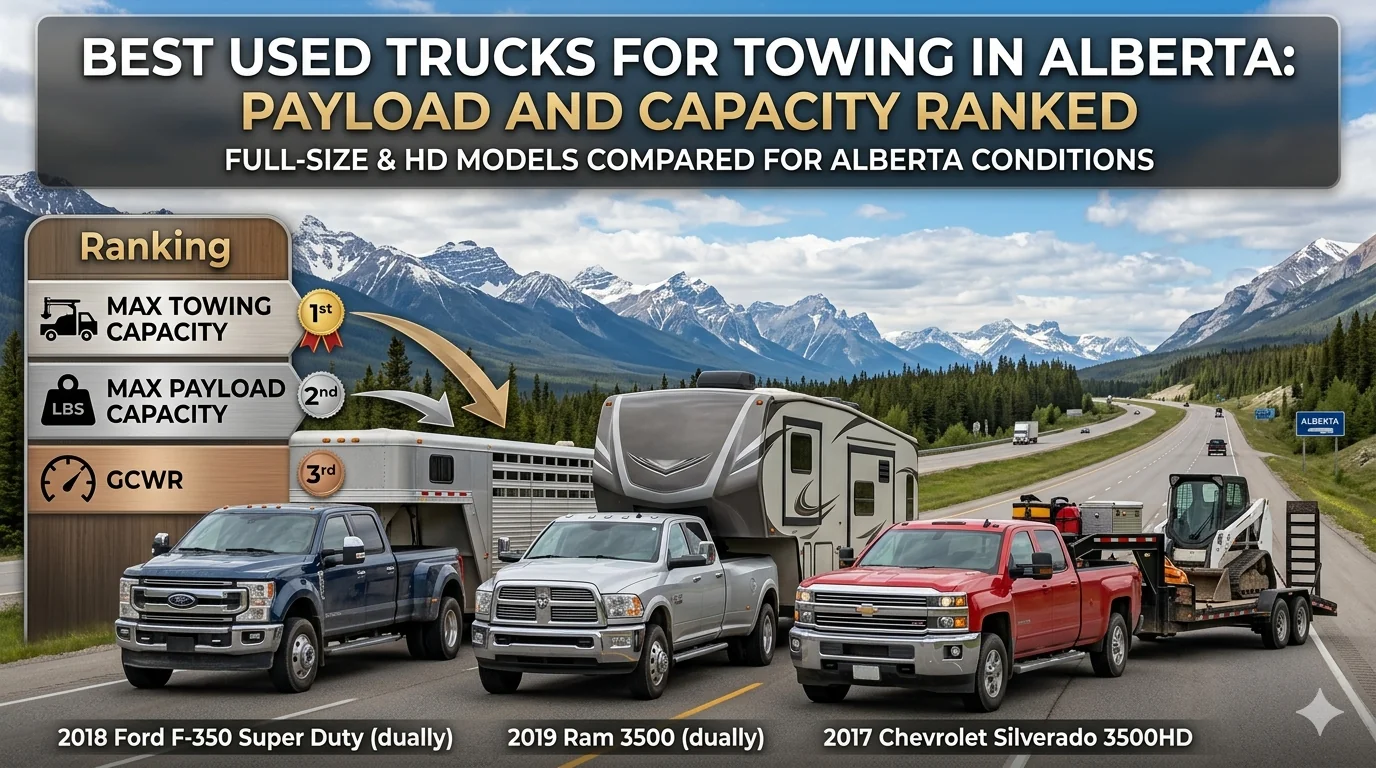
Best Used Trucks for Towing in Alberta: Payload and Capacity Ranked
In this article
- Why Towing Specs Are More Complicated Than the Sticker Suggests
- The Towing Comparison Table: Popular Used Trucks Ranked
- Real Alberta Towing Scenarios — What You Actually Need
- Pulling a Boat to Sylvan Lake
- Hauling an RV Through the Rockies
- Horse Trailer on Rural Alberta Roads
- Half-Ton vs Mid-Size: When the Tacoma or Ranger Is Enough
- How Towing Affects Truck Value — and Your Financing
- Engine Options and What They Mean for Towing
- Gas V8 vs Turbocharged Gas V6
- Diesel for Towing
- Towing Maintenance: What to Watch on a Used Tow Truck
- Towing in Alberta: Regulations Worth Knowing
- Finding the Right Used Tow Truck for Your Budget
- Related Buyer Guides
- Compare and Apply
Check Your Options in 3 Minutes
No credit impact. All credit situations welcome.
★★★★★ 114+ Google Reviews · AMVIC Licensed · Free Delivery 300km
You're standing at the boat launch at Sylvan Lake on a Friday afternoon, and the truck in front of you is visibly struggling — rear end squatting, trailer swaying, brake lights flashing in panic. It's a painful reminder that not all trucks are created equal when it comes to towing. If you're shopping for a used truck in Alberta and towing is part of the plan — whether that's a 28-foot fifth wheel, a horse trailer, or a bass boat — getting the right specs matters far more than getting the right colour.
This guide breaks down towing capacity, payload, and tongue weight for the most popular used trucks in Alberta, using real-world towing scenarios you'll actually face on Highway 2, the Icefields Parkway, and gravel roads that lead to fishing spots no app has found yet.
See what you pre-qualify for
Three quick answers — soft check, no commitment.
Why Towing Specs Are More Complicated Than the Sticker Suggests
Every truck manufacturer publishes a maximum towing capacity. That number is technically accurate — but it's also the ceiling achieved under ideal conditions: single occupant, no cargo, perfect weather, sea-level altitude. In Alberta, you are rarely operating at sea level. Calgary sits at 1,045 metres. Banff is at 1,383 metres. Thin air reduces engine output, particularly for naturally aspirated engines, and you need to factor that in before hitching up.
The three numbers that actually govern safe towing are:
- Maximum Towing Capacity — the highest weight you can legally pull behind the truck, according to the manufacturer
- Payload Capacity — how much weight the truck's bed, cab, and hitch can carry (this includes passengers, cargo, AND tongue weight)
- Tongue Weight — the downward force the trailer hitch exerts on the truck; typically 10–15% of the trailer's total weight
Here's where buyers get burned: a truck might have a 10,000-lb tow rating but a payload of only 1,400 lbs. Add two adults (400 lbs), gear in the bed (200 lbs), and a trailer with 1,200 lbs of tongue weight — you've just exceeded payload before the trailer starts rolling. Exceeding payload is dangerous and voids your warranty.
Always check the yellow sticker on the driver's door jamb. It shows the specific truck's GVWR and payload — not the class maximum. Two identical-looking trucks from the same year can have different payloads depending on trim and build options.
The Towing Comparison Table: Popular Used Trucks Ranked
All figures below represent commonly available used configurations. Actual capacity depends on engine, trim, and factory options — always verify the door sticker on the specific truck you're buying.
| Truck | Max Tow Capacity | Typical Payload | Best Engine for Towing | Notes |
|---|---|---|---|---|
| Ford F-150 | Up to 13,200 lbs | 1,400–2,000+ lbs | 3.5L PowerBoost or 3.5L EcoBoost | Highest payload potential in class with max payload package |
| Chevrolet Silverado 1500 | Up to 13,300 lbs | 1,400–2,200 lbs | 6.2L V8 or 3.0L Duramax diesel | Duramax diesel excellent for sustained mountain grades |
| RAM 1500 | Up to 12,750 lbs | 1,400–1,900 lbs | 5.7L HEMI or 3.0L EcoDiesel | Coil-spring rear suspension provides smoother tow experience |
| GMC Sierra 1500 | Up to 13,200 lbs | 1,400–2,100 lbs | 6.2L V8 or 3.0L Duramax diesel | Shares platform with Silverado; MultiPro tailgate is a usability bonus |
| Toyota Tundra | Up to 10,200 lbs (2022+) / 8,800 lbs (pre-2022) | 1,100–1,940 lbs | i-FORCE MAX hybrid (2022+) | Pre-2022 naturally aspirated V8 is bulletproof; lower peak but legendary reliability |
| Toyota Tacoma | Up to 6,800 lbs | 1,000–1,200 lbs | 3.5L V6 | Mid-size: better for boats and small trailers; not for large RVs |
| Chevrolet Colorado | Up to 7,700 lbs (diesel) | 900–1,500 lbs | 2.8L Duramax diesel | Diesel Colorado is surprisingly capable; manoeuvrable in tight campgrounds |
| Ford Ranger | Up to 7,500 lbs | 1,100–1,560 lbs | 2.3L EcoBoost | Good for ATVs, snowmobiles, or a small boat; not a highway hauler |
Real Alberta Towing Scenarios — What You Actually Need
Pulling a Boat to Sylvan Lake
A typical 20-foot fibreglass runabout with a tandem-axle trailer weighs between 4,500 and 6,500 lbs loaded with gear. For this, any half-ton with a proper hitch package will work comfortably. The bigger concern is Highway 2 at 120 km/h with crosswind — stability control and trailer sway control (standard on most late-model trucks) make a meaningful difference. The RAM 1500's coil-spring rear suspension actually produces a notably smoother and more stable tow experience on paved highways compared to the leaf-spring competition, which is worth considering if this is your primary use case.
Hauling an RV Through the Rockies
This is the scenario where specs become life safety. A 30-foot travel trailer can easily hit 9,000–11,000 lbs loaded. Add mountain grades that hold 8–10% for kilometres at a stretch, and you need a truck that can control engine braking on the descents as much as it can push on the climbs. For this use case, you want the F-150 with the Max Tow package, the Silverado or Sierra with the 6.2L, or ideally a diesel option for better sustained torque and towing mileage. On a route like the Trans-Canada through Kicking Horse Pass, inadequate truck-to-trailer ratio is how brakes overheat and disasters happen.
If you're regularly towing an RV over 9,000 lbs, be honest with yourself: a half-ton is at its limit. A used 3/4-ton or one-ton truck (Silverado 2500, Ram 2500, F-250) is the right tool and often available at only a modest price premium in Alberta's used market.
Horse Trailer on Rural Alberta Roads
A two-horse bumper-pull trailer with horses aboard sits around 5,500–7,000 lbs. The challenge isn't raw weight — it's that horses shift their weight constantly, introducing unpredictable sway. You need a truck with active trailer sway control, a weight-distributing hitch on heavier rigs, and enough payload remaining after the horses' load is distributed. The Silverado 1500 and Sierra 1500 with the Duramax diesel offer exceptionally linear torque delivery that minimizes the jerky acceleration that unsettles horses. Equally important: payload. If you're putting two large horses plus a rider and gear, work backwards from your actual tongue weight — don't guess.
Half-Ton vs Mid-Size: When the Tacoma or Ranger Is Enough
Mid-size trucks have become legitimately capable over the past decade. The Toyota Tacoma at 6,800 lbs max tow and the Ford Ranger at 7,500 lbs cover the majority of recreational towing in Alberta — ATVs, snowmobiles, Sea-Doos, small boats, and utility trailers. They're easier to park in Kananaskis campsites, get better fuel economy when not towing, and cost less to buy and insure.
The honest answer: if your heaviest trailer is under 5,500 lbs and you drive in the city most of the week, a mid-size truck will serve you well. If you're regularly near 7,000 lbs or above, or if you tow in mountain terrain, step up to the full-size.
How Towing Affects Truck Value — and Your Financing
Trucks hold their value better than almost any other vehicle category in Canada, and properly equipped tow-capable trucks hold value even better than base models. This has a direct impact on your financing position. A well-maintained F-150 XLT with the Max Tow package depreciates slower than an equivalent base work truck, meaning if you finance it today and need to sell or trade in two years, you're more likely to be in an equity position rather than upside-down.
For buyers financing a used truck purchase, this stability works in your favour. Lenders see trucks as lower-risk collateral because the used market is deep and demand is consistent — particularly in Alberta where trucks are tools, not toys. This can sometimes mean slightly better financing terms compared to higher-depreciation vehicles.
If you're curious about what your monthly payments would look like, use our payment calculator to run scenarios before you visit the lot. For a $32,000 used F-150 financed at 9.99% over 72 months, you're looking at roughly $295 biweekly — a useful baseline for budgeting.
Engine Options and What They Mean for Towing
Gas V8 vs Turbocharged Gas V6
The traditional choice for serious towing was always the V8 — the 5.7L HEMI in a RAM, the 5.3L or 6.2L Ecotec3 in a Silverado. These engines produce linear, predictable power that feels reassuring under load. The newer turbocharged V6 options (Ford's 3.5L EcoBoost in particular) produce equal or superior peak torque, often with better fuel economy under load because they operate more efficiently at altitude. The trade-off: more complexity, more to go wrong, and some towing enthusiasts still prefer the V8's grunt on steep grades.
Diesel for Towing
Diesel in a half-ton — the 3.0L Duramax in the Silverado/Sierra, the 3.0L EcoDiesel in the RAM — delivers torque at lower RPMs, which translates to less strain on sustained grades. Fuel economy while towing is typically 20–30% better than the equivalent gas engine. The cost consideration: diesel trucks command a $2,000–5,000 premium used, and diesel-specific maintenance (fuel filters, DEF fluid, more expensive oil changes) adds to the total cost of ownership. For drivers who tow more than 5,000 km per year loaded, the math often works out in diesel's favour.
Towing Maintenance: What to Watch on a Used Tow Truck
Buying a used truck that has been used for towing means that truck has worked harder than its odometer alone suggests. Before buying, look for:
- Transmission condition — overheating is the killer. Ask about transmission fluid service history. Discoloured or burnt-smelling fluid is a red flag.
- Hitch wear and receiver condition — heavy rust or elongated receiver holes suggest heavy use
- Brake wear patterns — uneven wear can indicate trailer brake controller issues or brake system stress
- Rear suspension sag — worn-out helper springs or air bags on trucks that have hauled heavy loads regularly
- Cooling system service history — radiators and transmission coolers work overtime when towing
- Frame condition — particularly important on trucks used for agricultural towing; check for stress cracks around the hitch mount area
A pre-purchase inspection by a qualified mechanic is worth every dollar on a used tow truck. The cost of diagnosing a problem before purchase is a fraction of the cost of fixing it after.
Towing in Alberta: Regulations Worth Knowing
Alberta's highway safety regulations require:
- Trailers over 2,800 kg GVWR must have their own braking system
- Safety chains are required — they must cross under the trailer tongue
- Trailer lighting must be functional: brake lights, turn signals, and running lights
- Overwidth loads (over 2.6 metres) require a permit and may need pilot vehicles
- Maximum speed when towing is 110 km/h (posted) unless signs indicate otherwise
If you're hauling between cities — say, picking up a trailer from Red Deer and towing back to Airdrie — the Highway 2 corridor sees RCMP commercial vehicle enforcement regularly. An improperly equipped truck-and-trailer combination is a ticket and a roadside inspection. Do it right from the start.
Finding the Right Used Tow Truck for Your Budget
Alberta's used truck market is one of the most active in Canada. Oilfield, agriculture, and recreation create sustained demand — and sustained supply. Late-model used trucks are available at most price points, and financing options are accessible regardless of your credit history. Our lenders work with all credit situations, from strong prime files to buyers who've had past challenges. Whether you're looking at a $15,000 Tacoma for pulling the sled trailer or a $45,000 F-150 for serious RV hauling, there are financing structures that can make it work.
Ready to find the right truck for your towing needs? Start your financing application and let us match you with the truck and lender combination that fits your situation. Or check out our guide on diesel vs gas trucks in Alberta if you're still working through the engine decision — it goes deep on the real-world cost comparison over a 5-year ownership period.
Compare and Apply
- Bad Credit Financing — Complete Guide — get approved despite bad credit
Financing Resources
Related Articles


Ready to Find Your Vehicle?
Browse our inventory or apply for financing. All credit situations welcome.
★★★★★ 114+ Google Reviews · AMVIC Licensed · Free Delivery 300km