
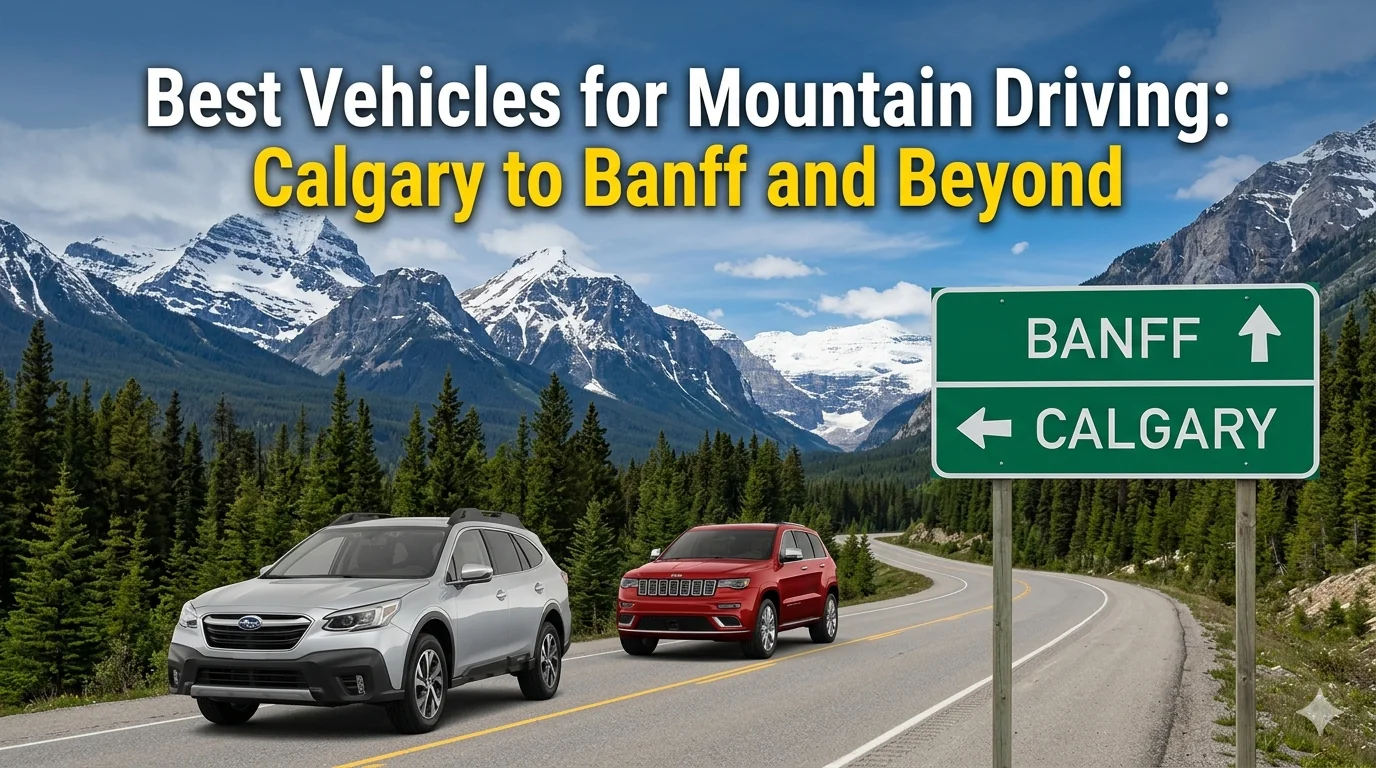
Best Vehicles for Mountain Driving: Calgary to Banff and Beyond
In this article
- What "Mountain Ready" Actually Means
- Ground Clearance: The Number That Matters
- AWD vs 4WD on Mountain Highways
- Engine Braking: Why Your Transmission Matters More Than Your Engine Going Downhill
- Tires: The Only Contact Point That Actually Matters
- Altitude and Engine Performance: What Changes Above 1,400 Metres
- Top Vehicle Picks for Calgary-to-Banff and Beyond
- Subaru Outback — The Logical Choice for Mountain Highways
- Toyota 4Runner — When the Pavement Ends
- Jeep Wrangler — Purpose-Built, One Trade-Off
- Ford Bronco Sport — The Balanced Middle Ground
- Hyundai Tucson — Best Everyday Driver That Can Handle Mountains
- Key Mountain Highways in Alberta: What to Expect
- Highway 1 (Trans-Canada) — Calgary to Banff
- Highway 93 (Icefields Parkway) — Banff to Jasper
- Winter Chain Requirements
- Vehicle Preparation Checklist for Mountain Driving
- Comparing the Top 5: Mountain Capability at a Glance
- Driving Technique for Alberta Mountain Roads
- Pre-Trip Route Check
- Speed Management on Descents
- Following Distance
- Passing on Mountain Highways
- How Mountain Driving Affects Your Vehicle's Long-Term Condition
- What to Look for When Buying a Used Mountain Vehicle
- Finding the Right Mountain-Ready Used Vehicle in Alberta
- Related Buyer Guides
- Compare and Apply
Check Your Options in 3 Minutes
No credit impact. All credit situations welcome.
★★★★★ 114+ Google Reviews · AMVIC Licensed · Free Delivery 300km
You're at the bottom of the hill on Highway 1 west of Canmore, a loaded roof rack overhead, a trailer-load of camping gear behind you, and a 7% grade stretching to the next summit. The driver ahead of you in the underpowered crossover is already tapping the brakes every 200 metres going downhill — burning through pads, overheating rotors, and quietly terrifying everyone in the passing lane. The right vehicle makes mountain driving feel natural. The wrong one turns a weekend trip into a white-knuckle experiment. Here's what actually separates a mountain-capable vehicle from one that just has a picture of mountains in the brochure.
See what you pre-qualify for
Three quick answers — soft check, no commitment.
What "Mountain Ready" Actually Means
Every automaker slaps "mountain mode" or "terrain select" on their marketing, but mountain capability comes down to four concrete things: ground clearance, drivetrain configuration, engine braking ability, and tire contact patch. Everything else is trim.
Ground Clearance: The Number That Matters
For Highway 1 and Highway 93, you don't need extreme clearance — these are paved roads. But you need enough to handle the chunky packed snow that builds up in wheel ruts between plowing cycles, roadside debris after rockfall events, and the uneven gravel at mountain rest stops and trailheads. The practical threshold for Alberta mountain roads is 7.5 inches of ground clearance. Below that, you're compromising. Above 8.5 inches, you're comfortable in almost any condition these roads throw at you.
AWD vs 4WD on Mountain Highways
There's a whole debate worth reading in our AWD vs 4WD comparison for Alberta, but the short version for mountain highway driving is this: AWD systems that operate automatically (Subaru Symmetrical, Toyota Dynamic Torque Control, Honda Real Time AWD) are better suited to pavement-dominant mountain driving because they engage seamlessly without driver input. Traditional 4WD (Toyota's part-time 4x4, Jeep Command-Trac) is better for off-pavement scenarios — forest service roads, ski hill access roads, backcountry. For the Highway 1 corridor, AWD wins. For anything past the pavement, 4WD wins.
Engine Braking: Why Your Transmission Matters More Than Your Engine Going Downhill
Most drivers focus on horsepower and torque for climbing — and those matter. But descent control is equally important and depends entirely on your transmission type. Going down a sustained 6-8% grade like the descent into Lake Louise or the west side of Rogers Pass, your brakes alone cannot safely hold vehicle speed without overheating. You need engine braking.
- Traditional automatic transmissions (6-speed, 8-speed, 10-speed) allow manual gear selection — use it. Select 3rd or 2nd on sustained descents. This is the best combination for mountain driving.
- CVT transmissions (found in many Nissan, Subaru, Mitsubishi models) have improved significantly but still provide less engine braking than traditional automatics. Some CVTs now include simulated gear steps specifically for this. Still functional, but not the mountain driver's first choice.
- Manual transmissions give you total control over engine braking and are excellent for experienced drivers on mountain roads. Downshift before the descent, not halfway through it.
- Hill Descent Control (HDC) — available on Jeep Wrangler, Ford Bronco Sport, Toyota 4Runner, and others — automatically manages braking and throttle on steep descents. It's a genuine safety feature, not a gimmick.
Tires: The Only Contact Point That Actually Matters
No drivetrain in the world overcomes the wrong tires on a mountain highway in winter. Alberta does not legally require winter tires province-wide, but BC does — and if your mountain driving takes you through Banff to Rogers Pass, you're in BC territory where winter tires (or chains) are mandatory from October 1 to April 30 on most mountain highways. Our full tire care guide for Alberta winters covers this in detail. For mountain-specific driving, you want a severe-service rated winter tire (the mountain snowflake symbol, not just M+S). Three-peak mountain snowflake tires maintain flexibility at -30°C where all-season tires go hard and lose 50%+ of their grip.
Altitude and Engine Performance: What Changes Above 1,400 Metres
Banff sits at 1,383 metres. The Icefields Parkway at its highest point (Sunwapta Pass) reaches 2,035 metres. At that altitude, naturally aspirated engines produce roughly 8-10% less power than at sea level — the air is thinner, there's less oxygen per cylinder, and combustion efficiency drops. You'll notice it most during passing manoeuvres on two-lane mountain highways.
Turbocharged engines partially compensate because the turbo compresses intake air, partially offsetting the density loss. This is one reason modern turbocharged crossovers (Ford Bronco Sport 1.5T, Hyundai Tucson 1.6T) can feel surprisingly capable at altitude despite their smaller displacement. Larger naturally-aspirated engines (Toyota 4Runner 4.0L V6, Jeep Wrangler 3.6L V6) still have the raw power advantage, but the gap narrows at elevation compared to sea level testing numbers.
Diesel engines are minimally affected by altitude — they're compression-ignition and don't depend on stoichiometric air-fuel ratios the same way. If you're doing heavy towing through the mountains, diesel remains the most altitude-stable option.
Top Vehicle Picks for Calgary-to-Banff and Beyond
Subaru Outback — The Logical Choice for Mountain Highways
If you drive mountain roads regularly but don't go off-pavement, the Subaru Outback is the strongest all-around choice. The Symmetrical All-Wheel Drive system is always-on (not on-demand) — in snow, ice, or during sudden lane changes on slick pavement, all four wheels are already engaged. Ground clearance is 8.7 inches — above the practical threshold. The 2.5L naturally aspirated engine doesn't feel strained at altitude, and the 2.4L turbocharged XT variant adds meaningful passing power on two-lane switchbacks. Subaru EyeSight driver assistance handles highway fatigue well on the long Icefields Parkway drive. The CVT isn't our favourite for engine braking, but the X-Mode system (available on Outback) adds low-speed descent control for gravel forest service roads.
Toyota 4Runner — When the Pavement Ends
The Toyota 4Runner is the mountain vehicle for people who actually leave the highway. It's a body-on-frame SUV with a locking rear differential, Crawl Control, Multi-Terrain Select, and up to 9.6 inches of ground clearance. The 4.0L V6 feels strong at altitude — 270 horsepower with a traditional 5-speed automatic transmission that engine-brakes exactly as you'd want. The tradeoff is fuel economy (14-16 city, 18-21 highway in litres per 100 km). For anyone doing serious mountain terrain — forest service roads, ski hill back access, off-highway trails — nothing in this price range touches the 4Runner's capability.
Jeep Wrangler — Purpose-Built, One Trade-Off
The Jeep Wrangler does one thing better than every other vehicle on this list: it goes where the road stops. Solid front and rear axles, 10.8 inches of ground clearance, a transfer case with proper low-range gearing, and available locking differentials front and rear. Hill Descent Control is standard. On-road, the Wrangler gives up a lot to purpose-built highway vehicles — wind noise at 110 km/h, a wider turning radius, and fuel consumption that's consistently in the 13-15 L/100km range. If your mountain driving is 80% highway and 20% trail, consider the Bronco Sport or 4Runner instead. If it's 50/50, the Wrangler's off-pavement dominance tips the scales.
Ford Bronco Sport — The Balanced Middle Ground
The Ford Bronco Sport sits between a car-based crossover and the body-on-frame Wrangler. It's a unibody construction with 8.8 inches of ground clearance, available Sasquatch package (wider track, bigger tires, more capable off-road modes), and Trail Control (essentially a low-speed cruise control for technical terrain). The 1.5L EcoBoost turbo four maintains decent power at altitude. For Alberta drivers who want to reach backcountry trailheads, camp on Crown land, or handle mountain pass conditions, the Bronco Sport hits a sweet spot that a standard crossover can't match.
Hyundai Tucson — Best Everyday Driver That Can Handle Mountains
If mountain driving is 20% of your life and city driving is 80%, the Hyundai Tucson earns its spot here. The HTRAC AWD system is genuinely capable — not just marketing. Ground clearance at 7.3 inches is on the lower end of our threshold, so it's not a backcountry vehicle, but for Highway 1 year-round and highway-accessible mountain terrain, it performs well. The 1.6T engine maintains solid power at altitude, fuel economy is meaningfully better than body-on-frame alternatives, and Hyundai's warranty coverage is industry-leading. For Calgarians who drive to Canmore regularly, the Tucson is a practical choice without the penalties of running a 4Runner every day.
Key Mountain Highways in Alberta: What to Expect
Highway 1 (Trans-Canada) — Calgary to Banff
Alberta's busiest mountain corridor. 128 km from Calgary to Banff, with significant grade changes starting at Dead Man's Flats. The highway is well maintained and has runaway lanes on major descents. Conditions can deteriorate rapidly — the gap between clear pavement and full blizzard at Rogers Pass is sometimes under 30 minutes. Highway message signs at Calgary's western approach post active chain control requirements for BC sections. The Canmore area frequently has different conditions than either Calgary or Banff — check DriveBC and 511 Alberta before departure.
Highway 93 (Icefields Parkway) — Banff to Jasper
230 km of some of the most scenic and most demanding mountain driving in North America. The Parkway reaches 2,035 metres at Sunwapta Pass. It's closed to trucks over a certain weight rating and has no services for stretches up to 100 km. Check the best road trips from Calgary guide for seasonal conditions and what you'll encounter. Engine performance loss at altitude is most noticeable here. Fuel up in Lake Louise before heading north — the next reliable stop is Jasper.
Winter Chain Requirements
For Alberta mountain roads specifically, chains are not commonly required — but when BC is part of your route (which it is for most Banff visitors continuing to Rogers Pass or Revelstoke), BC's chain control applies. Requirements are posted at chain-up areas and on DriveBC. Passenger vehicles with winter tires are typically exempt from chain requirements that apply to light trucks, but always verify before departure.
Vehicle Preparation Checklist for Mountain Driving
Before any mountain highway trip — winter or summer — run through this list. These aren't optional for mountain conditions; they're what separates a good trip from a roadside emergency.
- Brakes — Mountain descents punish worn brake pads and warped rotors. A brake inspection before a mountain trip is not overcautious; it's basic safety. If your pads are below 4mm, replace them before the trip, not after.
- Tire tread and pressure — Cold mountain air drops tire pressure. Check at operating temperature, not after sitting overnight. Tread depth below 4/32" (3mm) is unsafe in mountain conditions even on summer tires.
- Coolant levels — Overheating on mountain climbs is a real risk with low coolant. Check the reservoir.
- Transmission fluid — Automatics and CVTs work hard on sustained grades. Burning transmission fluid smells distinct; if you notice it on a descent, stop and cool down before continuing.
- Emergency kit — Minimum for mountain driving: booster cables or jump pack, warm blankets, flares or LED road emergency triangles, small shovel, traction boards or cat litter, first aid kit, water, and energy bars. Cell coverage disappears between Banff and Jasper for stretches.
Our full maintenance resources cover each of these systems in depth. If your used vehicle is due for a checkup before a mountain adventure, get it looked at before you go.
Comparing the Top 5: Mountain Capability at a Glance
| Vehicle | Ground Clearance | Drivetrain | Hill Descent Control | Best Use Case |
|---|---|---|---|---|
| Subaru Outback | 8.7" | Symmetrical AWD (always-on) | Yes (X-Mode trim) | Highway + light gravel |
| Toyota 4Runner | 9.6" | Part-time 4WD + AWD option | Yes (standard) | Serious off-pavement |
| Jeep Wrangler | 10.8" | 4WD with low range | Yes (standard) | Technical trail driving |
| Ford Bronco Sport | 8.8" | AWD with off-road modes | Yes (Trail Control) | Backcountry trailheads |
| Hyundai Tucson | 7.3" | HTRAC on-demand AWD | No | Highway, light terrain |
Driving Technique for Alberta Mountain Roads
The right vehicle matters, but technique is what keeps you out of trouble when conditions change fast. These habits apply regardless of what you're driving.
Pre-Trip Route Check
Check 511 Alberta and DriveBC before every mountain trip from October through April. Conditions at Calgary can be completely different from conditions at Banff — the weather systems that hit the Rockies develop quickly and post information updates frequently. If 511 shows a travel advisory between Canmore and Lake Louise, that is not a suggestion. Experienced mountain drivers treat it as serious data.
Speed Management on Descents
The posted speed limit on Alberta mountain highways is the maximum for ideal conditions — not a target for winter or wet conditions. A general rule that experienced mountain drivers use: whatever your comfortable speed is on flat highway in comparable conditions, reduce it by 20 km/h on sustained downgrades. Your vehicle's kinetic energy scales with the square of your speed. Descending at 80 km/h instead of 100 km/h means your brakes need to dissipate 36% less energy. That difference is measured in whether your rotors reach dangerous temperatures before the bottom of the hill.
Following Distance
The standard 2-second following distance applies in ideal conditions. On a mountain highway with packed snow or ice, add a full second for every factor that degrades traction: winter precipitation adds one, darkness adds one, sustained grade adds one. In worst-case mountain winter conditions, you might be maintaining 6+ seconds of following distance — which sounds excessive until you're behind a vehicle that hits black ice and slows from 90 km/h to a near-stop in two seconds.
Passing on Mountain Highways
Two-lane sections of Highway 93 have limited passing opportunities. The rule: if you're not certain you have the power and space to complete the pass safely, don't start it. At altitude, your engine has less reserve power than at sea level — a pass that seemed comfortable at sea level may leave you alongside a semi at the start of an uphill section with no room and no power to accelerate out of it.
How Mountain Driving Affects Your Vehicle's Long-Term Condition
Regular mountain driving has specific wear patterns that don't show up in city driving. Brake pads wear faster on descents — if you're driving Highway 1 regularly, expect to replace pads 30-40% sooner than city-only use. Suspension components take more stress from road surface irregularities at mountain road conditions. Transmission fluid degrades faster from sustained grade driving — heat cycles that a flat-highway transmission never sees happen routinely on mountain passes. And if you're parking on mountain slopes regularly, your parking brake cable and mechanism get more use than most owners account for.
None of this is catastrophic — it just means regular maintenance intervals matter more, and you should be transparent about mountain use history when trading in or selling. Track your vehicle's service history carefully if mountain driving is a significant part of your use case. A well-maintained mountain vehicle is worth more at trade-in than an equivalent unmaintained one; a neglected one is worth less than you'd expect.
What to Look for When Buying a Used Mountain Vehicle
When buying a used vehicle specifically for mountain capability, the inspection priorities shift compared to a standard used car check. Brake rotor thickness and pad depth are the first things to ask about — a previous owner who drove Highway 1 every weekend without maintaining brakes has left you with a problem. Check the transmission fluid condition (it should be clear to light pink, not dark brown or burnt-smelling). Inspect the undercarriage for damage consistent with high-centering on rocks — frame rail scrapes and skid plate damage tell a story about how the previous owner used the vehicle.
Verify that any AWD or 4WD system engages and disengages properly during your test drive. Take the vehicle uphill under load and downhill without brakes — listen for transfer case noise, feel for drivetrain vibration, and confirm the system transitions smoothly. A 4Runner or Wrangler with a worn transfer case can cost $3,000-5,000 to repair; knowing before you buy is worth the extra test drive time.
Finding the Right Mountain-Ready Used Vehicle in Alberta
The vehicles we've highlighted here — Subaru Outback, Toyota 4Runner, Jeep Wrangler, Ford Bronco Sport, Hyundai Tucson — all have strong used market availability in Alberta. When evaluating a used example, specifically ask about the service history for brake work and transmission service. A 4Runner that's spent its life in the mountains will have more brake history than one that's been a Calgary city vehicle; that's expected, but you want to see it was maintained.
At Shift Happens Auto Sales, we work with buyers across every credit situation. Whether you're financing a first vehicle for mountain season or upgrading from a two-wheel-drive car that's not cutting it on Highway 1, we have access to a 25,000+ vehicle network to find the right mountain-capable vehicle at a payment that works for you. Start your financing application here — it takes minutes and our team will find options that fit your situation.
Compare and Apply
- Best Subprime Dealers in Calgary (2026) — finding the right subprime dealer in Calgary
Financing Resources
Related Articles

Ready to Find Your Vehicle?
Browse our inventory or apply for financing. All credit situations welcome.
★★★★★ 114+ Google Reviews · AMVIC Licensed · Free Delivery 300km