
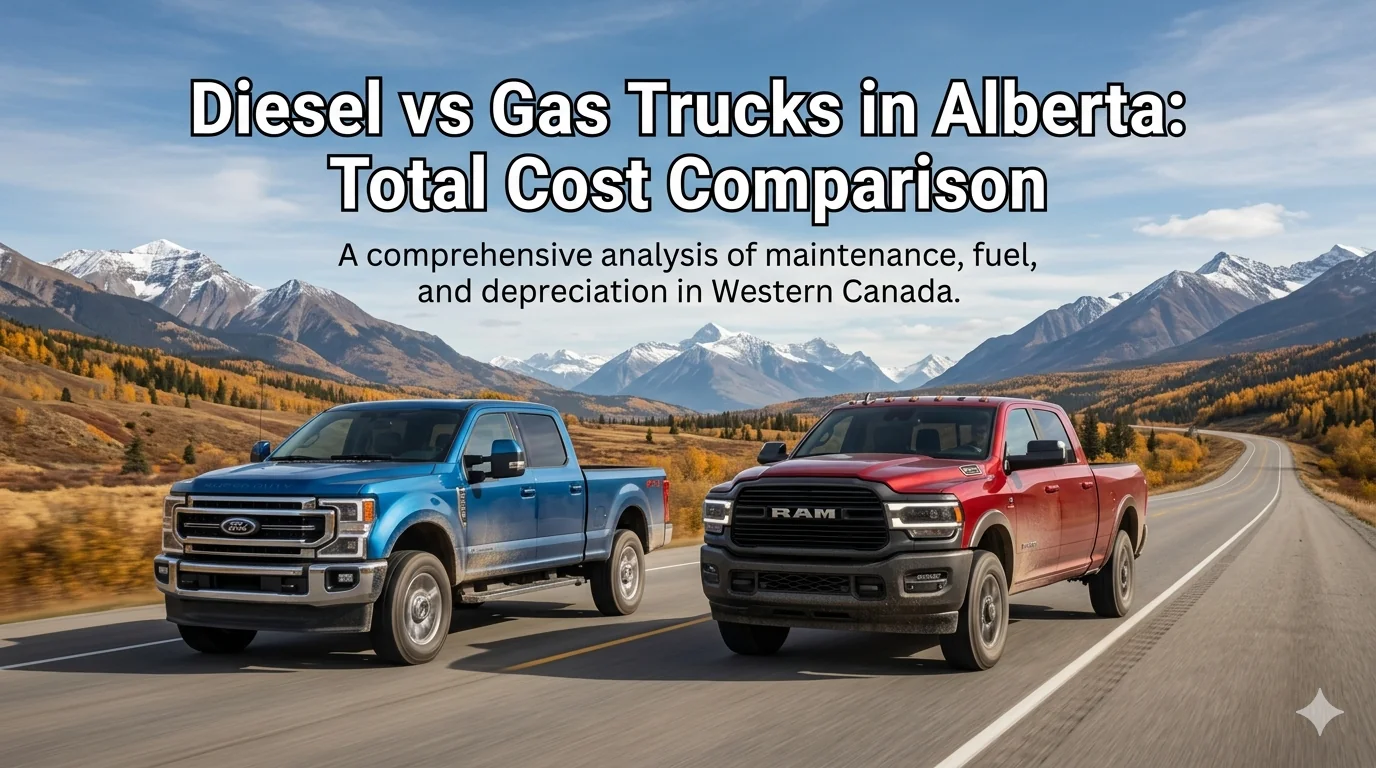
Diesel vs Gas Trucks in Alberta: Total Cost Comparison
In this article
- The Purchase Price Gap: What You're Actually Paying Upfront
- Fuel Cost Reality Check: Alberta Pump Prices in 2026
- The Half-Ton Diesel vs Gas Fuel Economy Breakdown
- Maintenance Costs: Where Diesel Gets Expensive
- Oil Changes
- DEF Fluid (Diesel Exhaust Fluid)
- Fuel Filters
- Turbo and Emissions System Maintenance
- Annual Maintenance Cost Summary
- Resale Value: The Diesel Advantage is Real
- F-150 PowerStroke vs 3.5L EcoBoost: The Closest Comparison
- RAM EcoDiesel vs 5.7L HEMI: The Torque Argument
- Duramax vs Gas Silverado: The Work Truck Case
- Cold Weather and Diesel in Alberta: The Honest Picture
- Diesel Reliability by Generation: What to Watch For on Used Trucks
- F-150 PowerStroke 3.0L (2018–2021)
- RAM EcoDiesel 3.0L — Generation Watch
- Duramax 3.0L (2019+)
- When Diesel Makes Sense in Alberta
- What About Gas Hybrid Trucks? The Third Option
- When Gas Makes More Sense
- The 5-Year Total Cost of Ownership: By Driving Profile
- Financing a Diesel vs Gas Truck: What Changes
- Related Buyer Guides
- Compare and Apply
Check Your Options in 3 Minutes
No credit impact. All credit situations welcome.
★★★★★ 114+ Google Reviews · AMVIC Licensed · Free Delivery 300km
You're standing in a truck lot in Alberta, staring at two near-identical half-tons — one diesel, one gas. The diesel has a $6,000 premium on the sticker. The salesperson tells you diesel "pays for itself." The gas truck owner in the next row says that's a myth. Who's right? Neither of them is giving you the full picture — and the real answer depends entirely on how you actually use the truck.
This breakdown covers everything that matters for Alberta truck buyers: purchase price, fuel economics at current pump prices, maintenance realities, resale trajectory, and the specific use-cases where each powertrain wins. We'll use real numbers, not vague promises. By the end, you'll know exactly which engine makes financial sense for your situation.
See what you pre-qualify for
Three quick answers — soft check, no commitment.
The Purchase Price Gap: What You're Actually Paying Upfront
The diesel premium varies by manufacturer and trim, but in the Alberta used truck market it typically lands in the $4,000–$8,000 range for comparable model-year, mileage, and trim level. Here's what that looks like in practice:
| Model Comparison | Typical Used Gas Price | Typical Used Diesel Price | Premium |
|---|---|---|---|
| F-150 XLT (2019–2021) | $38,000–$44,000 | $44,000–$51,000 | ~$6,000–$7,000 |
| RAM 1500 (2019–2021) | $36,000–$42,000 | $42,000–$49,000 | ~$5,000–$7,000 |
| Silverado 1500 (2018–2021) | $35,000–$41,000 | $41,000–$48,000 | ~$5,000–$7,000 |
That upfront premium is real money — and it needs to be earned back through either fuel savings, lower maintenance costs, or higher resale value. Whether it actually does depends on your driving profile.
Fuel Cost Reality Check: Alberta Pump Prices in 2026
Alberta's fuel pricing has settled into a predictable spread: regular gasoline sitting around $1.50/L and diesel running approximately $1.60/L in the Calgary-Airdrie corridor. Diesel costs more at the pump — full stop. The diesel advantage comes purely from consuming fewer litres per kilometre, not from any per-litre price benefit.
The Half-Ton Diesel vs Gas Fuel Economy Breakdown
In real-world Alberta driving — a mix of highway, city, and loaded towing conditions — here's what owners typically report:
| Truck | Engine | Real-World L/100km | Cost Per 100km |
|---|---|---|---|
| F-150 | 3.0L PowerStroke Diesel | 9.5–11.5 | $15.20–$18.40 |
| F-150 | 3.5L EcoBoost V6 Gas | 12.5–15.0 | $18.75–$22.50 |
| RAM 1500 | 3.0L EcoDiesel V6 | 9.0–11.0 | $14.40–$17.60 |
| RAM 1500 | 5.7L HEMI V8 | 13.5–16.5 | $20.25–$24.75 |
| Silverado 1500 | 3.0L Duramax Diesel | 9.5–11.0 | $15.20–$17.60 |
| Silverado 1500 | 5.3L EcoTec3 V8 | 13.0–15.5 | $19.50–$23.25 |
The diesel saves roughly $4–$7 per 100 kilometres. Over 25,000 km/year, that's $1,000–$1,750 in annual fuel savings. Over 30,000 km/year (typical for work and oilfield drivers), it climbs to $1,200–$2,100. At 20,000 km/year or less, the savings shrink to $800–$1,400 annually — and the math starts tilting against diesel.
Break-even calculation: If the diesel premium is $6,500 and you save $1,500/year in fuel, break-even is 4.3 years. At 20,000 km/year saving only $900, break-even stretches to 7+ years — longer than many Albertans keep a truck.
Run your own numbers using our payment calculator to see how the price difference affects your monthly budget before factoring in fuel.
Maintenance Costs: Where Diesel Gets Expensive
Diesel engines require more expensive maintenance, and in Alberta's climate, the cost gap is meaningful. Here's an honest breakdown:
Oil Changes
Diesel oil changes cost more in two ways: the oil itself (typically 10–11 litres vs 6–8 for gas), and the oil type (diesel-spec oils command a premium). Expect to pay $120–$180 per diesel oil change compared to $70–$110 for a gas truck. With diesel-recommended intervals of 10,000–15,000 km (similar to modern gas trucks), the annual cost difference is $80–$150 for most driving patterns.
DEF Fluid (Diesel Exhaust Fluid)
All diesel trucks built after 2010 use Selective Catalytic Reduction (SCR) systems that require DEF. You'll consume roughly 1L of DEF per 300–400 km — at about $6–$10 per litre, that's an additional $400–$700/year at 25,000 km. This is a maintenance cost many buyers overlook entirely.
Fuel Filters
Diesel fuel systems require more frequent fuel filter changes — typically every 25,000–40,000 km. At $80–$150 per service, this adds another $80–$150/year. Gas trucks rarely require dedicated fuel filter service in the first 150,000 km.
Turbo and Emissions System Maintenance
Modern diesel trucks have turbocharged engines and complex emissions systems (DPF, EGR, SCR). While these components are durable, failures are expensive: DPF cleaning or replacement runs $600–$2,500; EGR cooler replacement on problematic engines (notably some Ram EcoDiesels) can reach $3,000–$5,000. Gas engines have fewer of these failure points — a turbo rebuild on a gas EcoBoost is less complex than diesel emissions system repair. For used trucks with higher mileage, this risk deserves serious weight.
Annual Maintenance Cost Summary
| Item | Gas Truck (25,000 km/yr) | Diesel Truck (25,000 km/yr) |
|---|---|---|
| Oil changes (2–3x/yr) | $200–$300 | $280–$450 |
| DEF fluid | $0 | $500–$700 |
| Fuel filters | $0–$50 | $100–$150 |
| Other routine service | $300–$500 | $300–$500 |
| Annual total | $500–$850 | $1,180–$1,800 |
The diesel costs $500–$1,000 more per year to maintain — which directly offsets a significant portion of the fuel savings. For many drivers, especially those doing city-heavy kilometres, the net annual advantage of diesel is nearly zero once maintenance is counted. See our guide on oil change schedules for used cars for more detail on service intervals.
Resale Value: The Diesel Advantage is Real
This is where diesel earns its keep — at least in Alberta. Truck buyers in this province place a premium on diesel, particularly in the oilfield, construction, and agricultural sectors. The resale retention numbers support this:
- A 2019 F-150 PowerStroke diesel retains approximately 10–15% more of its original value after 5 years compared to the equivalent gas model
- RAM EcoDiesel models consistently command $3,000–$6,000 more than HEMI equivalents with similar mileage
- Duramax Silverados see strong residual demand from buyers who do regular towing
However, this advantage comes with a caveat: if diesel emissions regulations tighten or DEF infrastructure becomes harder to access in rural Alberta, resale dynamics could shift. For now, diesel holds value better — but it's not guaranteed forever.
If you're researching specific models, browse our used F-150 inventory, used RAM 1500s, and used Silverados to compare current market pricing directly.
F-150 PowerStroke vs 3.5L EcoBoost: The Closest Comparison
Ford's half-ton diesel — the 3.0L PowerStroke — is the most common diesel vs gas comparison in Alberta, because the alternative (the 3.5L EcoBoost V6) is legitimately excellent. This is the closest contest in the segment.
The PowerStroke returns 9–11 L/100km in mixed driving. The EcoBoost returns 12–15 L/100km. The diesel pulls ahead on fuel, but the EcoBoost's towing capacity (up to 6,350 kg) is competitive with the diesel (6,350 kg), and its payload rating is similar. The PowerStroke costs about $6,000–$7,000 more used and $600–$800 more per year to maintain. For a driver doing 25,000 km/year with moderate towing, the 5-year diesel advantage is roughly:
- Fuel savings: $6,500–$8,000
- Extra maintenance cost: -$3,000–$4,000
- Resale premium: +$3,000–$5,000
- Net 5-year advantage over gas: $6,500–$9,000 — barely covering the premium
For high-mileage or heavy-towing scenarios, diesel wins clearly. For mixed use, it's a wash. For commuter-first use, gas wins.
RAM EcoDiesel vs 5.7L HEMI: The Torque Argument
The EcoDiesel produces 480 lb-ft of torque vs the HEMI's 410 lb-ft. That torque advantage is immediately noticeable when towing — the diesel doesn't need to work as hard, which extends drivetrain longevity on high-tow vehicles. The HEMI, meanwhile, is one of the most proven truck engines ever built. It's simpler, cheaper to service, and less likely to face the emissions system headaches that have plagued some early EcoDiesel generations.
The EcoDiesel's 3rd-generation (2020+) reliability record is considerably better than the 1st and 2nd generations. If you're looking at a RAM EcoDiesel, 2020 and newer is where the risk drops substantially. The transmission and drivetrain maintenance profile of both engines is otherwise similar.
Duramax vs Gas Silverado: The Work Truck Case
For Albertans using trucks as actual work tools — hauling equipment, pulling fifth-wheel trailers, running oilfield or construction routes — the 3.0L Duramax in the Sierra and Silverado is arguably the strongest diesel option in the half-ton segment. It's a clean, modern engine with relatively few early-generation reliability issues compared to the other two.
The Duramax in a Silverado/Sierra enables 3,900 kg of towing capacity — less than the 5.3L V8 gas (roughly 4,500 kg) but with meaningfully better economy when pulling. At 30,000 km/year with 30% of that mileage under tow, diesel wins the 5-year cost comparison by roughly $8,000–$12,000. That's a real return. At 15,000 km/year mostly unloaded, that number drops below $3,000 — barely covering the premium.
Cold Weather and Diesel in Alberta: The Honest Picture
Alberta's climate introduces a variable that most diesel vs gas comparisons don't address: what happens when it's -30°C in Red Deer in February. Diesel fuel gels at low temperatures. Modern diesels use winterized fuel blends and heated fuel filters to manage this — and Alberta fuel suppliers blend diesel for cold-weather operation throughout winter. In practice, cold-start issues are rare for trucks with functioning glow plugs, a quality fuel system, and fuel purchased locally.
That said, there are real cold-weather considerations for diesel owners:
- Plugging in matters more. Diesel engines benefit significantly from block heaters in Alberta winters — not just for starting but for protecting the DPF system, which works best at operating temperature. Gas trucks need block heaters too, but diesel's benefit is more pronounced.
- Short trips hurt diesels disproportionately. A diesel that never reaches full operating temperature struggles to complete DPF regeneration cycles — the self-cleaning process that prevents soot buildup. City-only driving in winter is the worst possible use case for a diesel.
- DEF freezes at -11°C. Modern trucks have heated DEF tanks and lines to prevent this, but it's worth knowing that a neglected or faulty DEF heating system can leave you with a truck that derate its power and eventually won't start. In a properly maintained truck, this isn't a problem. In a neglected one, it's an expensive problem.
Gas trucks simply don't have these complications. A cold gas V8 starts, warms up, and drives — full stop. For Albertans who do a lot of short-trip, cold-weather driving, that simplicity has genuine value. Our winter vehicle care guide covers cold-weather preparation for both powertrain types in more detail.
Diesel Reliability by Generation: What to Watch For on Used Trucks
Reliability data matters more on diesels than gas trucks because diesel failures are disproportionately expensive. Here's a generation-by-generation breakdown of the specific issues to watch on used examples:
F-150 PowerStroke 3.0L (2018–2021)
Generally clean reliability record. Known issues are minor: some reports of rough idle on high-mileage examples, and the variable geometry turbo requires clean oil to stay healthy. Buy from a vehicle with documented regular oil changes. Pre-purchase inspection should include a scan tool check for DPF health and any pending emissions codes.
RAM EcoDiesel 3.0L — Generation Watch
- 1st Gen (2014–2016): Avoid. EGR cooler failures, oil cooler issues, and Fiat Chrysler's emissions settlement created real headaches. High risk.
- 2nd Gen (2017–2019): Improved but still carries some carry-over risk. Acceptable with thorough inspection and full maintenance history.
- 3rd Gen (2020+): Substantially better. The redesigned cooling system and updated emissions components resolved the major failure patterns. Buy with more confidence.
Duramax 3.0L (2019+)
The cleanest reliability record of the three. GM's entry into the half-ton diesel segment came late, and they learned from the competition's mistakes. Relatively few documented failure patterns. If buying used, this is the lowest-risk diesel option in the segment.
For any used diesel, the inspection checklist should include: DPF condition and regeneration history, EGR cooler and cooler lines, turbo actuator operation, and any stored or pending fault codes. A pre-purchase inspection from a diesel-specialist shop is worth every dollar.
When Diesel Makes Sense in Alberta
- Annual mileage over 25,000 km. Fuel savings compound at high mileage. Below that threshold, the economics become marginal.
- Regular towing or hauling. Diesel's torque advantage and economy under load is where it earns its keep. Towing a 4,500 kg trailer weekly? Diesel is genuinely the right tool.
- Oilfield, construction, or agricultural use. These drivers typically log 35,000–50,000+ km/year under load. Diesel ROI is clear and significant.
- Long rural highway drives. Calgary to Edmonton to Grande Prairie and back: diesel shines on sustained highway pulls.
- Planning to keep the truck 7+ years. The resale premium and fuel savings need time to accumulate and exceed the premium.
What About Gas Hybrid Trucks? The Third Option
The truck market is changing. Ford's F-150 PowerBoost hybrid (a 3.5L EcoBoost paired with an electric motor) is now showing up in the used market with enough frequency that Alberta buyers should be aware of it as a third option alongside diesel and traditional gas.
The PowerBoost hybrid returns 10–12 L/100km in mixed driving — meaningfully better than the non-hybrid EcoBoost's 12–15 L/100km, and approaching diesel economy without the complexity of a diesel emissions system. It also delivers 570 lb-ft of torque, which exceeds the PowerStroke diesel's output. Towing capacity is comparable. And critically, it charges its own battery — no plugging in required, no range anxiety, no infrastructure dependency.
The hybrid premium on used examples is currently $3,000–$5,000 over an equivalent gas F-150, which is less than the diesel premium. The economics are compelling for city-heavy mixed drivers who want better economy without diesel maintenance costs. The main unknown is long-term hybrid battery longevity — the technology is relatively new in trucks and there's less long-term data than there is on proven diesel or gas V8 drivetrains.
For most Alberta buyers doing heavy towing on rural routes, the diesel still edges out the hybrid. For Calgary-area commuters who occasionally pull a trailer, the PowerBoost hybrid may actually be the optimal choice — it's just not yet as well-understood or widely discussed as the diesel-vs-gas comparison.
When Gas Makes More Sense
- Under 20,000 km/year. The fuel savings don't add up fast enough to recover the premium within a typical ownership cycle.
- Primarily city driving. Stop-and-go traffic punishes diesel economy, narrowing the gap significantly. DEF systems also work less efficiently in short trip patterns.
- Occasional, not regular, towing. Pulling a camper twice a year doesn't justify paying for a diesel engine year-round.
- Budget-constrained buyers. The lower purchase price and simpler maintenance of a gas truck may matter more than theoretical long-term savings.
- Buying a high-mileage used truck. A gas engine at 200,000 km carries less risk of expensive emissions system failures than a diesel at the same mileage.
Key takeaway: Diesel wins at high mileage and regular towing. Gas wins for daily commuters and light-use truck owners. The break-even for most Alberta drivers is 25,000–30,000 km/year with meaningful towing included in that mileage.
The 5-Year Total Cost of Ownership: By Driving Profile
Let's put the full picture together across three representative Alberta truck owners:
| Driver Profile | Annual KM | Towing | Diesel 5-yr TCO Advantage | Verdict |
|---|---|---|---|---|
| Airdrie-to-Calgary commuter | 18,000 | Rare | -$1,500 (diesel costs more) | Gas wins |
| Contractor, mixed city/highway | 28,000 | Regular | +$4,000–$6,000 | Diesel wins |
| Oilfield / long-haul Alberta | 45,000 | Heavy | +$12,000–$18,000 | Diesel wins clearly |
These numbers assume fuel at $1.50/L gas and $1.60/L diesel, standard maintenance costs, and a $6,000 diesel purchase premium. They'll shift as pump prices move — but the relative pattern is stable.
You can explore more head-to-head truck comparisons in our guide to the best trucks for towing in Alberta, which covers payload and towing specs across all the major half-tons.
Financing a Diesel vs Gas Truck: What Changes
The higher purchase price of a diesel truck means your financing picture is different. On a $45,000 diesel vs $39,000 gas truck at 9.99% over 84 months biweekly, the diesel costs roughly $39/biweekly more — about $1,014/year in extra payments. Factoring in fuel savings of $1,000–$1,500/year at 25,000 km, the net cash flow difference is close to zero. Many buyers are surprised to find that a diesel, financed properly, doesn't actually cost more per month once fuel is accounted for.
Whether you're financing a diesel or gas truck, our team works with buyers across all credit situations to find terms that work. Start your application here and we'll match you with lenders from our network who specialize in truck financing in Alberta.
If you're also looking at maintenance budgets going forward, our resource on vehicle maintenance costs in Alberta breaks down what you should budget annually depending on the type of vehicle you choose. And if you're coming from Edmonton or anywhere else in the province, we work with Alberta-wide buyers — distance is not a barrier.
Compare and Apply
- Bad Credit Financing — Complete Guide — Alberta's subprime auto financing guide
Financing Resources
Related Articles


Ready to Find Your Vehicle?
Browse our inventory or apply for financing. All credit situations welcome.
★★★★★ 114+ Google Reviews · AMVIC Licensed · Free Delivery 300km