
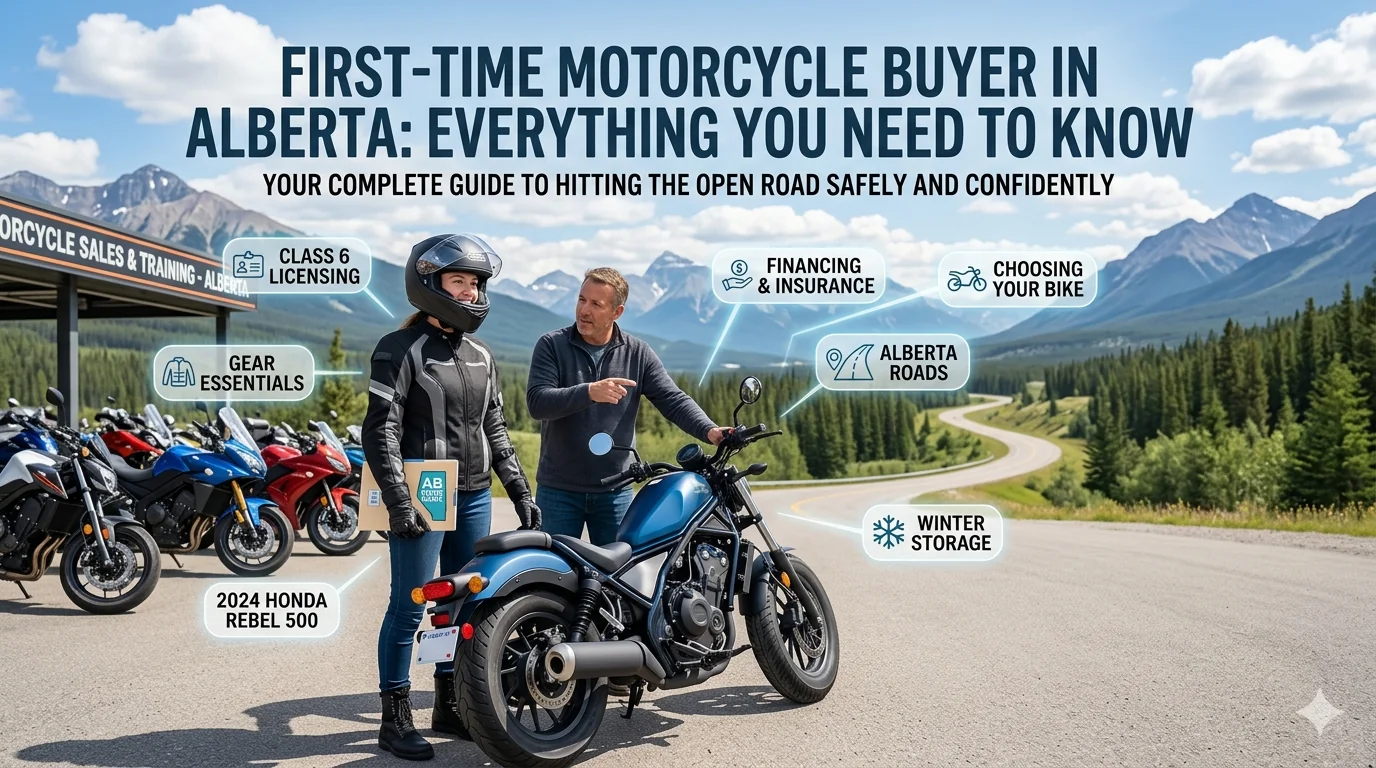
First-Time Motorcycle Buyer in Alberta: Everything You Need to Know
In this article
- Alberta's Graduated Motorcycle Licensing: How It Actually Works
- Stage 1: Class 6 Learner (6L)
- Stage 2: Class 6 (Full Licence)
- Choosing Your First Bike: What Actually Matters
- Engine Size: Start Smaller Than You Think You Need
- Motorcycle Types: Which Fits Your Riding Plans?
- New vs Used for Your First Motorcycle
- Gear Essentials: What You Actually Need Before You Ride
- Helmet: Your Most Important Purchase
- Jacket: Protection + Warmth in Alberta's Climate
- Gloves
- Boots
- Pants
- Financing a Motorcycle as a First-Time Buyer
- Rates and Terms
- What Lenders Look For
- How to Test Ride Before You Buy
- Common First-Bike Mistakes to Avoid
- Your First Season: What to Expect
- Ready to Get Started?
- Related Buyer Guides
- Compare and Apply
Check Your Options in 3 Minutes
No credit impact. All credit situations welcome.
★★★★★ 118+ Google Reviews · AMVIC Licensed · Free Delivery 300km
Buying your first motorcycle is one of those purchases that feels completely different from buying a car. The stakes feel higher — partly because they are, physically — but also because the learning curve, licensing, insurance, and gear decisions all hit at once. Done right, it's one of the most rewarding vehicle purchases you'll make. Done wrong, you end up with a bike that scares you, insurance premiums that break you, or a machine sitting in the driveway because it wasn't what you actually needed. This guide covers everything a first-time buyer in Alberta needs to know, from licensing to your first real ride.
See what you pre-qualify for
Three quick answers — soft check, no commitment.
Alberta's Graduated Motorcycle Licensing: How It Actually Works
Alberta uses a two-stage motorcycle licensing system called the Class 6 graduated licence. Understanding how it works before you buy is important — your licence stage affects what you can ride, when you can ride, and significantly impacts your insurance rates.
Stage 1: Class 6 Learner (6L)
Getting your learner's permit requires passing a written motorcycle knowledge test at any Alberta registry agent. The test covers Alberta traffic law as it applies to motorcycles, right-of-way rules, lane positioning, and hazard recognition. You can study using the Alberta Motorcycle Operator Guide, which is available free from Alberta Transportation's website.
Cost: approximately $20-30 for the written test. When you pass, you'll receive a Class 6L licence stamp on your driver's licence.
Restrictions on a 6L:
- No passengers allowed
- No riding between midnight and 5:00 AM
- Must display an "L" plate on the rear of the motorcycle
- Must hold the 6L for a minimum of one year before advancing (unless you complete an approved training course)
- Zero blood alcohol tolerance
Stage 2: Class 6 (Full Licence)
To get your full Class 6 licence, you must either:
- Hold the 6L for one year and pass a riding skills road test, OR
- Complete an approved motorcycle safety course (MFOP — Motorcycle and Moped Operator Program or equivalent), which waives the road test requirement
The safety course route is strongly recommended for first-time riders. Most courses run over a weekend and cost $300-500. You'll learn motorcycle controls, slow-speed manoeuvring, emergency braking, and road hazard response on a practice bike — often provided by the school. Completing an approved course also unlocks insurance discounts that can reduce your annual premium by $200-500, making the course pay for itself quickly.
Insurance reality check: New Class 6 riders in Alberta typically pay $1,500-3,000 per year in motorcycle insurance. Your rate depends on your age, driving record, the bike you choose, and whether you've completed a safety course. This is real money — factor it into your total ownership budget before you fall in love with a specific bike.
Choosing Your First Bike: What Actually Matters
The biggest mistake new riders make is buying a bike based on how it looks, not how it fits. Your first motorcycle should be a learning platform, not a statement. The good news: getting this right doesn't mean buying something boring — it means buying something appropriate.
Engine Size: Start Smaller Than You Think You Need
For most new riders, 300cc-650cc is the ideal range. This isn't about power — it's about control margin. A 300-650cc bike has enough power to cruise at highway speeds, merge safely, and feel genuinely engaging to ride. What it doesn't have is the explosive power that catches new riders off guard.
Here's the practical truth: a 400cc bike at 80% of its capability is more fun and more educational than a 1000cc bike at 20% of its capability. Learning to ride well on a mid-sized machine builds skills that transfer directly to larger bikes later. Jumping onto a 900cc or 1,000cc bike as a brand-new rider is how people get hurt in the first season.
Motorcycle Types: Which Fits Your Riding Plans?
| Type | Examples | Best For | First-Bike Rating |
|---|---|---|---|
| Standard / Naked | Honda CB300R, Kawasaki Z400, Yamaha MT-03 | Versatile commuting, learning fundamentals | Excellent |
| Cruiser | Honda Rebel 300/500, Royal Enfield Meteor 350 | Relaxed riding, commuting, touring | Very Good |
| Adventure / Dual-Sport | Honda CRF300L, Kawasaki Versys-X 300 | Mixed road and trail, touring | Good (versatile but top-heavy) |
| Sport Bike | Kawasaki Ninja 400, Honda CBR500R | Sporty riding, track days | Acceptable in 300-500cc range only |
| Large Cruiser/Touring | Harley-Davidson Sportster, Honda Gold Wing | Long distance, highway comfort | Poor (too heavy for new riders) |
If your primary goal is exploring Alberta's mountain roads and highway routes, a standard or adventure bike gives you the most versatility. If commuting from Airdrie into Calgary is the primary use case, a fuel-efficient standard or small cruiser is ideal — you want something light and manoeuvrable in traffic, not a 300kg touring bike.
For sport bike financing specifically, note that sport bikes in the 600cc+ range often carry higher insurance rates even for experienced riders. In the 400-500cc range, they're quite manageable. But a 600cc or 1000cc supersport as a first bike is insurance suicide — expect to pay significantly above average rates, and understand that the power characteristics of these bikes are genuinely difficult for new riders to manage.
New vs Used for Your First Motorcycle
Used wins for most first-time buyers, for a few clear reasons:
- Lower financial risk: New riders drop bikes. It's not a question of skill — tip-overs in parking lots, stalls at intersections, and missed gear shifts are part of learning. A tip-over on a $5,000 used bike that leaves a scratch on the bar-end and a cracked turn signal costs you $40. The same tip-over on a $12,000 new bike costs you insurance deductible, depreciation shock, and emotional pain.
- Lower insurance costs: Insurers rate newer, higher-value bikes higher. A 2019 Honda CB500F insures for significantly less than a 2024 model.
- No new-bike depreciation hit: New motorcycles lose 15-20% of their value in the first year. Let the previous owner absorb that.
When shopping used, check the used motorcycle inventory in Airdrie and Calgary's used motorcycle listings for well-maintained examples from private sellers and dealers. Key inspection points: check that the bike starts easily cold, look for oil leaks around the engine cases and fork seals, inspect the tires for remaining tread and age (the DOT date code is on the sidewall), and check for accident damage that may not be obvious at first glance — misaligned bodywork, bent forks, or frame damage from a prior impact.
Gear Essentials: What You Actually Need Before You Ride
Gear is not optional. Alberta law requires a helmet; everything else is technically voluntary, but experienced riders treat a full gear loadout as non-negotiable. Here's what to budget for and what matters most.
Helmet: Your Most Important Purchase
Budget: $250-800 for a quality first helmet. Don't buy used helmets — you can't inspect internal foam damage from a prior impact, and foam doesn't recover between hits.
Look for DOT (mandatory in Alberta) and ECE 22.06 certification. SNELL-certified helmets meet a more aggressive impact standard, though the ECE standard has improved significantly. For Alberta's variable temperatures, a modular or full-face helmet with a pinlock anti-fog insert is worth the extra cost — you'll be riding in conditions from 5°C to 30°C through the season, and a fogged visor in cool morning air is genuinely dangerous.
Jacket: Protection + Warmth in Alberta's Climate
Budget: $200-600. Look for a jacket with CE Level 1 or Level 2 armour in the shoulders, elbows, and a back protector pocket (buy the back protector separately if the jacket doesn't include one — it's worth it). In Alberta's climate, a textile jacket with a removable thermal liner gives you year-round versatility: liner in for September and May riding, liner out for July and August.
Gloves
Budget: $50-200. Gloves are the first thing that contacts the ground in a fall — abrasion protection at the palm and knuckle reinforcement matters. Alberta's morning temperatures in May and September can be cold enough to numb unprotected hands within minutes of highway speed riding. Get insulated gloves for shoulder-season use.
Boots
Budget: $100-300 for a dedicated motorcycle boot with ankle protection. Your feet and ankles absorb impact in almost every type of accident. A dedicated moto boot (even one that looks like a casual shoe) provides ankle reinforcement that a regular boot or sneaker cannot. You'll also want a sole that doesn't slip on wet footpegs.
Pants
Budget: $150-400. CE-rated textile or leather pants with knee and hip armour. Denim provides essentially zero abrasion protection in a slide — dedicated motorcycle pants are what stand between you and gravel in a low-side. Many riders start by prioritizing the jacket and work up to pants in their second season; that's understandable given budget constraints, but don't put it off indefinitely.
Total gear budget reality: Quality first-time gear costs $700-1,500 for the full kit (helmet, jacket, gloves, boots, pants). This isn't negotiable from a safety standpoint — factor it into your total first-year budget alongside the bike, insurance, and any financing costs.
Financing a Motorcycle as a First-Time Buyer
Motorcycle financing works differently from car loans, and first-time buyers sometimes get surprised by the terms. Here's what to expect.
Rates and Terms
Motorcycle financing through powersports lenders typically runs slightly higher rates than car loans, because motorcycles have a more limited resale market and higher seasonal depreciation risk. Through Shift Happens' motorcycle financing, rates start from 6.99% for well-qualified buyers and go higher for subprime situations — the same range as car loans, but the average rate for the first-time buyer is typically in the 10-16% range depending on credit profile.
Let's look at real numbers. A $7,500 used motorcycle at 13.99% over 48 months works out to approximately $97 biweekly. At the same rate over 60 months, it's $80 biweekly. These are very manageable numbers, but remember: add insurance ($150-250/month for new riders), gear amortized over 2-3 years ($30-50/month), and maintenance. Total first-year ownership cost for a used bike including all-in is typically $4,000-7,000 — spread over a 5-6 month riding season.
What Lenders Look For
For motorcycle financing in Airdrie and across Alberta, lenders evaluate the same factors as car loans: credit score, income stability, debt-to-income ratio, and down payment. A meaningful down payment (10-20% of the bike's value) strengthens any application and reduces monthly payments. For first-time buyers with limited credit history, demonstrating stable income is the most important factor.
If your credit situation is complicated — recent late payments, a consumer proposal, or you're rebuilding after difficult financial times — we work with lenders who specialize in these situations. We don't guarantee approval, but we have relationships with 15+ lenders and work to match every applicant with the best available option. The powersports financing options at our Airdrie location are designed for real people, not just people with perfect credit histories.
How to Test Ride Before You Buy
Testing a motorcycle before buying is both more important and more complicated than test-driving a car. You need a valid 6L or Class 6 licence to legally ride on public roads, which means you should have your learner's permit in hand before you start test-riding bikes.
For dealer test rides: most dealers will ask to see your licence and may require a damage deposit for higher-value bikes. Come prepared to spend at least 20-30 minutes on the bike, not just a parking lot loop. Ride at different speeds, brake firmly from highway speed (in a safe area), and feel how the bike responds when you're not expecting something.
Key things to evaluate on a test ride:
- Can you touch the ground comfortably? (One foot flat is ideal; tiptoeing both feet is acceptable on lighter bikes, dangerous on heavier ones)
- Does the clutch engagement point feel smooth and predictable?
- How does the bike feel in slow-speed manoeuvres?
- Is the seating position comfortable for 30+ minutes?
- Can you reach the controls without stretching or cramping?
Common First-Bike Mistakes to Avoid
Experienced riders see the same mistakes play out every spring. Knowing them in advance saves money and sometimes saves far more than that.
- Buying too much bike: The single most common and most dangerous mistake. A 600cc+ supersport as a first bike is statistically much more dangerous than a 400cc standard. The power comes on faster than new reflexes can manage. Start smaller — you can always upgrade in 12-18 months when your skills genuinely need more capability.
- Skipping the safety course: The formal instruction compresses what would take a season of trial and error into two days of structured learning. The insurance discount alone usually pays for the course within a year.
- Underestimating insurance costs: New riders routinely get sticker shock when they call their insurer after buying the bike. Get insurance quotes BEFORE committing to a purchase — and factor in the bike's specific model and value when getting quotes, as these significantly affect premiums.
- Riding with gear compromises: Helmet only, no jacket, sneakers — this is how "I'm only going a few km" turns into a very expensive skin graft. Gear up every time, from the first day.
- Not reading the owner's manual: Your first motorcycle will have specific quirks, maintenance intervals, and break-in procedures that aren't intuitive. The manual tells you what fuel octane to use, what oil the engine takes, and when the valves need checking. Actually read it.
- Riding alone in the first few weeks: Riding with an experienced rider who can observe your habits and give feedback is one of the fastest ways to improve. Many riding clubs in the Calgary-Airdrie area run beginner-friendly group rides through the season.
Your First Season: What to Expect
Your first season will feel different from what you imagined. In a good way, mostly. You'll spend the first few rides just managing controls — clutch friction zone, smooth braking, gear selection. By mid-summer those become automatic and the actual riding starts to emerge. By September you'll be a genuinely competent beginner, which sets up a much better second season.
Plan your first-season riding around daylight, good weather, and routes you know well. Alberta's foothills and highway network give you access to some of the best riding in Canada — the pre-season checklist will keep your bike ready for every opportunity. When you're ready to explore what Alberta has to offer on two wheels, you'll find the Airdrie area is an ideal base — 20 minutes from the mountains, direct access to both the foothills highway network and Highway 2 for north-south touring.
Ready to Get Started?
Whether you're shopping for your first bike or working through the financing side of things, Shift Happens is set up to help riders across all credit situations. Browse current inventory across Alberta, or use the approval quiz to get a quick read on your financing options before you apply. If you've been considering the ATV vs motorcycle question, our ATV vs motorcycle comparison breaks down both options for Alberta buyers. Whatever route you take, get your gear sorted, get your licence started, and get out there — Alberta's riding season is short enough that there's no reason to delay. Apply for financing today and we'll help you figure out what's possible.
Compare and Apply
- Complete Bad Credit Car Buying Guide (Alberta) — how to buy a car with bad credit in Alberta
Financing Resources
Related Articles
Ready to Find Your Vehicle?
Browse our inventory or apply for financing. All credit situations welcome.
★★★★★ 118+ Google Reviews · AMVIC Licensed · Free Delivery 300km