
Highway 2 Winter Driving: Calgary to Edmonton Safety Guide
In this article
- Understanding the QE2 Winter Risk Zones
- The Airdrie/Crossfield Corridor (km 0-40 North of Calgary)
- The Olds/Innisfail Zone (km 85-120 from Calgary)
- Red Deer and the Blindman River Bridge (km 148)
- Edmonton Approaches (km 270-300)
- Vehicle Preparation Checklist Before a Winter QE2 Trip
- Tires First, Everything Else Second
- Battery Check
- Block Heater — Use It Every Night
- Full Winterization Checklist
- Your QE2 Emergency Kit
- Heat and Shelter
- Extraction Equipment
- Emergency Communication
- Supplies for Waiting
- What to Do If Stranded on Highway 2
- Gas Stations and Rest Stops Along the QE2 Corridor
- Winter Driving Techniques That Actually Work on QE2
- Speed and Following Distance
- Handling Black Ice
- When to Pull Over and Stop
- Best Vehicles for Regular QE2 Commuting
- Features That Actually Matter for QE2 Winter Driving
- How Winter Preparedness Affects Resale Value
- Get Road-Ready at Shift Happens Auto Sales
- Related Buyer Guides
- Compare and Apply
Check Your Options in 3 Minutes
No credit impact. All credit situations welcome.
★★★★★ 114+ Google Reviews · AMVIC Licensed · Free Delivery 300km
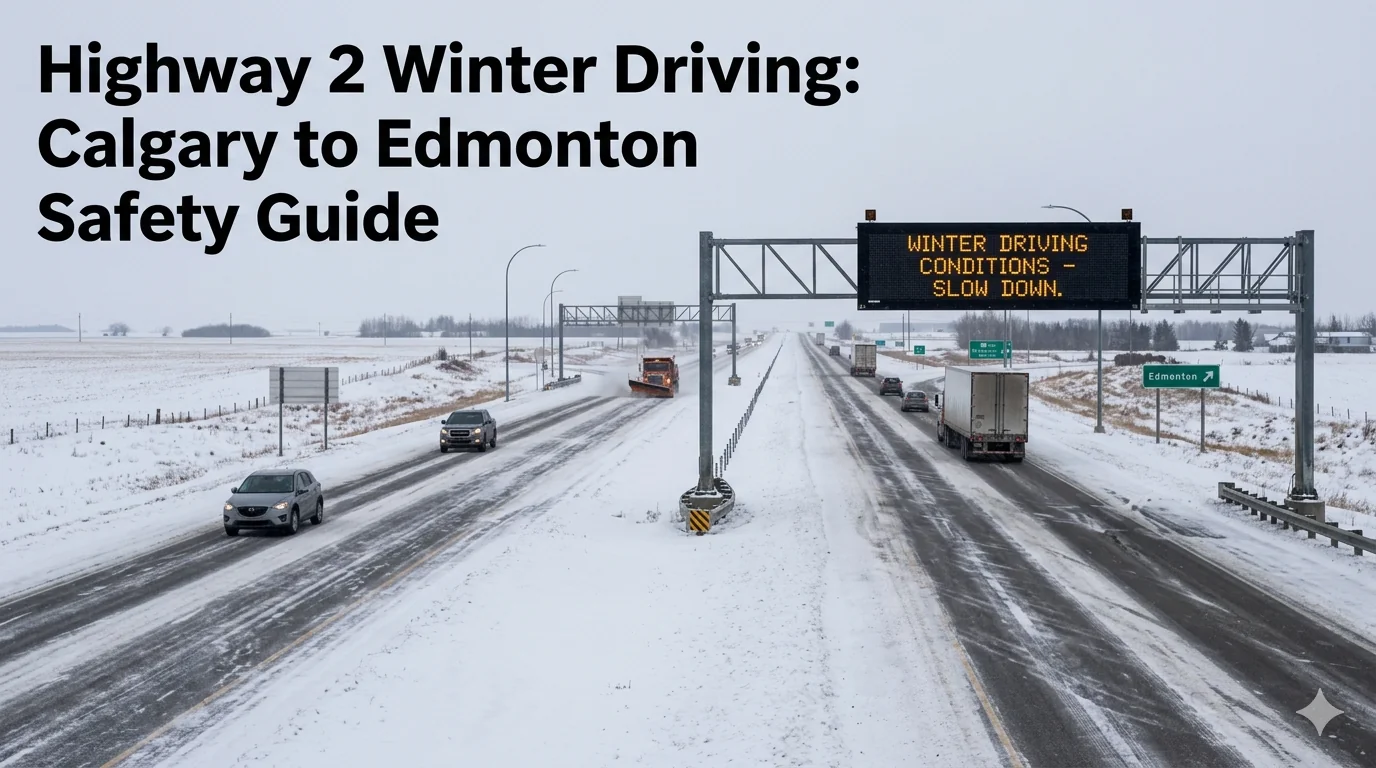
Alberta's Queen Elizabeth II Highway carries roughly 30,000 vehicles per day between Calgary and Edmonton. When a January blizzard drops visibility to 200 metres near Olds, when black ice forms silently on the overpass at Crossfield at 3 AM, or when a jackknifed semi closes both southbound lanes south of Red Deer — this is where unpreparedness stops being inconvenient and starts being dangerous. This is a complete, Alberta-specific guide to surviving QE2 winter driving, with the vehicle preparation, emergency protocols, and route knowledge that regular Highway 2 travellers need.
See what you pre-qualify for
Three quick answers — soft check, no commitment.
Understanding the QE2 Winter Risk Zones
Highway 2 is not uniformly dangerous in winter — it has specific high-risk zones that regular travellers learn to treat differently. Knowing where conditions change is the first layer of safety.
The Airdrie/Crossfield Corridor (km 0-40 North of Calgary)
The area immediately north of Calgary between Airdrie and Crossfield sits on open prairie with minimal windbreaks. When a Chinook drops out and the temperature plunges, this stretch is the first to glaze. Crossfield in particular sits in a slight topographic bowl that traps cold air. The overpasses at the Crossfield and Carstairs exits are consistently the worst spots on this stretch — bridges flash-freeze because cold air circulates both above and below the road surface, pulling heat out from both sides simultaneously. Slow down 15-20 km/h before any overpass in these conditions, regardless of what the main road surface looks like.
The Olds/Innisfail Zone (km 85-120 from Calgary)
This section consistently produces Alberta's worst QE2 accident clusters. The highway is relatively straight here, speeds climb back up after construction zones, and the terrain is featureless enough that blowing snow creates sudden whiteout conditions with almost no warning. The dip between Olds and Innisfail traps blowing snow across the road surface. In a severe storm, this is where you make the call to stop — either at the Tim Hortons in Innisfail or the Flying J at Red Deer — rather than push through.
Red Deer and the Blindman River Bridge (km 148)
The Red Deer area has its own weather microclimate. The river valleys create inversion layers that hold fog and mist at road level when both ends of the city are clear. The Blindman River bridge south of Lacombe is another chronic black ice producer in these conditions. 511 Alberta will post road condition updates specific to this segment — check it before you reach this zone, not when you're already in it.
Edmonton Approaches (km 270-300)
The final approach to Edmonton through Leduc sees consistent heavy truck traffic and the road surface degrades faster here than anywhere else on the corridor. Combined with Edmonton's tendency toward wet snow (the city sits at lower elevation than Calgary and gets slightly warmer storms), this section gets wet, heavy, pack-down conditions that are a different challenge than the dry blowing snow further south.
Vehicle Preparation Checklist Before a Winter QE2 Trip
Every point on this list is a decision made before you leave home — when you have options. None of them help you once you're in trouble at kilometre 160 at 11 PM in a blizzard.
Tires First, Everything Else Second
If your vehicle has anything other than three-peak mountain snowflake winter tires on it between October and April, you are not prepared for a QE2 winter trip — full stop. All-season tires tested at -25°C retain roughly 50% of their warm-temperature grip. Winter tires at the same temperature retain close to 80%. On glare ice between Olds and Innisfail, that difference is 40+ metres of additional stopping distance at 110 km/h. Our Alberta winter tire guide breaks down exactly which tires perform in Alberta conditions and how to read the ratings.
Battery Check
A battery that starts reliably at +5°C may not start at -30°C. Cold reduces battery capacity — a battery at 30% health will fail at -25°C even if it's been starting fine in November. Get your battery load-tested, not just voltage-checked, before winter season. A load test reveals actual cold-cranking capacity. Batteries over 5 years old should be replaced proactively. See our cold climate battery maintenance guide for the full picture.
Block Heater — Use It Every Night
Alberta vehicles should have a block heater plugged in whenever overnight temperature drops below -15°C. Below -25°C, it's not optional — cold engine starts below this temperature accelerate wear dramatically. A block heater keeps the coolant and oil warm enough to flow immediately on startup, protects cylinder walls, and gets your cabin heater working within minutes instead of 10-15. The block heater guide covers cord routing, timer use (plug in 2-4 hours before you need the vehicle, not overnight — it's not designed to run for 10 hours straight), and extension cord specifications.
Full Winterization Checklist
- Windshield washer fluid — Must be rated to -40°C. Regular washer fluid freezes on your windshield at -20°C and creates an instant visibility crisis. Check fluid level before every winter highway trip.
- Wiper blades — Standard wipers clog with ice and snow. Winter-rated beam wipers (like Bosch Icon or Rain-X Latitude) maintain contact across the full blade length in frozen conditions.
- Oil viscosity — If you're running 5W-30 in summer, your oil spec should include winter performance. 0W-20 or 0W-30 flows better in extreme cold. Check your owner's manual for cold-weather recommendations.
- Four-wheel alignment — Winter potholes and road deterioration knock alignment out. Misaligned vehicles pull during emergency lane changes in slippery conditions.
- Brakes — Check pad life before winter season. Our complete winter car care guide covers the full system.
Your QE2 Emergency Kit
Alberta Transportation recommends a basic emergency kit. We're going to tell you what actually matters if you're stuck in a ditch on the QE2 in -30°C weather at 2 AM with no cell service.
Heat and Shelter
This is the survival priority. Your vehicle can run for heat as long as you have fuel — which is why you should never let your tank drop below half on a winter highway trip. If you're stuck and running the engine for heat: clear snow away from the tailpipe before running the vehicle, crack a window slightly, and check every 20-30 minutes that exhaust isn't backed up. Carbon monoxide poisoning in a snow-buried vehicle is a real cause of winter highway fatalities in Alberta. Items to carry: two survival/emergency blankets (the foil type — they're small and effective), a heavy wool or fleece blanket, chemical hand warmers.
Extraction Equipment
A telescoping ice scraper and snow brush is the minimum. Add a full-size snow shovel — you cannot dig out with the ice scraper. Sand or a small bag of cat litter provides traction under drive wheels if you're in a ditch with some vehicle function remaining. Traction boards (MaxTrax style) are overkill for most drivers but genuinely work if you're regularly driving in deep snow conditions.
Emergency Communication
Cell coverage on QE2 is generally good between Calgary and Edmonton, but there are gaps — particularly in the Olds-to-Didsbury stretch in certain weather. A portable battery pack charged to full is essential. Consider a Garmin inReach or SPOT satellite communicator if you drive the corridor frequently in winter — they work where cell towers don't. CAA membership is cheap and worth every dollar in the winter highway context.
Supplies for Waiting
Water (frozen water in your bottle is not water), energy bars or granola bars, a headlamp with fresh batteries, and a first aid kit. You may wait two to four hours for emergency services on a bad-weather QE2 night — this isn't speculation, it's what Alberta's conditions produce during multi-vehicle pile-up incidents when services are overwhelmed.
What to Do If Stranded on Highway 2
If you go off-road or your vehicle breaks down on QE2 in winter conditions, the decision tree is simple:
- Stay with your vehicle. Always. A vehicle is visible to searchers. A person walking in blowing snow at night is not. Exceptions: your vehicle is on fire, or you can clearly see shelter within a 200-metre walk. Otherwise, stay.
- Signal for help. Turn on your hazard lights. At night, a headlamp facing traffic, a road flare, or LED emergency triangles make you visible. Position triangles or flares 60-100 metres behind and ahead of your vehicle if road conditions allow.
- Call 911 and 511 Alberta. 911 dispatches emergency services. 511 Alberta's condition line can confirm whether tow services are en route to your zone. In no-cell areas, if you have a satellite communicator, activate it.
- Manage heat conservatively. Run the engine for heat in 10-15 minute cycles rather than continuously. This preserves fuel. Keep tailpipe clear.
- Track your fuel. If you started with less than a quarter tank, you need to be conservative immediately. Heat and communication are fuel-dependent — know how long you have.
Gas Stations and Rest Stops Along the QE2 Corridor
Highway 2 has good fuel availability, but in a blizzard, knowing where the stops are matters.
| Location | km from Calgary (approx) | 24hr Fuel? | Food |
|---|---|---|---|
| Airdrie (Costco, Flying J) | 35 | Yes | Yes |
| Crossfield (Co-op) | 53 | No | Limited |
| Carstairs (Shell) | 70 | No | Limited |
| Olds (Husky) | 90 | Yes | Yes |
| Innisfail (Tim Hortons / Shell) | 108 | Yes | Yes |
| Red Deer (multiple — Flying J, Petro-Canada) | 150 | Yes | Yes |
| Ponoka (Husky) | 178 | No | Limited |
| Wetaskiwin (multiple) | 195 | Yes | Yes |
| Leduc (multiple) | 255 | Yes | Yes |
| Edmonton (Nisku area and beyond) | 290+ | Yes | Yes |
Red Deer is the critical decision point for southbound travellers hitting bad weather. It's the halfway mark with full services. If conditions south of Red Deer are severe, this is your last comfortable stopping point before committing to the problematic Olds-Innisfail zone.
Winter Driving Techniques That Actually Work on QE2
Vehicle preparation is the foundation, but technique determines what happens when conditions deteriorate around you.
Speed and Following Distance
Environment Canada blowing snow warnings on the QE2 corridor often correspond with 100 km/h-plus wind gusts across open stretches north of Airdrie. When visibility drops below 200 metres, Highway Traffic Act in Alberta allows police to enforce speed restrictions well below posted limits — and Transport Canada data shows that most multi-vehicle pile-ups on QE2 occur when traffic is moving at 80-90% of posted speed in conditions that realistically support 40-50%. Following distance in winter conditions should be a minimum of 4 seconds. In blowing snow, double it. The semi truck ahead of you can stop much more slowly than you can — the 53-foot trailer behind it will continue forward if the braking isn't controlled, and you do not want to be in that path.
Handling Black Ice
Black ice on QE2 is often invisible — the road looks wet, or just darker than surrounding pavement. Warning signs: your steering feels unusually light, you can see other vehicles with their hazards on ahead, or you've just passed under a bridge or overpass. If you hit black ice mid-travel:
- Do not brake suddenly. Maintain steady throttle or ease off gently.
- Look further ahead than normal and steer in the direction you want to go, not away from where you're going.
- If your vehicle begins to rotate (oversteer), apply gentle counter-steering — opposite to the direction the rear is sliding. Then bring the wheel back to straight as the grip returns.
- Modern stability control systems intervene faster than you can, but they need a split second to sense the slip. Your job is to not create additional inputs that confuse the system while it works.
When to Pull Over and Stop
The decision to stop is the most important winter driving decision you'll make, and most drivers make it too late. Pull over and stop when: visibility drops below 100 metres and isn't improving, you can feel your vehicle skating on surfaces that should have traction, vehicles around you are losing control, or Alberta's 511 system posts a "Do Not Travel" advisory for your segment. Stopping is not failure. Stopping in a safe, visible location with hazards on is the correct choice. The collision statistics from QE2 winter incidents consistently show that drivers who pushed through when they should have stopped are overrepresented in the outcomes.
Best Vehicles for Regular QE2 Commuting
The Calgary-Edmonton corridor commuter needs a different vehicle profile than an occasional trip driver. You're driving this in all conditions, potentially 3-4 times per week, 30 weeks of winter weather per year. The priorities are reliability, highway economy, heated seats and steering wheel (non-negotiable in Alberta winters), and AWD that works automatically so you're not thinking about drivetrain modes at 6 AM.
If you're doing this commute regularly, our Airdrie to Calgary commute vehicle guide covers the specific priorities in detail. The general answer for QE2 commuting: AWD or 4WD is essentially mandatory. A front-wheel-drive sedan with good winter tires is manageable on most days, but the high-risk days on QE2 are the exact days when AWD versus FWD matters most.
Top options for this corridor include the best used cars for Canadian winters — vehicles with proven cold-weather reliability, available heated seats, and effective defrost systems. Subaru's Symmetrical AWD lineup, Toyota's AWD RAV4 and Camry AWD, and the Honda CR-V's real-time AWD all perform well in this context. For higher mileage winter commuting, Toyota's reliability record makes the RAV4 and Camry particularly strong candidates for total cost of ownership.
Features That Actually Matter for QE2 Winter Driving
When evaluating a vehicle for this specific use case — regular Alberta winter highway driving — here's what to prioritize in the used vehicle market:
Non-negotiable for QE2 winter use: Heated seats (not just a convenience — essential when your vehicle is cold at departure), rear window defroster, AWD or 4WD, winter tires (purchased separately or included). Everything else is preference.
- Heated steering wheel — Underrated. Driving with thick gloves reduces fine motor control for steering. A heated wheel lets you drive with thinner gloves or bare hands in comfort.
- Remote start — Allows defrost to run before you get in. Built-in is more reliable than aftermarket; look for it in the options list when shopping used.
- Auto-dimming rearview mirror — Reduces glare from vehicles behind you on dark winter highway driving, particularly from high-beam-equipped trucks.
- Adaptive cruise control with automatic emergency braking — On long QE2 stretches in clear conditions, adaptive cruise reduces driver fatigue. Emergency auto-braking provides a safety net when conditions change suddenly.
- High-visibility headlights (LED or HID) — Halogen headlights on older vehicles are genuinely inadequate in blowing snow conditions. LED headlights penetrate precipitation better and illuminate road edges more clearly at highway speed.
How Winter Preparedness Affects Resale Value
This connection surprises most owners: how you maintain a vehicle through Alberta winters directly affects what you'll get for it when you sell or trade. A vehicle with documented winter tire swaps, regular oil changes through cold months, and consistent undercarriage washing will appraise higher than one that wintered without care. The QE2 corridor's salt use is significant — if you're driving this route regularly, an annual undercarriage wash after the winter season and before spring is basic preservation that costs $30-60 and protects thousands in resale value. Vehicles with salt corrosion damage on frame rails, brake lines, and exhaust components lose significant value at trade-in appraisal, and the damage is cumulative — one neglected winter becomes a pattern that appraisers can see.
Get Road-Ready at Shift Happens Auto Sales
If your current vehicle isn't cutting it on Alberta's winter highways — wrong tires, questionable battery, no AWD, no heated seats — the most practical thing you can do is get into a vehicle that was built for these conditions. We work with buyers across all credit situations at Shift Happens Auto Sales in Airdrie, right on the QE2 corridor. Whether you're financing your first vehicle or upgrading to something more capable, apply for financing here and let us find options that work for your situation. We have access to 25,000+ vehicles through our network and lenders who specialize in Alberta buyers.
Compare and Apply
- Best Subprime Dealers in Calgary (2026) — who to use for bad credit car loans in Calgary
Financing Resources
Related Articles
Ready to Find Your Vehicle?
Browse our inventory or apply for financing. All credit situations welcome.
★★★★★ 114+ Google Reviews · AMVIC Licensed · Free Delivery 300km