
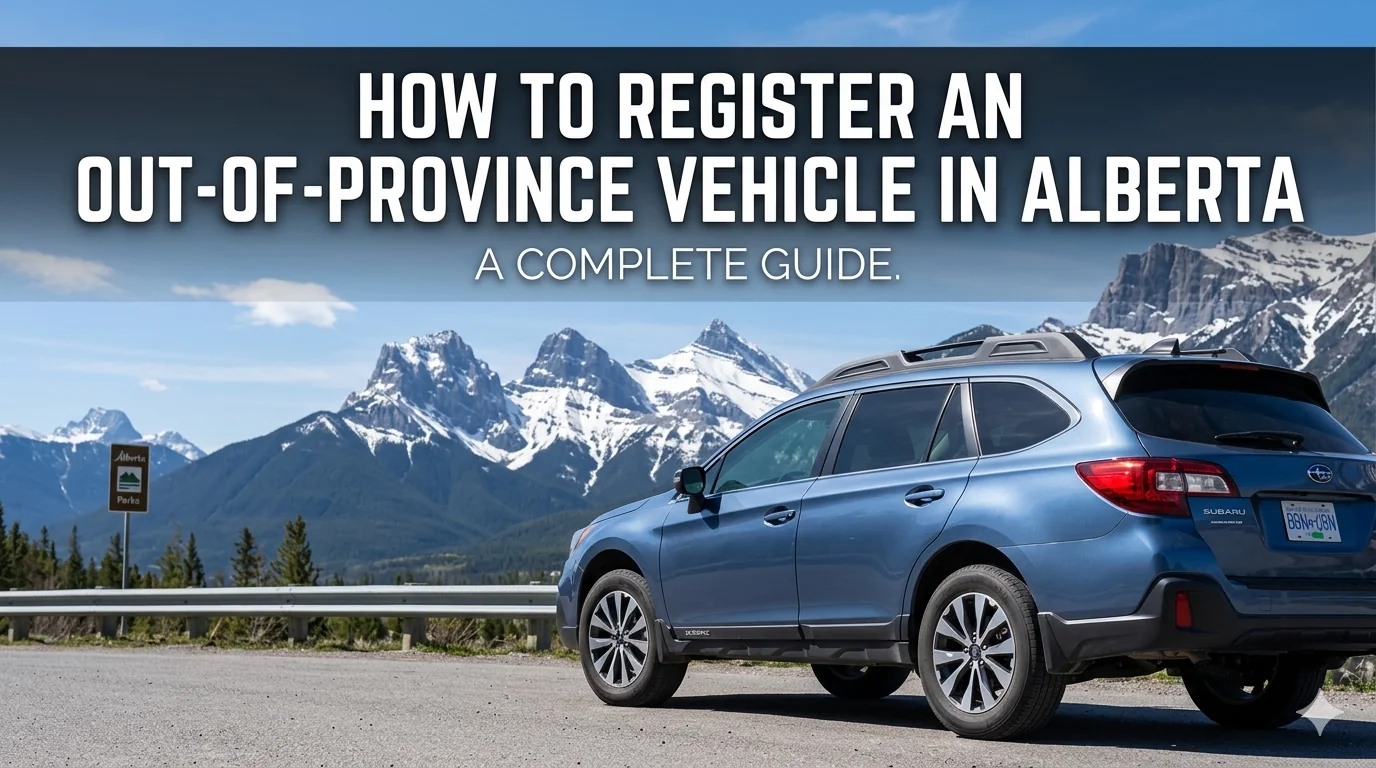
How to Register an Out-of-Province Vehicle in Alberta
In this article
- Why Out-of-Province Registration Gets Complicated
- Step 1: Required Documents Before You Start
- Step 2: The Out-of-Province Inspection — What It Is and What It Costs
- What Gets Inspected
- Inspection Costs and Timeline
- Step 3: Alberta Vehicle Registration
- Registration Costs: What to Budget
- Timeline Expectations
- The Big Gotchas: What Can Derail the Process
- Salvage and Branded Titles from Other Provinces and States
- Odometer Discrepancy
- Missing or Incomplete Ownership Documents
- Corporate or Fleet Ownership History
- US Imports: A Different Process Entirely
- Buying from an Alberta Dealer: What You Skip
- A Practical Example: BC to Alberta Transfer
- Special Cases Worth Knowing
- Fleet and Rental Vehicles
- Quebec Vehicles
- Leased Vehicles from Another Province
- Common Questions Answered
- Do I need Alberta insurance before the inspection?
- Can I drive the vehicle on out-of-province plates while I complete registration?
- What if the seller won't provide all the documents?
- Is a CARFAX report good enough instead of an inspection?
- Taking the Simpler Path
- Related Buyer Guides
- Compare and Apply
Check Your Options in 3 Minutes
No credit impact. All credit situations welcome.
★★★★★ 114+ Google Reviews · AMVIC Licensed · Free Delivery 300km
You found the perfect vehicle — but it's registered in BC. Or Ontario. Or worse, it came from a US state where titles work completely differently. Out-of-province vehicle registration in Alberta is doable, but it's not as simple as walking into a registry office with your paperwork. There are inspections required, specific documents that must be in order, and a few scenarios that can turn a good deal into a headache. Here's the complete picture so you know what you're getting into before you commit.
See what you pre-qualify for
Three quick answers — soft check, no commitment.
Why Out-of-Province Registration Gets Complicated
Alberta doesn't just accept another province's registration and call it a day — and for good reason. Vehicle standards, inspection requirements, and title branding systems vary significantly across Canada, and even more dramatically between Canada and the United States. A vehicle might be completely legal to drive in Quebec but fail to meet Alberta's equipment standards. A truck might have a clean title in Texas but be considered "salvage" under Canadian classifications.
The out-of-province (OOP) registration process exists to standardize these vehicles to Alberta's requirements. It protects subsequent Alberta buyers from unknowingly purchasing vehicles that don't meet provincial standards. It also catches some of the most common fraud scenarios — rolled-back odometers from US imports, undisclosed rebuilt titles, and structural damage that was repaired to another jurisdiction's standards.
Step 1: Required Documents Before You Start
Before anything else, gather your documents. Missing documentation is the most common reason the process gets delayed. You'll need:
- Bill of sale — showing the purchase price, vehicle description (VIN, year, make, model), seller's name and address, buyer's name and address, and date of sale. A handwritten bill of sale is acceptable; a printed form is better. If you bought from a dealer, their purchase agreement fills this role.
- Previous registration — the current registration document from the province or state where the vehicle was last registered. This establishes the ownership chain.
- Previous title — in provinces that issue separate ownership/title documents (Ontario, Quebec, BC, Saskatchewan), you need the ownership document transferred to your name. In Alberta, registration and ownership are combined on one document.
- Valid Alberta vehicle insurance — you must have Alberta insurance before you can register. You'll need your pink card or insurance binder document showing the vehicle's VIN is covered.
- Your Alberta driver's license — for identity verification.
- Out-of-province inspection certificate — more on this below, as it's the most significant requirement.
Pro tip: If you bought the vehicle privately from another province, ensure the seller has signed the back of the ownership/title document (in provinces that require it) before you leave. Getting a signature from someone in BC after the fact is a bureaucratic nightmare.
Step 2: The Out-of-Province Inspection — What It Is and What It Costs
This is the requirement that surprises most people. Every vehicle registered in Alberta for the first time from another province must pass an out-of-province inspection (OOP inspection) at an Approved Inspection Facility (AIF). This is mandatory — there's no waiving it.
The OOP inspection is a safety and standards inspection, not a mechanical quality check. An inspector verifies that the vehicle meets Alberta's equipment requirements and has no visible safety deficiencies. It's similar to a standard safety inspection but specifically focused on confirming the vehicle is roadworthy under Alberta's standards.
What Gets Inspected
- Lights and electrical systems (headlights, brake lights, turn signals, reverse lights)
- Brakes (brake fluid, disc/drum condition, brake lines)
- Steering and suspension components
- Tires (tread depth, condition, proper fitment)
- Windshield and wipers
- Horn
- Undercarriage for visible structural damage
- Emissions equipment (applicable to certain vehicles)
The inspection does not evaluate overall mechanical quality, the condition of wear items like spark plugs, or the accuracy of the odometer. For that kind of assessment, you'd want an independent pre-purchase inspection from a mechanic you trust — something we recommend for any used vehicle purchase regardless of where it came from. Our used car inspection checklist covers what to look for before you buy.
Inspection Costs and Timeline
OOP inspection fees are set by the inspection facility, not the government. Expect to pay $150-300 for a standard passenger vehicle inspection, with trucks and specialty vehicles sometimes costing more. The inspection itself usually takes 1-3 hours; booking an appointment in advance is strongly recommended, as popular AIFs can be booked a week or more out.
If the vehicle fails inspection, you'll receive a list of required repairs. Once repairs are completed (at any shop, not necessarily the inspection facility), you return for a re-inspection. Some facilities charge a reduced re-inspection fee; others charge the full amount. Ask before you book.
For a complete breakdown of what Alberta's vehicle inspection process involves and where to find AIFs, the out-of-province inspection guide has the full detail including how to find a certified facility near you.
Step 3: Alberta Vehicle Registration
Once your OOP inspection is passed and your insurance is arranged, you take everything to an Alberta registry agent (not a government office — Alberta uses private registry agents for vehicle registration). You'll need:
- Completed and passed OOP inspection certificate
- All ownership/title documents (properly transferred to your name)
- Bill of sale
- Current Alberta insurance documents
- Payment for registration fees
The registry agent registers the vehicle in Alberta's system, issues you new Alberta plates (if you don't already have plates to transfer), and records you as the registered owner. The whole registry visit usually takes 15-30 minutes once all your documents are in order.
Registration Costs: What to Budget
The registration fees themselves aren't enormous, but they add up when combined with the inspection. Here's a realistic cost breakdown:
| Cost Item | Typical Range | Notes |
|---|---|---|
| OOP Inspection | $150-300 | Varies by facility and vehicle type |
| Registration fee (annual) | $84-110 | Varies by vehicle weight/class |
| Plate transfer or new plates | $18-22 | If new plates required |
| Registry agent service fee | $15-25 | Private registry fee |
| Repairs if inspection fails | $0-1,500+ | Highly variable; factor into deal price |
Budget roughly $300-500 for a smooth OOP registration with no repair surprises. If the inspection turns up issues — worn tires, a brake problem, lighting deficiencies — the repair costs stack on top.
Timeline Expectations
If everything is in order, the process can be completed in 2-4 days: one day to book and complete the inspection, one day for any minor repairs if needed, and one registry visit to finalize registration. In reality, most people find it takes 1-2 weeks, accounting for inspection booking lead times, potential repairs, and getting all documents organized.
During this period, you can drive the vehicle on Alberta roads if you have valid insurance and carry the out-of-province registration from the previous jurisdiction. You have 3 months from establishing Alberta residency (or the date you bring the vehicle into Alberta) to complete the registration process.
The Big Gotchas: What Can Derail the Process
Salvage and Branded Titles from Other Provinces and States
This is the most serious complication in OOP registration. Each province and US state has its own title branding system, and they don't map cleanly onto each other.
A vehicle with a "Rebuilt" title in BC can be registered in Alberta, but only after passing the Alberta vehicle inspection requirements and having the rebuilt status noted on the Alberta registration. A "Salvage" title vehicle that hasn't been repaired and inspected cannot be registered for road use in Alberta at all.
US vehicles — particularly from states like Texas, Florida, and California — are a special concern. American title brands don't translate directly to Canadian classifications. A vehicle that's "clean title" in the US might have a history that would brand it in Canada. Always run both a CARFAX Canada and CARFAX US report on any American import before purchasing.
Warning: "Lemon law buybacks" are a US-specific vehicle category — cars returned to manufacturers under consumer protection laws. These are sometimes sold in Canada, often without full disclosure. A lemon law buyback may carry a branded title in its US state; if that title was clean, buyers may not discover the history without a thorough records search.
Odometer Discrepancy
Canadian odometers show kilometres. Many US vehicles show miles. When a US vehicle is imported to Canada, the odometer often shows an inflated-looking number in kilometres that is actually just the mileage figure converted. This is legal and must be disclosed — but it creates confusion.
More seriously, some imported vehicles have had odometers tampered with before or during import. The OOP inspection doesn't catch odometer fraud, but a CARFAX report that shows US service records (with mileage at each service) can reveal discrepancies. If the numbers don't track consistently, walk away.
Missing or Incomplete Ownership Documents
In some provinces (particularly Ontario), there's a specific process for transferring ownership. If the previous owner didn't properly complete the ownership transfer documentation, you may need to track them down — or pursue a legal process to establish clean title. This is significantly more common with private sales than dealer purchases.
Corporate or Fleet Ownership History
Vehicles coming from corporate fleets or leasing companies may have additional steps — the company must execute a proper bill of sale, and in some cases power of attorney documents are required. This is manageable but adds time.
US Imports: A Different Process Entirely
Importing a vehicle from the United States is substantially more complex than transferring between Canadian provinces and deserves its own note. In addition to the OOP registration process, US imports require:
- CBSA (Canada Border Services Agency) customs clearance and duty payment
- RIV (Registrar of Imported Vehicles) processing and an RIV inspection
- Confirmation the vehicle is eligible for Canadian import (not all US vehicles are — some don't meet Canadian safety standards and cannot be modified to comply)
- Recall compliance: all outstanding US safety recalls must be resolved before import is finalized
The full US import process can take weeks and cost several thousand dollars beyond the purchase price. For most buyers, the total cost of a US import ends up close to (or exceeding) comparable Canadian vehicles once all fees are factored in. That said, some buyers find good deals — particularly on trucks, where Canadian prices run significantly higher than US market prices.
Buying from an Alberta Dealer: What You Skip
This entire process — the OOP inspection, document gathering, title verification, and registry navigation — is what you avoid when you buy from an AMVIC-licensed Alberta dealer. When you purchase from a dealer in Edmonton, Calgary, or Airdrie, the vehicle is already registered (or registerable) in Alberta. The dealer handles the plate transfer, and you walk out with an Alberta-registered vehicle.
For vehicles that originated elsewhere, a reputable dealer has already cleared the OOP process before putting the vehicle on the lot. They've absorbed the inspection costs, addressed any deficiencies, and verified the title history. What you're paying for, in part, is that administrative certainty — especially valuable for buyers who don't want to manage the process themselves or who are financing, since most lenders won't finance an unregistered vehicle.
The guide to buying a car after moving to Alberta covers related ground if you're new to the province and navigating registration for the first time — there's overlap with the OOP process in terms of documentation requirements.
A Practical Example: BC to Alberta Transfer
To make this concrete, here's a realistic timeline for someone who bought a 2019 Toyota Highlander from a private seller in British Columbia:
- Day 0 — Purchase in BC. Seller signs the back of the BC Transfer/Tax form. You receive signed ownership, bill of sale, and current BC registration. Drive it home on the BC registration.
- Day 1-2 — Contact Alberta insurer to add the vehicle. Arrange OOP inspection appointment (book ahead — popular shops are 1 week out).
- Day 7 — OOP inspection. Vehicle passes. Receive inspection certificate.
- Day 8 — Visit Alberta registry agent with all documents. Pay registration fees. Receive Alberta registration and plates.
Total additional costs in this smooth scenario: ~$450 (inspection $200, registration ~$100, plates $20, registry fee $20, plus insurance adjustment). Total time: about 8-10 days from purchase to Alberta plates.
If the Highlander had failed inspection for a brake issue? Add repair costs ($300-800 depending on extent), a re-inspection appointment, and another week. Always factor potential inspection failure costs into your offer price on an out-of-province vehicle.
Special Cases Worth Knowing
Fleet and Rental Vehicles
Fleet vehicles coming from corporate registrations often have all documentation in order — corporate sellers typically know the paperwork requirements. Rental company vehicles sold at fleet auctions can be registered in Alberta but will carry a history of multiple drivers and high-mileage commercial use. This is disclosed and legal; it affects the vehicle's expected maintenance needs, not its registrability.
Quebec Vehicles
Quebec has a unique registration system — the provincial government (SAAQ) retains the title, and the "owner" holds a registration that proves the right to use the vehicle. When buying a Quebec vehicle privately, the process for transferring to Alberta is slightly different because there's no separate ownership certificate the seller signs over to you. A bill of sale and the current SAAQ registration document are the core documents. Alberta registry agents are familiar with this, but be prepared for slightly more back-and-forth.
Leased Vehicles from Another Province
If you've moved to Alberta but your vehicle is still under a lease from a BC or Ontario leasing company, you cannot simply register it in Alberta without the leasing company's involvement. The leasing company is the legal owner, and they need to authorize the inter-provincial registration change. Contact your leasing company first — most have a standard process for this, but it can take several weeks and may involve fee adjustments.
Common Questions Answered
Do I need Alberta insurance before the inspection?
Technically, you need insurance to drive the vehicle — including to the inspection. Most Alberta insurers will add a vehicle to your policy for inspection purposes before registration is complete. Call your insurer first.
Can I drive the vehicle on out-of-province plates while I complete registration?
Yes — Alberta gives you 3 months from bringing the vehicle into the province. Keep the out-of-province registration in the vehicle and ensure you have valid insurance coverage.
What if the seller won't provide all the documents?
Walk away. A legitimate private seller has the documents. Missing ownership history is a major red flag for stolen vehicles or title fraud. This is exactly why buying from a licensed Alberta dealer — who has verified the title chain as part of their business operations — reduces your risk significantly.
Is a CARFAX report good enough instead of an inspection?
No. CARFAX is a research tool; the OOP inspection is a legal requirement. Run both — the CARFAX tells you history, the inspection tells you current condition and code compliance. Our guide to spotting flood and hail damage covers what to look for before purchasing any out-of-province vehicle.
Taking the Simpler Path
If the OOP process sounds like more administrative work than you want to take on, buying a vehicle already registered (or registered-ready) in Alberta makes sense. At Shift Happens in Airdrie, we carry Honda CR-Vs, Highlanders, and a wide range of vehicles across all price points — all sourced from our network of 25,000+ vehicles and available for Alberta buyers without the OOP paperwork burden.
Our financing options cover all credit situations — whether you have strong credit, are rebuilding after some challenges, or are financing for the first time in Alberta. Start your financing application online, or reach out through our contact page if you have questions about specific vehicles or the buying process. We're AMVIC licensed, based in Airdrie, and focused on making the process straightforward — no surprises in the paperwork, no undisclosed history on the vehicles we sell.
Compare and Apply
- Bad Credit Financing — Complete Guide — subprime auto financing options
Financing Resources
Related Articles

Ready to Find Your Vehicle?
Browse our inventory or apply for financing. All credit situations welcome.
★★★★★ 114+ Google Reviews · AMVIC Licensed · Free Delivery 300km