
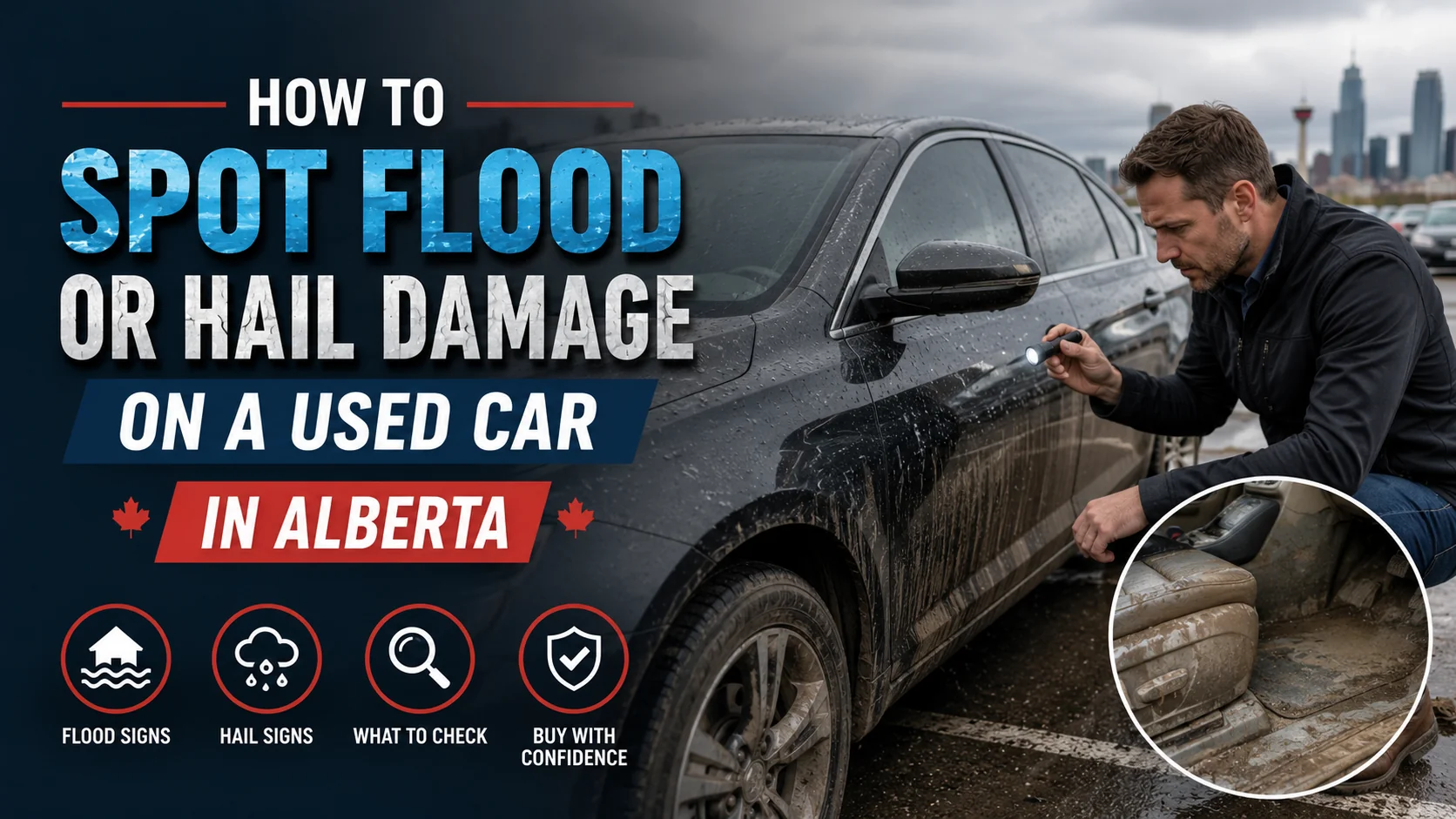
How to Spot Flood or Hail Damage on a Used Car in Alberta
In this article
- Why Alberta Is Ground Zero for Hail and Flood Damage Vehicles
- Understanding Alberta's Salvage Title and Rebuilt Designation
- AMVIC Disclosure Requirements
- How to Inspect for Hail Damage
- Visual Inspection — The Right Conditions Matter
- Panel-by-Panel Checklist
- Paint Tells the Story
- How to Inspect for Water and Flood Damage
- The Smell Test — First and Most Reliable
- Physical Evidence Inside the Cabin
- Under the Hood
- Electrical Gremlins — The Long-Tail Problem
- CARFAX and AutoCheck — What They Catch and What They Miss
- Why Rebuilt Salvage Vehicles Are Problematic for Financing
- Getting a Professional Pre-Purchase Inspection
- Red Flags That Should End the Conversation
- How Shift Happens Handles Hail and Flood History
- Related Buyer Guides
- Compare and Apply
Check Your Options in 3 Minutes
No credit impact. All credit situations welcome.
★★★★★ 114+ Google Reviews · AMVIC Licensed · Free Delivery 300km
In June 2020, a hailstorm ripped through Calgary and left behind $1.2 billion in insured damage — the costliest hail event in Canadian history. Tens of thousands of vehicles were written off, repaired, or quietly put back on the market without full disclosure. If you're shopping for a used car in Alberta right now, there's a real chance one of those vehicles — or one from a subsequent storm — is sitting on a lot or listed online near you. Knowing how to spot flood or hail damage before you sign anything is one of the most important skills a used car buyer can have in this province.
See what you pre-qualify for
Three quick answers — soft check, no commitment.
Why Alberta Is Ground Zero for Hail and Flood Damage Vehicles
Alberta sits in one of Canada's most active hail corridors. The area stretching from Calgary through Airdrie and east toward Chestermere sees multiple significant hailstorms every year between May and September. These aren't just dented hoods — severe storms produce golf-ball to baseball-sized hail that punches through metal, shatters glass, and floods engine compartments when hailstone buildup blocks drainage channels.
Flooding is a separate but equally serious risk. Southern Alberta's rivers run high during spring snowmelt and after heavy rain. The 2013 Calgary floods caused over $6 billion in total damage. Vehicles that sit in even six inches of moving floodwater can suffer catastrophic damage to electronic systems — and those systems may not fail immediately. You might drive a flood-damaged car for months before sensors, modules, or wiring harnesses start behaving strangely.
Both flood and hail-damaged vehicles can be legally sold in Alberta as long as proper disclosure is made. The problem is that disclosure doesn't always happen the way it should. A vehicle repaired by insurance and returned to service may change hands two or three times before it reaches you — and each transaction dilutes the paper trail.
Understanding Alberta's Salvage Title and Rebuilt Designation
When a vehicle is declared a total loss by an insurance company in Alberta, it receives a Salvage Brand on its title through the province's vehicle registration system. This brand stays with the vehicle permanently — it follows the VIN, not the owner. Once branded salvage, a vehicle cannot be legally registered for road use in Alberta until it passes a physical inspection conducted by an AMVIC-licensed inspector, after which it receives a Rebuilt Designation.
Here's what most buyers don't realize: a rebuilt designation means the vehicle was repaired well enough to pass inspection at that point in time. It does NOT mean the vehicle is fully restored to pre-loss condition. Rebuilt vehicles often have lingering issues — misaligned panels, electrical gremlins from water intrusion, structural repairs done to minimum standards rather than manufacturer specs.
Key rule: If a vehicle has a salvage or rebuilt brand on its Alberta registration, that information must be disclosed to you before sale. If a seller does not disclose a known brand, they are in violation of AMVIC rules and potentially provincial consumer protection law. Always verify registration documents yourself — don't take a verbal assurance.
For a deeper look at your rights as a buyer in these situations, the used car inspection checklist for Alberta buyers covers AMVIC disclosure rules in detail, including what a seller is legally required to tell you.
AMVIC Disclosure Requirements
Alberta Motor Vehicle Industry Council (AMVIC) licenses and regulates automotive dealers in this province. Under AMVIC rules, licensed dealers must disclose any known material defects, prior collision history, and registration brands before a sale is completed. "Material defect" is defined broadly enough to include significant hail damage, flood history, and structural repairs.
Private sellers in Alberta are held to a lower standard — they're expected to disclose what they know, but they don't have the same regulatory obligations as dealers. This is one of the reasons buying from an AMVIC-licensed dealer provides meaningful protection that private sales don't. If a licensed dealer fails to disclose known damage, you have a regulatory body — AMVIC — to file a complaint with and a legal avenue for recourse.
The Alberta vehicle inspection requirements page explains the inspection process that rebuilt vehicles must pass, including what inspectors look for and what a clean inspection actually certifies.
How to Inspect for Hail Damage
Hail damage ranges from obvious to nearly invisible depending on the severity of the storm and the quality of subsequent repairs. Here's a systematic inspection approach:
Visual Inspection — The Right Conditions Matter
Never inspect a vehicle in a covered parking lot or on a cloudy day if you're looking for hail damage. Hail dimples are best seen in direct sunlight from a low angle. Walk slowly around the vehicle with the sun at your back, looking across the hood, roof, trunk lid, and door panels. Even minor dimples will cast small shadows when light rakes across the surface at a sharp angle.
Also useful: bring a small LED flashlight and hold it flat against body panels in a dark corner. Roll light across the surface rather than shining it directly — this technique, borrowed from body shop technicians, reveals shallow dimples that natural light might miss.
Panel-by-Panel Checklist
- Hood and roof — highest-exposure panels. Any dimpling here almost certainly means the car was caught in a significant storm.
- Trunk lid — often overlooked by buyers. Check the full surface carefully.
- Door skins — run your hand along each door from the top edge downward. Fingertips feel dimples that eyes miss.
- Fenders — front fenders take hail hits but are also the panels most commonly replaced after damage. A replaced fender may indicate hidden hail history on the rest of the car.
- Pillars and rocker panels — hail rarely reaches these, but body filler in these areas suggests collision repair that may have overlapped with hail-related bodywork.
Paint Tells the Story
Hail damage that's been professionally repaired (paintless dent repair, or PDR) should leave no paint disturbance — PDR works by pushing dents out from behind without touching the surface. But lower-quality repairs may involve filler, which means paint was applied. Look for:
- Orange peel texture mismatch — factory paint has a consistent texture. Repainted panels look slightly different. Compare door to fender to hood.
- Color shade variation — subtle differences in color depth, especially visible at different angles or in varying light.
- Overspray on rubber seals — paint mist on door seals, trim pieces, or glass edges is a clear sign a panel was refinished.
- Panel gaps — major hail that required panel replacement often results in inconsistent gaps between panels. Pop each door, the hood, and the trunk and check that the gaps are even and consistent on both sides.
How to Inspect for Water and Flood Damage
Water damage is more insidious than hail damage because its effects accumulate invisibly over time. A car that sat in floodwater for two hours may look perfectly clean after a professional detail — and then spend the next two years slowly failing from the inside.
The Smell Test — First and Most Reliable
Get in the vehicle, close all the doors, and sit quietly for 30 seconds before you start looking. A musty, mildewy, or slightly chemical odor is a serious red flag. Water-damaged interiors that have been "remediated" often smell like industrial deodorizer — artificial pine or citrus scent in an older vehicle is suspicious. Trunk: open it, pull back the carpet liner, and smell. Wet smell or visible water staining = walk away.
Physical Evidence Inside the Cabin
- Water lines — look for tide marks on the lower portion of seat fabric, carpet, or door panels. These are horizontal stain lines left as flood water receded. Shampooing removes surface dirt but rarely eliminates water lines entirely.
- Rust in unusual places — check the underside of the dashboard, floor pan under the carpet, inside door hinges, and seat track bolts. Rust appearing on these interior metal surfaces is essentially impossible without water intrusion.
- Seatbelt mechanisms — flood water fills seatbelt retractor housings. Even after drying, these often feel gritty, sluggish, or make crunching sounds when pulled. Test every seatbelt.
- Carpet and padding — ask if you can pull back a corner of the carpet at the rocker sill. Wet padding underneath that appears dry on top is common — it absorbs water like a sponge and retains it for months.
- Fogged or moisture-stained headlights and taillights — water intrusion from heavy flooding often compromises lens seals. Look for condensation or watermarks inside the lens housing.
Under the Hood
Water in the engine bay leaves a distinct residue. Look for:
- Mud or sediment deposits in recesses that normal road grime doesn't reach — behind the battery tray, in HVAC inlet channels, in the ABS module bracket.
- Corrosion on electrical connectors. Factory connectors are designed to resist moisture but not submersion. Greenish or white corrosion on wiring harness connectors is a major warning sign.
- High-water marks on the inside of the fuse box lid or under the air filter housing.
Electrical Gremlins — The Long-Tail Problem
Flood-damaged electronics don't always fail immediately. Water causes micro-corrosion inside circuit boards, connector pins, and sensor housings that progresses over months or years. Be alert to:
- Warning lights that appear intermittently or clear themselves
- Power windows, mirrors, or locks that work inconsistently
- Infotainment system that restarts, freezes, or displays error codes
- Climate control that behaves erratically
- ABS or traction control warning lights
An OBD-II scan can reveal stored fault codes even if no warning lights are currently illuminated. A $20 Bluetooth OBD scanner lets you read these codes from your phone. Codes related to multiple unrelated modules (HVAC, BCM, TCM, ABS all at once) on a vehicle with no known history is a strong flood indicator.
CARFAX and AutoCheck — What They Catch and What They Miss
Vehicle history reports are essential, but they're not comprehensive. CARFAX Canada and AutoCheck pull data from insurance companies, provinces, law enforcement, and auction houses — but reporting is voluntary in many cases, and cross-border transactions create gaps.
What history reports catch reliably:
- Insurance total-loss declarations (if reported)
- Registration brands (salvage, rebuilt, flood) when recorded provincially
- Major collision claims reported through insurance
- Odometer disclosures at sale points
What they miss:
- Cash-settled insurance claims (common for hail damage where the owner keeps the car and pockets the money without repairing)
- Damage repaired without an insurance claim
- Vehicles that flooded in other provinces or the US before being imported to Alberta
- Partial flooding that didn't trigger a total-loss declaration
Pro tip: A clean CARFAX does not mean clean vehicle. It means clean reporting. Run the report — but don't let a clean report short-circuit a physical inspection.
If you're concerned about a specific vehicle's insurance status, the guide to insurance write-offs in Alberta explains how to interpret insurance status designations and what a "non-repairable" brand means versus a repairable write-off.
Why Rebuilt Salvage Vehicles Are Problematic for Financing
Even if a rebuilt salvage vehicle passes inspection and looks clean, it creates real problems when it comes to financing and insurance. Most lenders — including the majority of the 15+ lenders in our network — will not finance vehicles with salvage or rebuilt brands on their titles. The ones that will typically require larger down payments, apply higher interest rates, and cap loan terms shorter than they would for a clean-title vehicle.
The reason is straightforward: rebuilt salvage vehicles depreciate faster and are harder to resell or recover value on if a borrower defaults. Lenders price that risk accordingly — or decline outright.
Insurance is the other challenge. Standard auto insurance is typically available for rebuilt vehicles, but at higher premiums, and comprehensive/collision coverage is often excluded or heavily restricted. That means if a rebuilt vehicle gets damaged again, you may be covering it out of pocket. This is exactly the situation where GAP insurance becomes critically important — if a rebuilt vehicle is financed and then totalled, the insurance payout may fall well short of the outstanding loan balance.
Getting a Professional Pre-Purchase Inspection
Everything in this guide is what a careful buyer can do without tools. A professional pre-purchase inspection goes further. An AMVIC-licensed mechanic with a hoist can:
- Inspect the full undercarriage for rust, flood sediment, and frame damage
- Pull the vehicle history against provincial records
- Use a paint depth gauge to identify panels that have been repainted (factory paint has a consistent thickness; body filler and repaint add measurable depth)
- Perform a full scan of all electronic modules and document stored fault codes
- Check structural integrity of the floor pan, frame rails, and pillar welds
A pre-purchase inspection from a reputable shop typically costs $150-$250 in the Calgary-Airdrie area. On an $18,000 vehicle purchase, that's a 1.4% insurance policy against buying a flood or hail-damaged car that will cost you thousands down the line. It's one of the best investments you can make in the buying process. The Alberta vehicle inspection requirements page explains which inspections are required by law and which are optional but strongly recommended.
If you're looking at a Toyota Highlander or a Ford Escape — two popular used SUVs that moved a lot through the Calgary market around 2020 — a paint depth gauge check is especially worthwhile, given how many of these were caught in the 2020 storm. Browse available used Toyota Highlanders in Calgary and used Ford Escapes in Calgary and always request a history report before viewing.
Red Flags That Should End the Conversation
Some things are non-negotiable dealbreakers, regardless of price:
- Seller refuses a pre-purchase inspection — a legitimate seller has nothing to fear from an independent inspection. Refusal is near-certain evidence of something to hide.
- Rebuilt or salvage brand with undisclosed history — if you discover a brand that wasn't mentioned proactively, the relationship with that seller is over.
- Active mold or biological growth — visible mold in the carpet, headliner, or HVAC vents means a vehicle that sat in standing water long enough to develop a contamination problem. This is not remediated by shampooing.
- Multiple mismatched panels on a vehicle with "no accidents" according to the seller — body panels don't replace themselves.
- Price well below market with vague explanation — hail and flood damaged vehicles get sold cheaply because they can't compete on quality. If it seems too cheap, ask why clearly and demand documentation.
How Shift Happens Handles Hail and Flood History
Every vehicle we sell comes with a full history report, and our team inspects vehicles before they go to inventory. We don't stock rebuilt salvage vehicles. When customers ask specifically about a vehicle's background, we pull records and share them — not because we have to, but because we'd rather earn a customer for life than make a quick sale.
If you want to check recalls or safety notices on a vehicle you're considering, our post on how to check recalls before buying a used car walks through the Transport Canada database and how to interpret open recall status.
Shopping for a used vehicle in Calgary or the surrounding area? We can help you navigate the inventory with your specific situation in mind. If you've found a vehicle you want a second opinion on, or if you're ready to explore your financing options, connect with us and we'll give you straight answers. No pressure, no hidden history — just a clean deal.
Compare and Apply
- Complete Bad Credit Car Buying Guide (Alberta) — Alberta car buying guide for all credit situations
Financing Resources
Related Articles

Ready to Find Your Vehicle?
Browse our inventory or apply for financing. All credit situations welcome.
★★★★★ 114+ Google Reviews · AMVIC Licensed · Free Delivery 300km