
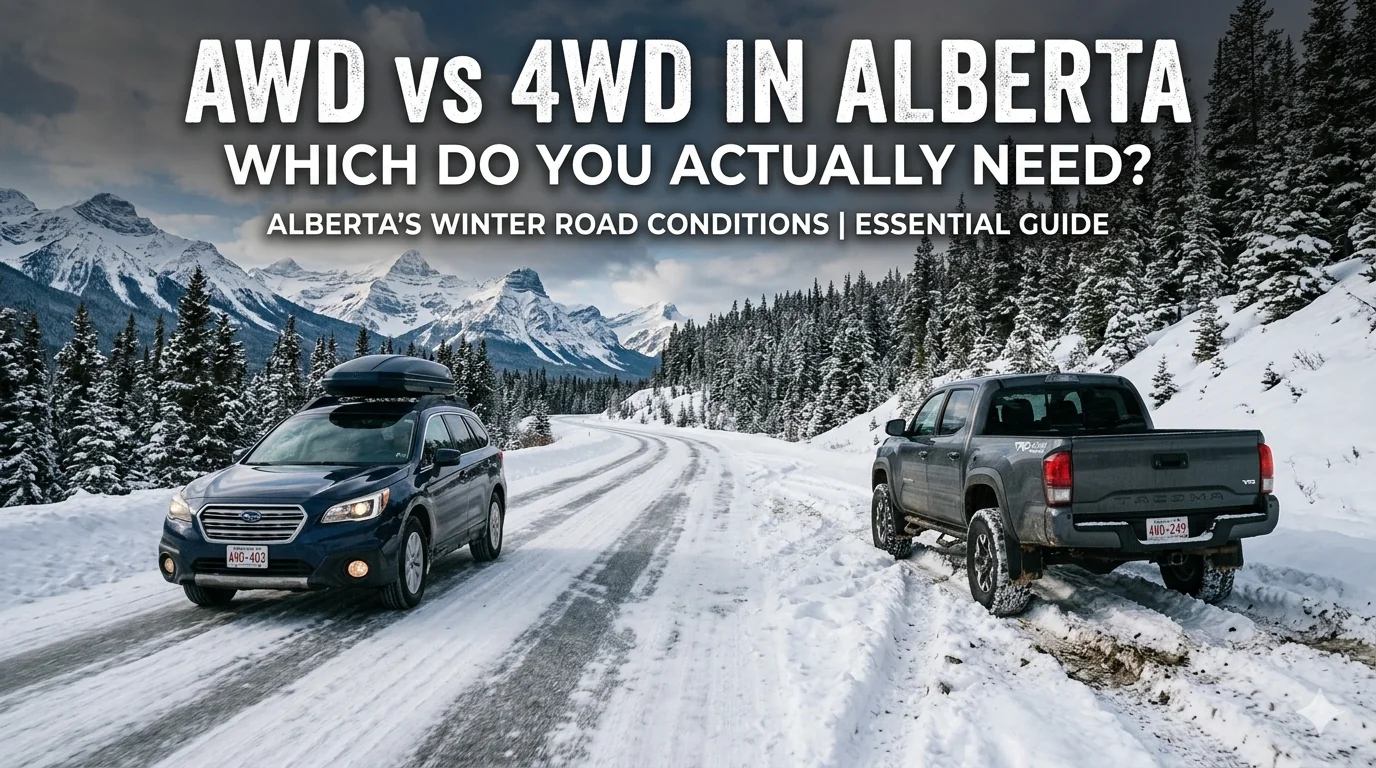
AWD vs 4WD in Alberta: Which Do You Actually Need?
In this article
- How AWD Actually Works
- How 4WD Actually Works
- The Real Difference in Performance: Where Each System Shines
- Alberta's Driving Reality: Where Do You Actually Drive?
- Calgary and Airdrie Urban Driving
- Mountain Corridors (Highway 1, Highway 93)
- Rural Alberta: Acreages, Farm Lanes, and Oilfield Access
- Fuel Economy: The Real Cost of 4WD
- Maintenance and Ownership Cost Differences
- AWD Maintenance
- 4WD Maintenance
- The Tire Caveat That Changes Everything
- Specific Vehicle Profiles: Which System Fits Which Lifestyle
- Toyota RAV4 AWD — The Right Choice For...
- Subaru Outback AWD — The Right Choice For...
- Jeep Wrangler 4WD — The Right Choice For...
- Ford F-150 4WD — The Right Choice For...
- The Decision Framework: 5 Questions to Ask Yourself
- AWD and 4WD in Alberta's Used Car Market
- Related Buyer Guides
- Compare and Apply
Check Your Options in 3 Minutes
No credit impact. All credit situations welcome.
★★★★★ 106+ Google Reviews · AMVIC Licensed · Free Delivery 300km
Every October, the same question floods Alberta Facebook groups and Reddit threads: "I'm looking at a RAV4 AWD and a Wrangler 4WD — what's the difference, and which do I need for winters here?" It's a legitimate question, and the honest answer is more nuanced than the truck-focused crowd wants to admit. Most Albertans don't need what they think they need — but some absolutely do. Here's how to actually figure out which camp you're in before you spend money on the wrong system.
See what you pre-qualify for
Three quick answers — soft check, no commitment.
How AWD Actually Works
All-wheel drive is an automatic system. The vehicle monitors wheel slip in real time and redistributes torque between axles — and often between individual wheels — without any input from the driver. You don't press a button. You don't think about it. The system just responds.
Most modern AWD systems are actually part-time: they run in front-wheel-drive mode the majority of the time to save fuel, and engage the rear axle only when the system detects slip or anticipates the need. Full-time AWD (found on some Subarus and luxury vehicles) sends power to all four wheels continuously.
The Toyota RAV4 AWD is a good example of how most crossover AWD systems operate: in normal conditions, it's essentially front-wheel drive. In low-traction situations, the rear electric motor engages within milliseconds. The system is seamless and invisible to the driver — which is exactly the point.
The Subaru Outback uses Symmetrical AWD, which is always active and distributes torque through a continuously variable front-rear split. It's one of the few passenger-car-based systems that genuinely approaches the capabilities of a true four-wheel drive in everyday traction situations — and it's a meaningful reason Subarus are disproportionately popular in mountain towns like Canmore and Banff.
How 4WD Actually Works
Four-wheel drive is a mechanical system designed for serious off-road and low-traction scenarios. Traditional part-time 4WD (the kind on most trucks and body-on-frame SUVs) locks the front and rear driveshafts together, forcing both axles to turn at the same speed. This is extremely effective in mud, snow, sand, and rocks — and extremely damaging if used on dry pavement, because the locked axles create binding in corners.
This is why a proper 4WD vehicle has distinct modes:
- 2H — two-wheel drive (rear), used on dry pavement for normal driving
- 4H — four-wheel drive high, for slippery surfaces at normal speeds (highway snow, gravel, mud)
- 4L — four-wheel drive low, for maximum torque at very low speeds (rock crawling, deep mud, steep grades, getting unstuck)
The Jeep Wrangler is the archetype of this system. Its Command-Trac or Rock-Trac 4WD systems are designed with a proper two-speed transfer case, solid axles, and locking differentials on higher trims. It is objectively the most capable off-road production vehicle you can buy. It is also a compromise in every other dimension — fuel economy, ride quality, highway noise, and cargo space — that you only make sense of if you actually use that capability.
The Ford F-150 4WD works similarly for trucks: electronic-shift-on-the-fly between 2H, 4A (automatic), 4H, and 4L. Modern trucks have made 4WD easier to engage and more forgiving to use, but the underlying mechanical architecture — locking front and rear axles — is the same as it's been for decades.
The Real Difference in Performance: Where Each System Shines
| Condition | AWD | 4WD | Winner |
|---|---|---|---|
| City driving, wet roads | Excellent | Good (but usually in 2WD) | AWD (seamless) |
| Highway in light snow | Excellent | Good | Tie |
| Unplowed side streets, 10–20cm snow | Good | Better | 4WD |
| Deep snow, drifts | Limited | Strong | 4WD |
| Off-road, mud, rocks | Not designed for this | Excellent | 4WD |
| Mountain highway (Hwy 1, 93) | Good with winter tires | Good with winter tires | Tie (tires matter more) |
| Rural acreage, farm lanes | Marginal in deep conditions | Strong | 4WD |
| Fuel economy | Better | Worse (especially in 4WD) | AWD |
| Daily comfort & refinement | Better | Worse (body-on-frame) | AWD |
Alberta's Driving Reality: Where Do You Actually Drive?
Alberta's geography creates genuinely different traction demands depending on where you live and where you go. Let's be specific:
Calgary and Airdrie Urban Driving
The City of Calgary plows arterials and major collectors within hours of a snowfall. Side streets take longer. For the average Calgary commuter — Highway 2 to downtown, Deerfoot to the northeast, MacLeod Trail south — a modern AWD crossover with proper winter tires handles 95% of winter conditions without drama. The RAV4 AWD is dominant in this space for exactly this reason: capable enough, efficient enough, practical enough.
Mountain Corridors (Highway 1, Highway 93)
This is where the AWD-vs-4WD debate gets interesting. The Trans-Canada from Calgary to Canmore and Banff gets packed snow, ice, and blowing drifts — sometimes all on the same day. Parks Canada enforces winter tire requirements on Highway 93 through Banff. The critical insight: on a properly maintained mountain highway, AWD with winter tires is adequate. The traction advantage of 4WD over AWD is most pronounced in unpacked snow and off-road, not on plowed mountain highways at legal speeds.
Where 4WD earns its keep: if you're accessing backcountry ski areas via unplowed forest service roads, driving to a remote cabin on an unmaintained road, or need to push through a drift to access a property. Those scenarios genuinely reward a proper 4WD system.
Rural Alberta: Acreages, Farm Lanes, and Oilfield Access
If you're driving a quarter mile of farm lane to get to your acreage, or accessing a rural property on a grid road that doesn't get plowed until Tuesday, 4WD is the right answer. AWD systems are not designed to extract a vehicle from a stuck position or push through unbroken snow. They prevent you from getting stuck; they don't get you unstuck. For rural Alberta — particularly central and northern Alberta where snowfall accumulation is higher and municipal clearing is slower — 4WD trucks and SUVs make practical sense that the city data doesn't capture.
Fuel Economy: The Real Cost of 4WD
The fuel economy difference between an AWD crossover and a 4WD truck/SUV is substantial — but most of it comes from the vehicle type, not the drivetrain system itself. A RAV4 AWD gets roughly 8.5L/100km combined. A Wrangler 4WD gets roughly 13–14L/100km. That difference is partly the 4WD hardware, but mostly the Wrangler's aerodynamically challenged body, heavier weight, and lower-geared axles.
Comparing more directly: a Silverado 1500 in 2WD mode gets approximately 12.5L/100km highway. In active 4WD, expect 13.5–15L/100km depending on conditions. The incremental cost of running 4H on a winter highway adds roughly 10–15% to fuel consumption. Over an Alberta winter, that can add $400–700 to annual fuel costs on a truck-class vehicle.
AWD systems that deactivate rear axles when not needed (the RAV4, many crossovers) do so specifically to minimize this penalty. If you drive an AWD vehicle in city conditions and the system is rarely engaging, your real-world fuel cost is close to 2WD.
Maintenance and Ownership Cost Differences
AWD Maintenance
Modern AWD crossovers are relatively low-maintenance. The main items to watch:
- Rear differential fluid (if liquid-cooled rear coupling) — typically every 50,000–80,000 km
- Transfer case fluid — every 50,000–80,000 km depending on manufacturer
- Matching tire sizes — running mismatched tires (different wear levels between axles) can damage the AWD coupling on many systems. Never put a spare of a different size on an AWD vehicle and drive significant distance
4WD Maintenance
Traditional 4WD systems are mechanically simpler in some respects — they've been around for 70 years — but the transfer case and front differential add service requirements:
- Transfer case fluid — every 50,000 km; more often if used heavily off-road
- Front differential fluid — every 50,000 km
- CV axles and u-joints — particularly on vehicles used off-road; inspect annually
- Front locking hubs (on older 4WD trucks with manual hubs) — require periodic inspection
For a complete picture of what maintaining these systems actually costs over time, our guide on winter car care in Alberta breaks down the seasonal maintenance schedule by vehicle type.
The Tire Caveat That Changes Everything
Neither AWD nor 4WD helps you stop. Both systems improve your ability to apply power to the ground — forward traction. Braking is determined by your tires and your ABS, regardless of how many wheels are driven. This is the most important thing to internalize when comparing AWD and 4WD for winter driving.
A front-wheel-drive vehicle on dedicated winter tires will out-stop an AWD or 4WD vehicle on all-seasons in winter conditions. The overconfidence that comes from AWD/4WD capability is a genuine risk factor — drivers who feel planted on snow sometimes don't realize their braking distance is still extended until it's too late.
The priority order for Alberta winter safety: winter tires first, AWD/4WD second. The combination of both is excellent. But if you had to choose one investment, winter tires deliver more safety improvement per dollar than the drivetrain upgrade, on most driving profiles.
The most capable winter setup isn't a Wrangler on all-seasons. It's a RAV4 on Michelin X-Ice winters. Tires are the interface between your vehicle and the road — everything else is secondary.
Specific Vehicle Profiles: Which System Fits Which Lifestyle
Toyota RAV4 AWD — The Right Choice For...
Calgary and Airdrie commuters who occasionally go to the mountains for ski weekends. Families who want traction confidence without a large truck's compromises. Anyone whose winter driving is primarily on maintained roads. The RAV4 dominates Alberta sales for good reason — it threads the needle between capability and efficiency better than almost anything at its price point. Pair it with winter tires and you're covered for 95% of Alberta winters.
Subaru Outback AWD — The Right Choice For...
Mountain-town residents, frequent Banff/Jasper/Kananaskis visitors, and drivers who spend time on gravel and light forest service roads. Subaru's Symmetrical AWD combined with the Outback's higher ground clearance (214mm) makes it genuinely capable on ungroomed winter roads — more so than most AWD crossovers. The Outback is the closest thing to a 4WD without actually being one, and it's comfortable, fuel-efficient, and practical in ways that body-on-frame alternatives aren't.
Jeep Wrangler 4WD — The Right Choice For...
Off-road enthusiasts. Backcountry access. People who go places where roads don't. The Wrangler is the only choice on this list that has genuine rock-crawling capability, and it earns that by making compromises in every daily-driver dimension. If your weekends involve Kananaskis backcountry or the Ghost Wilderness Area, the Wrangler makes sense. If you're weighing it against a RAV4 for Calgary commuting plus occasional Banff trips, you're probably paying a capability tax you won't cash in.
Ford F-150 4WD — The Right Choice For...
Drivers who need towing or hauling capability combined with winter traction. Acreage owners. Rural Alberta commuters on unplowed roads. The 4WD full-size truck remains the practical all-rounder of Alberta life for anyone who works in trades, agriculture, or oilfield — or anyone who genuinely hauls things. The F-150 in 4WD is excellent at what it's designed for, and it holds its value well in Alberta's market.
The Decision Framework: 5 Questions to Ask Yourself
- Do you drive on unplowed roads more than 5 times per winter? If yes, lean 4WD or at minimum a more capable AWD system (Subaru).
- Do you go off-road (trails, backcountry, farm lanes)? If yes, 4WD is the right tool.
- Do you tow heavy loads? Trucks with 4WD generally have higher tow ratings. If towing is central, the truck/4WD combination likely serves you better regardless of winter driving.
- Is daily driving comfort a priority? AWD crossovers are quieter, more comfortable, and more fuel-efficient on-road. 4WD body-on-frame vehicles make noise and trade-offs you feel daily.
- What's your realistic maintenance commitment? If you're not someone who thinks about vehicle maintenance much, a simpler AWD crossover with fewer fluid service points is genuinely lower risk over time.
AWD and 4WD in Alberta's Used Car Market
In Alberta, AWD and 4WD commands a meaningful premium over 2WD equivalents in the used market — typically $1,500–4,000 more depending on vehicle type and age. This premium is well-supported by demand: Alberta buyers correctly price in the winter utility. It also means that when you eventually sell or trade in an AWD or 4WD vehicle, you recover a higher proportion of that premium than you would in a milder province.
From a financing perspective, AWD and 4WD vehicles are excellent collateral. Strong used market demand means lenders are comfortable with higher loan-to-value ratios on these vehicles compared to 2WD alternatives. For buyers who've had credit challenges, financing a well-selected AWD or 4WD vehicle can actually be more accessible than financing a 2WD equivalent of the same price — because the lender has more confidence in recovering value if needed.
Our financing team works with 15+ lenders who understand Alberta's vehicle market, including buyers working to find vehicles built for Canadian winters. Whether your credit is excellent or you've had bumps in the road, there are options for every situation — no guarantees, but real lenders who specialize in making deals work.
If you're still narrowing down between vehicle types and want to understand mountain driving specifically, our deep-dive on the best vehicles for Calgary-to-Banff mountain driving covers this terrain in detail. And if you've landed on an SUV and want to compare your options by price range, check out our used SUVs in Calgary inventory — we carry AWD crossovers and 4WD SUVs across a range of budgets, with financing options to match.
Compare and Apply
- Bad Credit Financing — Complete Guide — bad credit car financing in Alberta
Financing Resources
Related Articles



Ready to Find Your Vehicle?
Browse our inventory or apply for financing. All credit situations welcome.
★★★★★ 106+ Google Reviews · AMVIC Licensed · Free Delivery 300km