

Best Used Cars for New Grads Starting Their Career in Alberta
In this article
- What New Grads Actually Need to Prioritize (And What Doesn't Matter Yet)
- What Actually Matters
- What Can Wait
- The Best Used Cars for Alberta New Grads: Model Breakdown
- Toyota Corolla: The Textbook Answer for Good Reason
- Honda Civic: Slightly More Personality, Still Financially Sound
- Hyundai Elantra: The Most Bang for Budget
- Mazda3: The Best-Driving Practical Car
- Kia Forte: The Underrated Choice
- What Does a New Grad Car Loan Actually Look Like?
- Income and Debt-to-Income Ratio
- Credit Score and First-Time Buyer Reality
- How Your First Car Loan Builds Credit
- Balancing Student Loan Debt with a Car Payment
- The 15% Transportation Rule
- Down Payment Strategy
- Term Length and the Career Trajectory Consideration
- Does Your Car Affect Your Career Opportunities in Alberta?
- Insurance Costs by Vehicle: New Grad Reality
- Practical Steps: How to Buy Your First Car as an Alberta New Grad
- Dealer vs Private Sale: What New Grads Should Know
- Private Sale Advantages
- Private Sale Risks for First-Time Buyers
- What to Look for When Inspecting a Used Compact Car
- Before the Test Drive
- During the Test Drive
- After the Test Drive
- First-Time Financing Programs in Alberta
- Related Buyer Guides
- Compare and Apply
Check Your Options in 3 Minutes
No credit impact. All credit situations welcome.
★★★★★ 114+ Google Reviews · AMVIC Licensed · Free Delivery 300km
You've just crossed the stage, moved your tassel, and collected a degree that cost you somewhere between $30,000 and $80,000. Now you've landed your first real job — congratulations. There's just one problem: the office is in Airdrie, you live in Calgary's northeast, transit adds 90 minutes each way, and your student loan payments start in six months. You need a car. You need it to be reliable. And you need it not to wreck you financially before your career even gets traction.
This guide is built specifically for Alberta new grads navigating that exact situation. Not a generic "best cars for young people" list — a real breakdown of which vehicles make sense for your income, your debt load, your commute, and your credit profile at this specific stage of life.
See what you pre-qualify for
Three quick answers — soft check, no commitment.
What New Grads Actually Need to Prioritize (And What Doesn't Matter Yet)
Before we get to specific models, let's talk about what the criteria should be. New grads tend to walk into dealerships focused on the wrong things — how the car looks, what features it has, whether it feels fun to drive. Those things are fine to want, but they shouldn't be driving the decision at this life stage.
What Actually Matters
- Reliability over everything. A repair bill of $1,200 is manageable in year five of your career. In year one, it can break your budget and miss a loan payment. Pick a vehicle with a documented reliability track record — not a hope and a prayer.
- Low insurance costs. Insurance in Alberta is determined partly by your vehicle choice. A sporty coupe or high-performance sedan will cost you $200–$400/month to insure as a young driver with limited history. A sensible compact might be $110–$160. That's a real difference on an entry-level salary.
- Fuel economy. If you're commuting from Calgary to Airdrie five days a week (roughly 80 km round trip), fuel costs add up fast. A car that gets 8 L/100km vs one that gets 13 L/100km saves you $600–$900/year at current Alberta gas prices.
- Resale value. You'll likely want to upgrade in 3–5 years as your income grows. Starting with a vehicle that holds its value means more equity to put toward the next one — rather than being underwater on your loan.
- Affordable financing. Your first car loan is likely your biggest loan since your student debt. Monthly payment, interest rate, and term length all affect your budget and your credit trajectory.
What Can Wait
AWD is nice to have in Alberta winters, but front-wheel drive with quality winter tires handles the Calgary–Airdrie corridor just fine for most conditions. A sunroof, heated seats, and a premium sound system are comforts — they're not reasons to go $5,000 over budget and carry a higher payment for 84 months.
The Best Used Cars for Alberta New Grads: Model Breakdown
Toyota Corolla: The Textbook Answer for Good Reason
The Toyota Corolla is not exciting. It is also never going to strand you on the Deerfoot in January with a dead transmission. That trade-off is exactly right for a new grad. The 2017–2021 Corolla returns 8–10 L/100km in mixed driving, requires oil changes every 8,000 km, and has one of the lowest ownership cost profiles of any car on the road. Insurance costs are low because it's not a theft target and the parts are cheap. Resale retention on Corollas is strong — you'll lose less equity over your first ownership period than almost any alternative.
Realistic budget for a clean 2018–2020 Corolla: $18,000–$24,000. Finance that at 9.99% over 72 months and you're looking at approximately $150–$195 biweekly — manageable on most Alberta entry-level salaries.
Honda Civic: Slightly More Personality, Still Financially Sound
The Honda Civic offers a bit more driver engagement than the Corolla without sacrificing the reliability fundamentals. The 10th-generation Civic (2016–2021) is particularly well-regarded: good fuel economy (8–10.5 L/100km), refined interior for its class, and a track record that holds up to scrutiny. The turbocharged 1.5L engine is excellent — just make sure oil changes aren't skipped, as carbon buildup can be an issue on neglected examples.
One important note: the Si and Type R variants are not for this list. They're significantly more expensive to insure, and the performance premium doesn't serve a new grad's budget. Stick to LX, Sport, or EX trim Civics.
Hyundai Elantra: The Most Bang for Budget
The Hyundai Elantra is consistently the best value proposition in the compact segment. A 2018–2021 Elantra typically runs $14,000–$20,000 used — $3,000–$5,000 less than an equivalent Corolla or Civic. Reliability has improved dramatically from earlier generations; the 2.0L naturally aspirated engine is simple, proven, and inexpensive to service. The 5-year/100,000 km warranty transfers partially on used purchases under certain conditions.
If your budget is genuinely tight — student loan payments are real, entry-level salaries don't always stretch — the Elantra gets you into something reliable and covered without stretching your finances dangerously thin. Check our guide to the cheapest vehicles to insure in Alberta for how the Elantra stacks up on insurance premiums.
Mazda3: The Best-Driving Practical Car
If driving enjoyment matters to you and you're willing to pay a slight premium for it, the Mazda3 is the answer. Mazda's commitment to driving dynamics results in a car that's genuinely fun to pilot through the Rockies or on a highway run to Edmonton, while still returning solid fuel economy (8.5–11 L/100km) and carrying one of the best reliability records in its class.
The 2019–2022 Mazda3 is a particularly strong used pick: modern platform, refined interior materials that punch above their price point, and Mazda's SkyActiv engines that are simple and durable. Expect to pay $19,000–$26,000 for clean examples. The AWD sedan variant is worth the slight premium for Alberta winters if the numbers work.
Kia Forte: The Underrated Choice
The Kia Forte doesn't get the same reputation as its competitors, which means buyers often underestimate it — and smart shoppers can find value. The 4th-generation Forte (2019+) is a genuinely good car: comfortable, fuel-efficient, and backed by Kia's industry-leading warranty history. Reliability data on the 2019–2022 models is solid. For a new grad prioritizing low payment over everything else, a 2020 Forte at $15,000–$19,000 is hard to argue against.
What Does a New Grad Car Loan Actually Look Like?
Let's be concrete. You're 23, you graduated in spring, you've started your first job at $55,000/year, and you have $42,000 in student loan debt. You need a car. Here's what your financing picture actually looks like:
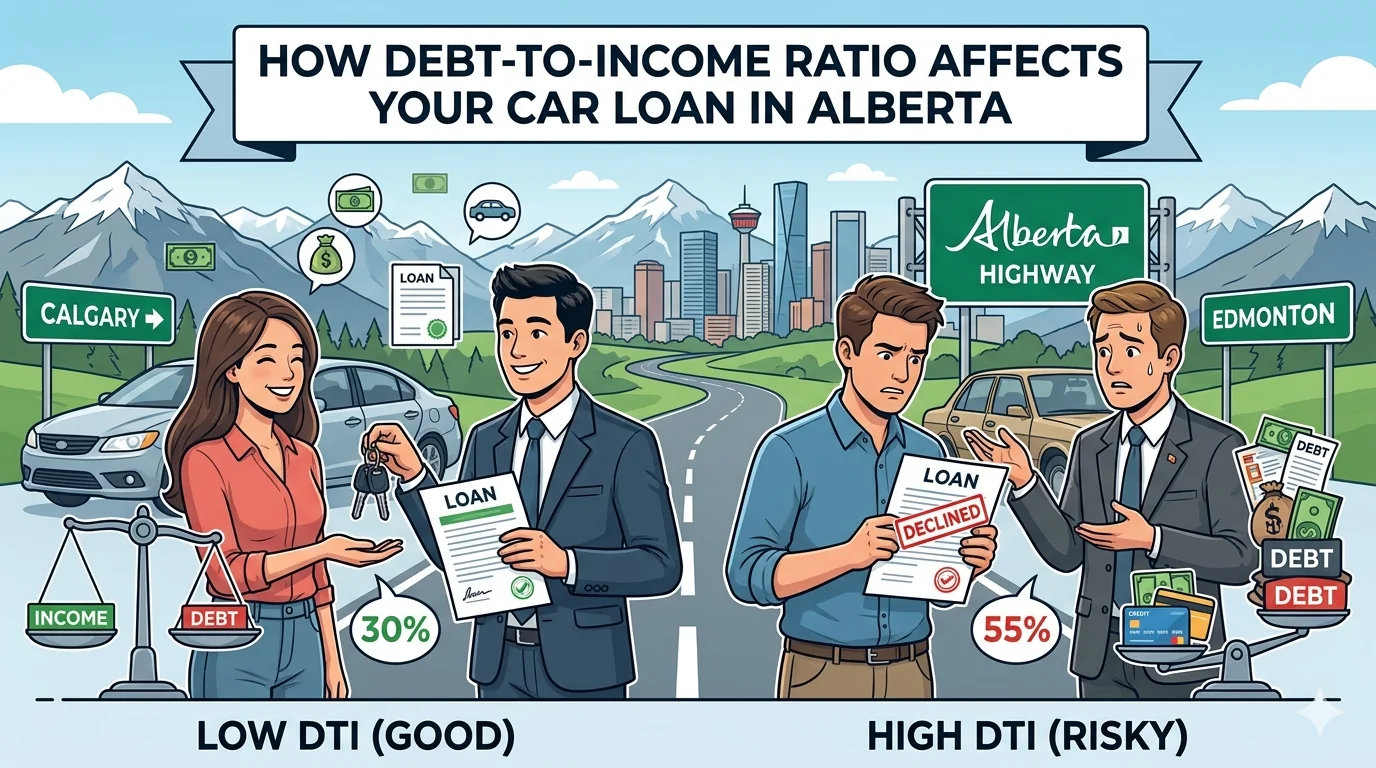
Income and Debt-to-Income Ratio
At $55,000/year, your gross monthly income is approximately $4,583. Lenders typically want total debt payments (including the car loan) to sit below 40–45% of gross income. Your student loan payment at $42,000 over 10 years at 5.5% is roughly $455/month. That leaves approximately $1,600–$1,650 of your monthly debt capacity for a car payment — though keeping it under $1,000 is smarter if you want financial breathing room.
A $20,000 car loan at 11.99% over 84 months is approximately $165 biweekly. Add $120–$160 for insurance. Fuel at 1,200 km/month in a Corolla: roughly $90/month. Total all-in transportation cost: approximately $660–$700/month. That's manageable on a $55,000 income — especially if you're not carrying expensive rent.
Credit Score and First-Time Buyer Reality
New grads often have thin credit files — not bad credit, just not much history. A student credit card or an OSAP/Alberta Student Loan counts for something, but you may not have a robust credit profile yet. Here's what to expect:
- Credit score 660+: Near-prime or prime financing. Rates from 6.99–12.99% depending on lender and term. Strong approval odds.
- Credit score 600–659: Near-prime. Rates typically 10.99–17.99%. Approval likely with clean income documentation.
- Credit score 500–599: Subprime range. Rates 17.99–24.99%. More lenders will want a down payment. Still very much workable — this is our specialty.
- Thin file (no derogatory marks, just limited history): Often treated similarly to near-prime. A first-time buyer lender may be the right fit.
Our first-time car buyer program is built specifically for situations like this. We work with lenders who understand that a thin file isn't the same as a bad file — and who price their rates accordingly.
How Your First Car Loan Builds Credit
This is something new grads often don't think about, but it's genuinely important: a car loan is one of the most effective credit-building tools available to you. Here's how it works in practice.
Payment history makes up roughly 35% of your Equifax credit score. A car loan that you pay on time, every two weeks, for 60 or 72 months generates approximately 130–180 on-time payment records. Each one is a positive mark. Within 12–18 months of consistent payments, most borrowers with thin files see their credit score climb 40–80 points — sometimes more.
This matters because your credit score at age 28 will affect your mortgage rate. A 60-point improvement on your score could translate to a lower rate on a $400,000 home purchase — that's potentially tens of thousands of dollars over a 25-year amortization. The car loan that seemed like a burden at 23 becomes a credit foundation at 28.
Read more about exactly how this works in our detailed guide on how car payments build your credit score and the credit-building benefits of a first car loan. There's also a longer-format guide on the timeline for credit score improvement from a car loan that's worth reading before you apply.
Balancing Student Loan Debt with a Car Payment
The math can feel overwhelming: student loan, car payment, rent, groceries, and you're trying to also save something. Here's a framework that actually works:
The 15% Transportation Rule
Keep your total transportation costs — car payment, insurance, fuel, and an estimated $100/month for maintenance — under 15% of your gross monthly income. At $55,000/year, that's $687/month. At $65,000/year, it's $812/month. These aren't rigid limits, but they're a useful guardrail.
Down Payment Strategy
Every dollar of down payment reduces your loan amount and therefore your rate risk. If you have $2,000–$3,000 in savings, putting it down on a car loan is often better than keeping it liquid — especially if your interest rate is above 10%. A $3,000 down payment on a $20,000 loan at 12.99% saves you roughly $1,200 in total interest over 72 months.
That said, don't wipe out your emergency fund. Three months of expenses should be untouchable. Down payment money comes from surplus savings, not from your buffer.
Term Length and the Career Trajectory Consideration
New grads often have salary growth ahead of them that their current income doesn't reflect. A 72- or 84-month term keeps payments low now — and you can always make extra payments or refinance at a better rate in 18–24 months once you've built a payment history and possibly received a raise. Don't lock yourself into a shorter term that strains your budget in year one just to save interest in year four.
Does Your Car Affect Your Career Opportunities in Alberta?
This sounds like a strange question, but in Alberta specifically, the answer is genuinely yes — particularly in sectors like energy, construction, and agriculture. Many entry-level roles outside of Calgary and Edmonton's urban cores require you to drive to sites, client locations, or remote offices. Not having a reliable car limits your job options more than most people realize at graduation.
The Airdrie and Calgary corridor is a good example. Many companies based in Airdrie are not accessible by transit at reasonable hours. Carpooling works until it doesn't — when someone moves, leaves the company, or changes shifts, you're suddenly scrambling. A reliable car at the start of your career is an investment in your ability to take opportunities, not just get to the job you already have.
Field roles — environmental science, engineering technicians, healthcare delivery, social work — often require a vehicle as a condition of employment. In those fields, not having a car isn't an option at all.
Insurance Costs by Vehicle: New Grad Reality
Alberta insurance is calculated per driver, not just per vehicle — your driving history, age, and claims record all factor in. As a new grad with limited driving history, expect to pay more than an experienced driver in the same vehicle. Here's what new grads typically see in the Calgary-Airdrie area:
| Vehicle | Estimated Monthly Insurance (New Grad, Clean Record) |
|---|---|
| Toyota Corolla (2018–2020) | $105–$145 |
| Honda Civic LX (2018–2021) | $110–$155 |
| Hyundai Elantra (2018–2021) | $100–$140 |
| Mazda3 (2019–2021) | $115–$160 |
| Kia Forte (2019–2021) | $105–$145 |
| Honda Civic Si | $185–$260 |
| VW GTI | $195–$280 |
The spread between a sensible compact and a sporty variant can be $80–$150/month — over $1,000/year. That's real money that could go toward student loan payments instead. Make the boring choice now; drive the interesting car in year five when you can actually afford to insure it.
Practical Steps: How to Buy Your First Car as an Alberta New Grad
- Pull your credit report first. Know your score before you walk into any dealership. Free through Borrowell or Credit Karma. Surprises at the desk are never good.
- Calculate your actual maximum payment. Gross monthly income × 15% = total transportation budget. Subtract estimated insurance and $100 for maintenance. What's left is your maximum car payment.
- Get pre-qualified before you shop. Our application takes a few minutes and tells you what you're working with before you fall in love with a car you can't qualify for.
- Prioritize reliability tier above your budget ceiling. Buy the best-maintained, lowest-mileage Corolla, Civic, or Elantra your budget allows. Resist the temptation to stretch for a more exciting car that comes with unknown maintenance history.
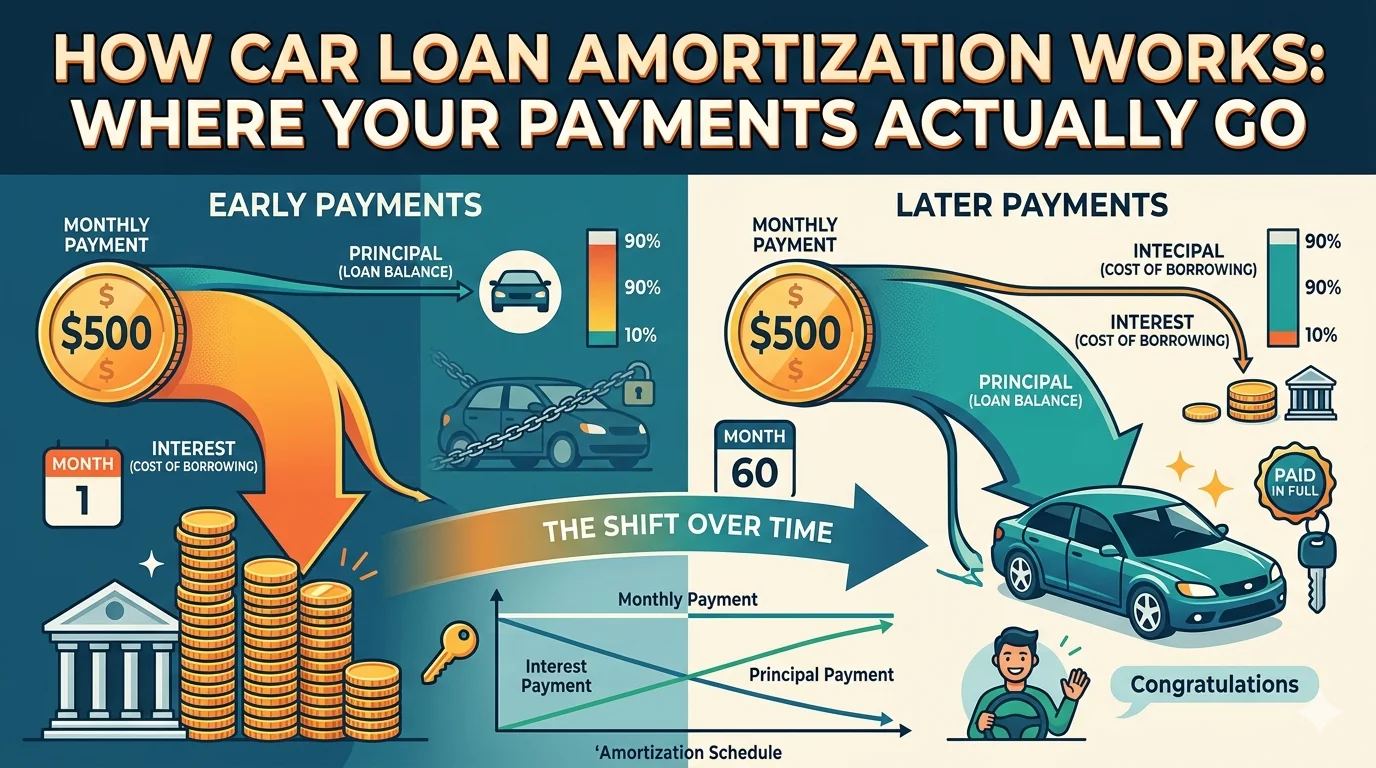
- Ask about total cost of borrowing, not just monthly payment. A longer term has a lower payment but more total interest. Know both numbers.
- Get a pre-purchase inspection on any used car. $100–$150 for a third-party mechanic inspection. Non-negotiable on a private sale; worth doing on dealer purchases too.
If you're ready to start the process, apply for financing here — our team will review your situation and match you with lenders suited to your credit and income profile. We work with options for first-time buyers regardless of credit history, and we're transparent about rates and terms upfront.
Dealer vs Private Sale: What New Grads Should Know
You'll find used Corollas and Civics on Facebook Marketplace for $2,000–$4,000 less than dealer prices. That gap is real and it's tempting. Here's the honest trade-off for a new grad:
Private Sale Advantages
- Lower purchase price — the savings are genuine, not illusory
- No dealer fees or admin charges
- More room to negotiate based on vehicle condition
Private Sale Risks for First-Time Buyers
- No financing from a private seller. You need cash or a pre-approved bank/credit union loan. If you have a thin credit file, your bank may not approve you, or may approve a lower amount than you need — limiting your options to cheaper, older, higher-mileage vehicles.
- No consumer protections. Private sales in Alberta are "as-is." If the transmission fails two weeks after you drive it home, there is no recourse. You bear all the risk.
- No AMVIC oversight. Alberta's Motor Vehicle Industry Council regulates licensed dealerships but has no authority over private sellers. A dealer who misrepresents a vehicle faces real consequences; a private seller faces much less.
- You need a mechanic inspection you trust. Non-negotiable on a private sale. Budget $100–$150 for a third-party inspection and walk away from any seller who refuses.
For a new grad with a thin credit file and limited mechanical knowledge, the dealer route — with its financing access, inspection history, and consumer protection coverage — often makes more practical sense even at a higher sticker price. The $3,000 you "save" on a private sale can disappear in a single repair bill on an undisclosed problem.
What to Look for When Inspecting a Used Compact Car
Whether you buy from a dealer or private seller, knowing what to check saves you from expensive mistakes. Here's a new-grad-friendly inspection checklist for used compacts:
Before the Test Drive
- Run a CarFax or AutoCheck report. $40 well spent — shows accident history, odometer rollbacks, and past ownership count.
- Check all four tires for even tread wear. Uneven wear often signals alignment or suspension issues.
- Look for paint overspray around door seals and under the hood — evidence of bodywork after a collision.
- Check under the car for rust, particularly on the frame rails, exhaust, and subframe. Alberta roads use salt and calcium chloride in winter — rust progression is real.
- Open and close all doors, windows, and the trunk. Gaps or stiffness can indicate previous frame damage.
During the Test Drive
- Cold start the engine. It should start immediately without smoke or excessive noise. Smoke on cold start suggests oil burning — expensive.
- Brake firmly at highway speed. The car should stop straight with no pulling. Pulling suggests a brake caliper or rotor issue.
- Accelerate hard through all gears (or all CVT ranges). Hesitation, shuddering, or slipping suggests drivetrain issues.
- Listen for clunks or rattles over bumps — suspension wear in Canadian climates is normal on high-mileage vehicles.
- Check that all tech works: Bluetooth, backup camera, climate control. These seem minor but are expensive to fix on used vehicles.
After the Test Drive
- Re-check the oil dipstick when the engine is warm. Low oil or milky/grey oil (coolant contamination) are red flags.
- Ask for full service records. Corollas and Civics with documented maintenance history are worth a $1,000–$2,000 premium over undocumented equivalents.
Use our payment calculator to stress-test your budget against different vehicle prices before you finalize — knowing your comfortable payment ceiling before negotiating prevents emotional overspending at the desk.
First-Time Financing Programs in Alberta
Several lenders in our network offer programs specifically designed for first-time buyers and thin-file applicants. These aren't charity programs — they're products built around the reality that new grads and young professionals are higher earning potential borrowers, not high-risk ones, and some lenders price that correctly.
What first-time buyer programs typically offer:
- Approval with limited credit history (as few as 6 months of any credit activity)
- Rates that reflect income and stability rather than just score
- Flexibility on down payment when employment is stable and verifiable
- Credit reporting to both bureaus from day one of the loan
The key is having documentation ready: your offer letter or recent pay stubs, SIN card, proof of address, and your void cheque or direct deposit info. The more organized you are going in, the faster and smoother the approval process runs.
Remember: Your first car loan is a credit-building exercise as much as a transportation solution. Choose a vehicle that keeps payments manageable so you never miss one — a perfect payment history over 60 months is worth more to your financial future than a nicer car today.
You're starting from scratch, and that's fine. Alberta's economy rewards mobile, reliable workers — having a car you can depend on is part of being that person. Start with the right vehicle, keep the payments consistent, and the rest of the financial picture gets easier from there.
Compare and Apply
- Complete Bad Credit Car Buying Guide (Alberta) — Alberta car buying guide for all credit situations
Financing Resources
Related Articles

Ready to Find Your Vehicle?
Browse our inventory or apply for financing. All credit situations welcome.
★★★★★ 114+ Google Reviews · AMVIC Licensed · Free Delivery 300km