
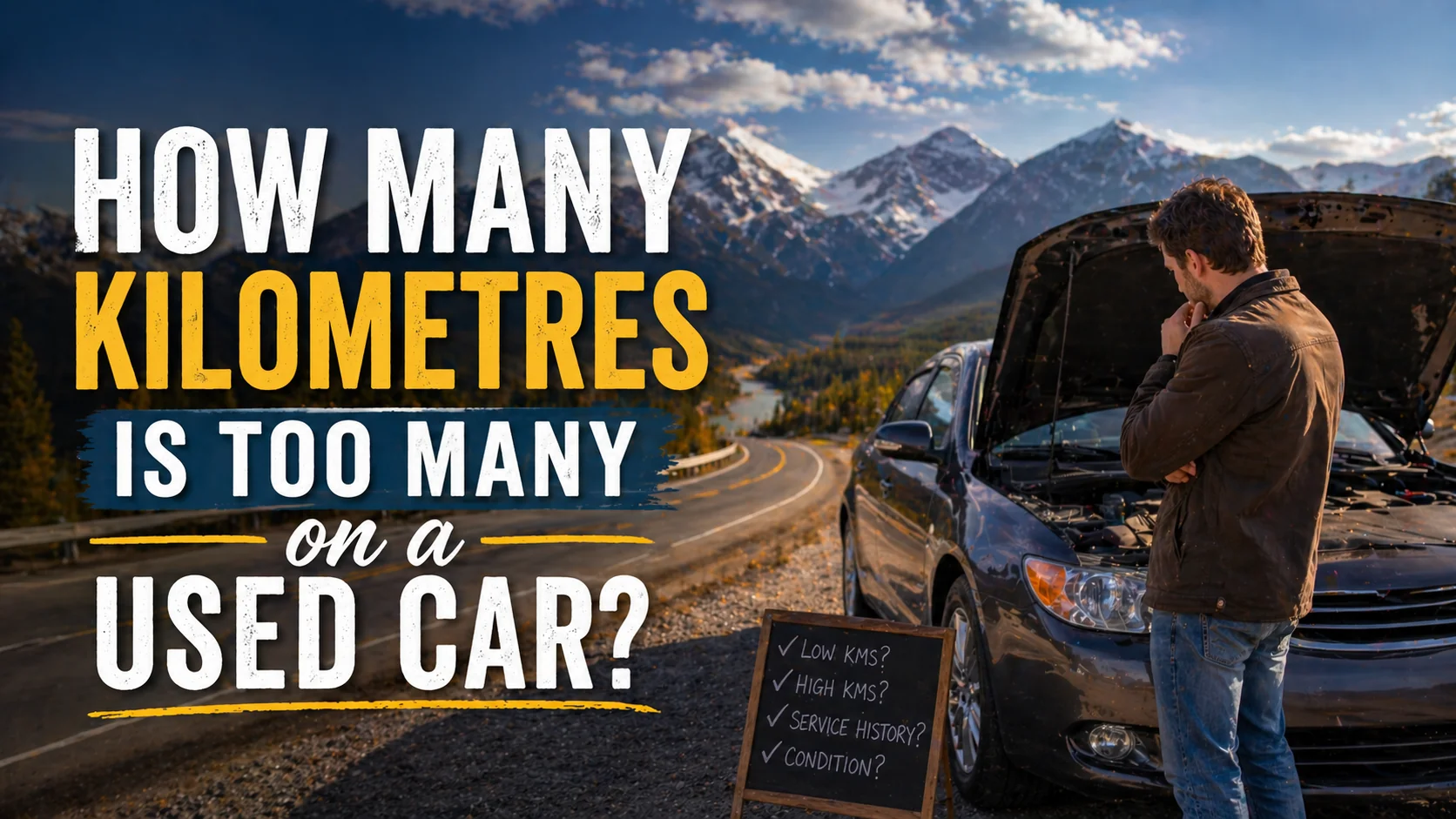
How Many Kilometres Is Too Many on a Used Car?
In this article
- Why the "Maximum km" Rule Misses the Point
- Highway Kilometres vs. City Kilometres: A Real Difference
- Highway Driving
- City Driving
- Breakdown by Vehicle Category: How Many Km Is Actually Too Many?
- Sedans and Compact Cars
- Trucks
- SUVs and Crossovers
- Minivans
- The Financial Case for High-Kilometre Vehicles
- What to Inspect on a High-Kilometre Vehicle
- Oil and Fluids
- Engine Sounds
- Transmission Behaviour
- Suspension and Steering
- Brakes
- Rust and Frame
- High-Kilometre Vehicles and Alberta Financing
- Lender Mileage Limits
- Loan Terms and Amounts
- Insurance Considerations
- Decision Matrix: Should You Buy This High-Km Vehicle?
- Extending the Life of Your High-Kilometre Purchase
- The Bottom Line on Kilometres
- Related Buyer Guides
- Compare and Apply
Check Your Options in 3 Minutes
No credit impact. All credit situations welcome.
★★★★★ 106+ Google Reviews · AMVIC Licensed · Free Delivery 300km
Someone tells you they found a great deal on a used Toyota Corolla — 230,000 km, one owner, clean history. Your first instinct might be to say "that's way too many kilometres." But is it? The honest answer is: it depends, and the blanket "no more than 150,000 km" rule people throw around is costing Alberta buyers real money by steering them away from perfectly solid vehicles.
Kilometres are a proxy for wear — but they're a crude one. A pickup that spent eight years on gravel roads in Fort McMurray has lived a very different life than a sedan that logged 200,000 km mostly on the QE2 between Calgary and Edmonton. Understanding what the odometer actually tells you — and what it doesn't — can help you find vehicles that are undervalued precisely because buyers are afraid of the number.
See what you pre-qualify for
Three quick answers — soft check, no commitment.
Why the "Maximum km" Rule Misses the Point
The idea that used cars become unreliable past a certain odometer reading is a holdover from an era when vehicles genuinely did wear out faster. Modern engines, transmissions, and materials are built to tolerances that simply didn't exist 30 years ago. A 2012 Honda Civic with 280,000 km and full service records is a more reliable buy than a 2018 Civic with 80,000 km and no documented maintenance.
The variables that actually predict longevity are maintenance history, driving conditions, and vehicle type — not the number alone. Kilometres without context are like a patient's age without their health history. Useful, but far from the whole picture.
Key insight: A well-maintained vehicle at 250,000 km is almost always a better buy than a neglected one at 100,000 km. The odometer tells you how far it's gone — not how well it was treated along the way.
Highway Kilometres vs. City Kilometres: A Real Difference
Not all kilometres are created equal, and this distinction matters enormously when evaluating a high-mileage vehicle.
Highway Driving
Highway kilometres are genuinely easier on a vehicle. Consistent speeds reduce wear on brakes and transmission. The engine runs at a steady operating temperature, which is ideal for combustion efficiency and oil distribution. A vehicle that accumulated most of its kilometres commuting 45 minutes each way on Highway 2 has experienced a fundamentally different mechanical life than one grinding through rush hour in northeast Calgary every day.
City Driving
Stop-and-go traffic is hard on virtually every major system. Brakes wear faster. The transmission cycles through gears constantly. The engine never quite reaches optimal operating temperature on short trips, which means incomplete combustion and oil contamination over time. Components like starters, alternators, and cooling systems work harder in city conditions.
When you see a high-km vehicle for sale, ask directly: where were those kilometres driven? A seller who knows their vehicle's history will usually be able to tell you. If the answer is primarily highway driving between two Alberta cities, the mechanical wear may be substantially less than the odometer suggests.
Breakdown by Vehicle Category: How Many Km Is Actually Too Many?
Different vehicles age differently. Here's a realistic look at what's achievable — and what you should expect — across the major categories.
Sedans and Compact Cars
Japanese sedans are the gold standard for high-mileage value. Toyota Corollas and Camrys routinely run to 400,000+ km with proper maintenance. Honda Civics and Accords are similarly capable. If you're buying a well-maintained Japanese sedan with 250,000 km, you're likely looking at a car that still has many kilometres left — at a price that reflects buyer fear more than mechanical reality.
Korean brands have improved dramatically since 2012. A Hyundai Elantra or Kia Forte from 2015 onward with documented service is a reasonable buy past 200,000 km. Pre-2012 Korean vehicles are more variable — the manufacturing quality gaps were real. European sedans (BMW, Audi, Mercedes) require more caution at high mileage; complex electronics and expensive parts mean that 200,000 km on a German vehicle carries more financial risk than the same number on a Japanese one.
Trucks
Half-ton trucks built for work are engineered to last. A Ford F-150 with a 5.0L V8 or 3.5L EcoBoost, maintained properly, can genuinely reach 400,000–500,000 km. Ram 1500 Hemi engines are known for similar durability. Chevy Silverado 5.3L V8s are among the most proven powerplants in North America.
The caveat with trucks is how they were used. A farm truck that spent years hauling heavy loads on rough terrain will show different wear patterns than a work truck that drove highway kilometres for a trades company. Inspect the frame, suspension components, and towing-related hardware carefully. Trucks that were used hard need more scrutiny — but trucks that were maintained well are often the best high-km value on the market.
SUVs and Crossovers
Body-on-frame SUVs (4Runner, older Tahoe, Jeep Wrangler) share their durability with trucks and can often hit 300,000+ km. Unibody crossovers like the Honda CR-V, Toyota RAV4, and Mazda CX-5 are also capable of 250,000–300,000 km with proper care, though their all-wheel-drive systems add a maintenance variable to monitor.
Luxury SUVs — BMW X5, Audi Q5, Mercedes GLC — need the same caution as their sedan counterparts. The engineering is excellent, but when things go wrong at high mileage, repair costs can be significant. A 200,000 km BMW X5 at a low price might look attractive until you factor in the probability of upcoming repairs.
Minivans
Often overlooked, minivans are exceptional high-mileage buys. The Toyota Sienna and Honda Odyssey are built with the same reliability DNA as their sedan counterparts. 250,000–300,000 km on a well-maintained Sienna is entirely reasonable. Dodge Grand Caravans are less capable but were sold in such high volume that finding a good example with service records is not difficult.
The Financial Case for High-Kilometre Vehicles
Here's where the opportunity becomes concrete. Let's compare two identical 2018 Toyota RAV4s:
| Spec | Vehicle A | Vehicle B |
|---|---|---|
| Kilometres | 95,000 km | 195,000 km |
| Price | $26,500 | $17,500 |
| Service History | Partial records | Full records, highway driven |
| Remaining potential km | ~155,000 (to 250K) | ~55,000 (to 250K) |
| Cost per remaining km | ~$0.17/km | ~$0.32/km |
On a pure remaining-kilometre basis, Vehicle A wins. But if Vehicle B is genuinely highway-driven with a documented maintenance history, it may reach 300,000+ km — flipping the math entirely. The point isn't that high-km vehicles are always the better deal; it's that the decision requires actual analysis rather than a reflexive odometer cutoff.
High-kilometre vehicles also tend to depreciate more slowly. A car that's already priced low has less room to fall. If you need to sell in two years, you're not absorbing the steepest part of the depreciation curve.
For buyers working with a tighter budget, used vehicles under $15,000 in the Airdrie area often include well-maintained higher-km examples that represent genuine value — if you know how to evaluate them properly.
What to Inspect on a High-Kilometre Vehicle
A thorough inspection is non-negotiable on any used vehicle, but it's especially important past 150,000 km. Use our complete used car inspection checklist for a detailed walkthrough. Here are the highest-priority items specific to higher-mileage vehicles:
Oil and Fluids
Pull the oil dipstick. Clean, amber oil is a good sign. Dark but clean oil just means it's due for a change — normal. Milky or frothy oil suggests coolant contamination, which indicates a head gasket problem. Check the coolant reservoir for signs of oil in the coolant (dark streaks or oily residue). Check power steering fluid, brake fluid, and transmission fluid levels and condition.
Engine Sounds
Start the vehicle cold if possible. A healthy engine should start readily and settle into a smooth idle within 30 seconds. Listen for ticking (valve train wear), knocking (rod bearing wear — serious), or a rough idle that persists. Rev the engine briefly and listen. Blue smoke from the exhaust on startup suggests worn piston rings or valve stem seals. White smoke can indicate coolant burning, especially if it smells sweet.
Transmission Behaviour
Drive through all gears. Automatic transmissions should shift smoothly and respond promptly. Hesitation, hard shifts, or a feeling of the transmission "hunting" for the right gear are warning signs. Manual transmissions shouldn't slip or grind between gears. Check for transmission fluid leaks under the vehicle — a small drip can escalate quickly.
Suspension and Steering
On a test drive, find a quiet parking lot and turn the steering wheel lock to lock at low speed. Clicking or grinding sounds from the front end suggest CV joint wear — common on higher-km front-wheel-drive vehicles. Drive over a speed bump and listen for clunking, which indicates worn ball joints or control arm bushings. The vehicle should track straight on a flat road without pulling.
Brakes
Apply the brakes firmly at 40 km/h. The vehicle should stop in a straight line without pulling. Vibration through the pedal usually means warped rotors. Squealing is often just glazed pads. Grinding is metal-on-metal contact — the rotors need immediate attention. Check the brake fluid reservoir; very dark fluid suggests it hasn't been changed in years.
Rust and Frame
Alberta winters mean road salt, and road salt means rust. Surface rust on body panels is cosmetic. Structural rust on frame rails, subframes, or around suspension mounting points is a different matter. Get under the vehicle or use a flashlight to check. Rust-through on structural components is a deal-breaker regardless of how good the engine sounds.
Pro tip: Budget $150–200 for a pre-purchase inspection from an independent mechanic. On a $15,000 vehicle, that's 1% of the purchase price for an informed decision. It's the best money you can spend on a used vehicle purchase.
High-Kilometre Vehicles and Alberta Financing
Financing a high-mileage vehicle in Alberta involves some specific considerations that buyers should understand before they start shopping.
Lender Mileage Limits
Most lenders have odometer thresholds that affect whether they'll finance a vehicle and at what terms. Common cutoffs range from 150,000 to 200,000 km, though this varies by lender and vehicle type. Some lenders will finance up to 250,000 km on certain vehicle types. Our high-mileage car financing page covers this in detail — working with a multi-lender dealership gives you access to lenders whose programs accommodate higher-km vehicles that traditional banks decline outright.
Loan Terms and Amounts
Lenders typically offer shorter maximum terms on high-mileage vehicles — 48 or 60 months rather than 72 or 84. This protects them against the vehicle's value declining faster than the loan balance. For you as a buyer, shorter terms mean higher biweekly payments but less total interest paid.
For example: a $12,000 loan on a high-mileage vehicle at 14.99% over 48 months works out to approximately $155 biweekly. The same loan over 60 months would be around $128 biweekly — but you'd pay nearly $1,400 more in interest over the life of the loan.
Insurance Considerations
High-kilometre vehicles are generally cheaper to insure because their replacement value is lower. Alberta insurance rates are based partly on vehicle value — a $10,000 vehicle costs less to insure for collision and comprehensive than a $30,000 vehicle. If you're dropping to liability-only coverage on a vehicle with no outstanding loan, the annual savings can be substantial. Check with your insurer about the threshold where dropping comprehensive coverage makes sense financially.
Decision Matrix: Should You Buy This High-Km Vehicle?
Use this matrix to evaluate any high-kilometre vehicle you're considering:
| Factor | Green Light | Yellow Light | Red Light |
|---|---|---|---|
| Service Records | Full records, regular intervals | Partial records or receipts | No records, "just maintained it" |
| Km Type | Primarily highway | Mixed highway/city | Heavy city or off-road use |
| Vehicle Type | Japanese sedan or half-ton truck | Korean/American sedan, body-on-frame SUV | European luxury, complex AWD systems |
| Engine/Trans Condition | Clean, no leaks, smooth operation | Minor leaks, slight rough idle | Knocking, smoke, slipping trans |
| Frame/Rust | Surface rust only | Some pitting, no structural involvement | Structural rust-through |
| Pre-Purchase Inspection | Clean bill from independent mechanic | Minor items noted, priced accordingly | Major items found, seller won't negotiate |
| Price vs Market | 15–25% below similar lower-km examples | 10–15% below market | Priced same as lower-km examples |
A vehicle that scores mostly green across these factors is worth serious consideration regardless of the odometer reading. Mostly red means walk away, regardless of price.
Extending the Life of Your High-Kilometre Purchase
If you do buy a higher-mileage vehicle, the maintenance practices that kept it running this long need to continue. Our Alberta vehicle maintenance guide has the full breakdown, but the priorities for high-km ownership are:
- Oil changes on schedule. Every 5,000–8,000 km with synthetic oil, or per the manufacturer's specification. On a high-km engine, fresh oil is the cheapest insurance you can buy.
- Cooling system maintenance. Flush coolant every 5 years or 150,000 km. Older coolant becomes acidic and attacks aluminum components — a particular concern on aging engines.
- Transmission fluid. Many manufacturers list transmission fluid as "lifetime" — that lifetime ends around 150,000 km regardless of what the manual says. A transmission fluid service ($150–300) can add years to an aging gearbox.
- Timing belt/chain inspection. If the vehicle has a timing belt and you don't have records of when it was last replaced, budget for it immediately. A snapped belt can destroy an otherwise good engine.
For a more detailed look at keeping a high-mileage vehicle running, read our post on extending the life of a high-mileage vehicle in Alberta. The most reliable used cars in the world are only as reliable as the maintenance they receive — a truth that applies whether the odometer shows 80,000 km or 280,000 km. Check the most reliable used cars and what to maintain to understand which models hold up best over the long haul.
The Bottom Line on Kilometres
There is no universal answer to "how many kilometres is too many on a used car." The right number depends on the vehicle type, its maintenance history, how those kilometres were driven, and what price it's being offered at. A blanket cutoff ignores all of that context and leads buyers to pay premiums for low-km vehicles with unknown histories — or miss genuinely solid buys because an arbitrary number looked too high.
The disciplined approach: focus on condition over kilometres, verify the maintenance history, get a pre-purchase inspection, and let the price reflect the vehicle's actual remaining useful life rather than the fear a large number generates.
If you're in the Airdrie area and want guidance on evaluating specific vehicles, we're happy to help you think through any particular unit you're considering. And when you're ready to move forward, check your financing options — we work with lenders who understand high-mileage vehicles and can structure deals that make sense for the vehicle's actual value, not just its odometer reading.
Compare and Apply
- Bad Credit Financing — Complete Guide — financing for low credit scores
Financing Resources
Related Articles

Ready to Find Your Vehicle?
Browse our inventory or apply for financing. All credit situations welcome.
★★★★★ 106+ Google Reviews · AMVIC Licensed · Free Delivery 300km