
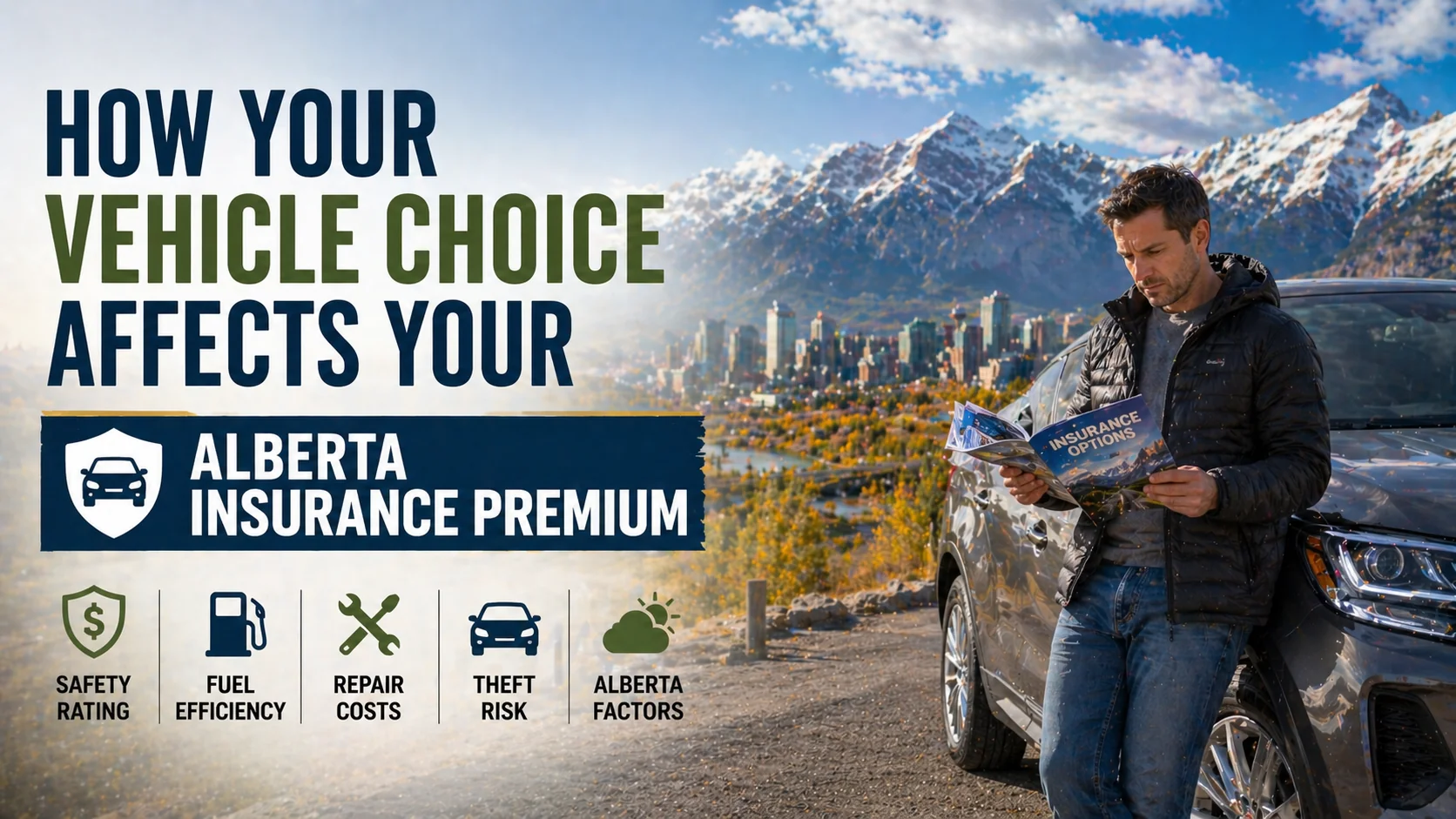
How Your Vehicle Choice Affects Your Alberta Insurance Premium
In this article
- How Alberta Auto Insurance Rates Are Calculated
- 1. Vehicle Age and Depreciation
- 2. Safety Ratings and Claims History
- 3. Theft Rate by Vehicle Model
- 4. Repair Cost and Parts Availability
- 5. Engine Size and Performance Profile
- Cheapest vs Most Expensive Vehicle Categories to Insure in Alberta
- Lowest Insurance Cost — General Categories
- Highest Insurance Cost — General Categories
- The Honda Civic vs Dodge Charger: A Real Numbers Example
- New vs Used: How Vehicle Age Affects Insurance Cost
- How Financing Affects Your Insurance Requirements
- Multi-Vehicle Discounts and How to Stack Savings
- Teen Driver Considerations
- How Your Driving Record Interacts With Your Vehicle Choice
- Specific Alberta Insurance Considerations
- Alberta's Grid Rate System
- Direct Compensation Property Damage (DCPD)
- Seasonal Vehicles and Snowmobile Insurance
- Looking Up a Vehicle's Insurance Profile Before You Buy
- What Alberta's Cheapest-to-Insure Vehicles Have in Common
- Putting It All Together Before You Buy
- Related Buyer Guides
- Compare and Apply
Check Your Options in 3 Minutes
No credit impact. All credit situations welcome.
★★★★★ 106+ Google Reviews · AMVIC Licensed · Free Delivery 300km
You've narrowed it down to two vehicles: a 2019 Honda Civic and a 2019 Dodge Charger. Both fit your budget. Both are available in your area. Both look great. Then you call your insurance broker — and suddenly the Charger costs $1,800 more per year to insure than the Civic, before you've even driven it off the lot. That's not a random number. It's the result of specific, predictable rating factors that every insurer uses. Understanding those factors before you buy is one of the highest-leverage financial decisions you can make as a vehicle owner in Alberta.
See what you pre-qualify for
Three quick answers — soft check, no commitment.
How Alberta Auto Insurance Rates Are Calculated
Alberta uses a regulated but not government-run insurance model. Private insurers set their own rates within AIRB (Alberta Insurance Rate Board) guidelines. This means your premium reflects your personal driving history AND the statistical risk profile of the specific vehicle you drive. Unlike some provinces, Alberta does not have a public insurer — your rate is the sum of your risk plus your vehicle's risk.
The vehicle-specific factors that affect your premium break down into five categories. Every one of them is knowable before you buy.
1. Vehicle Age and Depreciation
Newer vehicles cost more to insure for comprehensive and collision coverage because their replacement value is higher. A 2023 vehicle costs more to replace than a 2016 one. But there's a breakeven point — typically around 8-12 years old — where the vehicle's market value drops low enough that comprehensive and collision coverage no longer makes financial sense. At that point, you might carry liability-only, which dramatically lowers your premium. This is why buying a used vehicle that's 4-7 years old can hit a sweet spot: lower purchase price than new, meaningful depreciation from peak values, but still valuable enough that the vehicle is worth protecting.
2. Safety Ratings and Claims History
Insurers track their historical claims data by vehicle model. A vehicle with a poor IIHS (Insurance Institute for Highway Safety) rating or NHTSA star rating has statistically higher injury claims per collision — and insurers price this in. More importantly, insurers track medical payment claims, liability claims, and collision repair costs per model. Vehicles with structurally complex frames (high-strength steel with specialized repair requirements), vehicles with expensive sensors embedded in bumpers and mirrors, and vehicles with aluminum body panels all cost more to repair after a collision — and that cost flows into your premium.
3. Theft Rate by Vehicle Model
This is where many buyers get surprised. Insurers access the IBC (Insurance Bureau of Canada) annual stolen vehicle list, which tracks theft rates by make, model, and year. Some vehicles are stolen dramatically more often than others — and if your model is on a high-theft list, your comprehensive rate reflects it. The IBC's most stolen vehicles in Canada consistently include specific pickup trucks (certain Ford F-150 and Ram 1500 configurations), Honda Civic/CR-V models (because older examples lack modern immobilizers and there's a massive parts market), and Lexus luxury SUVs. A Honda Civic from 2009-2015 carries higher theft premiums than you'd expect from a modest sedan because of this history.
Newer vehicles with factory immobilizers and GPS tracking have better theft profiles. If theft rates are a concern, ask your insurer for the theft rating of any vehicle you're considering before you buy.
4. Repair Cost and Parts Availability
Two vehicles with identical market values can have dramatically different repair costs. German luxury vehicles — BMW, Audi, Mercedes — require proprietary diagnostic equipment, dealer-certified technicians, and OEM parts that cost 2-3x equivalent Japanese-brand parts. A Dodge Charger with a modified exhaust and aftermarket wheels signals to insurers (and to adjusters) a profile associated with higher-speed driving and more frequent collision claims. Vehicles with basic, widely available parts (Honda, Toyota, Hyundai) are cheaper to repair and cheaper to insure.
Increasingly, vehicles with Advanced Driver Assistance Systems (ADAS) — cameras in bumpers, radar in grilles, sensors in mirrors — cost dramatically more to repair after even minor collisions. A front-end collision that was a $1,200 bumper replacement in 2015 is a $4,500+ repair today if the bumper contains a radar sensor that needs recalibration. Insurers have already repriced for this reality.
5. Engine Size and Performance Profile
High-performance vehicles — V8 engines, turbocharged muscle cars, sports car configurations — carry surcharges because their claims history shows higher-speed accidents and more severe collision outcomes. A Dodge Charger R/T with a 5.7L HEMI attracts a meaningfully different premium than a Charger SXT with a 3.6L V6, even at the same vehicle age and market value. Engine displacement is a direct rating factor with most Alberta insurers.
Cheapest vs Most Expensive Vehicle Categories to Insure in Alberta
Lowest Insurance Cost — General Categories
- Compact sedans and hatchbacks with good safety ratings — Toyota Corolla, Hyundai Elantra, Kia Forte, Mazda3. Low theft rates, cheap parts, excellent safety ratings, low engine displacement.
- Minivans — Statistically lowest accident rate of any vehicle type. Drivers of minivans are disproportionately parents with children in the vehicle — the safest demographic on the road. Chrysler Pacifica, Honda Odyssey, Toyota Sienna all rate well.
- Basic crossovers with standard 2.0-2.5L engines — RAV4, CR-V, Hyundai Tucson. AWD adds slightly, but the profile is still moderate overall.
Highest Insurance Cost — General Categories
- Performance/muscle cars — Dodge Charger, Dodge Challenger, Ford Mustang, Chevrolet Camaro. High theft rates, high-speed claim history, expensive performance parts.
- German luxury vehicles — BMW 3/5 Series, Audi A4/Q5, Mercedes C/E Class. Repair costs dominate the premium calculation.
- Pickup trucks (full-size, newer) — High theft rates on newer Ram and F-150 models, expensive ADAS-equipped bumpers, large repair bills after collisions.
- Sports cars — Subaru WRX/STI, Mazda Miata, Ford Mustang. Performance profile drives surcharges.
The Honda Civic vs Dodge Charger: A Real Numbers Example
Let's make this concrete. A 34-year-old driver with a clean driving record in Calgary, financing a vehicle (so comprehensive and collision is required by the lender), comparing a 2019 Honda Civic LX and a 2019 Dodge Charger SXT.
| Factor | 2019 Honda Civic LX | 2019 Dodge Charger SXT |
|---|---|---|
| Market value | ~$19,000 | ~$24,000 |
| Engine | 1.5L turbo 4-cyl | 3.6L V6 |
| IBC theft rating | Moderate | Lower (newer) |
| IIHS rating | Top Safety Pick+ | Acceptable |
| Typical annual premium | ~$1,900-2,400 | ~$2,900-3,800 |
| 5-year premium difference | — | ~$5,000-7,000 more |
The 5-year premium gap roughly equals the vehicle price difference. In other words, the Charger doesn't just cost more to buy — it costs about the same amount more to insure over its ownership life. That's a real financial variable that belongs in your total cost calculation before you buy, not after.
For a comprehensive look at how to calculate all the costs of vehicle ownership, our guide on total cost of car ownership in Alberta walks through insurance, fuel, maintenance, and financing together.
New vs Used: How Vehicle Age Affects Insurance Cost
The general pattern: newer vehicles cost more to insure for comprehensive and collision because they're worth more to replace. But this isn't linear. A 2020 vehicle costs meaningfully more to insure than a 2016, but a 2024 costs less than you might expect over a 2023 because safety technology on the newest models genuinely reduces collision frequency — and insurers are beginning to reflect this in pricing.
Used vehicles between 4-8 years old typically hit the insurance sweet spot: enough depreciation from peak values to lower your comprehensive/collision costs, modern enough to have standard safety features (backup cameras, stability control, lane keeping assist), and old enough that premium repair parts aren't at maximum cost.
If you're comparing a new vehicle lease versus buying used, run your insurance numbers both ways before deciding. The sticker price difference is visible; the insurance difference over 4 years is not until you calculate it explicitly. Our guide to reliable used cars under $10,000 covers vehicles where low purchase price and low insurance combine for the strongest total value.
How Financing Affects Your Insurance Requirements
This surprises many first-time buyers: when you finance a vehicle, your lender has a claim on the asset until it's paid off. To protect that asset, lenders require comprehensive and collision coverage as a condition of your loan. You cannot legally carry liability-only on a financed vehicle.
This means your insurance cost is not fully in your control when you're financing — you must carry the coverage the lender requires. The practical implication: if you're buying an older vehicle (10+ years, $8,000-12,000 market value), your comprehensive/collision premium might represent 30-40% of the vehicle's annual value. At that ratio, some owners choose to pay cash for older vehicles specifically to gain control over their insurance coverage level.
For newer financed vehicles, GAP insurance is worth understanding. If you owe $28,000 on a vehicle and it's written off, your regular insurance pays market value — which might be $23,000 after depreciation. GAP covers the $5,000 difference. Lenders sometimes offer this; it's also available through third parties. Read the terms carefully before adding it.
Our first-time car buyer guide walks through the full financing picture including what lenders require for coverage.
Multi-Vehicle Discounts and How to Stack Savings
Alberta insurers offer multi-vehicle discounts when you insure multiple vehicles on the same policy — typically 5-15% per additional vehicle. If your household has two vehicles, running them on separate policies with separate insurers almost always costs more than combining them.
Other commonly available discounts in Alberta:
- Bundling home and auto — 10-20% discount with most insurers when you insure your home and vehicle together.
- Winter tire discount — Not all Alberta insurers offer this yet, but some do (typically 3-5%). Ask directly — it's not always advertised.
- Claims-free history — Each year without a claim builds your discount. After 6+ years claims-free, your base rate can be 30-40% lower than a new driver.
- Usage-based insurance (UBI) — Telematics programs that track your driving. Good for low-mileage drivers or drivers willing to demonstrate conservative driving habits. Savings of 10-25% possible.
- Anti-theft devices — Approved alarm systems, tracking devices, or steering wheel locks can reduce comprehensive premiums on high-theft-risk vehicles.
Teen Driver Considerations
Adding a teen driver to your policy in Alberta produces the largest single premium increase of any life event — because statistically, drivers aged 16-25 are involved in fatal and serious-injury crashes at 3x the rate of drivers 35-55. Insurers price accordingly.
The vehicle a teen is listed as a primary driver on matters enormously. A teen listed on a Honda Civic will cost significantly less than a teen listed on a Dodge Challenger. If a teen shares usage of multiple household vehicles, insurers typically assign them as primary on the cheapest-to-insure vehicle — which is part of why having a modest, reliable second vehicle matters in households with new drivers.
The graduated licence program (GLP) in Alberta doesn't directly affect your premium, but insurance companies track new driver status. Completing an approved driver education course can reduce the teen surcharge by 10-15% with some insurers. It's worth calling and asking specifically which courses they recognize.
For teens buying their first vehicle independently, our payment calculator can help model the combined cost of financing plus insurance before committing — insurance is often the larger monthly cost for a teen driver on a modest vehicle.
How Your Driving Record Interacts With Your Vehicle Choice
Your insurance premium is a multiplication of your personal risk profile and your vehicle's risk profile. Understanding both sides helps you make choices that minimize your total cost.
A driver with a clean record driving a high-risk vehicle (muscle car, high-theft truck) may pay less than a driver with two at-fault accidents driving a low-risk vehicle. But the combination of a risky vehicle and a spotted driving record produces exponential increases — because risk is multiplicative in actuarial tables, not additive. If you've had an at-fault accident in the past three years, choosing a lower-risk vehicle is one of the few levers you can pull to meaningfully reduce your premium while your record cleans up.
Claims-free years accumulate into discounts called "merit" adjustments. Alberta insurers typically grant merit discounts for each consecutive year without an at-fault claim — up to a cap of around 40% off the base rate after 6+ years. An at-fault claim resets or reduces this. The interaction: if you're at year 5 of a clean record and approaching maximum merit, buying a high-risk vehicle is less damaging than buying it at year 0, because your merit discount partially offsets the vehicle surcharge. Run the actual numbers with your broker before assuming.
Specific Alberta Insurance Considerations
Alberta has some insurance dynamics that differ from other provinces — things that catch newcomers and even long-time residents off guard.
Alberta's Grid Rate System
Alberta uses a Grid Rate system that sets the maximum rate for basic coverage that insurers can charge. This means you have legal rate protection on certain coverage types — but it also means shopping insurers is still valuable, because some insurers price well below the Grid cap while others sit at it. Always get at least three quotes when buying or changing vehicles. The difference between the most and least expensive insurer for the same driver and vehicle profile can be 30-50% in Alberta's competitive market.
Direct Compensation Property Damage (DCPD)
Alberta introduced DCPD coverage changes in recent years. Under this system, if you're in a not-at-fault collision, you claim from your own insurer rather than the other driver's. This simplified the claims process and reduced repair time for not-at-fault claims. The implication for vehicle choice: your insurer pays to repair your vehicle whether or not the accident was your fault. This is one more reason insurers care about your specific vehicle's repair cost profile — they're potentially covering it regardless of fault assignment.
Seasonal Vehicles and Snowmobile Insurance
If you're insuring a vehicle you don't drive year-round — a motorcycle, RV, or recreational vehicle — Alberta allows you to reduce or remove collision and comprehensive during storage periods, dramatically reducing your annual premium on that vehicle. If you're adding a second vehicle to your household specifically for winter (a beater truck for QE2 winter runs while keeping a nicer vehicle garaged), the multi-vehicle discount plus storage adjustments can make this financially viable. Talk to your broker about what makes sense for your specific vehicle mix.
Looking Up a Vehicle's Insurance Profile Before You Buy
You don't have to guess. Before buying any used vehicle, you can get a real insurance quote — most Alberta insurers will provide this with just the VIN. Give your broker or insurer the VIN and your profile, and ask for a quote before you sign anything. This should be a standard step in your due diligence, like getting a vehicle history report or mechanical inspection.
The cheapest vehicles to insure in Alberta page gives you a baseline by vehicle category. The IBC annual stolen vehicle list is public — search for it before buying any vehicle on the high-theft spectrum. IIHS safety ratings are available free at iihs.org by make, model, and year. Armed with those three resources plus a direct quote from your broker, you'll go into any vehicle purchase knowing exactly what it costs to own, not just to buy.
What Alberta's Cheapest-to-Insure Vehicles Have in Common
Looking across the vehicles that consistently rank at the bottom of insurance cost in Alberta, a clear profile emerges:
- 4-cylinder engines under 2.5L — No performance surcharge, lower repair cost per claim
- IIHS Top Safety Pick or Pick+ rating — Lower injury claims translate directly to lower premiums
- Widely available parts and independent repair capability — Toyota, Honda, Hyundai parts are available at every auto parts store; proprietary European parts are not
- Low IBC theft rating — Either a vehicle that's rarely stolen, or a newer model with modern immobilizers that prevent theft of previous-generation vulnerable models
- Sedan or wagon body style — Lower centre of gravity, lower rollover risk, lower severity outcomes in collisions
The Toyota Corolla consistently wins the cheapest-to-insure category in Alberta because it checks every box on this list. The Honda Civic follows closely. If your priority is minimizing total monthly transportation cost — payment plus fuel plus insurance plus maintenance — vehicles in this category are the mathematically correct choice for most budgets.
Putting It All Together Before You Buy
Vehicle choice affects your insurance premium in predictable, knowable ways. Before you commit to any purchase, build your real monthly cost: vehicle payment + insurance + fuel + maintenance. Insurance alone can shift that number by $150-300/month between a Civic and a Charger — at the same purchase price. A $24,000 Charger at 14.99% over 72 months is about $234 biweekly in payments. Add $250/month more in insurance than the Civic, and the Charger's real cost advantage disappears entirely compared to a $19,000 Civic. Run those numbers for your specific situation using our payment calculator before you decide.
At Shift Happens Auto Sales in Airdrie, we help buyers find vehicles that work for their total financial picture — not just the sticker price. We work with all credit situations, and our team can help you find vehicles that hit the right balance of capability, reliability, and insurance cost for Alberta roads. Use our financing application to get started — it's fast, there's no pressure, and knowing your financing range before you shop makes everything easier.
Compare and Apply
- Bad Credit Financing — Complete Guide — get approved despite bad credit
Financing Resources
Related Articles

Ready to Find Your Vehicle?
Browse our inventory or apply for financing. All credit situations welcome.
★★★★★ 106+ Google Reviews · AMVIC Licensed · Free Delivery 300km