
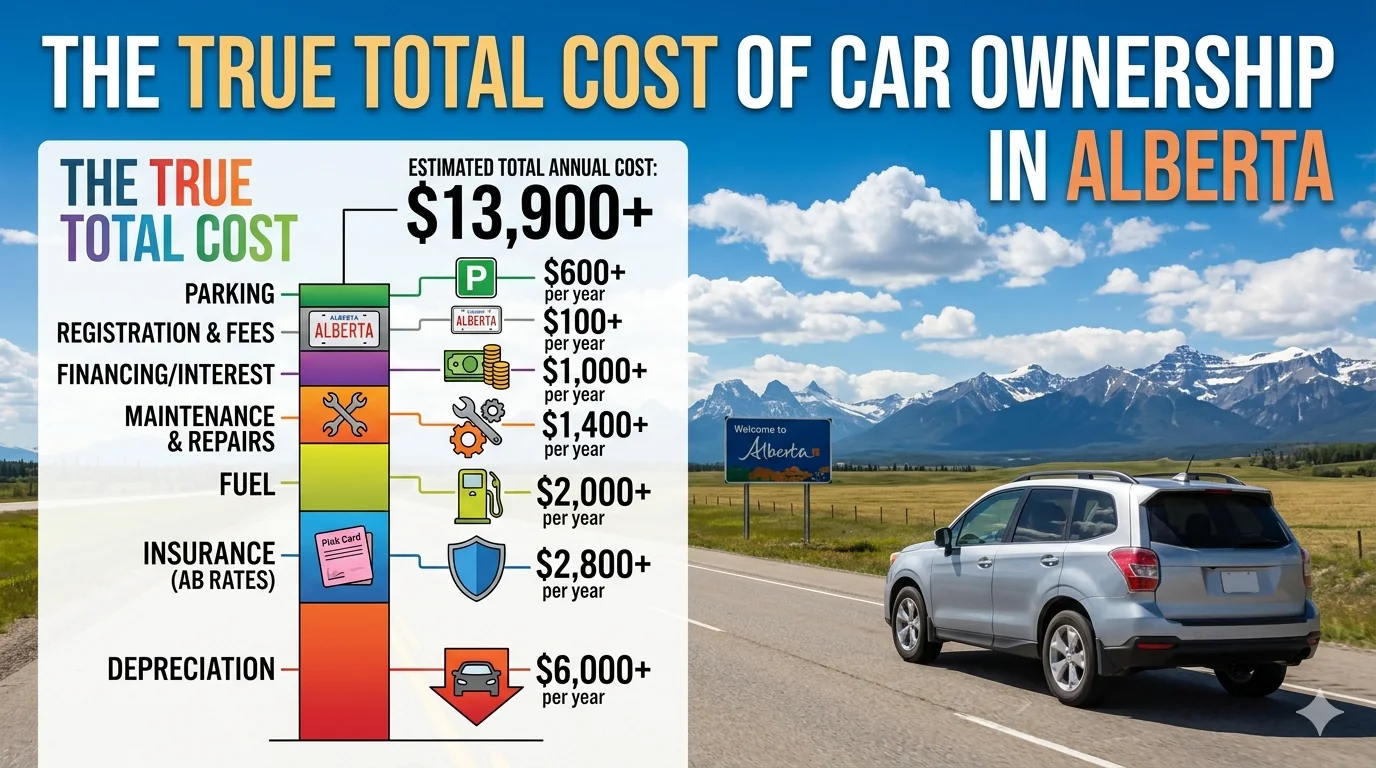
The True Total Cost of Car Ownership in Alberta
In this article
- The Six Cost Buckets of Car Ownership
- 1. Loan Payment
- 2. Insurance
- 3. Fuel
- 4. Maintenance and Repairs
- 5. Registration, Licensing, and Government Fees
- 6. Depreciation
- Annual Cost Tables: Three Vehicle Types Compared
- Economy Sedan: ~$6,800/Year
- Midsize SUV: ~$9,200/Year
- Full-Size Truck: ~$12,400/Year
- How Alberta Compares to Other Provinces
- Five-Year Ownership Cost Comparison
- The Costs People Consistently Forget
- Winter Tires
- Block Heater
- Parking
- Parking Passes and Permits
- Extended Warranty / Mechanical Breakdown Insurance
- How to Minimize Total Cost at Every Stage
- At Purchase
- During Ownership
- At Sale or Trade-In
- Making a Well-Informed Decision
- Related Buyer Guides
- Compare and Apply
Check Your Options in 3 Minutes
No credit impact. All credit situations welcome.
★★★★★ 106+ Google Reviews · AMVIC Licensed · Free Delivery 300km
Every car ad leads with the monthly payment. "$299 biweekly — drive home today!" What that number never tells you is what driving actually costs once you factor in insurance, fuel, maintenance, registration, depreciation, winter tires, and the parking pass you'll need if you work in downtown Calgary. The true total cost of car ownership in Alberta is significantly higher than most buyers plan for — and the gap between the sticker number and the real number is where financial stress lives. This guide builds out that full picture so you're making decisions with complete information.
See what you pre-qualify for
Three quick answers — soft check, no commitment.
The Six Cost Buckets of Car Ownership
Total ownership cost breaks into six distinct categories. Most buyers think carefully about one (the payment) and roughly about one more (insurance or fuel). The other four catch people off guard. Here's the complete picture:
1. Loan Payment
This is the most visible cost. In Alberta, financing terms run 12-96 months with rates ranging from 6.99% for prime borrowers to 29.99% for deep subprime. Most used vehicle buyers in our market finance at 9.99-19.99% depending on credit profile, down payment, and vehicle age. Use our payment calculator to model your specific scenario — the rate and term interact in ways that aren't intuitive. A $20,000 loan at 12.99% over 84 months costs $4,700 more in interest than the same loan over 60 months. Longer terms feel more affordable but cost more in the end.
2. Insurance
Alberta has consistently ranked among the most expensive provinces for auto insurance. Unlike BC and Manitoba, Alberta has a private insurance market — which creates competition but also significant price variation based on your driving record, the specific vehicle, your postal code, and your claims history. Budget $150-$280/month for a used vehicle in Calgary or Airdrie with a clean driving record. A collision claim in the last three years can add $50-$100/month. Young drivers (under 25) often pay $250-$400/month. Your choice of vehicle is one of the biggest levers you have — our page on cheapest cars to insure in Alberta breaks down which makes and models carry the lowest premiums. A used Honda Civic costs substantially less to insure than an equivalent-priced pickup truck or sports car.
3. Fuel
With Alberta gas prices fluctuating between $1.35 and $1.75/L over the past year, fuel is a real variable. The calculation is simple: your monthly kilometers divided by 100, multiplied by your vehicle's fuel consumption rating (L/100km), multiplied by the current price per litre. What surprises people is how much vehicle choice matters. A compact sedan at 8.5L/100km costs roughly $127/month at $1.50/L for 1,000 km of driving. A full-size truck at 15L/100km costs $225/month for the same distance. At 2,000 km/month (a reasonable commuter distance on Highway 2 between Airdrie and Calgary), those numbers double — $254 vs. $450/month. That's a $196/month difference that directly affects your actual life.
4. Maintenance and Repairs
Budget $1,000-$2,500/year depending on vehicle age, mileage, and reliability record. This covers scheduled maintenance (oil changes every 5,000-8,000 km at $80-$130 each, tire rotation, fluid checks) plus the inevitable unplanned repairs that every used vehicle eventually needs. Our vehicle maintenance guide covers what's required at each mileage interval. The key discipline: treat maintenance as a fixed monthly expense, not a bill that arrives unexpectedly. Set aside $85-$200/month and don't touch it unless the vehicle needs something. When you reach $1,500 in the account, you've bought yourself significant peace of mind.
5. Registration, Licensing, and Government Fees
Annual vehicle registration in Alberta runs $90-$115 for a passenger vehicle. On initial purchase, you'll pay a one-time registration transfer fee. If you're buying an out-of-province vehicle, factor in a mandatory out-of-province inspection ($100-$200) and any required repairs to bring it to Alberta standards. These aren't large ongoing costs but they're real first-year expenses that belong in your budget. Alberta has no provincial sales tax, which is a genuine advantage — you pay GST (5%) on the vehicle purchase but not the additional 6-9.975% PST that buyers in BC, Ontario, or Quebec pay. On a $20,000 vehicle, that's $1,200-$2,000 in savings compared to most other provinces.
6. Depreciation
Depreciation is the invisible cost — the money you're losing even when you're doing nothing wrong. New vehicles lose 15-25% of their value in the first year alone. Used vehicles depreciate more slowly, but they still lose value. A $20,000 used vehicle might be worth $13,000-$15,000 five years later depending on mileage, condition, and market demand. This matters because depreciation represents real money when you eventually sell or trade in. Buying a vehicle that's already absorbed its steepest depreciation curve — typically anything 3-5 years old with 40,000-80,000 km — minimizes this cost. It's one of the strongest arguments for buying used rather than new.
Annual Cost Tables: Three Vehicle Types Compared
Let's build concrete annual cost estimates for three representative vehicles that Albertans commonly buy. These use realistic 2026 numbers for a buyer in the Calgary-Airdrie corridor driving approximately 18,000 km/year.
Economy Sedan: ~$6,800/Year
Representative vehicle: 2017 Toyota Corolla with 90,000 km, purchased for $14,500 at 12.99% over 72 months.
| Cost Category | Monthly | Annual |
|---|---|---|
| Loan payment | $270 | $3,240 |
| Insurance | $155 | $1,860 |
| Fuel (8.5L/100km, 1,500 km/mo) | $128 | $1,536 |
| Maintenance reserve | $90 | $1,080 |
| Registration (annualized) | $9 | $105 |
| Total | $652 | $7,821 |
Note: The $6,800 headline figure assumes slightly older vehicle, lower insurance rate, and fewer km — this table shows a more typical scenario at ~$7,800. Your actual numbers will vary based on driving record, exact vehicle, and distance.
Midsize SUV: ~$9,200/Year
Representative vehicle: 2019 Toyota RAV4 with 75,000 km, purchased for $28,000 at 9.99% over 72 months.
| Cost Category | Monthly | Annual |
|---|---|---|
| Loan payment | $497 | $5,964 |
| Insurance | $190 | $2,280 |
| Fuel (10.5L/100km, 1,500 km/mo) | $158 | $1,890 |
| Maintenance reserve | $110 | $1,320 |
| Registration (annualized) | $9 | $105 |
| Total | $964 | $11,559 |
Full-Size Truck: ~$12,400/Year
Representative vehicle: 2020 Ford F-150 with 65,000 km, purchased for $42,000 at 9.99% over 84 months.
| Cost Category | Monthly | Annual |
|---|---|---|
| Loan payment | $667 | $8,004 |
| Insurance | $230 | $2,760 |
| Fuel (14.5L/100km, 1,800 km/mo) | $290 | $3,480 |
| Maintenance reserve | $130 | $1,560 |
| Registration (annualized) | $9 | $105 |
| Total | $1,326 | $15,909 |
The gap between the economy sedan and the full-size truck isn't $6,000/year — it's closer to $8,100/year once you account for the higher insurance, fuel, and maintenance costs that come with a larger vehicle. If you're deciding between vehicle classes, this is the real number to weigh. For a deeper look at what truck ownership actually costs to maintain, our post on the real cost of maintaining a used truck in Alberta covers this in detail.
How Alberta Compares to Other Provinces
Alberta sits in an interesting position among Canadian provinces. On the purchase side, the absence of provincial sales tax is a genuine advantage. On the insurance side, it's one of the more expensive markets. Here's how the math compares on a $25,000 vehicle purchase and first-year ownership:
| Province | Tax on $25K Purchase | Avg Annual Insurance | First-Year Advantage vs. Alberta |
|---|---|---|---|
| Alberta | $1,250 (GST only) | $2,100–$2,500 | — |
| British Columbia | $3,000 (GST + PST 12%) | $1,800–$2,200 (ICBC) | −$750 on tax, +$300 on insurance |
| Ontario | $3,250 (HST 13%) | $2,400–$3,200 | −$2,000 on tax, −$400 on insurance |
| Quebec | $3,750 (GST + QST 9.975%) | $1,200–$1,600 | −$2,500 on tax, +$600 on insurance |
The bottom line: Alberta's no-PST advantage saves you $1,750-$2,500 on a typical used vehicle purchase compared to most provinces. That savings is partially offset by higher insurance premiums, particularly if you're in Calgary where rates have risen significantly over the past three years. Over a five-year ownership period, Alberta generally comes out ahead — but not by as wide a margin as the purchase tax savings suggest. Our guide on how to lower car insurance after buying used in Alberta covers strategies for reducing this cost once you've purchased.
Five-Year Ownership Cost Comparison
Looking at total cost over a 5-year ownership period changes the conversation significantly. Depreciation becomes a major factor, and the cumulative difference between vehicle classes becomes very clear:
| Cost Component | Economy Sedan | Midsize SUV | Full-Size Truck |
|---|---|---|---|
| Total payments (72-84 mo) | $16,200 | $29,820 | $56,028 |
| Total interest paid | $1,700 | $7,820 | $14,028 |
| Insurance (5 years) | $9,300 | $11,400 | $13,800 |
| Fuel (5 years) | $7,680 | $9,450 | $17,400 |
| Maintenance (5 years) | $5,400 | $6,600 | $7,800 |
| Registration (5 years) | $525 | $525 | $525 |
| Depreciation (estimated) | $4,500 | $10,000 | $16,000 |
| 5-Year Total Cost | $43,605 | $67,795 | $109,553 |
| Cost per month | $727 | $1,130 | $1,826 |
The full-size truck costs more than twice as much to own over five years as the economy sedan. If you need a truck for work — hauling, towing, a trade job that requires one — that cost is justified. If you're buying a truck because you like trucks, it's worth understanding what you're committing to. For a detailed breakdown of whether the truck justification holds in your situation, our post on budgeting for a car on a tight income walks through how to align vehicle choice with financial reality.
The Costs People Consistently Forget
Even careful buyers often miss these:
Winter Tires
In Alberta, winter tires aren't legally required (unlike Quebec), but they're effectively necessary. All-season tires lose 50%+ of their grip below -7°C — the temperature range you'll spend several months in every year on highways like the QE2 between Calgary and Calgary and Red Deer. A set of four winter tires for a typical sedan runs $600-$900 installed. This is a one-time purchase (tires last 4-5 winter seasons), but it's a year-one budget item that many first-time buyers don't account for.
Block Heater
If you're buying a vehicle that didn't come with a block heater, installation runs $150-$300 depending on the shop and vehicle. In Calgary winters, where temperatures regularly drop to -25°C and below, a block heater is the difference between your engine starting reliably and struggling every morning. The operating cost is minimal (roughly $0.25-$0.40 per night of use), but the installation cost is a legitimate first-year expense.
Parking
If you work downtown Calgary, monthly parking is a significant cost. Reserved downtown lots run $250-$450/month. Even peripheral lots or park-and-ride options run $80-$150/month. This can add $1,000-$5,400/year to your total ownership cost — and it rarely gets factored into the "total cost of ownership" calculation. Remote workers and Airdrie residents who commute by car to suburban employers mostly avoid this, but it's worth calculating for your specific situation.
Parking Passes and Permits
Residential parking permits in some Calgary communities, condo parking stall fees if you move, and paid workplace parking all layer on top of the downtown parking scenario. These vary enormously by situation but can run $50-$200/month for some buyers.
Extended Warranty / Mechanical Breakdown Insurance
Not technically a surprise cost — you're offered one at the dealership — but many buyers underestimate repair costs on older used vehicles and then wish they'd purchased coverage. A comprehensive extended warranty on a 3-4 year old vehicle typically runs $1,500-$3,000 total, added to the loan. Worth considering if you're buying a vehicle out of factory warranty or with high mileage.
How to Minimize Total Cost at Every Stage
Total cost of ownership is a system — and there are levers at every stage:
At Purchase
- Buy a vehicle that's already absorbed peak depreciation. 3-5 year old vehicles with 50,000-100,000 km hit the sweet spot: most depreciation is done, and significant reliability life remains.
- Shop by insurance cost, not just sticker price. Get quotes on 3-4 vehicles before committing. Insurance variance between similar-priced vehicles can be $50-$150/month — that's $3,600-$10,800 over five years.
- Maximize your down payment. Even an extra $1,500-$2,000 down can meaningfully reduce your interest costs on a subprime loan. Use our financing application to see how different down payment amounts affect your rate and payment.
During Ownership
- Follow the maintenance schedule. Deferred maintenance compounds. A $130 oil change skipped becomes a $900 engine repair. The Alberta vehicle maintenance guide outlines exactly what needs doing and when.
- Compare insurance annually. Loyalty rarely pays in the Alberta insurance market. Quotes take 20 minutes and can save $200-$600/year. After two years of clean driving, your rate should improve — call and ask.
- Drive to minimize fuel cost. Steady highway speeds, minimal idling, and smooth acceleration/braking can improve real-world fuel economy by 10-15%. On $2,000/year in fuel, that's $200-$300 back in your pocket for doing nothing different except how you drive.
At Sale or Trade-In
- Maintain records. A complete service history can add $500-$2,000 to your trade-in or private sale value. Keep receipts for every oil change, tire rotation, and repair.
- Time the market. SUVs and trucks sell well in fall; convertibles and sports cars in spring. Selling in season can meaningfully improve your realized value.
- Know when to trade vs. repair. When a single repair exceeds 50% of the vehicle's current market value, it's usually time to move on — particularly if it's a recurring system (transmission, engine) rather than a one-time item.
Making a Well-Informed Decision
The monthly payment is the headline, but total cost of ownership is the real story. An economy sedan might feel less exciting than a midsize SUV, but over five years it can save you $24,000+ in cumulative costs — money that can go toward a down payment on a home, building savings, or simply having financial room to breathe. If a truck is genuinely required for your work or lifestyle, own that decision with full cost awareness. If you're choosing a larger vehicle out of preference, make sure the preference is worth $40,000-$65,000 over five years.
When you're ready to run the numbers for your specific situation — vehicle, credit profile, down payment, term — our team at Shift Happens in Airdrie can help you model real scenarios. We work with all credit situations, and our multi-lender model means your application goes to 15+ lenders who compete for your business. The result is better rates than you'd get going directly to a single lender. Start your application here and see what's actually available for your budget.
Compare and Apply
- Complete Bad Credit Car Buying Guide (Alberta) — Alberta car buying guide for all credit situations
Financing Resources
Related Articles
Ready to Find Your Vehicle?
Browse our inventory or apply for financing. All credit situations welcome.
★★★★★ 106+ Google Reviews · AMVIC Licensed · Free Delivery 300km