
What Happens If You Miss a Car Payment in Alberta?
In this article
- Day 1 to Day 29: The Grace Period Window
- Day 30: The Credit Report Hit
- Day 60: Escalation and Account Review
- Day 90: The Repossession Threshold
- Alberta Repossession Laws: What the PPSA Actually Says
- How a Missed Payment Affects Future Financing
- Options When You're Falling Behind: Ranked by Damage Level
- Option 1: Call Your Lender Immediately
- Option 2: Refinance the Loan
- Option 3: Voluntary Surrender
- Option 4: Sell the Vehicle Privately
- Option 5: Debt Consolidation
- What Happens to Your Credit Score at Each Stage
- Protecting Yourself Before It Happens: Prevention Strategies
- If You're Already Behind: Your Next 48 Hours
- Related Buyer Guides
- Compare and Apply
Check Your Options in 3 Minutes
No credit impact. All credit situations welcome.
★★★★★ 114+ Google Reviews · AMVIC Licensed · Free Delivery 300km
It's a Tuesday and you realize the car payment was supposed to come out yesterday — and it didn't. Maybe you forgot to move money between accounts. Maybe an unexpected expense hit first. Maybe you've been dreading this moment for weeks because things have been genuinely tight. Whatever brought you here, the next 90 days matter enormously, and most people badly underestimate how quickly a missed payment in Alberta escalates from a minor embarrassment to a serious financial and legal problem. Here's exactly what happens — day by day, stage by stage — and what you can do at each point to limit the damage.
See what you pre-qualify for
Three quick answers — soft check, no commitment.
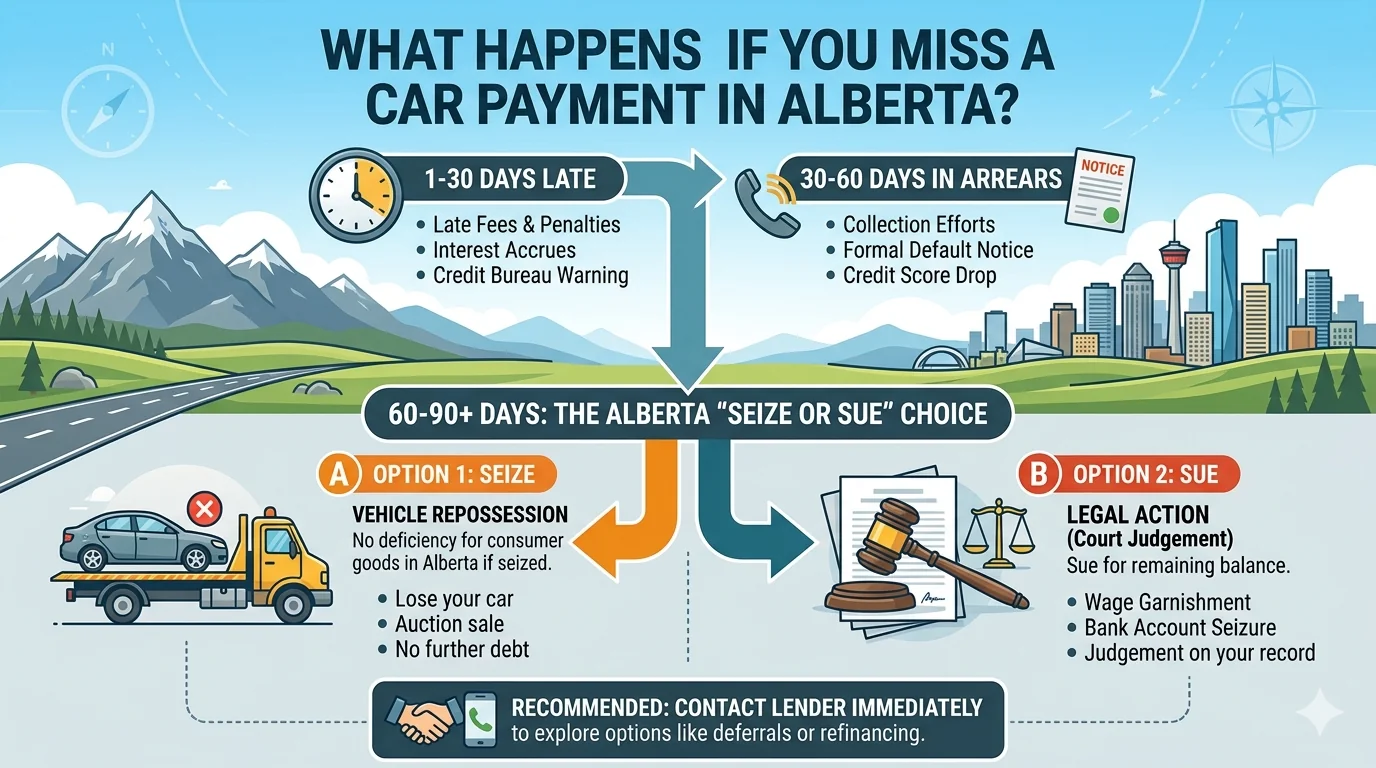
Day 1 to Day 29: The Grace Period Window
Most Alberta auto loan contracts include a grace period — typically 10 to 15 days — during which a late payment won't trigger a lender call or formal notice. However, this grace period is written into your specific contract — Alberta law does not require it. Read your loan agreement. Some lenders, particularly in the subprime space, have shorter grace periods or none at all.
What does happen immediately on day 1? Your lender's automated system flags the account. No human has looked at it yet, but the internal clock starts. If you have automatic payments set up and the payment bounced due to insufficient funds, your bank may also charge an NSF fee — typically $45–$65 in Alberta — and your lender may charge their own returned payment fee on top of that.
During this window, the damage is almost entirely reversible. The payment hasn't been reported to Equifax or TransUnion yet. Your credit score is intact. Call your lender the moment you realize there's a problem — even before the grace period expires. Lenders log these contacts and it signals good faith. Most will work with you on a brief extension if this is your first late payment and you communicate proactively.
The single most important thing you can do in this window: call your lender before they call you. A borrower who reaches out first is treated very differently from one who goes silent and waits to be chased.
Day 30: The Credit Report Hit
This is the hard line. Once a payment is 30 days past due, lenders in Canada are permitted — and most are contractually obligated — to report the delinquency to Equifax and TransUnion. You'll see a "30-day late" notation appear on your credit file. This is the first marker that becomes visible to future lenders.
How much does a single 30-day late payment affect your credit score? The impact depends heavily on your starting point. For someone with a credit score of 720, a single 30-day late can drop them 60–110 points. For someone already in the 580–620 range, the drop is typically 30–50 points — there's less "distance to fall," but they're now pushed deeper into subprime territory where future approvals become harder and rates go higher.
The notation stays on your Equifax file for six years from the date of the late payment — not six years from when you bring it current. That's a long shadow from a single missed payment. Understanding how this looks on your file is easier if you know how to read an Equifax credit report — the R-rating system (R1 through R9) is how lenders see your payment history at a glance, and an R2 at 30 days becomes an R3 at 60 days, and so on.
At the 30-day mark, your lender's collections department will also begin active outreach — calls, emails, and sometimes text messages. In Alberta, third-party debt collectors are regulated by the Fair Trading Act, but your original lender contacting you directly isn't subject to the same restrictions. Expect persistent contact.
Day 60: Escalation and Account Review
A 60-day delinquency is a serious flag. Your lender's file will likely be escalated from front-line collections to a more senior recovery team. The calls become more frequent and more urgent in tone. A second 30-day late notation is added to your credit file (R3 rating), compounding the damage from the first.
At this stage, the lender begins evaluating whether to pursue remedies beyond phone calls. In Alberta, secured lenders — meaning lenders who hold a security interest in your vehicle under the Personal Property Security Act (PPSA) — have legal standing to repossess the vehicle once you're in default. The definition of "default" is in your loan contract. Many contracts define default as any missed payment, meaning the lender has technically had repossession rights since day 1 — they simply haven't exercised them yet.
The 60-day window is often your last realistic opportunity to negotiate a payment deferral or hardship arrangement without the lender moving to enforcement. If you're at this stage, consider looking at car loan refinancing in Alberta as a way to restructure the debt entirely — lower monthly payments through a longer term can sometimes cure an active default situation, depending on the lender.
If you have negative equity in the vehicle — you owe more than it's worth — a 60-day default puts you in a particularly difficult position. The lender knows that selling the car at auction won't cover the full balance, which means they have less incentive to wait. Understanding negative equity car financing helps you negotiate from a more informed position.
Day 90: The Repossession Threshold
At 90 days past due, most Alberta lenders will have made the decision to repossess. A third delinquency notation (R4 rating) hits your credit file. Depending on the lender, your account may have already been handed to an external collection agency or a repossession firm. In Alberta, repossession agents operating under a valid court order or under PPSA provisions can take your vehicle from your driveway, your workplace, or a public street — often without advance notice.
There are rules. Under Alberta's PPSA, a lender must:
- Have a valid security interest registered against the vehicle (which they do — it's the loan agreement)
- Provide you with a "notice of seizure" after repossession
- Allow you a statutory redemption period to recover the vehicle by paying all arrears plus costs
- Provide a "notice of disposition" before selling the vehicle, giving you a final opportunity to redeem
What they don't have to do is warn you in advance. The first indication many Alberta borrowers get that their vehicle is being seized is waking up to an empty driveway. If the vehicle is in a locked garage or on private property where the agent can't access it without a breach of peace, they may need a court order — but this is a technicality that buys days, not solutions.
If repossession happens, you're still responsible for any deficiency balance — the gap between what the vehicle sells for at auction and what you still owe on the loan. Auction prices for repossessed vehicles in Alberta typically run 30–50% below retail market value. On a $25,000 loan balance with an auction sale at $14,000, you're personally liable for the $11,000 difference, plus repossession costs, storage fees, and auction fees — which can add another $2,000–$4,000. That deficiency becomes an unsecured debt that the lender or their assigned collector will pursue.
Alberta Repossession Laws: What the PPSA Actually Says
The Personal Property Security Act (PPSA) governs secured lending — including auto loans — across Alberta. The key provisions every borrower should understand:
- Right of redemption. At any point before the vehicle is sold, you have the right to redeem it by paying the full outstanding balance plus all enforcement costs. "Catching up" on arrears is only an option if your contract allows reinstatement — not all do. Read your contract.
- Notice of disposition. Before selling the vehicle, the lender must send you a written notice stating the proposed method of sale (private or public/auction), the time and date, and your right to object or claim a commercially reasonable sale.
- Commercially reasonable sale. The lender must sell the vehicle in a "commercially reasonable manner" — they can't just give it away. However, Alberta courts have consistently allowed auction sales well below retail as meeting this standard.
- Surplus. If the vehicle sells for more than the outstanding balance plus costs, you're entitled to the surplus. In practice, this almost never happens with repossessed vehicles.
- Deficiency. If the proceeds don't cover the balance plus costs, you owe the difference. The lender has two years from the date of sale to pursue the deficiency through the courts.
One important note: Alberta does not have a "one action rule" like some provinces and U.S. states. Alberta lenders can repossess the vehicle AND pursue you for the deficiency. Both remedies are available simultaneously.
How a Missed Payment Affects Future Financing
The downstream consequences of a missed payment extend well beyond the immediate situation. Here's what future lenders see and how they respond:
At 30 days late: you can still qualify for prime financing from most lenders, but you'll likely see your rate increase by 1–3 percentage points. A $20,000 loan that might have been approved at 8.99% may now come back at 11.99%. Over 72 months, that difference costs approximately $2,100 in additional interest.
At 60 days late: you're solidly in near-prime to subprime territory for the next 12–18 months, even if you bring the account current. Many prime lenders have automated filters that exclude any applicant with a 60-day late in the past 24 months. Rates from 14.99–19.99% become more likely on a future vehicle purchase.
After repossession: you'll appear as a high-risk borrower to most standard lenders for 3–6 years. However — and this is important — specialized lenders exist who work specifically with car loans after repossession in Alberta. Approval is possible. The conditions are different: typically a larger down payment (10–20% of vehicle value), a shorter loan term, and a higher rate. But the path exists, and lenders evaluate the full picture, not just the R9 on your file.
Your credit score recovery after a repossession is gradual. On a realistic timeline: the score starts recovering 12–18 months after you re-establish positive payment history. The notation fades in importance after 2–3 years of clean history on a new account. After 6 years, it drops off your Equifax file entirely. The credit rebuilding timeline walks through what to realistically expect year by year.
Options When You're Falling Behind: Ranked by Damage Level
If you're reading this before a payment is actually missed — or in that first 30-day window — you have real options. Here they are, ranked from least to most damaging:
Option 1: Call Your Lender Immediately
This is always the first move. Most lenders have hardship programs that never get advertised. A payment deferral (moving one payment to the end of the loan term) is often available once per 12 months for borrowers in good standing. A modified payment plan — lower payments for 3–6 months while you stabilize — is another possibility. These programs only exist if you ask. If you wait for the lender to find you, you've lost the option.
Option 2: Refinance the Loan
If you're current but struggling, refinancing before you miss a payment is far easier than after. Extending a 48-month loan to 72 months can meaningfully lower your biweekly payment. For example, a $22,000 balance at 12.99% drops from approximately $289/biweekly on a 48-month term to $208/biweekly on a 72-month term — an $81 biweekly difference that can be the margin between keeping the vehicle and losing it. One thing to consider: if you're weighing paying the loan off faster vs. extending the term, our post on whether you should pay off your car loan early walks through when each approach makes financial sense.
Option 3: Voluntary Surrender
If you genuinely cannot afford the vehicle and no modification solves the math, voluntary surrender is less damaging than forced repossession — but only slightly. The repossession notation still hits your credit file (R8 vs R9, in Equifax terms). The difference is that you control the timing and condition of the vehicle's surrender, which can sometimes result in a better auction price and a smaller deficiency balance. It also avoids the stress and indignity of an unannounced seizure.
Option 4: Sell the Vehicle Privately
If you have equity in the vehicle — it's worth more than you owe — selling it privately before default is the cleanest exit. You pay out the loan from the sale proceeds, walk away with no deficiency, and no repossession on your credit file. The challenge: most people who are struggling with payments are also in a negative equity position. Check your current payoff amount against your vehicle's current market value before ruling this out.
Option 5: Debt Consolidation
If the car payment is just one of several financial pressures, a debt consolidation approach might address the whole picture rather than just one symptom. The credit rebuilding path often starts with getting total monthly obligations to a manageable level — sometimes that means consolidating other debts to free up cash flow for the car payment.
What Happens to Your Credit Score at Each Stage
To make this concrete, here's an approximate credit score impact table for someone starting at 620:
| Stage | Credit Impact | Estimated Score After | Time on File |
|---|---|---|---|
| 1–29 days late (no report yet) | None | 620 | N/A |
| 30 days late (R2) | -30 to -50 pts | 570–590 | 6 years |
| 60 days late (R3) | Additional -20 to -40 pts | 530–570 | 6 years |
| 90 days late (R4) | Additional -20 to -30 pts | 500–550 | 6 years |
| Repossession (R8/R9) | Total: -100 to -150 pts | 470–520 | 6 years from date |
These are approximations — the actual impact depends on your full credit profile, not just this one account. But the progression is accurate directionally. Understanding what hurts your credit score most can help you prioritize which actions to take first.
Protecting Yourself Before It Happens: Prevention Strategies
The best time to think about missed payments is before you sign the loan — not after. Here are the structural decisions that make payment defaults less likely:
- Biweekly payments aligned with payroll. If you're paid biweekly, set your car payment to draft the same week you're paid. You never have to "remember to move money" because the timing is built in. Most Alberta lenders default to biweekly payments anyway — it's worth confirming the draft date aligns with your pay cycle.
- Payment-to-income ratio under 15%. Before signing, calculate your biweekly car payment as a percentage of your biweekly take-home pay. If you're at 20–25%, a single unexpected expense can trigger a miss. Use the payment calculator to model different term lengths and find a payment that has margin.
- Emergency buffer before borrowing. Having even one month's worth of car payments in a separate savings account provides a circuit breaker for the most common trigger (a single unexpected expense or short paycheck).
- Right-size the vehicle. A used Hyundai Elantra at $17,000 with a $285 biweekly payment is a better financial decision than a $29,000 SUV at $485 biweekly if the larger payment puts you at the edge of affordability. Choosing a vehicle that gives your budget breathing room is the most underrated prevention strategy.
If You're Already Behind: Your Next 48 Hours
If you're reading this because you've already missed a payment, here's your immediate action plan:
- Today: Locate your loan agreement and read the default provisions. Know your exact grace period. Find the lender's direct collections number — not the general customer service line.
- Today or tomorrow: Call the lender. Have your account number, the amount you're short, and a realistic timeline ready. Ask specifically: "Do you have a deferral or hardship program?" and "What are my options to bring this current?"
- This week: Get a clear picture of your finances. Income, essential expenses, what needs to change to make the car payment sustainable. If the vehicle is no longer the right fit financially, use the approval check tool to see whether a different vehicle at a lower price point might be achievable — restructuring the whole picture is sometimes cleaner than patching one payment at a time.
- If you're in Red Deer or anywhere in Alberta and the situation has already escalated to collections or repossession threats, consider reaching out directly — our team has navigated these situations before and can sometimes help structure a path to a replacement vehicle that works within the new reality of your credit profile.
A missed payment doesn't have to become a repossession. A repossession doesn't have to become a permanent barrier to financing. Alberta's subprime lending market exists specifically because people's financial situations are complicated and lenders willing to look at the whole story can find workable solutions. Understanding the timeline — knowing exactly what's at stake at each stage — is the first step to getting ahead of it. When you're ready to explore what your options look like now, apply online and we'll give you a straight answer about where you stand.
Compare and Apply
- Complete Bad Credit Car Buying Guide (Alberta) — your complete Alberta subprime buyer guide
Financing Resources
Related Articles


Ready to Find Your Vehicle?
Browse our inventory or apply for financing. All credit situations welcome.
★★★★★ 114+ Google Reviews · AMVIC Licensed · Free Delivery 300km