
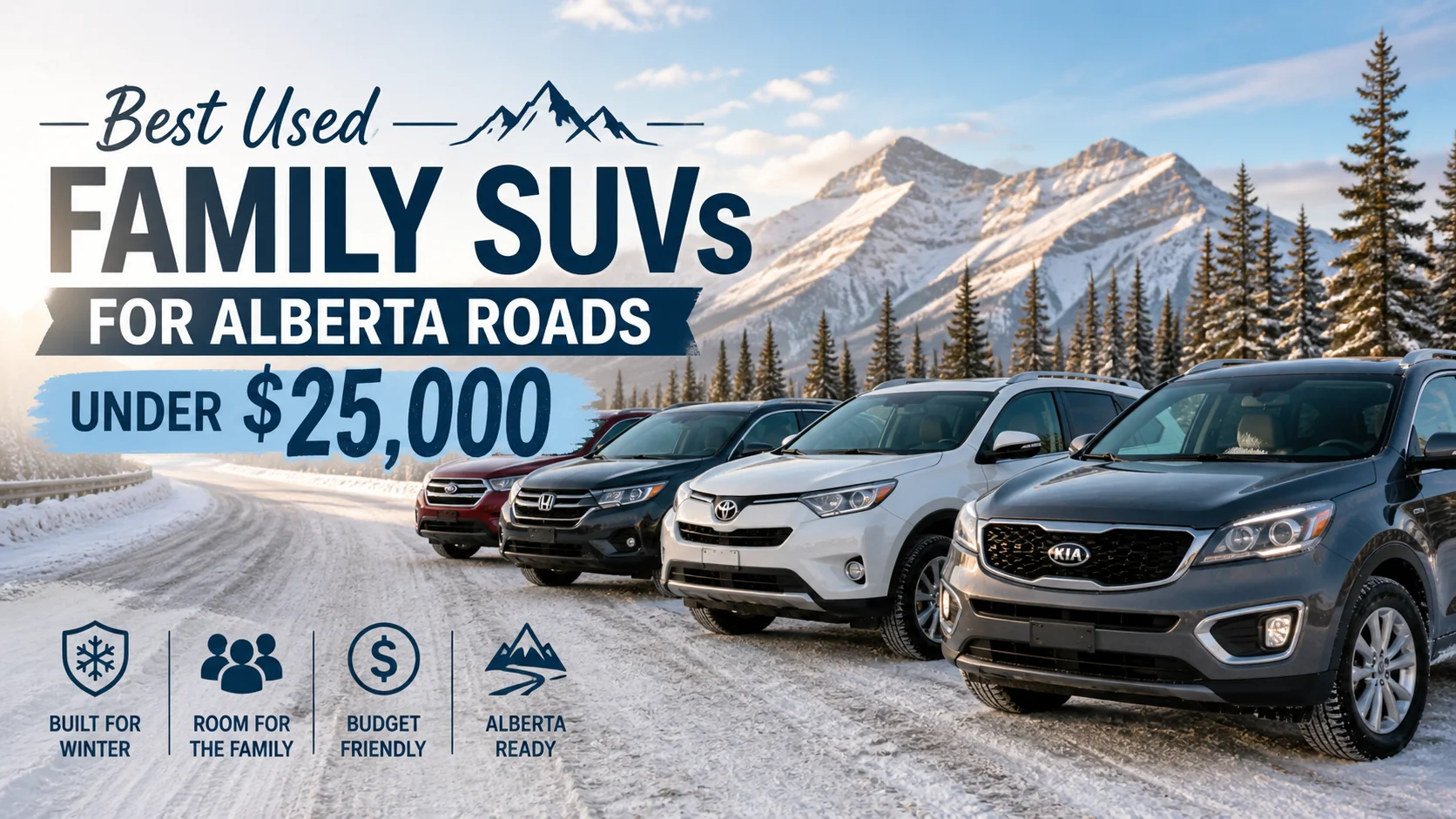
Best Used Family SUVs for Alberta Roads Under $25,000
In this article
- What Families Actually Need (That Brochures Don't Say)
- Toyota Highlander 2016–2019: The Gold Standard for Family Reliability
- Honda Pilot 2016–2018: More Room Where It Counts
- Hyundai Santa Fe 2019–2021: Modern Safety Tech at Under $25,000
- Ford Explorer 2017–2019: American Space at a Fair Price
- Chevrolet Traverse 2018–2020: Maximum Space, Maximum Practicality
- Kia Sorento 2019–2021: Value Leader with Genuine Quality
- Head-to-Head: What Families Actually Care About
- Winter Capability: Honest Assessment for Alberta Families
- Realistic Financing Scenarios for Alberta Families
- Our Recommendation by Family Type
- Related Buyer Guides
- Compare and Apply
Check Your Options in 3 Minutes
No credit impact. All credit situations welcome.
★★★★★ 106+ Google Reviews · AMVIC Licensed · Free Delivery 300km
You need enough space for three kids, two hockey bags, and a Golden Retriever, but you're not prepared to spend $55,000 on something new that depreciates $8,000 the moment you drive it off the lot. The $25,000 used SUV market in Alberta is genuinely excellent right now — vehicles that were $45,000–$55,000 new are coming off lease and into the secondhand market at prices that make real financial sense for families. The challenge is knowing which ones are genuinely family-ready and which ones look impressive on a test drive but will cost you in repair bills within two years. This guide covers six family SUVs worth buying under $25,000 in Alberta, ranked by what actually matters when you have children in the vehicle.
See what you pre-qualify for
Three quick answers — soft check, no commitment.
What Families Actually Need (That Brochures Don't Say)
Cargo capacity numbers from manufacturer spec sheets don't tell you whether a car seat fits behind a 6-foot driver without crushing them. Safety ratings from the Insurance Institute for Highway Safety (IIHS) matter, but a "Top Safety Pick" from 2016 doesn't automatically mean the vehicle meets 2026 standards — active safety systems have improved significantly in just the last five years. And fuel economy EPA estimates are measured in controlled conditions, not on the 23-minute commute from Calgary to Airdrie in -18°C stop-and-go traffic.
The criteria used to rank these vehicles: rear-seat legroom and car seat installation ease (LATCH anchor accessibility), cargo volume behind the second and third row, safety rating currency, all-wheel drive capability for Alberta winters, fuel economy in real Alberta driving conditions, and the cost to maintain them after you buy. A seven-seat SUV that requires $3,000 in maintenance per year isn't a family win — it's a budget trap.
Toyota Highlander 2016–2019: The Gold Standard for Family Reliability
If there's one vehicle on this list where the premium purchase price is fully justified by long-term cost of ownership, it's the Toyota Highlander. The 3rd-generation Highlander (2014–2019) is arguably the most proven three-row family SUV in its class, and the 2016–2019 model years represent the sweet spot where safety technology, powertrain maturity, and value converge.
Why it's the family benchmark: Toyota's 3.5L V6 paired with an 8-speed automatic (2018–2019) or 6-speed (2016–2017) has demonstrated exceptional durability across hundreds of thousands of real-world owner reports. J.D. Power's long-term dependability studies consistently place the Highlander among the top three vehicles in its class. For a family buying a vehicle they intend to keep for 8–12 years, that track record is worth significant premium.
Car seat compatibility: The Highlander's LATCH anchors are easy to access in both the second and third rows. The second row can be adjusted fore and aft independently, allowing a rear-facing infant seat in row two without eliminating all rear-row legroom. This is not universal in three-row SUVs — it's a genuine differentiator.
Cargo space: 2,492L behind row one (all rows folded). More importantly, the flat load floor when the third row is folded is one of the flattest in the segment — essential for actual luggage loading.
Safety ratings: 2018–2019 models earned IIHS Top Safety Pick+ with standard forward collision warning and automatic emergency braking. Earlier 2016–2017 models require a technology package for these features — confirm the specific trim before purchasing.
Winter capability: Toyota's Dynamic Torque-Control AWD system (standard on most Canadian trims) is genuinely capable in snow. It automatically distributes torque to the rear wheels before slippage occurs, which is particularly effective on icy ramps and on-ramps. Pair with Bridgestone Blizzak DM-V2 or Michelin X-Ice Snow SUV tires for a complete Alberta winter setup.
Fuel economy: 13.0L/100km combined in real Alberta driving is realistic — higher than the 3.5 V6 suggests because the 8-speed gearbox (2018+) optimizes highway cruising efficiently. Budget approximately $260–$320/month in fuel for a family driving 1,500 km/month.
Common issues: Very few in this generation. Check coolant hose connections on higher-mileage examples; some 2014–2016 models had minor seepage at the lower radiator hose. The 3rd-row seating is genuinely tight for adults — if you regularly transport adult passengers in row three, a Pilot or Traverse may serve better.
Maintenance cost: $700–$1,000/year for routine maintenance. Toyota parts are widely available and inexpensive relative to the vehicle's tier. Timing chain (no belt) eliminates a major scheduled expense.
Best for: Families who want the longest ownership horizon with the lowest total cost of ownership and genuinely don't want to think about their vehicle.
Honda Pilot 2016–2018: More Room Where It Counts
The Honda Pilot answers the single biggest complaint about the Highlander: third-row space. Honda engineered the Pilot with one of the most genuinely usable third rows in its class — a 12-year-old can sit there for a two-hour drive to Banff without a mutiny in progress. If you regularly transport more than four people, the Pilot's space advantage over the Highlander is meaningful.
Second-row magic seats: The EX-L and Touring trims feature Honda's signature 60/40 walk-through second row, which slides forward to create a passage to the third row without removing a car seat. For families with multiple children at different stages — an infant seat in row two and older kids in row three — this feature alone can tip the buying decision.
Safety ratings: 2016–2018 Pilots earned strong IIHS ratings. Honda Sensing (forward collision warning, lane keeping assist, adaptive cruise control) was available as an option in 2016 and became standard on most trims in 2017. Verify which safety package is installed before purchase.
Powertrain: The 3.5L V6 with a 9-speed automatic (2016–2018) made headlines for shudder and harsh engagement issues early in its run. Honda released multiple software updates and hardware fixes through 2016–2017; by 2018, most units from new production had the updated TCM. When shopping a 2016–2017, ask whether the transmission was ever serviced or updated — dealer records will show this.
AWD system: Honda's Real Time AWD is rear-biased and reactive (engages after slip is detected). It's competent in light-to-moderate Alberta snow conditions but less confident on steep, icy inclines than Toyota's proactive system. Winter tires close this gap substantially.
Fuel economy: 12.8L/100km combined in real driving — similar to the Highlander. The 9-speed doesn't offer dramatically better highway efficiency than the Highlander's 8-speed in practice.
Cargo space: 2,626L behind row one — larger than the Highlander. The third row folds flat without needing to be removed (common on competitors), which is a practical day-to-day convenience.
Maintenance cost: $750–$1,050/year. Honda parts are reasonably priced; independent shops across Calgary are well-versed in the platform. Budget an extra $200–$300 for the 9-speed transmission fluid service if records are absent.
Hyundai Santa Fe 2019–2021: Modern Safety Tech at Under $25,000
The 4th-generation Hyundai Santa Fe (2019–present) entered the market as a 5-seat crossover — note that it does not offer a third row. If you need seven seats, look elsewhere on this list. But for families of four or five who want a genuinely modern vehicle with current-generation safety technology, the Santa Fe punches above its price class in this budget.
Why it belongs here: A 2020 Santa Fe Sport 2.4L AWD with the Safety package can be found under $25,000 in Alberta. That vehicle includes forward collision avoidance with pedestrian detection, blind spot monitoring, rear cross-traffic alert, lane keeping assist, and driver attention alert — a full suite of active safety systems that competitors only offered as expensive packages in the same model year.
Interior quality: The 2019–2021 Santa Fe made a significant quality jump over its predecessor. Soft-touch materials appear on most visible surfaces, the infotainment system is responsive, and noise insulation is notably better than Korean competitors from even two years prior.
Car seat installation: LATCH anchors are accessible but partially obscured by seat cushion foam in the second row — not ideal for parents doing frequent reinstalls. The outboard positions are easier than the center.
Engine options: The 2.4L naturally-aspirated four-cylinder is the reliable choice. The 2.0L turbocharged engine makes more power but carries the same cold-weather oil dilution risk as turbo competitors — if you park outside in Alberta winters, stick with the 2.4L.
AWD system: HTRAC AWD (standard on most trims) is more sophisticated than earlier Hyundai systems, with available torque vectoring on the rear axle. It's genuinely effective in winter conditions.
Reliability: The 2019+ generation has built a strong reliability record in its first five years on the road. Avoid the 2.0T if service records are incomplete — turbo engines need strict oil change adherence.
Maintenance cost: $600–$900/year. The 2.4L engine is simple and widely serviced. Hyundai's 5-year/100,000 km comprehensive warranty (first owner) may still be partially in force on early 2019 models — run the VIN through Hyundai Canada's coverage checker.
Ford Explorer 2017–2019: American Space at a Fair Price
The Ford Explorer is the volume pick in this segment — it's been the best-selling three-row SUV in North America for most of the past decade. That volume means high parts availability, competitive service pricing, and a large pool of well-maintained examples to choose from. It also means the Explorer has worked through most of its common issues through software and hardware updates across the model run.
The 2017–2019 case: These model years benefit from Ford's refinements to the 2.3L EcoBoost turbo-four and 3.5L V6. The 3.5L naturally-aspirated V6 is the powertrain to target for reliability — it avoids the turbocharger complexity of the EcoBoost variants and the documented overheating issues of the 3.5L EcoBoost in extreme towing applications.
Three-row practicality: The Explorer's second row is flat-floored with excellent LATCH anchor access. The third row is genuinely usable for elementary school-age children, less so for teenagers on longer trips. Cargo behind the third row (283L) is the tightest on this list — if you need to carry luggage with a full load of passengers, the Explorer requires a roof box or cargo carrier.
Safety ratings: 2017–2019 models earned Good or Acceptable ratings from IIHS. The available Safe and Smart package (XLT and above) adds forward collision warning, automatic braking, and adaptive cruise — verify these are present on any vehicle you're considering.
Common issues: The 2017–2019 generation had documented complaints about exhaust fumes entering the cabin through the rear hatch seal and HVAC system. Ford issued several TSBs (Technical Service Bulletins) addressing this. Ask specifically about this repair on any Explorer in this range, or have a mechanic check whether the fix was applied. This issue should be resolved on any well-maintained example by now, but verify.
AWD system: Ford's Intelligent 4WD with Terrain Management System handles Alberta winters competently. The Snow mode adjusts throttle response and transmission shift points for improved traction on slippery surfaces — a genuinely useful feature.
Maintenance cost: $800–$1,200/year. Ford parts are widely available and competitive. The 3.5L V6 has a timing chain; the 2.3L EcoBoost uses a timing chain as well but requires more rigorous oil change intervals for turbocharger longevity.
Chevrolet Traverse 2018–2020: Maximum Space, Maximum Practicality
If you need the most interior volume and the flattest load floor on this list, the Chevrolet Traverse wins. The 2nd-generation Traverse (2018+) grew significantly over its predecessor and now offers one of the largest passenger volumes in the non-luxury segment. For large families, hockey families, or anyone who regularly carries equipment, the Traverse's sheer space is a legitimate competitive advantage.
Space numbers that matter: 2,781L behind row one with all rows folded — the largest in this comparison. The third row accommodates adults more comfortably than any other vehicle on this list. Headroom in row three is exceptional for a non-SUV-truck-based platform. The second-row captain's chairs (on LT and above) create a true walk-through to row three — no car seat gymnastics required.
Powertrain: The 3.6L V6 with 9-speed automatic is the only powertrain option in this generation. It makes 310 horsepower — notably more than any competitor here — but fuel consumption reflects this. Expect 13.5–14.5L/100km in real Calgary commuting conditions. That's $20–$30 more per month in fuel than the Highlander or Pilot.
AWD system: GM's Active Twin-Clutch AWD (standard on LT and above) allows the rear wheels to be disconnected in 2WD mode for highway fuel savings, then re-engaged proactively when sensors detect slippage risk. In Alberta snow conditions, this system performs well once properly learned — it takes a brief calibration period when temperatures drop.
Safety ratings: 2018–2020 Traverses earned IIHS Top Safety Pick status. Standard safety features expanded significantly in 2020 — if your budget can stretch to a 2020 model, the additional standard active safety equipment justifies the modest price premium.
Reliability: GM's 3.6L V6 has a timing chain with a history of stretch-related issues at higher mileage if oil changes were delayed. Ask for oil change records specifically. At 120,000+ km, have the timing chain inspected. The 9-speed transmission has been generally well-reviewed in this application — better than GM's 8-speed in smaller vehicles.
Common issues: Check for water intrusion around the panoramic sunroof on Traverse models so equipped — a known issue on some examples. The fix (resealing) is straightforward but worth confirming before purchase.
Maintenance cost: $850–$1,200/year. GM parts are the most widely available and competitively priced on this list — every small-town Alberta mechanic is comfortable with the 3.6L. This is a meaningful advantage for buyers in communities outside Calgary and Airdrie.
Kia Sorento 2019–2021: Value Leader with Genuine Quality
The Kia Sorento in this generation occupies a similar position to the Forte in the sedan segment — it delivers more features per dollar than Japanese competitors, and the reliability story of the 4th-generation Sorento is genuinely strong. The 2019–2021 third-generation Sorento (built on Kia's then-current platform) can be found with full technology packages at prices that undercut comparable Highlanders and Pilots by $2,000–$4,000.
Configuration note: The 2019–2020 Sorento offers both 5-seat and 7-seat configurations. The 7-seat version's third row is strictly for children — do not expect adult comfort. The 5-seat version offers significantly more cargo space and a more composed rear suspension tune. If your family genuinely uses seven seats, confirm the third row works for your children's ages and sizes before committing.
Powertrain: The 2.4L naturally-aspirated four-cylinder (base) and 2.0L turbocharged four-cylinder (SX) are both available. Apply the same advice as the Santa Fe: the 2.4L is the reliability choice, particularly for Alberta's extreme cold starts. The 3.3L V6 (available in some trims) is excellent but typically prices above the $25,000 ceiling.
Safety ratings: 2019–2021 Sorentos earned IIHS Top Safety Pick status. Kia's Driver Assistance package (forward collision avoidance, blind spot monitoring, rear cross-traffic alert, lane keep assist) was standard or inexpensively added across most trim levels.
Winter capability: Kia's AWD system in this generation is reactive rather than predictive — it engages after the front wheels slip. Competent for typical Alberta conditions; less so on technical winter terrain. A good set of winter tires matters more for the Sorento than for the Highlander.
Warranty upside: Like the Forte, the Sorento may have remaining Kia powertrain warranty transferable to a second owner. Run the VIN — this can be a significant financial advantage on an early 2019 model.
Maintenance cost: $650–$950/year. Kia dealerships across Calgary provide solid service coverage. Independent mechanics are increasingly familiar with this platform as the vehicles age into the aftermarket.
Head-to-Head: What Families Actually Care About
| Model | Seats | Cargo (max) | Row 3 Adult Fit | IIHS Rating | AWD Type | Est. Maintenance/yr |
|---|---|---|---|---|---|---|
| Toyota Highlander '16–'19 | 7–8 | 2,492L | Tight | TSP+ ('18–'19) | Proactive | $700–$1,000 |
| Honda Pilot '16–'18 | 7–8 | 2,626L | Good | TSP ('17–'18) | Reactive | $750–$1,050 |
| Hyundai Santa Fe '19–'21 | 5 | 1,977L | N/A | TSP+ ('19+) | Torque vectoring | $600–$900 |
| Ford Explorer '17–'19 | 7 | 2,274L | Moderate | Good/Accept. | Terrain modes | $800–$1,200 |
| Chevy Traverse '18–'20 | 7–8 | 2,781L | Best in class | TSP ('18–'20) | Active twin-clutch | $850–$1,200 |
| Kia Sorento '19–'21 | 5 or 7 | 2,042L | Children only | TSP ('19+) | Reactive | $650–$950 |
Winter Capability: Honest Assessment for Alberta Families
Every vehicle on this list comes with available all-wheel drive — but not all AWD systems are equal in Alberta conditions. For the Highway 2 corridor and Calgary city streets, any of these systems paired with quality winter tires will handle 95% of winter driving situations without issue. The differences emerge in edge cases: steep icy parking structures, Highway 1 between Calgary and Canmore in an early November snowstorm, or Deerfoot when it hasn't been plowed yet after a 20cm overnight dump.
The proactive systems (Highlander's Dynamic Torque-Control) maintain traction before slippage begins by monitoring steering angle, throttle position, and individual wheel speeds. Reactive systems (Pilot's Real Time AWD, Sorento's base AWD) detect slippage and then respond. For most families on most Alberta days, this distinction is academic. For a family that regularly drives mountain roads or commutes on uncleared secondary highways, it's worth considering. Our AWD vs 4WD comparison for Alberta goes deeper on the technical differences if this matters for your situation.
The universal rule for Alberta family vehicles: winter tires are not optional. All-season tires underperform dedicated winter tires below 7°C — not just in snow, but in cold temperatures generally, because the rubber compound stiffens. Budget $1,400–$1,800 for a quality winter tire set on steel rims for any vehicle in this size class. This is a first-year purchase — factor it into your total budget when evaluating these vehicles. See our complete guide to winter tires in Alberta for brand recommendations by driving style.
Realistic Financing Scenarios for Alberta Families
A $22,000 SUV financed at 12.99% over 72 months with $2,500 down works out to approximately $217 biweekly. At 9.99%, the same scenario drops to $198 biweekly. At 19.99% (the higher end of what subprime lenders quote for families with credit challenges), the same vehicle at 72 months costs approximately $258 biweekly. The rate difference between prime and subprime on a 72-month loan at this price point is real money — but it's also manageable, and on-time payments for 12–24 months will position you for a refinance at a better rate.
A note on loan term: stretching to 84 or 96 months reduces the biweekly payment, but on a vehicle in this price range and age, you're increasing the risk of the loan balance exceeding the vehicle's value (negative equity) if anything goes wrong. For family vehicles in the $20,000–$25,000 range, 60–72 months is generally the right balance between payment and risk. Use our payment calculator to model your exact scenario before you walk into a dealership.
Single-parent families, families with one income earner, or families navigating a credit rebuild often wonder whether a $22,000 vehicle is accessible. The honest answer: it depends on income and existing debt load, not just credit score. We work with 15+ lenders who specialize in different credit profiles — from prime rates for strong credit to second-chance financing for those rebuilding. If you're not sure where you stand, the approval quiz takes two minutes and gives you a realistic picture without pulling your credit. If you're specifically navigating a family vehicle purchase during a credit rebuild, our guide to upgrading for a growing family covers strategies that work at different credit stages.
Our Recommendation by Family Type
Best overall for most Alberta families: Toyota Highlander 2018 LE AWD. The reliability record, proactive AWD, and proven long-term ownership story make it the safest choice across a 10-year ownership horizon. Pay the modest premium over comparable Pilots and Sorentos — it's earned.
Best for large families (5+ people regularly): Chevrolet Traverse 2018 LT AWD. The interior volume advantage is real, the third row is actually usable, and the 3.6L V6 has genuine reliability when oil change intervals are respected.
Best for budget-conscious families: Kia Sorento 2020 EX AWD (5-seat). You'll save $3,000–$4,000 versus a comparable Highlander and still get full active safety tech, excellent build quality, and potentially remaining powertrain warranty coverage.
Best for tech-forward families: Hyundai Santa Fe 2020 Preferred AWD. The active safety suite is the most comprehensive in the segment for the money. Appropriate if your family is 4–5 people and you don't need a third row.
Every vehicle on this list represents a legitimate family investment at under $25,000. The differences come down to your specific family size, driving patterns, and priorities. If you'd like to talk through which of these makes sense for your situation, our team at Shift Happens is straightforward about it — we'd rather help you find the right vehicle than sell you the wrong one. Browse our current used SUV inventory, or check your financing options to know your budget before you shop. We serve families across Calgary, Airdrie, and the surrounding region from our Highway 2 location — no appointment required.
Compare and Apply
- Bad Credit Financing — Complete Guide — bad credit car financing in Alberta
Financing Resources
Related Articles
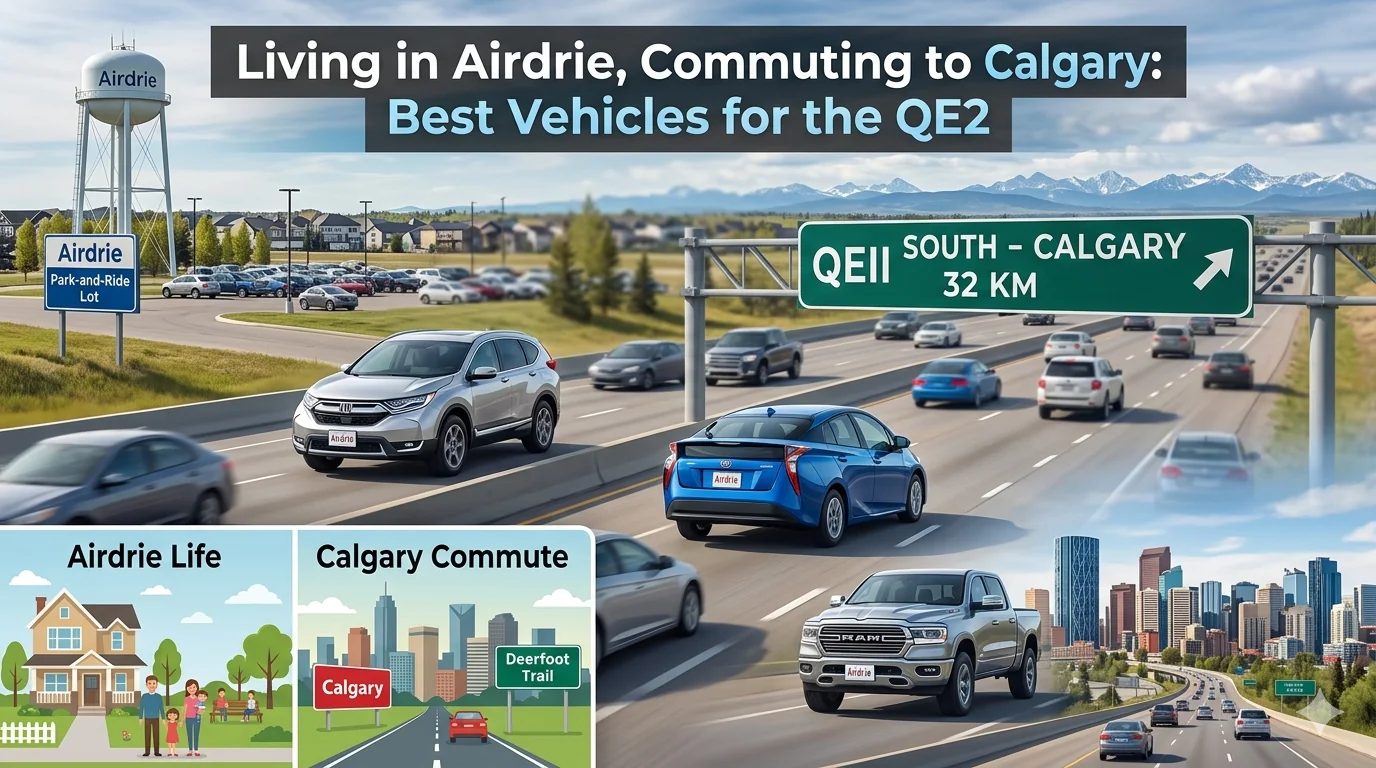


Ready to Find Your Vehicle?
Browse our inventory or apply for financing. All credit situations welcome.
★★★★★ 106+ Google Reviews · AMVIC Licensed · Free Delivery 300km