
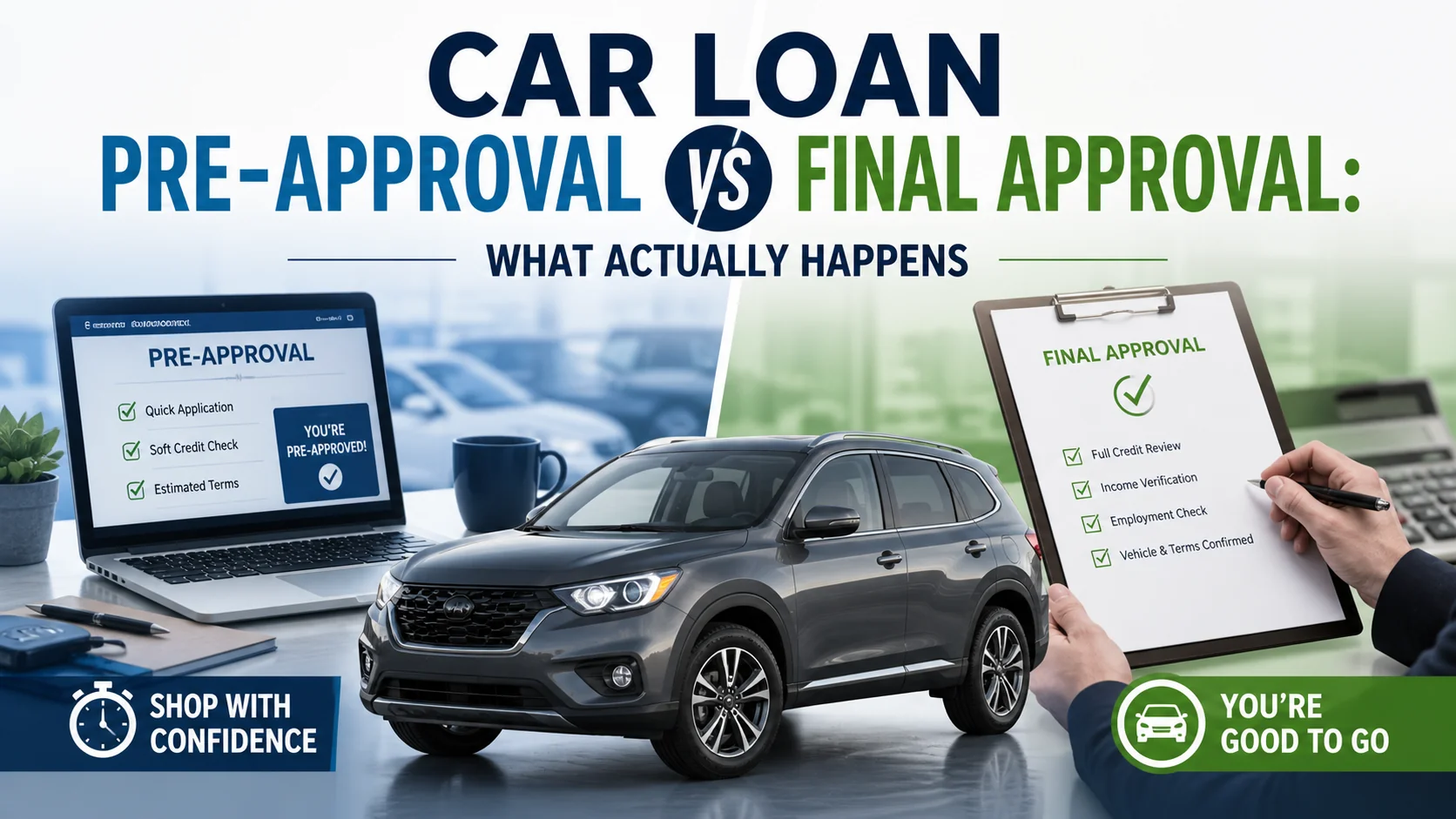
Car Loan Pre-Approval vs Final Approval: What Actually Happens
In this article
- What Pre-Approval Actually Checks
- What Final Approval Actually Checks
- What Can Change Between Stages — and Why
- Your Credit Changed
- Income Verification Came Back Different
- The Vehicle Doesn't Match the Advance
- Your Debt-to-Income Ratio Shifted
- The Pre-Approval Timeline in Alberta
- How Pre-Approval Differs by Lender Type
- How Multi-Lender Brokers Change the Game
- How to Protect Your Pre-Approval Between Stages
- Pre-Approval Is Not a Lock on Rate or Amount
- When Final Approval Gets Complicated
- Tax Filing Gaps
- Income Inconsistency
- Vehicle Condition or History Issues
- Undisclosed Existing Obligations
- What to Do If Final Approval Falls Through
- Getting Started on the Right Foot
- Related Buyer Guides
- Compare and Apply
Check Your Options in 3 Minutes
No credit impact. All credit situations welcome.
★★★★★ 106+ Google Reviews · AMVIC Licensed · Free Delivery 300km
You submitted your application, held your breath, and got the call: "You're pre-approved." Relief floods in — until someone mentions the words "subject to final approval." Suddenly pre-approval feels a lot less certain. What exactly does it mean, and why isn't it the finish line? Understanding the difference between these two stages could save you from a nasty surprise on the day you expected to drive home in your new vehicle.
See what you pre-qualify for
Three quick answers — soft check, no commitment.
What Pre-Approval Actually Checks
Pre-approval is a lender's conditional offer based on a snapshot of your financial profile. At this stage, the lender is working with the information you've provided — income, employment, existing debts, and a credit bureau pull. They're asking: "Based on what we see right now, are we willing to lend to this person?" The answer comes back as a conditional yes, along with a preliminary loan amount and rate range.
What pre-approval does not involve is independent verification. The lender hasn't called your employer to confirm your salary. They haven't scrutinized your bank statements for the past 90 days. They haven't appraised the specific vehicle you want to buy. Think of pre-approval as the lender saying, "We're interested — pending the details checking out."
The credit check at pre-approval stage is usually a "soft pull" or a preliminary hard pull. Either way, it gives the lender enough information to make a directional decision without committing to final terms. When you understand how car financing works, you realize this stage is about establishing eligibility, not locking in a contract.
What Final Approval Actually Checks
Final approval is a different animal entirely. At this stage, everything gets verified. The lender's underwriting team goes through your application with documentation to back it up. Here's what they're confirming:
- Employment and income verification — pay stubs, T4s, or NOAs (Notice of Assessment) from CRA. Self-employed applicants face a deeper dive, with business financials often required.
- Vehicle appraisal and title check — the lender needs to know the vehicle is worth what you're paying and has a clean title. A used car with undisclosed liens or odometer fraud can kill a deal at this stage.
- Insurance confirmation — you can't finalize a car loan without proof of insurance. In Alberta, you need to arrange coverage before you drive off the lot.
- Debt-to-income verification — the lender cross-checks your stated monthly obligations against what's actually showing on bureau and your bank statements.
- Final credit review — between pre-approval and final approval, your credit can change. New credit applications, missed payments, or increased card balances all show up here.
This is also where the lender applies their specific program rules. Subprime lenders, for instance, have tiered programs with different advance limits depending on your beacon score. A subprime versus prime financing comparison shows you just how different those program guidelines can be.
What Can Change Between Stages — and Why
Here's the uncomfortable truth: your rate, loan amount, or required down payment can all shift between pre-approval and final approval. Sometimes significantly. The most common reasons:
Your Credit Changed
If you applied for new credit between pre-approval and final approval — a store card, another vehicle, even a cell phone contract — those hard inquiries and new balances appear on your bureau. A lender who pre-approved you at one rate tier may re-categorize you after seeing additional credit activity. The same applies if a payment slipped during that window. Even a single 30-day late notice on an existing account can shift your beacon score enough to move you into a higher-rate bracket.
Income Verification Came Back Different
Pre-approval income figures come from what you stated on the application. If your actual pay stubs or T4s show something different — lower base pay than you quoted, fewer hours than expected, or inconsistent deposits — the lender recalculates your qualifying amount. This is especially common for people with variable income, commission-based pay, or recent job changes. For self-employed applicants, the gap between stated income and provable income is where deals most often stall.
The Vehicle Doesn't Match the Advance
Every lender has advance guidelines — the maximum percentage of a vehicle's book value they'll lend. If the car you chose is priced above what the lender's program allows relative to its appraised value, you'll need to make up the gap with a larger down payment. This catches people off guard when they pre-approve for a dollar amount, pick a vehicle priced at that amount, and then discover the lender will only advance 85% of book value on that specific make, age, and mileage combination.
Your Debt-to-Income Ratio Shifted
If any of your existing monthly obligations changed — a rent increase, a new support payment, a credit card that went to collections — those changes affect your qualifying capacity. Lenders in Alberta typically cap your total debt service ratio at 40-44% of gross monthly income, though subprime programs have different thresholds.
The Pre-Approval Timeline in Alberta
In Alberta, pre-approval decisions typically come back within a few hours to one business day through a dealership that uses a multi-lender model. Final approval after you've chosen a vehicle and submitted documentation usually takes one to three business days, though some lenders can move faster on straightforward files.
The full timeline from first inquiry to driving home typically looks like this:
- Day 1: Application submitted, credit pulled, pre-approval issued (often same day)
- Day 1-3: Vehicle selected, documents requested (pay stubs, ID, proof of insurance)
- Day 2-5: Lender underwriting reviews documents, vehicle appraisal completed
- Day 3-7: Final approval issued, loan documents prepared
- Day 4-8: Documents signed, funding confirmed, keys in hand
Rushed timelines are possible — especially on straightforward prime files — but building in a week of buffer avoids pressure decisions. Same-day turnaround is possible for well-documented prime files, but that's the exception rather than the rule for anything involving credit complexity.
Key insight: Pre-approval is a green light to shop, not a locked contract. Treat it as a strong indicator — not a promise — until documents are signed and funding is confirmed.
How Pre-Approval Differs by Lender Type
Not all pre-approvals carry the same weight. A pre-approval from a major chartered bank tends to be more conservative but more reliable — they apply stricter criteria upfront, which means fewer surprises at final approval. A pre-approval from a subprime lender is often more accessible, but comes with more conditions attached, because subprime programs rely more heavily on the specific vehicle details and borrower documentation to structure the deal.
Credit unions sit somewhere in between. Their pre-approvals often reflect a relationship-based assessment — if you've been banking with them for years and have a solid deposit history, they may look at your application more holistically than a lender processing thousands of applications in a queue. The trade-off is that credit unions typically can't move as fast, and their program flexibility at final approval is more limited than specialty subprime lenders.
For buyers with complicated files — recent job change, non-traditional income, past credit events — the type of lender issuing the pre-approval matters as much as the approval itself. A pre-approval from a lender whose program doesn't actually fit your profile is worse than no pre-approval, because it creates false expectations about what final approval will look like. This is why the intake process at a multi-lender broker involves matching your profile to the right lender before sending the application, not after.
How Multi-Lender Brokers Change the Game
Here's where working with a dealership like Shift Happens gives you a structural advantage. When you apply at a single bank or credit union, you get one pre-approval decision — theirs. If you don't fit their specific program guidelines, the answer is no, and you start over.
A multi-lender model works differently. Your application goes to multiple lenders simultaneously — in our case, across 15+ lenders ranging from major financial institutions to specialized subprime lenders. Each lender pre-approves based on their own program criteria. You end up with multiple conditional offers, which creates two major advantages:
Competition on rate: When lenders know others are in the mix, pricing tends to sharpen. The spread between a lender's opening offer and their best offer is real — and it's leverage you only have when multiple lenders are competing. You can see the difference this creates on our Alberta car loan rates page.
Redundancy on approval: If one lender's final approval falls through because of a program-specific rule, another lender's approval may still hold. A single-lender application has no fallback. A multi-lender submission has multiple paths to a funded deal.
When you compare dealership financing versus going to your bank directly, this redundancy is one of the most underrated advantages of the dealership route — especially for buyers who aren't textbook prime borrowers.
How to Protect Your Pre-Approval Between Stages
The window between pre-approval and final approval is when deals most often fall apart due to applicant behaviour. Here's how to protect yourself:
- Do not apply for any new credit. Every hard inquiry can move your score. Hold off on store cards, new phone contracts, or any other applications until your car loan is funded.
- Do not make large purchases on existing credit. A spike in utilization — say, putting a vacation on your credit card — can drag your score mid-process.
- Do not change jobs. A new employer triggers a new employment verification and can pause the file. If a job change is unavoidable, disclose it immediately rather than hoping the lender won't notice.
- Do not miss any existing payments. This sounds obvious, but pre-approval windows of 3-4 weeks can span a bill cycle. Set reminders for anything due in that window.
- Gather your documents early. Having pay stubs, T4s, and ID ready accelerates the final approval stage and reduces the window during which things can go wrong.
If you're wondering how your current financial picture is likely to land, our approval likelihood quiz gives you a realistic read before you submit a formal application.
Pre-Approval Is Not a Lock on Rate or Amount
One of the most common misconceptions we encounter is treating pre-approval as a locked-in rate. It isn't. The pre-approval rate is based on your profile at the moment of application. Final approval rate is based on your verified profile at the time of underwriting, the specific vehicle you've chosen, and that lender's current program pricing.
In a rising rate environment, even the time between stages can affect your final rate if the lender updates their pricing. Most pre-approvals have an expiry — typically 30 to 90 days — after which you'd need to reapply. Alberta lenders generally hold pre-approval terms for 30 days on subprime files and up to 90 days on prime files, though this varies by institution.
The pre-approval amount is also not a shopping budget ceiling in the way most people think. It represents the maximum the lender was willing to consider at time of pre-approval, based on a specific vehicle profile. The actual advance on a specific vehicle may be less — or occasionally more — depending on that vehicle's age, mileage, and book value. A 2019 Ford F-150 with 80,000 km will qualify for a different advance than a 2016 F-150 with 140,000 km, even at the same selling price. Check out our current used Ford F-150 inventory near Calgary to see how vehicle condition factors into the equation in practice.
When Final Approval Gets Complicated
Some files sail through final approval without a hitch. Others hit bumps. Here are the scenarios that most commonly create friction at the final stage in Alberta:
Tax Filing Gaps
Lenders in Alberta frequently request NOAs (Notice of Assessment) from CRA to verify income. If your taxes aren't filed — or if there's a gap year — this can stall or kill the file. CRA My Account access is the fastest way to pull your NOAs if you don't have paper copies.
Income Inconsistency
Alberta's energy sector means a lot of buyers have income that swings — good years and lean years. If your most recent year's NOA shows significantly less than your current take-home, lenders may average two or three years rather than taking the most recent. Know which year of income you're presenting and why before the lender asks.
Vehicle Condition or History Issues
A CARFAX or CarProof report showing a salvage title, major accidents, or odometer inconsistencies can cause a lender to decline the specific vehicle while still being willing to fund a different one. This is vehicle-specific, not borrower-specific — and it's an argument for buying from a dealer who has already run the vehicle history report.
Undisclosed Existing Obligations
Bank statements sometimes reveal monthly obligations that weren't listed on the application — a payday loan, a spousal support payment, an informal loan. Lenders view undisclosed obligations as a risk signal beyond just the debt amount. Accurate disclosure upfront is always better than discovery at final approval.
Many of these issues are navigable with the right lender match. Our team has seen most of the common mistakes that tank car loan approval — and in many cases, the answer is simply choosing a lender whose program guidelines fit the specific situation.
What to Do If Final Approval Falls Through
If final approval is declined or comes back with significantly worse terms than expected, you have options. First, understand the specific reason — not all declines are created equal. A lender declining because the vehicle doesn't meet their program criteria is a different problem than a lender declining because of a debt-service ratio breach.
Second, a multi-lender broker can pivot to a different lender without restarting the entire process. Third, you may be able to restructure — different vehicle, different term, more down payment — to get within program guidelines. The lenders we work with cover a wide spectrum of programs, and what's a "no" at one institution is often a "yes" at another.
If you want to explore your options before submitting a formal application, you can also check the used Toyota Highlander inventory or any other vehicle pages to get a realistic sense of price points, then run the numbers against our biweekly payment calculator before applying.
Getting Started on the Right Foot
The cleanest path from pre-approval to final approval is a straightforward one: accurate application, stable financial situation during the process, and a vehicle that fits within your pre-approved program guidelines. When all three conditions are met, the two-stage process moves quickly and without surprises.
If your situation is more complicated — recent job change, credit challenges, non-traditional income — a dealership with a multi-lender model and experience navigating complex files is your best starting point. Every lender has different program guidelines, and knowing which lender fits your specific situation before the application goes out saves time and protects your credit score from unnecessary hard pulls.
Ready to find out where you stand? Start your financing application and we'll match your profile to the right lenders before anything gets submitted. No commitment, no pressure — just a clear picture of your options.
Serving buyers across Edmonton, Calgary, Airdrie, Red Deer, and everywhere in between — we work with all credit situations and every file gets individual attention.
Compare and Apply
- Complete Bad Credit Car Buying Guide (Alberta) — how to buy a car with bad credit in Alberta
Financing Resources
Related Articles
.webp)

Ready to Find Your Vehicle?
Browse our inventory or apply for financing. All credit situations welcome.
★★★★★ 106+ Google Reviews · AMVIC Licensed · Free Delivery 300km