
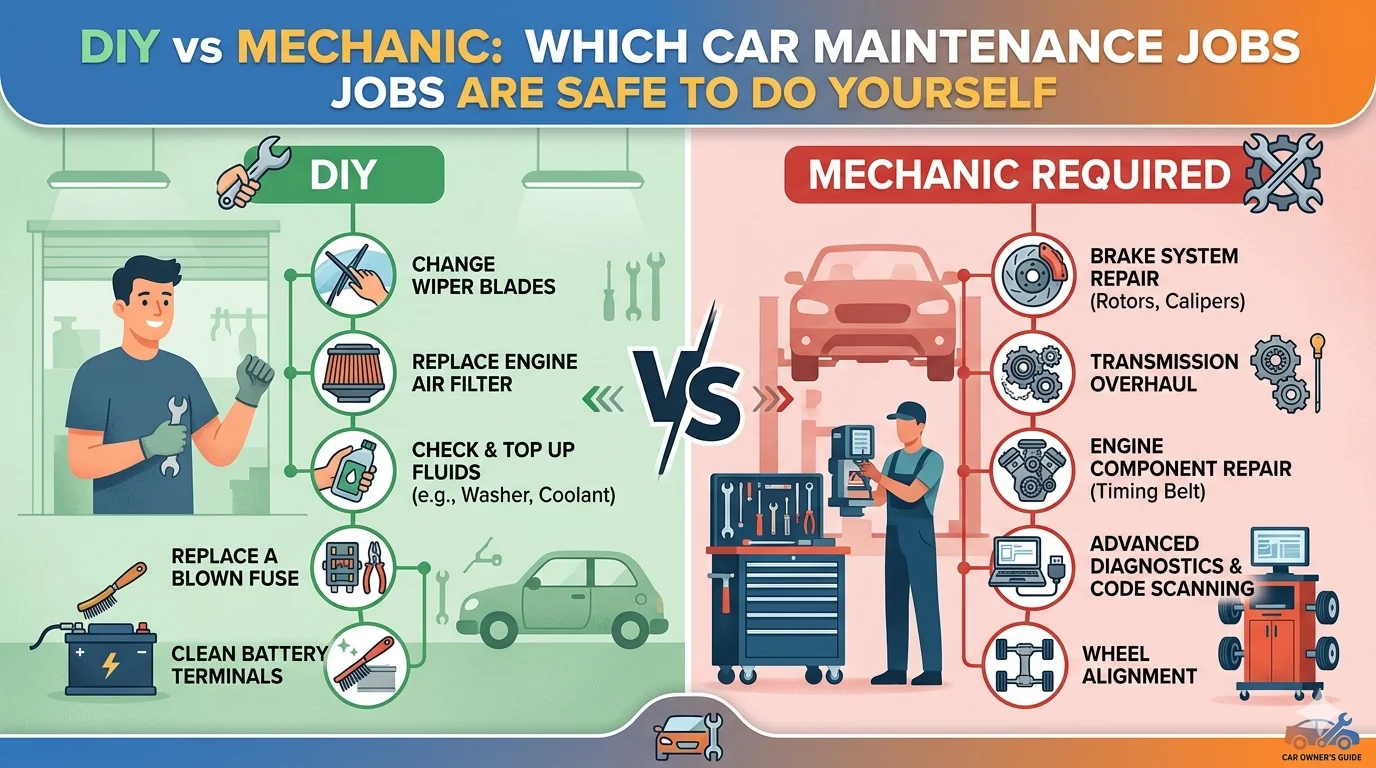
DIY vs Mechanic: Which Car Maintenance Jobs Are Safe to Do Yourself
In this article
- The DIY-Safe Jobs: Start Here
- Engine Air Filter
- Cabin Air Filter
- Windshield Wipers
- Exterior Bulbs
- Battery Swap
- DIY Oil Change: The Math
- Intermediate Jobs: Doable With the Right Tools and Patience
- Brake Pads (Front)
- Spark Plugs
- Coolant Flush
- Tools Every Alberta Car Owner Should Have
- The Cold Garage Problem: Alberta-Specific Considerations
- Leave These to the Professionals
- Timing Belt or Timing Chain
- Transmission Servicing
- Suspension and Alignment
- ADAS Calibration (Camera and Radar Systems)
- When YouTube Gets It Wrong: Model-Specific Gotchas
- The Decision Framework: When to DIY, When to Call
- Building Your Maintenance Confidence Over Time
- Related Buyer Guides
- Compare and Apply
Check Your Options in 3 Minutes
No credit impact. All credit situations welcome.
5.0118+ Google ReviewsAMVIC LicensedFree Delivery 300km
There's a moment every car owner faces: you're quoted $380 for an oil change and tire rotation at the dealership, and you think — "I could just do this myself." Sometimes you're right. Sometimes you're about to pull out a bolt you'll spend two hours trying to get back in while your hands freeze in a January garage. Knowing where the line is between smart DIY and expensive overconfidence is one of the most valuable skills you can develop as a vehicle owner.
The DIY-Safe Jobs: Start Here
These are the jobs where the risk of serious damage is low, the tools required are minimal, and YouTube actually works — as long as you find a video for your specific year, make, and model. Doing these yourself routinely can save you $600–$1,200 per year depending on your vehicle.
Engine Air Filter
This is the single best starting point for any new DIY mechanic. On most vehicles it takes five minutes, requires no tools, and the filter costs $15–$30 at any auto parts store. A shop will charge $30–$60 just for the part plus labour. The filter is almost always under the hood in a black plastic box — open the clips, pull out the old filter, drop in the new one. Done. Replace it every 20,000–30,000 km or when it looks visibly grey and packed with debris.
Cabin Air Filter
Often forgotten but equally easy. This filter sits behind your glove box or under the dash and keeps dust and allergens out of the interior. On most Civics, Corollas, and RAV4s, it's a 10-minute job: open the glove box, squeeze the sides to drop it down, pull the old filter, insert the new one. Cost: $15–$25 DIY vs $50–$80 at a shop. If you drive on gravel roads or in dusty conditions — common if you're commuting through rural Alberta — replace it annually.
Windshield Wipers
There is genuinely no reason to pay a shop to swap your wipers. New blades are $20–$40 a pair, and every auto parts store will install them for free if you buy there. In Alberta, replacing wipers twice a year — fall (switch to winter blades) and spring (switch back to all-season) — is the right cadence. Winter blades have a solid rubber frame that doesn't pack with ice. Don't skip this: a smeared windshield on the QE2 in a February blizzard is a serious visibility hazard.
Exterior Bulbs
Headlights, tail lights, brake lights, and turn signals are almost always DIY-accessible on older vehicles. The bulb costs $5–$20, and a standard Phillips screwdriver is usually all you need. The caveat: newer vehicles (post-2015, especially European brands) are increasingly moving to sealed LED assemblies that require bumper removal or specialized tools. Check your owner's manual before assuming it's simple. If it requires pulling a headlight housing that's sealed to the bumper cover — leave it.
Battery Swap
A dead battery is a $180–$250 shop visit — or a $100–$160 part plus 20 minutes of your time. The job itself is straightforward: disconnect the negative terminal first, then positive, remove the hold-down bracket, lift out the old battery, drop in the new one, reconnect positive first, then negative. The only real risks are shorting the terminals (keep a rag handy) and losing your radio presets. Some newer vehicles require a battery registration procedure after a swap — BMWs and Mercedes especially — which can affect charging system calibration. If your vehicle has a "smart" charging system, look this up before you start.
DIY Oil Change: The Math
An oil change is the poster child for DIY savings. Here's the honest breakdown:
| Vehicle Type | DIY Cost (oil + filter) | Shop Cost | Annual Savings (4x/year) |
|---|---|---|---|
| 4-cylinder sedan (5L) | $35–$45 | $80–$110 | $140–$260 |
| V6 SUV (6L) | $45–$60 | $90–$130 | $120–$280 |
| V8 truck (8L) | $60–$80 | $110–$150 | $120–$280 |
| Full synthetic (any) | Add $15–$25 | Add $30–$50 | Similar savings |
You'll need: an oil drain pan, an oil filter wrench, a socket set (typically 14–17mm drain plug), a funnel, and ramps or jack stands. Alberta-specific note: used motor oil cannot go in household recycling. Take it to any Canadian Tire, Mr. Lube, or Kal-Tire — they accept it for free. Do not pour it down a drain or leave it in your alley. It's an environmental violation with real fines.
Intermediate Jobs: Doable With the Right Tools and Patience
These jobs are within reach for a mechanically confident DIYer, but they have meaningful failure modes. Research your specific vehicle thoroughly. One wrong step — skipping a torque spec, forgetting a crush washer — can turn a $200 job into a $1,500 repair.
Brake Pads (Front)
Replacing front brake pads is one of the most economically impactful things you can do yourself. A shop charges $200–$350 per axle for parts and labour. DIY cost for quality pads: $40–$90. You'll need: a jack and jack stands (never work under a vehicle supported only by a floor jack), a C-clamp or brake caliper tool to compress the piston, and the right socket set. The process: remove the wheel, unbolt the caliper, hang it with a wire so it doesn't stress the brake line, remove the old pads, compress the caliper piston, install new pads, and reassemble. Always replace pads in pairs — both wheels on the same axle. If your rotors are scored or below minimum thickness (check with a micrometer), they need replacement too. A thorough brake inspection before the job is worth the time.
Spark Plugs
Spark plugs on 4-cylinder engines with a straight, accessible head are straightforward. On V6s and V8s — particularly those with coil-on-plug setups or plugs hidden under intake manifolds — it gets substantially more complex. The job: remove the ignition coil (usually one bolt plus a clip), use an extension bar and spark plug socket to remove the old plug, gap the new plug to spec, install hand-tight, then torque to spec. Over-tightening is the most common mistake — it can crack the plug or strip the head threads, which is a catastrophic outcome. If your engine requires intake manifold removal to reach the rear plugs (common on V6 minivans and transverse-mounted V6 SUVs), this is intermediate-to-advanced territory.
Coolant Flush
Modern coolant lasts 5 years or 150,000 km in many vehicles, but when it's time, a flush matters. Degraded coolant becomes acidic and attacks aluminum components — manifold gaskets, water pump housings, heater cores. The DIY job: drain old coolant, flush with distilled water, refill with the correct coolant type for your vehicle. The critical gotcha: your vehicle uses either OAT (orange, red, or yellow), HOAT (pink), or traditional green coolant — and mixing types causes gel precipitation that blocks coolant passages. Check your owner's manual, not just the colour at the store. Alberta's temperature swings (-35°C to +35°C) mean your coolant concentration needs to cover -45°C minimum — buy pre-mixed for climate zones or test with a refractometer.
Tools Every Alberta Car Owner Should Have
- Floor jack + 2 jack stands — minimum $150 investment. Never skip the stands.
- Socket set, metric and imperial — 3/8" drive covers 90% of tasks
- Torque wrench — non-negotiable for brake work and spark plugs
- Oil filter wrench — the universal kind, not vehicle-specific
- Multimeter — diagnose battery and alternator issues in minutes
- OBD-II scanner — $30–$80 tool that reads check engine codes before you visit a shop
- Breaker bar — Alberta's freeze-thaw cycles seize fasteners. You will need this.
The Cold Garage Problem: Alberta-Specific Considerations
Working on a car in a Canadian winter garage is not the same as watching a YouTube video filmed in a sunny California driveway. A few realities:
Unheated garage, sub-zero temps: Fluids become thick and hard to drain cleanly. Your hands lose dexterity in minutes. Metal contracts, making seized bolts even harder. If your garage is unheated and it's -20°C outside, do not attempt brake work — cold rotors are brittle and numb hands make torque control impossible. Wait for a warming trend or rent time at a heated space (some shops offer lift rental by the hour).
Cold soak affects torque specs: Many torque specs are specified at room temperature. At -30°C, aluminum components behave differently. This is particularly relevant for oil drain plugs on aluminum pans — over-tightening when cold, then the metal expands when warm, is a common cause of stripped threads.
Battery voltage drops in cold: If you're doing any electrical diagnostics, do them when the vehicle has been sitting at ambient temperature for at least 2 hours. A battery that reads 12.4V at -25°C is not the same health as 12.4V at +10°C. The cold weather battery guide covers load testing, which is a far more accurate measure than resting voltage.
Tire pressure swings: For every 10°C drop in temperature, tires lose roughly 1 PSI. In Alberta, an overnight temperature swing from +5°C to -25°C — 30°C — drops tire pressure by 3 PSI. This trips TPMS warnings constantly in fall. Understanding this pattern saves unnecessary trips to the shop. Seasonal tire care in Alberta is genuinely different from what the average how-to guide assumes.
Leave These to the Professionals
These jobs exist in a different category entirely. The risk of catastrophic failure — to the vehicle, to your safety, or to other road users — is high enough that amateur execution is not justified by cost savings.
Timing Belt or Timing Chain
On interference engines (most modern 4-cylinders), a timing belt or chain that breaks or slips causes piston-to-valve contact and destroys the engine. The timing belt itself is $30–$80. The labour to access it properly — often requiring engine mount removal, harmonic balancer removal, and disassembly of multiple covers — is 3–8 hours. If a professional misaligns the timing by even one tooth, the engine fires incorrectly or fails on startup. There is no economically justifiable DIY argument for this job. Pay a shop. It's $600–$1,200 well spent.
Transmission Servicing
A fluid drain-and-fill on an automatic transmission is borderline doable for a careful DIYer. A full flush, line pressure test, solenoid cleaning, or any internal work is not. Automatic transmissions are hydraulically complex with hundreds of failure modes — and many require proprietary diagnostic tools to check shift pressures and adaptation tables after service. Transmission maintenance is the one area where paying for dealer expertise often saves money long-term.
Suspension and Alignment
Replacing struts, control arms, or ball joints is possible at the DIY level with the right tools and knowledge. But here's the thing: after any suspension component replacement, the alignment changes. A vehicle with incorrect alignment will eat your new tires unevenly in months — a $700 loss — and may pull or handle dangerously. Alignment requires a machine, full stop. So if you replace struts yourself, you still need a $120–$180 alignment at a shop afterward. Factor that into your cost calculation.
ADAS Calibration (Camera and Radar Systems)
If your vehicle has lane departure warning, automatic emergency braking, or adaptive cruise control, replacing a windshield, front bumper, or any camera/radar component requires recalibration. This is computer-controlled and requires a target board, specialized software, and precise alignment. Getting it wrong means a system that triggers incorrectly at highway speeds or doesn't trigger at all when you need it. Do not skip this step.
When YouTube Gets It Wrong: Model-Specific Gotchas
Generic tutorials miss the details that matter. A few real examples of where confident DIYers get burned:
Ford F-150 5.4L spark plugs: The two-piece plug design used in the mid-2000s engines is notorious for breaking in half during removal, leaving the ceramic and electrode stuck in the head. The proper procedure requires soaking with penetrant for 24+ hours with the engine hot, then cold. Many shops refuse to quote a flat rate on this job. If you own a 2004–2008 F-150, research this before you commit.
Toyota Tacoma rear drum brakes: Some owners discover their Tacoma has rear drums, not discs — and the adjuster mechanism and springs are not intuitive. First-timers frequently reassemble them incorrectly and get a brake that doesn't engage properly. Watch a Tacoma-specific video, not a generic drum brake tutorial.
Honda Civic oil drain plug torque: The spec is 29 ft-lb. New owners who've only worked on trucks (where 50+ ft-lb is normal) strip the aluminum pan threads on the first change. Crush washers must be replaced every time — reusing them causes slow leaks that aren't immediately obvious.
The fix is simple: search "[year] [make] [model] [job] DIY problems" before you start. Read the forum threads. The people who've already broken things have documented exactly what to avoid.
The Decision Framework: When to DIY, When to Call
Run through this before every job:
- What's the failure mode? If the worst case is a slow oil leak, that's manageable. If the worst case is brake failure at highway speed, it's not.
- What tools do I actually have? Don't start a job that requires a tool you'll need to buy — add the tool cost to your comparison.
- Is there a model-specific issue I should know about? Spend 20 minutes researching before touching anything.
- What's the true cost delta? On a $120 shop job, saving $60 is meaningful. On a $2,000 job, saving $500 while risking a $5,000 engine rebuild is not.
If you're looking at a used truck's real maintenance costs or thinking about how DIY capability factors into the total cost of ownership, the math changes significantly when you can handle the routine stuff yourself. And if you're ever weighing whether repairs justify keeping a vehicle or it's time to move on, the high-mileage vehicle extension guide lays out that calculus in detail.
Building Your Maintenance Confidence Over Time
The smartest approach is to build your DIY repertoire progressively. Start with the zero-risk jobs: air filters, wipers, bulbs. Do those a few times until they're reflexive. Then move to oil changes — do it three or four times until the process is comfortable and you've learned your vehicle's quirks. Then tackle brake pads with a friend present the first time. Each job you learn compounds: you get faster, you understand your car better, and you'll catch problems early that would otherwise go unnoticed until they're expensive.
A well-maintained used vehicle keeps its trade-in value far better than a neglected one. If you're thinking about that long-term picture — whether to invest in maintenance or consider a trade — understanding the Alberta vehicle maintenance fundamentals gives you the baseline you need to make that call intelligently.
When it's time for your next vehicle, whether you're upgrading or just want a reliable starting point, explore your financing options with us. We work with all credit situations, and our multi-lender model means we're finding you the best available rate — not the first rate that works. Browse our Honda Civic inventory if fuel efficiency and low-maintenance reliability are your priorities, or visit us at our Airdrie dealership for a no-pressure conversation about what fits your situation.
Compare and Apply
- Bad Credit Car Loans — Complete Guide — auto loans for all credit situations
Financing Resources
Cars you could drive home
See all inventory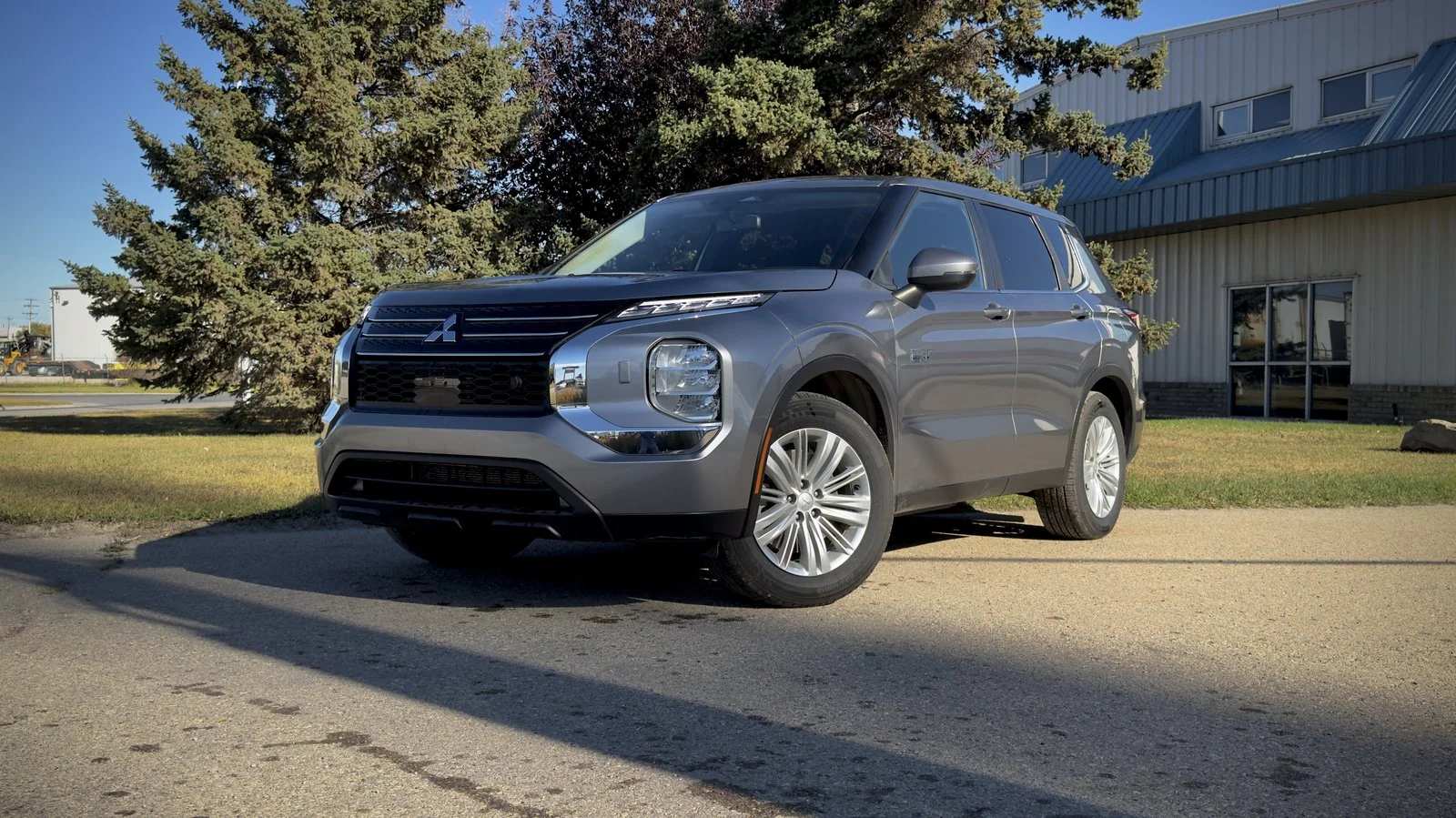
2023 Mitsubishi Outlander ES PHEV
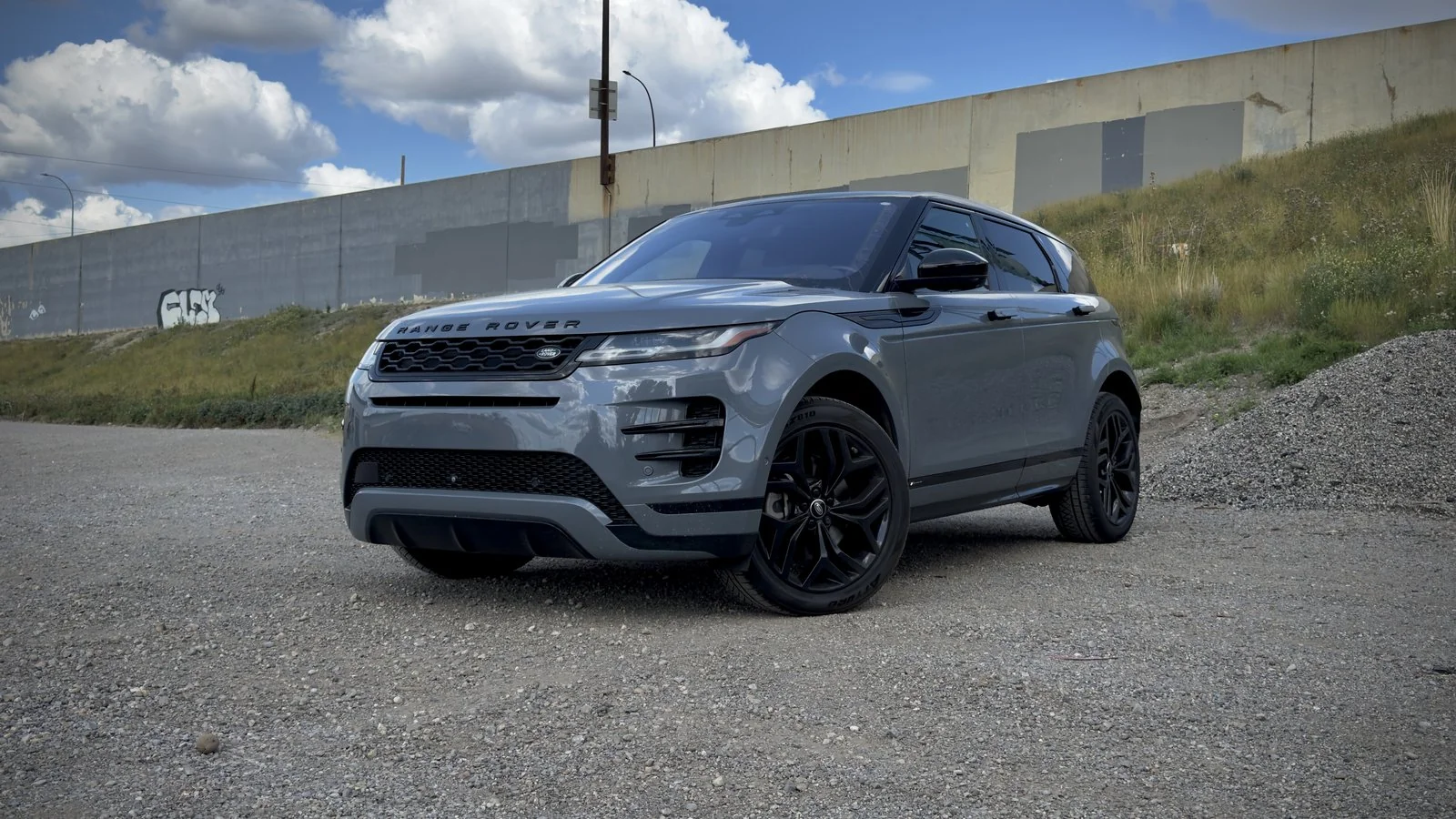
2021 Land Rover Range Rover Evoque R-Dynamic HSE
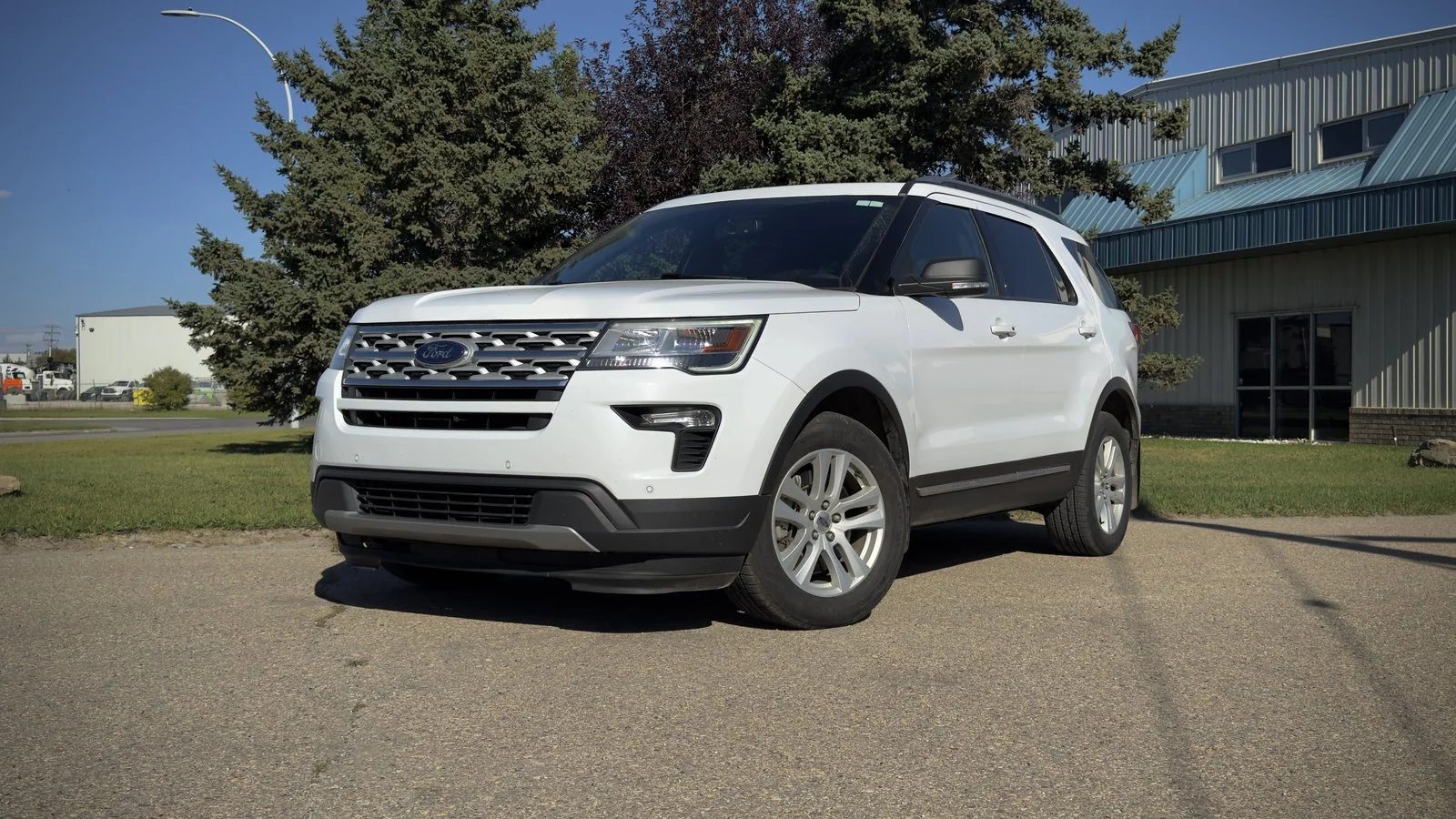
2019 Ford Explorer XLT
Not seeing it? We'll find it.
We source through our dealer partner network across Western Canada: 25,000+ vehicles to choose from. Tell us what you want and what works for your budget.
Find my car3 min · no credit impactOAC = on approved credit. Payments are examples at 6.49% APR over 84 months with $0 down, based on each vehicle's advertised price; GST extra. Your rate depends on your credit (4.99%–29.9% APR).
Related Articles


Ready to Find Your Vehicle?
Browse our inventory or apply for financing. All credit situations welcome.
5.0118+ Google ReviewsAMVIC LicensedFree Delivery 300km