
Living in Airdrie, Commuting to Calgary: Best Vehicles for the QE2
In this article
- The Numbers Behind the QE2 Commute
- Best Vehicles for the Solo Commuter: Fuel-Efficient Sedans
- Toyota Corolla
- Honda Civic
- Mazda3
- Best Vehicles for Family Commuters: SUVs with Room to Live
- Toyota RAV4
- Honda CR-V
- Mazda CX-5
- Best Vehicles for Trades Workers: Trucks That Earn Their Keep
- Fuel Cost Comparison: A Full Year on the QE2
- The Airdrie Advantage: Why the Commute Is Worth It
- Carpooling and Park-and-Ride Options
- Winter Commuting Safety on Highway 2
- Depreciation and Resale Value for Commuter Vehicles
- Commuter Vehicle Shopping Checklist
- Do You Even Need a Car in Airdrie?
- How to Finance Your Commuter Vehicle
- Related Buyer Guides
- Compare and Apply
Check Your Options in 3 Minutes
No credit impact. All credit situations welcome.
5.0118+ Google ReviewsAMVIC LicensedFree Delivery 300km
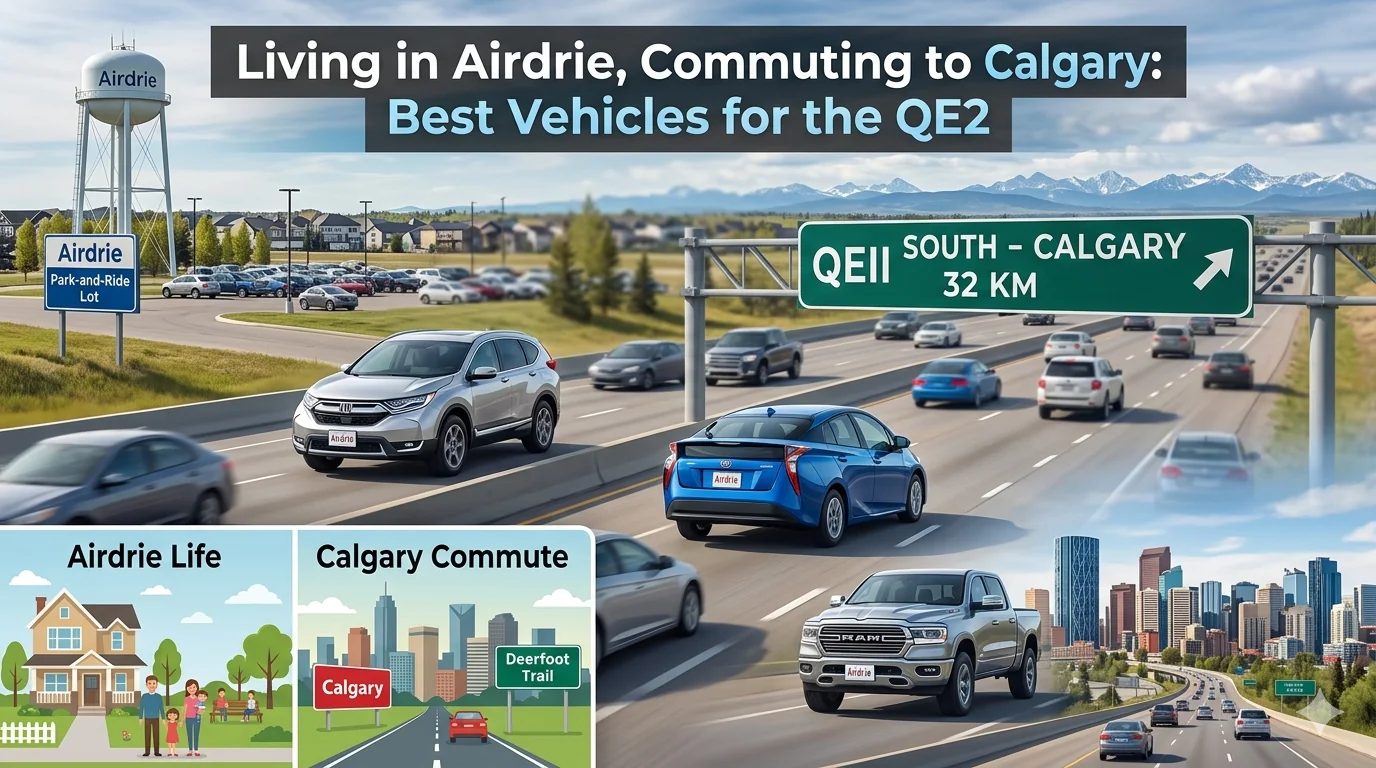
If you bought in Airdrie for the price, the space, or the quieter pace — welcome to the QE2 commuter club. On a clear Tuesday in July, you're in Calgary in 25 minutes. On a February morning when Transport Alberta has issued a highway advisory and every semi between Balzac and Deerfoot is doing 80 km/h? Budget an hour and bring coffee. The commute is real, the savings are real, and the vehicle you drive makes a bigger difference than most people realize — in safety, in fuel costs, and in how much you dread Monday mornings.
The Numbers Behind the QE2 Commute
Let's start with some math. The drive from central Airdrie to downtown Calgary runs roughly 45–55 km depending on your route and final destination. Round trip: 90–110 km per day. At 230 working days a year, that's approximately 20,700–25,300 km in commuting alone — before groceries, hockey practice, or weekend trips to Canmore.
That annual distance matters a lot when you're shopping for a used vehicle. A car putting on 25,000+ km per year of mostly highway driving is wearing differently than the same car doing 12,000 km in stop-and-go city traffic. Highway driving is gentler on brakes and transmissions but harder on fuel systems and tires. It also means you'll hit mileage thresholds faster — plan for that when budgeting for maintenance.
Key insight: A 5-year commute vehicle out of Airdrie will accumulate 125,000+ km from commuting alone. Factor total lifetime mileage — not just age — into your vehicle choice.
Fuel costs are the other big variable. The difference between a vehicle averaging 7.5 L/100km and one averaging 10.5 L/100km works out to roughly $750–$1,000 per year at current Alberta fuel prices (assuming ~$1.55/L average across seasons). Over five years, that's $3,750–$5,000 — not nothing when you're also carrying a car payment.
Best Vehicles for the Solo Commuter: Fuel-Efficient Sedans
If you're driving solo — no car seats, no hockey bags, no tools — the economics strongly favour a fuel-efficient compact sedan. These cars are cheap to insure, cheap to maintain, and built to rack up highway kilometres without complaint.
Toyota Corolla
The Toyota Corolla is the gold standard for reason: it genuinely holds up. Highway fuel economy sits around 6.5–7.0 L/100km for most model years from 2015 onward. Reliability data consistently puts Corolla near the top of the compact segment. Parts are cheap and available everywhere in Calgary. The ride isn't exciting, but on Highway 2 at 6:45 a.m., exciting is not what you're looking for.
Honda Civic
The Honda Civic offers slightly sportier dynamics and, depending on the trim and year, comparable or better fuel economy than the Corolla. The 1.5T engine in the 2017+ models is more fun to drive but has had some known issues — worth getting a pre-purchase inspection on any turbo-equipped Civic from that era. Earlier naturally-aspirated models are simpler and rock-solid.
Mazda3
The Mazda3 is the dark horse in this category. It drives better than both the Corolla and Civic, has strong reliability ratings, and Mazda's Skyactiv engines are among the most fuel-efficient naturally-aspirated units available. If you want the commute to feel less like a chore, the Mazda3 is worth the premium over a similarly-aged Corolla.
| Vehicle | Avg. Highway Fuel Economy | Est. Annual Fuel Cost (25,000 km) | Reliability Tier |
|---|---|---|---|
| Toyota Corolla (2017+) | 6.5 L/100km | ~$2,519 | Excellent |
| Honda Civic (2016+) | 6.8 L/100km | ~$2,635 | Very Good |
| Mazda3 (2014+) | 7.0 L/100km | ~$2,713 | Very Good |
| Mid-size SUV (avg.) | 9.5 L/100km | ~$3,681 | Varies |
| Full-size Truck (avg.) | 12.5 L/100km | ~$4,844 | Varies |
Fuel cost estimates based on 25,000 km/year at $1.55/L average. Highway-weighted mix assumed.
Best Vehicles for Family Commuters: SUVs with Room to Live
Not everyone commutes alone. If you're loading car seats in the dark, dropping kids at daycare before hitting the QE2, or hauling gear for after-school activities, the compact sedan calculus changes. You need space, reliability, and a back seat that doesn't make a seven-year-old miserable.
Toyota RAV4
The Toyota RAV4 dominates this category for a reason. It's spacious enough for two car seats plus groceries, AWD is standard on most trims (genuinely useful on a snow-covered QE2), and it holds its reliability reputation across generations. The 2013–2018 models offer excellent value used; the 2019+ refresh improved ride quality and tech. Annual fuel costs will run roughly $1,000–$1,500 more than a Corolla, but the utility trade-off is real.
Honda CR-V
The Honda CR-V is the other perennial choice in this segment. Interior packaging is genuinely impressive — more rear legroom and cargo space than it looks from outside. The 1.5T engine in 2017+ models is efficient (around 7.5–8.0 L/100km highway) but had some early oil dilution issues in cold climates; worth noting for an Alberta context. The pre-turbo models (pre-2017) are simpler and still plenty capable.
Mazda CX-5
If the RAV4 and CR-V feel generic, the Mazda CX-5 punches above its weight on interior quality and driving dynamics. It's notably more car-like to drive than either of its Japanese competitors, which matters on a daily 50-km highway grind. Fuel economy is competitive, and Mazda's reliability track record is strong.
Best Vehicles for Trades Workers: Trucks That Earn Their Keep
If you're a tradesperson commuting from Airdrie to a Calgary job site, a pickup truck isn't a preference — it's often a tool requirement. The question is which one, at what mileage, and whether the fuel cost is offset by what you're doing with the box.
A full-size half-ton averages 12–14 L/100km on the highway with a regular load. At 25,000 km/year, you're spending $4,650–$5,425/year on fuel compared to $2,500–$2,700 for a compact car. That's a $2,000–$2,700 annual premium for the utility. If the truck is genuinely working — hauling tools, pulling a trailer, getting on job sites — that premium pays for itself. If you're driving an empty truck bed to a desk job, you're paying $2,000+/year extra for the image.
For Airdrie-to-Calgary trades commuters, the most cost-effective approach is often a mid-size truck if your hauling needs allow it. The Toyota Tacoma, for instance, averages 10–11 L/100km highway — significantly better than a half-ton — and has the best long-term resale value in the segment. For heavier hauling or larger crews, a used Ford F-150 with the EcoBoost V6 or a RAM 1500 with the eTorque system offer better fuel economy than older V8 options.
Fuel Cost Comparison: A Full Year on the QE2
Here's what 25,000 km of Airdrie-Calgary commuting costs in fuel across different vehicle types, assuming $1.55/L:
| Vehicle Type | Typical L/100km | Annual Fuel Cost | 5-Year Fuel Cost |
|---|---|---|---|
| Fuel-efficient compact | 6.5–7.0 | $2,519–$2,713 | $12,594–$13,563 |
| Compact SUV / Crossover | 8.0–9.0 | $3,100–$3,488 | $15,500–$17,438 |
| Mid-size SUV | 9.5–11.0 | $3,681–$4,263 | $18,406–$21,313 |
| Mid-size truck | 10.5–12.0 | $4,069–$4,650 | $20,344–$23,250 |
| Full-size truck (V6) | 11.5–13.0 | $4,456–$5,038 | $22,281–$25,188 |
| Full-size truck (V8) | 13.0–15.0 | $5,038–$5,813 | $25,188–$29,063 |
These numbers don't include insurance, tires, or maintenance — but they illustrate why the vehicle choice matters. The spread between a compact and a full-size V8 truck is over $3,000/year in fuel alone. See our total cost of car ownership guide for a fuller picture of what any vehicle actually costs per year.
The Airdrie Advantage: Why the Commute Is Worth It
Airdrie's median home price consistently runs $100,000–$200,000 below comparable Calgary properties. For a family buying at $500,000 instead of $650,000 with a 5% down payment, that's roughly $740/month in mortgage savings over a 25-year amortization at current rates. Even after accounting for $250–$350/month in extra fuel costs and vehicle depreciation, the math often still favours living in Airdrie — particularly for families with school-aged children who benefit from Airdrie's newer suburban schools and quieter streets.
That said, the commute cost is real and belongs in your budget. Use our affordability calculator to see how different vehicle costs stack up against your income before you commit to a vehicle payment plus commuter fuel costs.
Carpooling and Park-and-Ride Options
Airdrie has two park-and-ride lots connected to Calgary Transit: the Yankee Valley Park and Ride and Airdrie North Park and Ride. Both offer free parking and connect to Calgary Transit bus routes into the city. For solo commuters whose companies offer downtown parking subsidies anyway, driving all the way in often makes more sense — but if you're paying $200–$300/month for downtown parking, the park-and-ride economics can flip the equation significantly.
For carpooling, Airdrie's Neighbourhood Facebook groups and commuter boards are active. Splitting the QE2 run with one other person cuts your fuel and wear costs in half — and the HOV lane access (on stretches with it) reduces commute time in peak hours.
Winter Commuting Safety on Highway 2
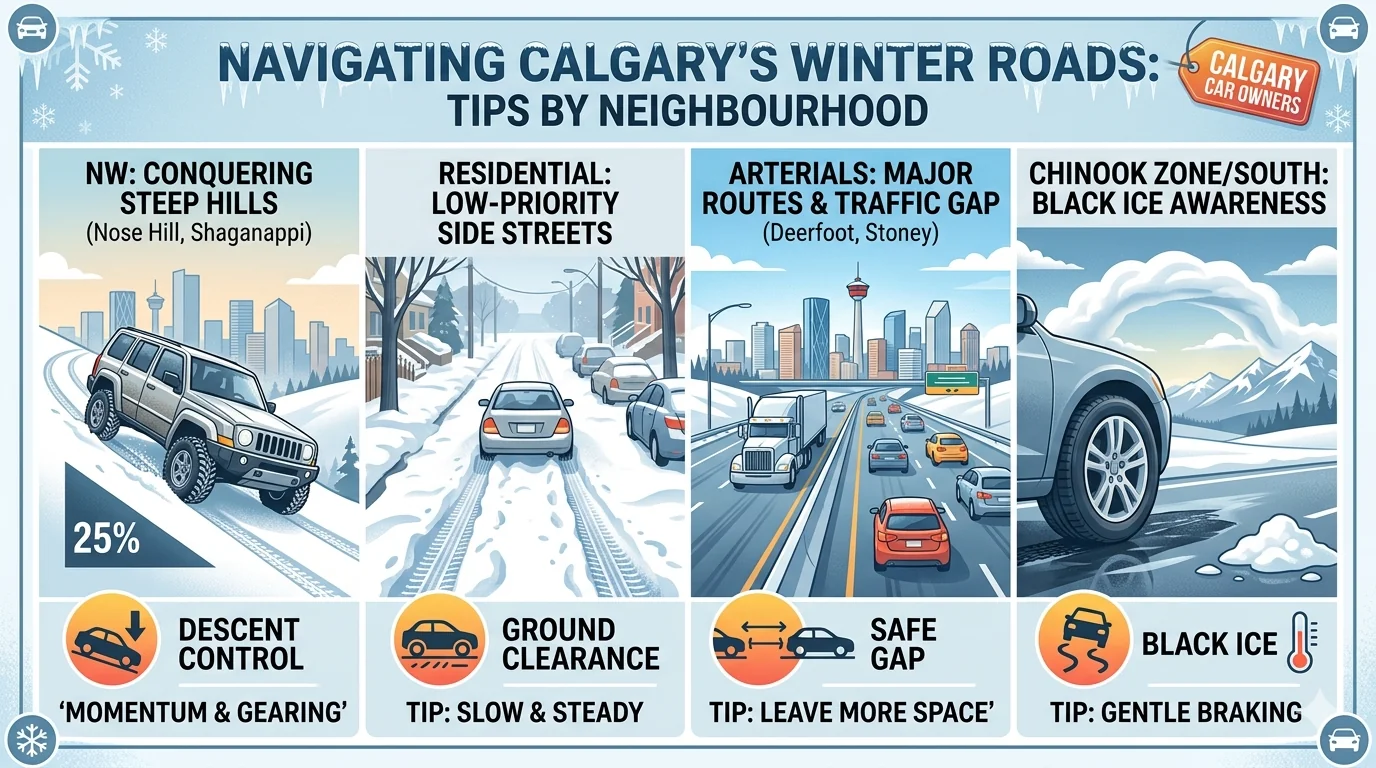
The QE2 between Airdrie and Calgary sees some of the worst winter driving conditions in the Calgary metro. It's open terrain — wind sweeps across it unimpeded — and the transition from city-maintained roads to highway can catch drivers off guard. A few non-negotiable truths for the winter commute:
- Winter tires are not optional. All-seasons are legal but they're not adequate. On black ice at Balzac or in a whiteout south of CrossIron, winter tires can be the difference between a close call and a collision. Our complete guide to winter tires in Alberta covers what to buy and why.
- AWD helps you go, not stop. AWD or 4WD improves traction on acceleration but does nothing for braking. On ice, an AWD vehicle without winter tires stops no better than a FWD car with them.
- Budget for a block heater. At -30°C, engines that don't start cost money and stress. Block heaters run $100–$200 installed. Our block heater guide covers installation and timers.
- Check road conditions before every winter drive. 511.alberta.ca is the real-time source. The QE2 can be fully closed with 15 minutes' notice in a bad storm.
- Leave a buffer in your car. An emergency kit (blanket, booster cables, sand, water, first aid) in the trunk is not excessive — it's standard for Alberta highway driving.
Winter highway safety is covered in detail in our post on Highway 2 winter driving safety — required reading for anyone new to the QE2 commute.
Depreciation and Resale Value for Commuter Vehicles
High annual mileage accelerates depreciation. A vehicle that would normally put on 18,000 km/year is accumulating 25,000+ km on an Airdrie commute — meaning it hits the 100,000 km mark in under four years instead of six. This changes both your vehicle's resale timeline and how you should think about financing term length.
There are two opposing forces here, and knowing how they interact saves real money:
- High-mileage vehicles depreciate faster in dollar terms — but the rate of depreciation as a percentage of value tends to slow once a vehicle crosses the 100,000 km mark. A well-maintained Corolla at 150,000 km sells for 60–70% of what it would at 80,000 km, not 40%. The market discounts high mileage but not linearly.
- Reliability history matters more than mileage milestones — a 200,000 km Corolla with full service records often beats a 130,000 km vehicle with an unknown history. For a commuter, the maintenance record is worth as much as the odometer reading.
If you're financing a commuter vehicle, consider shorter terms rather than stretching to 84 or 96 months. On a high-mileage vehicle, you want to own it outright before you hit the point where repair costs start competing with your payment. A $22,000 vehicle financed over 60 months builds equity faster and gets you to zero-owing while the car still has meaningful resale value.
Depreciation tip: For high-mileage commuter use, buy 2–4 years old rather than 1–2 years old. Let someone else absorb the steepest part of the depreciation curve. A 3-year-old Corolla that's been well maintained is a better commuter investment than a 1-year-old one at 30% more cost.
Models with the best resale value at high mileage for Alberta commuters: Toyota Corolla, Honda Civic, Toyota RAV4, and Mazda3. These hold value better at 150,000+ km than comparable vehicles from other manufacturers. If you're selling in 4–5 years with significant commuter mileage on the clock, brand choice at purchase genuinely affects what you pocket at the end.
Commuter Vehicle Shopping Checklist
Before you commit to a purchase, run this checklist specifically for commuter use. General used car advice covers some of this — but high annual mileage adds specific requirements that casual buyers miss.
- Check the maintenance history for interval compliance. On a commuter car, oil changes, tire rotations, and fluid services happen more frequently than on a low-mileage vehicle. A car doing 25,000 km/year should have records every 4–6 months. Gaps in records on a commuter car are a bigger red flag than gaps on a low-mileage vehicle.
- Verify timing belt or chain service. Many vehicles require timing belt replacement at 160,000–200,000 km. On a high-mileage commuter, verify this service has been done or budget for it. A timing belt failure can destroy an engine. Chain-driven engines (most modern vehicles) are less of a concern but still worth checking.
- Check tire age, not just tread. Tires more than 6 years old become a safety concern regardless of tread depth — rubber hardens and loses grip. A commuter car sitting on 7-year-old tires with good tread depth is still a tire replacement job. Look at the DOT date code on the sidewall (4-digit code: WWYY).
- Test the heat and AC properly. You'll use both systems every day. In winter, heat should be roasting within 5 minutes. In summer, AC should drop cabin temperature noticeably within 60 seconds. Don't accept "it works" — test it.
- Check for highway fatigue features. Adaptive cruise control, lane-keeping assist, and blind-spot monitoring don't just add comfort — on a 45-minute daily highway commute, they reduce driver fatigue meaningfully. 2018+ vehicles in the compact segment increasingly include these features. Factor it into your year-range decision.
- Budget a first-year maintenance reserve. When buying any used commuter vehicle, set aside $500–$1,000 for the first year. Tires, brakes, fluid services, and minor repairs catch up on high-mileage vehicles regardless of how clean the inspection was. Plan for it rather than being surprised by it.
Do You Even Need a Car in Airdrie?
Short answer for most residents: yes. Airdrie's transit options are limited, and Calgary Transit service into the city doesn't cover most Airdrie neighbourhoods directly. The detailed answer depends on your specific neighbourhood and job location — some people near the Airdrie bus routes can manage without a vehicle, but the majority of Airdrie residents need one for practical daily life.
If you're weighing the commute decision or choosing between vehicles, knowing that a car is essentially non-negotiable changes how you should approach the financing decision. This isn't a luxury — it's infrastructure.
How to Finance Your Commuter Vehicle
The good news: a practical commuter car doesn't have to be expensive. A 2016–2019 Toyota Corolla in solid shape can be found in the $15,000–$22,000 range. At $18,000 financed over 60 months at 9.99%, that's approximately $185/biweekly — before you factor in how much you're saving on mortgage by living in Airdrie instead of Calgary.
If your credit history has some bumps, that doesn't mean the commuter car isn't available to you. Our lenders work with all credit situations in Airdrie — including those rebuilding after a rough patch. Whether you're looking at a compact sedan for the fuel savings or need an SUV for the family, the right vehicle is out there. Check our guide to the cheapest cars to insure in Alberta to round out your total cost picture before you shop.
Ready to find your commuter vehicle? Start your financing application today — we'll match you with lenders who compete for your business and help you get on the QE2 with confidence.
Compare and Apply
- Best Subprime Dealers in Calgary (2026) — top bad credit car dealers Calgary 2026
- Best Bad Credit Car Dealers in Airdrie — top Airdrie dealerships for all credit situations
- Used Cars in Airdrie — Airdrie dealership — 100+ vehicles
Financing Resources
Cars you could drive home
See all inventory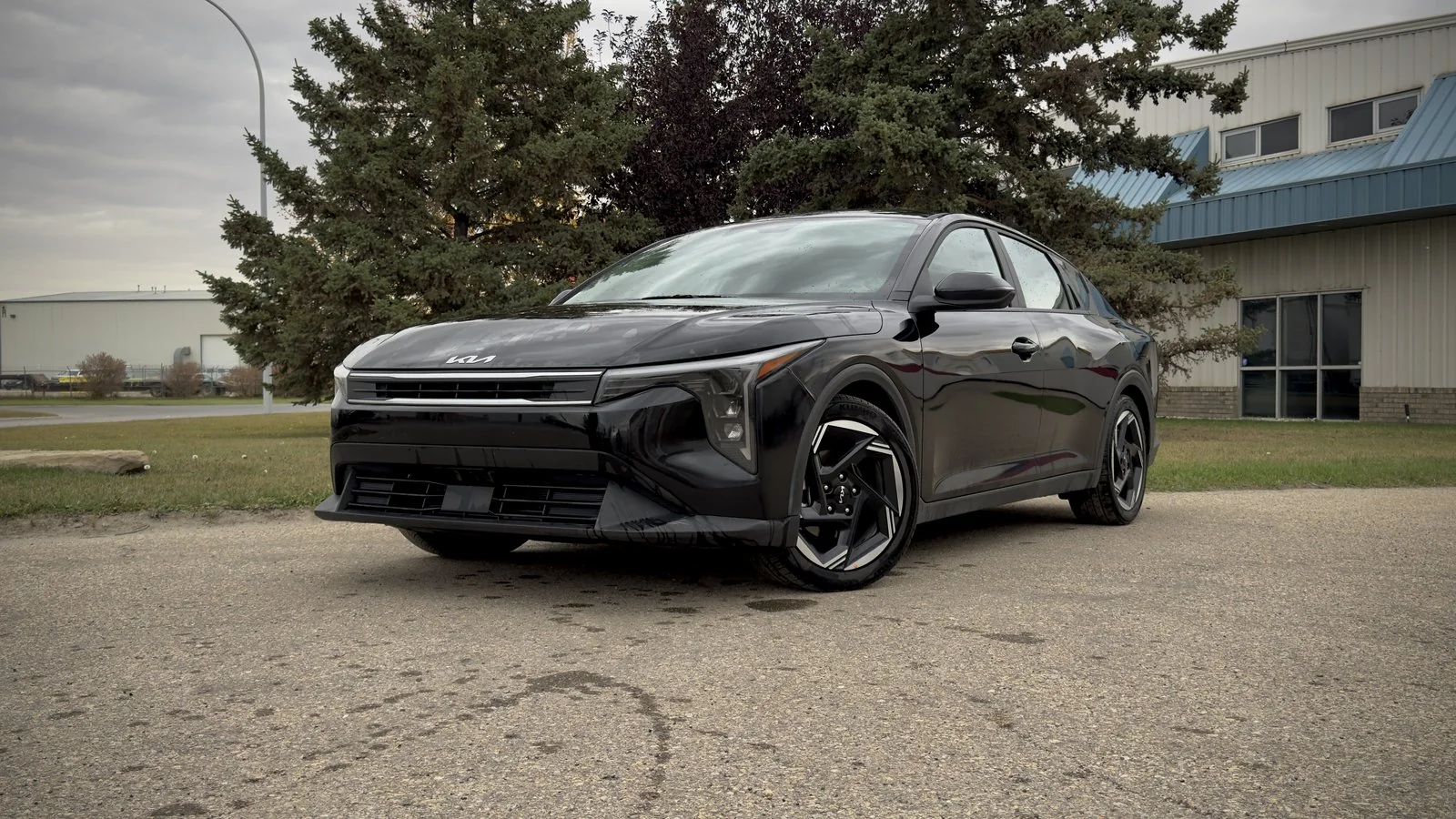
2025 Kia K4 EX
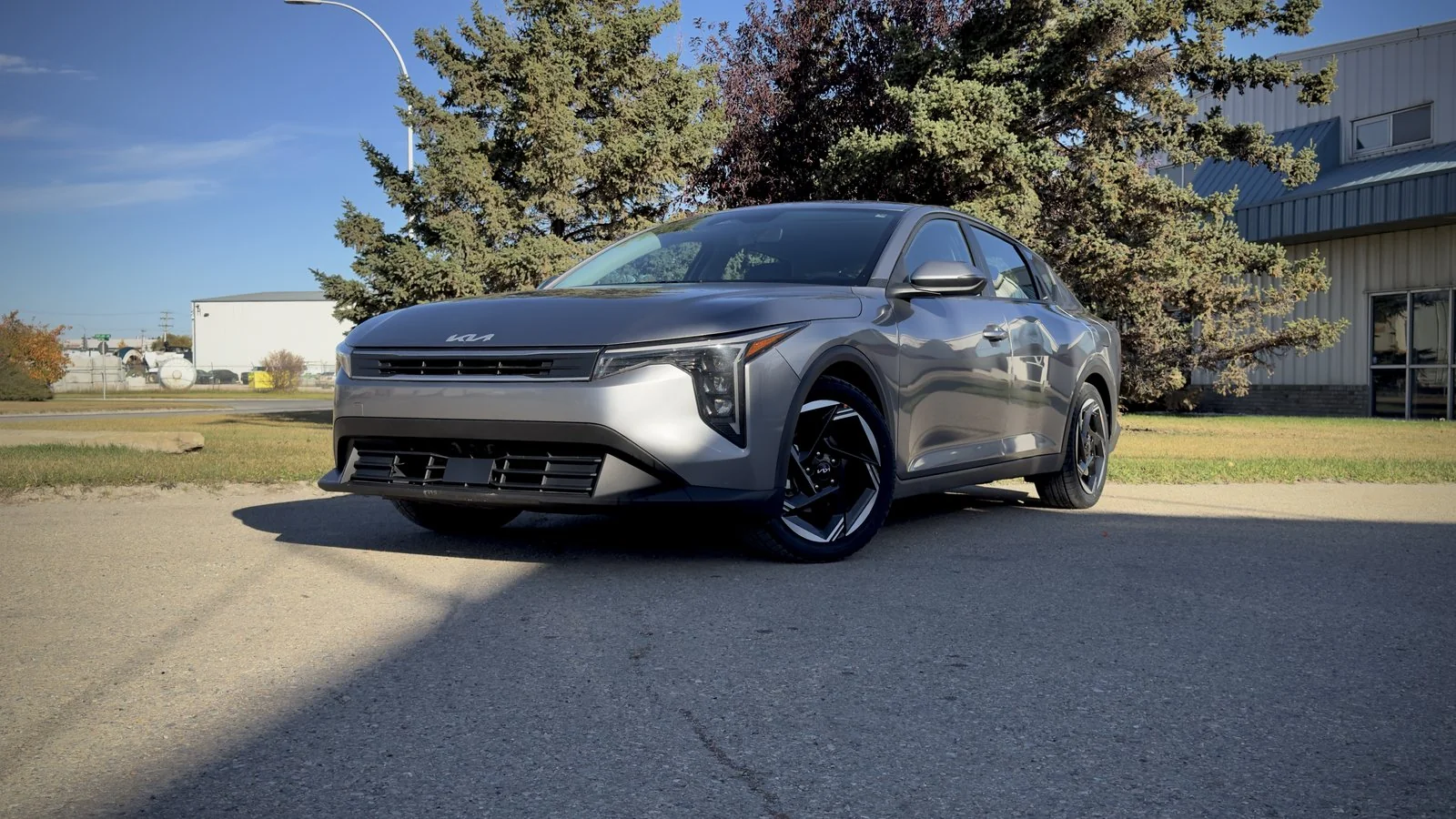
2025 Kia K4 EX
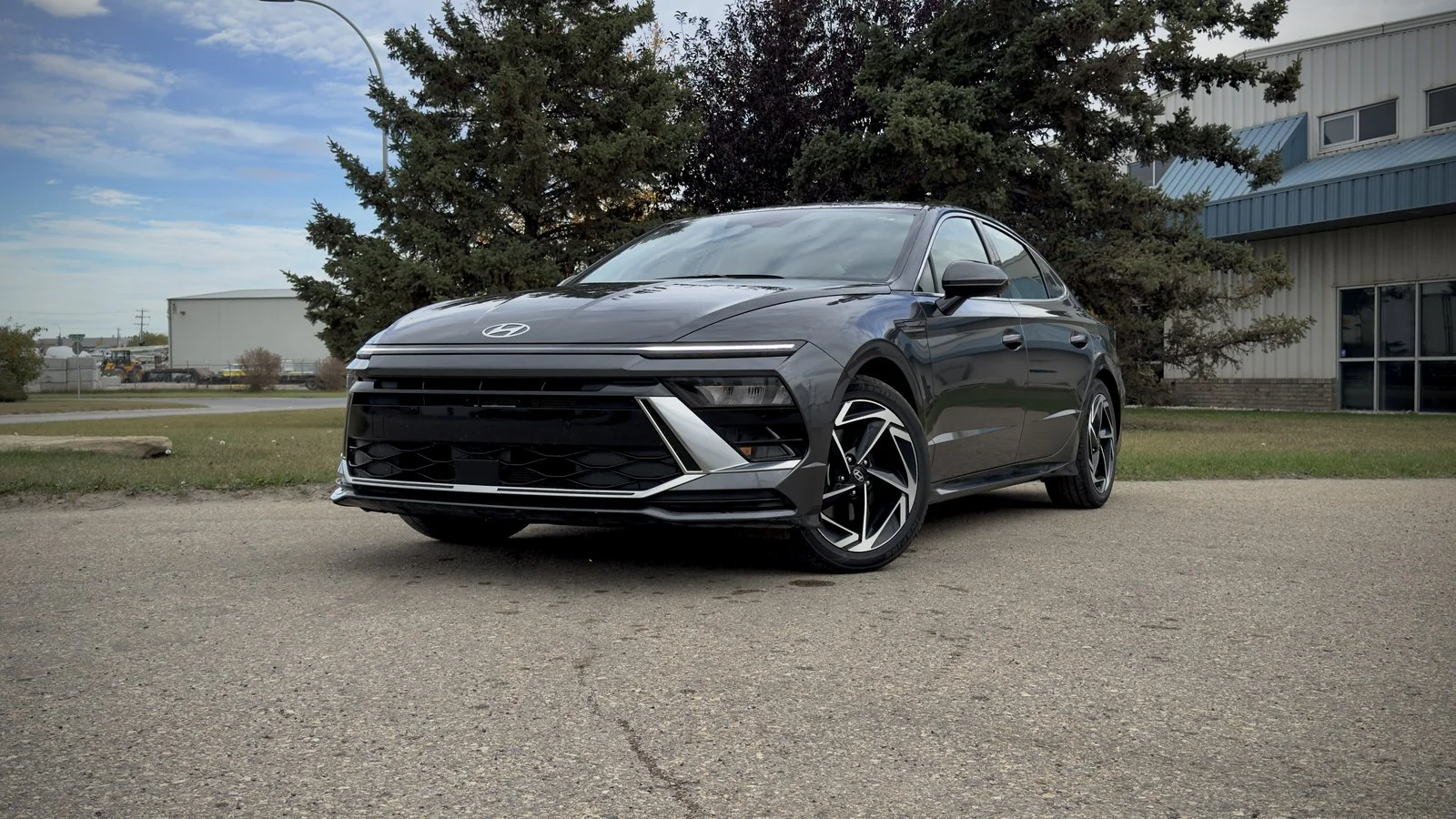
2025 Hyundai Sonata Preferred w/ Trend
Not seeing it? We'll find it.
We source through our dealer partner network across Western Canada: 25,000+ vehicles to choose from. Tell us what you want and what works for your budget.
Find my car3 min · no credit impactOAC = on approved credit. Payments are examples at 6.49% APR over 84 months with $0 down, based on each vehicle's advertised price; GST extra. Your rate depends on your credit (4.99%–29.9% APR).
Related Articles


Ready to Find Your Vehicle?
Browse our inventory or apply for financing. All credit situations welcome.
5.0118+ Google ReviewsAMVIC LicensedFree Delivery 300km