
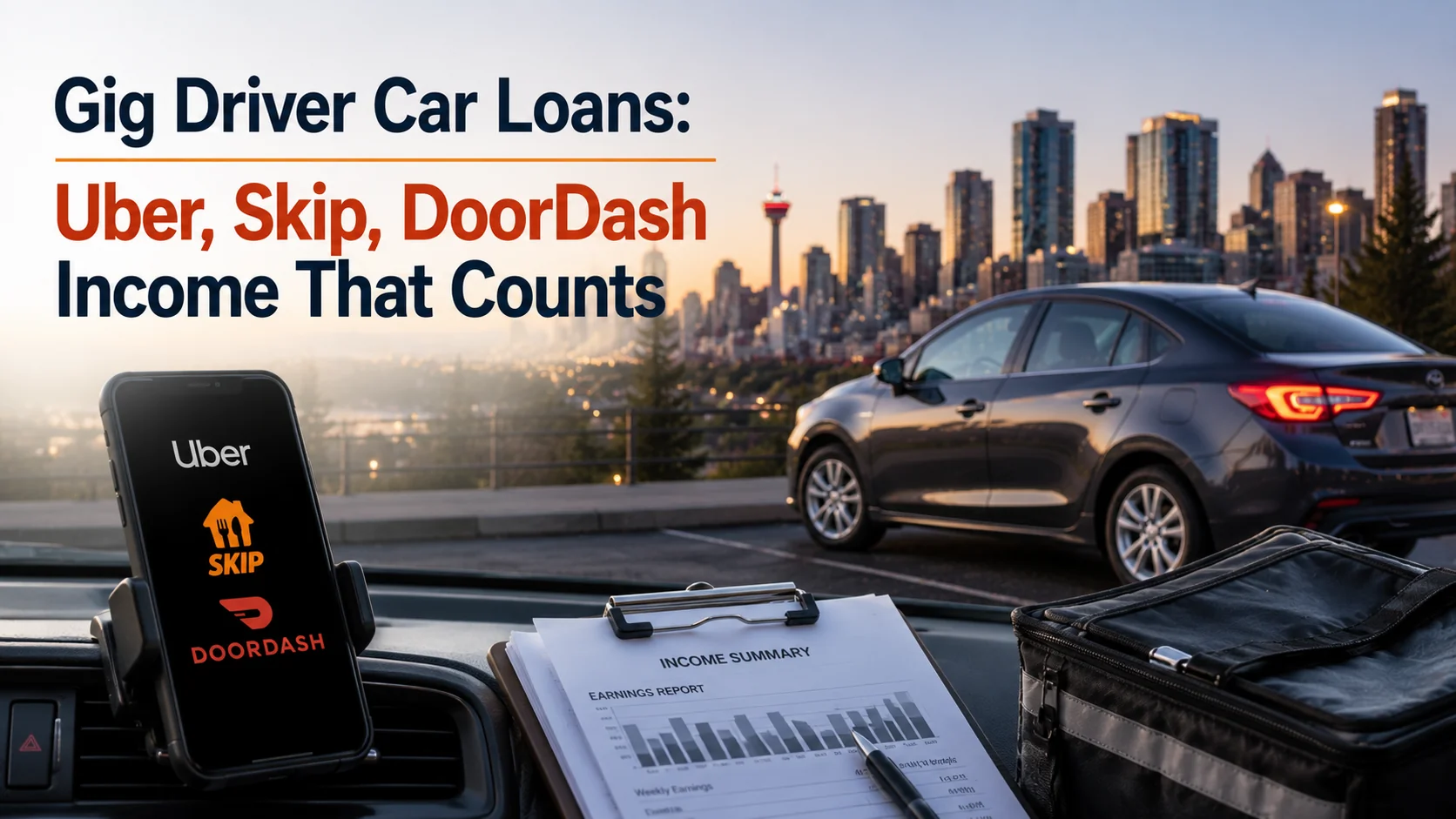
Gig Driver Car Loans: Uber, Skip, DoorDash Income That Counts
In this article
- Can Gig Drivers Get Car Loans in Alberta Using Uber, Skip, or DoorDash Income?
- Why Banks Say No — and Why Dealership Lenders Often Say Yes
- Which Documents Actually Get Your Income Counted
- Tier 1 — Most Accepted
- Tier 2 — Supporting Evidence
- How Lenders Calculate Your Qualifying Income
- Vehicle Selection: What Gig Lenders Care About Beyond Income
- Insurance: The Additional Complication for Gig Drivers
- Maximizing Your Approval Chances as a Gig Driver
- Continue Reading
- When Shift Happens Makes Sense for You
- Frequently Asked Questions
- How long do I need to be driving for Uber or DoorDash before I can get a car loan in Alberta?
- Does Uber income count the same as regular employment for a car loan?
- Can I use my Skip the Dishes or DoorDash income alongside a part-time T4 job for a car loan?
- What's the minimum income a gig driver needs to qualify for a $20,000 car loan in Alberta?
- Will my insurance situation as a gig driver affect my car loan approval?
- Compare and Apply
Check Your Options in 3 Minutes
No credit impact. All credit situations welcome.
★★★★★ 106+ Google Reviews · AMVIC Licensed · Free Delivery 300km
You drove for Uber 38 hours last week, made $1,140, and need a more reliable vehicle before the transmission on your 2012 Civic decides it's done. Your bank said your income "doesn't count the right way." That's not entirely wrong — but it's not entirely right either. Gig income is eligible for car loan qualification in Alberta when you document it correctly. Here's exactly what lenders want to see.
See what you pre-qualify for
Three quick answers — soft check, no commitment.
Can Gig Drivers Get Car Loans in Alberta Using Uber, Skip, or DoorDash Income?
Yes — Alberta auto lenders, particularly subprime and near-prime specialists, accept gig platform income for car loan qualification. Lenders typically use your 2 most recent T4A slips or 2 years of T1 tax returns (Line 10100 or Line 13500), averaged. Active platform earnings statements showing 6+ months of consistent deposits also support applications in progress.
Why Banks Say No — and Why Dealership Lenders Often Say Yes
When you go to your branch bank with Uber earnings statements, the lending officer runs into a wall: the bank's personal loan and auto loan systems are built around T4 employment income. T4A income (self-employment through a platform) often gets declined not because you don't earn enough, but because their underwriting model doesn't know where to put the number.
Dealership lenders — the specialized auto finance companies like Carfinco, Rifco, iA Auto Finance, and similar that receive applications through multi-lender networks — have distinct underwriting guidelines for self-employed and gig workers. They see thousands of gig economy applications and have built income assessment frameworks around T4A, T1 Line 13500, and bank deposit consistency. This is why gig worker car financing through a dealership network often succeeds where a bank branch fails.
The fundamental difference: a bank's system is binary (you pass T4 verification or you don't). A specialized lender's underwriter is a human reviewing a file and making a judgment call on income stability — a judgment call that can go in your favour if you've assembled the right documentation.
Which Documents Actually Get Your Income Counted
Document requirements vary by lender, but the standard package for gig driver financing in Alberta includes:
Tier 1 — Most Accepted
- 2 years of T1 personal tax returns — filed, with the Notice of Assessment for each year. Lenders use your net income from Line 15000, averaged across both years. If year 2 was significantly higher than year 1, some lenders will use only year 2 if you can demonstrate the improvement is permanent (platform earnings history showing the increase)
- 2 years of T4A slips from each platform — Uber, DoorDash, Skip the Dishes all issue T4A slips. These show gross platform earnings before your vehicle expenses and other deductions
Tier 2 — Supporting Evidence
- Platform earnings summaries — the annual earnings statement downloadable from your Uber or DoorDash driver app. Not the same as a T4A but corroborates the same numbers
- Bank statements (3–6 months) — showing consistent deposit deposits from the platforms. Lenders look for regularity and minimum balance patterns, not just totals
- Profit/loss statement for your driving activity — especially useful if you claim significant vehicle expenses on your T1, making Line 15000 look lower than your actual cash flow
If you're just starting on a platform (under 6 months), you have a documentation gap problem. Most lenders require at least 6–12 months of established income history. The non-traditional income qualification guide covers interim strategies for new gig workers.
The T4A vs T1 trap: Your T4A shows gross platform earnings. Your T1 Line 15000 shows net income after vehicle expenses, fuel, insurance, and other deductions. If you deducted $14,000 in vehicle expenses against $38,000 in Uber earnings, your T1 shows $24,000 — which is what lenders use. A $24,000 annual income qualifies for a meaningfully different vehicle than $38,000. Minimize deductions strategically in the tax year before applying for a car loan, or be prepared to show the T4A alongside a detailed expense breakdown to support a higher income claim.How Lenders Calculate Your Qualifying Income
The standard calculation for gig income in Alberta auto lending:
- Take Line 15000 from your most recent T1 tax return
- Take Line 15000 from the prior year's T1
- Average the two: (Year 1 + Year 2) ÷ 2 = qualifying annual income
- Divide by 12 for qualifying monthly income
- Apply DTI calculation: qualifying income × 44% = maximum total monthly debt service
- Subtract existing debt payments to arrive at maximum new car payment
Example: You earned $36,000 net last year and $29,000 net the year before. Average = $32,500/year = $2,708/month gross qualifying income. At 44% DTI ceiling, maximum total monthly debt = $1,191. If you have a credit card minimum of $80 and no other debts, you can support up to $1,111/month — or about $513 biweekly — in car payments. At 22.99% over 72 months, that biweekly payment supports a loan of approximately $23,800.
Vehicle Selection: What Gig Lenders Care About Beyond Income
Gig driving puts extreme mileage on vehicles. If you're driving 4,000+ km/month for Uber, you'll accumulate 50,000 km annually. A vehicle with 120,000 km today will have 170,000 km in a year. Lenders know this, and some subprime lenders apply a "high expected mileage" risk flag to gig driver applications that increases the rate slightly or restricts maximum loan-to-value.
This makes a strong argument for selecting a vehicle with lower odometer reading than you might otherwise consider — and for choosing a make and model with known longevity and low maintenance costs in Alberta's climate. A Toyota Corolla or Honda Civic with 80,000 km will serve a gig driver better over a 60–72 month loan term than a comparable-priced vehicle from a brand with higher repair frequency.
The vehicle maintenance guide covers cost-per-km estimates for common vehicles — especially relevant for gig drivers calculating the true operating cost of each vehicle option.
Insurance: The Additional Complication for Gig Drivers
Alberta auto lenders require proof of insurance before finalizing a car loan. For gig drivers, standard personal auto insurance doesn't cover you while you're actively working the platform — you need either platform-provided insurance (Uber and DoorDash have coverage agreements in Alberta) or a commercial use rider on your personal policy.
The financing process asks for your current insurance details. If you're applying through Shift Happens, the finance team will flag the commercial use question — because declaring the wrong use on your insurance is a policy breach that can leave you without coverage on a claim. Alberta auto lenders are also aware that vehicles used for commercial gig work sometimes have higher insurance costs, which affects the total ownership cost calculation. Budget for insurance accordingly before committing to a monthly payment.
Maximizing Your Approval Chances as a Gig Driver
Four practical steps that meaningfully improve your gig driver loan application in Alberta:
- File your taxes promptly: Any year of unfiled taxes is a disqualifying factor at most lenders. If you're behind, file before applying — even if you owe money. An unfiled T1 is worse than a T1 showing a balance owing
- Build 3+ months of bank statement history on the deposit account: Regular, consistent deposits from the platform — even if amounts vary week to week — demonstrate income pattern. Irregular deposits (large lump sums mixed with gaps) read as inconsistent income
- Minimize deductions in the qualifying year: If you have flexibility on when you apply, the tax year prior to application is the one that matters most. Reducing deductions that year increases your Line 15000 qualifying income. This is a legitimate tax planning decision — consult your accountant
- Have a down payment ready: Down payments reduce lender risk on gig income files. Even $2,000–$3,000 down meaningfully improves approval odds when income documentation is non-standard. Down payment strategies for non-standard borrowers cover options including trade-in equity
When you're ready to apply, check your approval likelihood first — the quiz takes 60 seconds and will tell you whether your income and credit profile currently look lender-ready before you invest time in a formal application.
Continue Reading
The questions this post raises usually lead to the topics below — pick the angle that fits your scenario:
- Best Used Vehicles for Uber and Rideshare in Calgary
- Best Used Vehicles for Alberta Gig Workers Who Drive Daily
When Shift Happens Makes Sense for You
Reach out to us if you: (1) are a gig driver in Alberta needing a reliable used vehicle, (2) have platform income documented via T4A or T1 returns, (3) have any credit situation from prime to deep subprime. Not a fit if: new vehicles only, lease-only inventory, or buying outside western Canada.
If you're in this spot, take the lighter first step: run an approval check (60 seconds) or start a financing application. Each one is a no-hit-to-credit query until you formally proceed.
Frequently Asked Questions
How long do I need to be driving for Uber or DoorDash before I can get a car loan in Alberta?
Most lenders require a minimum of 6–12 months of established platform income history, supported by bank statements or at least one full year's T4A or T1 return. Drivers with less than 6 months on a platform should look for lenders who accept bank deposit statements as income evidence, or apply with a cosigner who has traditional T4 income.
Does Uber income count the same as regular employment for a car loan?
No — Uber and other platform income is self-employment income (T4A), not employment income (T4). Lenders typically average 2 years of net income from T1 returns rather than using the most recent pay stub. This means income fluctuations and tax deductions both directly impact what you qualify for. Self-employment income is eligible — it just requires more documentation.
Can I use my Skip the Dishes or DoorDash income alongside a part-time T4 job for a car loan?
Yes — lenders can combine both income streams. Your T4 employment income is straightforward. Your platform T4A income is averaged using the T1 method. Both are added together for total qualifying income. Having a hybrid income profile can actually strengthen your application because it shows multiple income streams.
What's the minimum income a gig driver needs to qualify for a $20,000 car loan in Alberta?
At 22.99% over 72 months, a $20,000 vehicle requires approximately $379 biweekly. To support that payment at a 44% DTI with no other debts, you'd need approximately $2,050/month gross qualifying income, or about $24,600/year. With existing debts (credit card minimums, student loans), you need proportionally more income to keep DTI below 44%.
Will my insurance situation as a gig driver affect my car loan approval?
Insurance proof is required to finalize a car loan — your lender will not release funds without a valid insurance binder. If your insurance covers gig driving (platform insurance + personal policy with commercial rider), you're clear. If you're currently uninsured or only have personal-use coverage while actively gig driving, sort out the insurance situation before the financing stage — it's a hard stop at funding.
Compare and Apply
- Bad Credit Financing — Complete Guide — bad credit car financing in Alberta
Financing Resources
Related Articles

Ready to Find Your Vehicle?
Browse our inventory or apply for financing. All credit situations welcome.
★★★★★ 106+ Google Reviews · AMVIC Licensed · Free Delivery 300km