
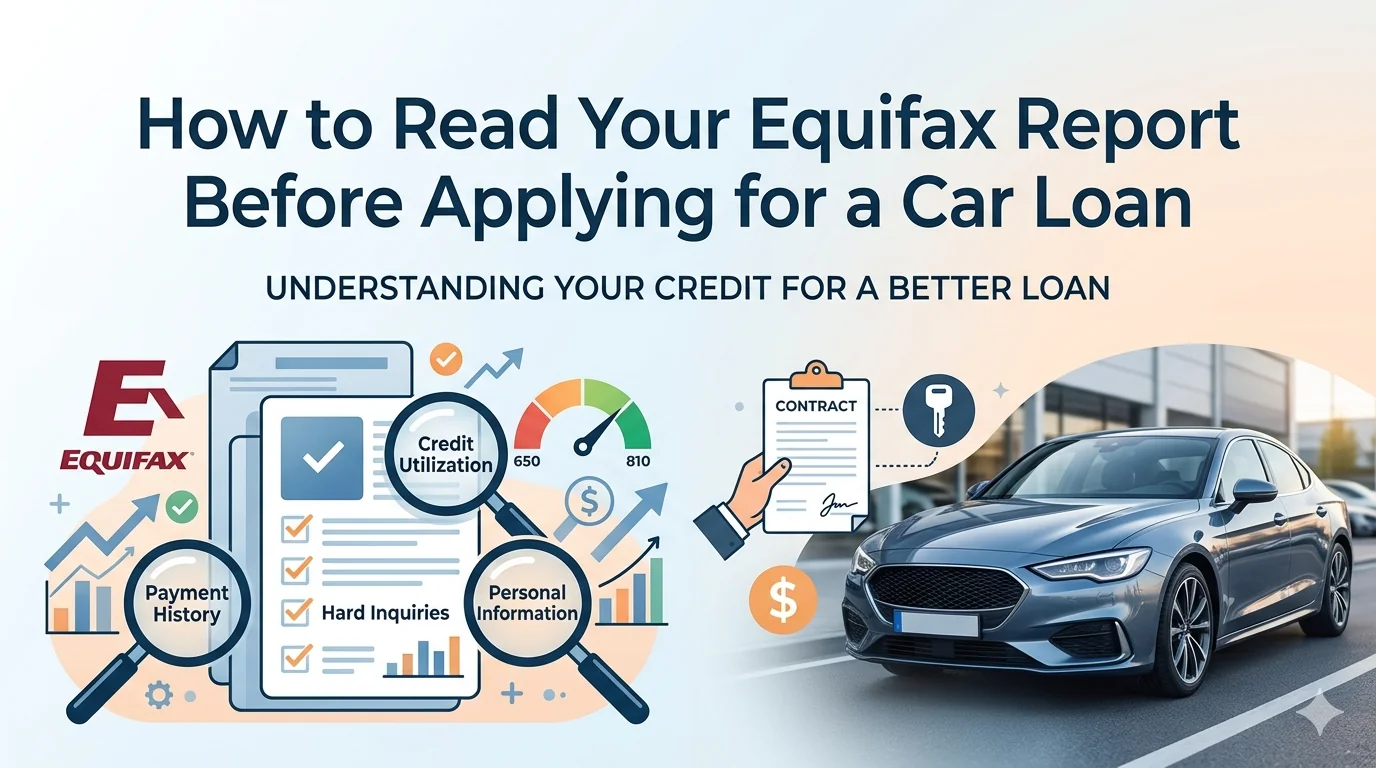
How to Read Your Equifax Report Before Applying for a Car Loan
In this article
- What Is an Equifax Report and Why Do Car Lenders Pull It?
- How to Get Your Equifax Report for Free in Alberta
- The Five Sections of Your Equifax Report — What Each One Means for Car Financing
- 1. Personal Information
- 2. Credit Summary
- 3. Account History (Trade Lines)
- 4. Public Records and Collections
- 5. Inquiries
- Understanding Credit Score Ranges in the Alberta Car Market
- How to Spot and Dispute Errors on Your Equifax Report
- What Lenders Actually Focus On Beyond the Score
- Payment Trajectory
- Depth of Credit History
- Recent Activity vs. Historical Negatives
- Utilization Rate
- Alberta-Specific Considerations
- Common Equifax Report Issues That Delay or Affect Car Loan Approvals
- How to Use Your Equifax Report to Prepare Before You Apply
- When You're Ready to Apply
- Related Buyer Guides
- Compare and Apply
Check Your Options in 3 Minutes
No credit impact. All credit situations welcome.
★★★★★ 106+ Google Reviews · AMVIC Licensed · Free Delivery 300km
Most people applying for a car loan in Alberta have never actually read their Equifax report. They apply, a lender pulls their bureau, and then they're either approved, countered, or declined — with little idea why. If you've ever been surprised by a higher rate or a condition you didn't expect, your Equifax report almost certainly held the answer. Knowing how to read it before you apply puts you in the driver's seat instead of the passenger seat.
See what you pre-qualify for
Three quick answers — soft check, no commitment.
What Is an Equifax Report and Why Do Car Lenders Pull It?
Canada has two major credit bureaus: Equifax and TransUnion. Most automotive lenders, including the 15+ lenders we work with, pull Equifax as their primary bureau — though some pull both. Your Equifax report is a detailed financial history document that shows every credit account you've opened, how you've paid it, how much you owe, and whether you have any public records like collections, judgments, or bankruptcy filings.
When a lender reviews your application for vehicle financing, they're not just looking at a single score. They're reading the narrative behind the score — how long you've had credit, whether you've missed payments recently, how much of your available credit you're using, and whether you've been shopping around aggressively. Your score is a summary; the report is the story.
Equifax Canada operates under different rules than Equifax US, which matters for Alberta residents who may have used American credit score tools. The Canadian scoring model runs from 300 to 900, and lender thresholds differ from what you'd see quoted for American car loans. Understanding how credit scores work in Canada is the foundation — reading your actual report is the next level.
How to Get Your Equifax Report for Free in Alberta
You're entitled to one free credit report per year from each bureau under Canadian consumer protection law, and you can get it directly from Equifax Canada at equifax.ca. This is different from Equifax's paid subscription service — the free report is your legal right, though it can take 10-15 business days to arrive by mail. If you need it faster, you can pay for immediate online access or use a free third-party service. Our page on checking your credit score for free walks through your options without upselling you on anything.
One important distinction: the free report you pull yourself is a "soft inquiry" — it does not affect your credit score. When a lender pulls your report, that's a "hard inquiry," which can temporarily lower your score by a few points. More on how multiple hard inquiries affect car loan applications shortly.
The Five Sections of Your Equifax Report — What Each One Means for Car Financing
Your Equifax report is organized into distinct sections. Here's what each one means when a car lender reads it.
1. Personal Information
This section lists your name, current and previous addresses, date of birth, Social Insurance Number (partial), phone numbers, and employment history as reported by lenders. Lenders use this to verify your identity and confirm your address history. Errors here — a misspelled name, a wrong address, an SIN that doesn't match — can cause application processing delays or trigger fraud flags. Check this first and make sure everything matches your government ID exactly.
2. Credit Summary
This is a snapshot of your total credit picture: how many accounts you have, total balances, total limits, and how many accounts are in good standing versus delinquent. A lender reviewing a credit application for car financing will look at this summary to quickly assess whether your overall debt load is manageable relative to your income. High balances close to your limits — even on accounts that are paid on time — signal financial strain.
3. Account History (Trade Lines)
This is the heart of your report. Every credit account you've had — credit cards, lines of credit, car loans, mortgages, student loans — appears here as a "trade line." Each trade line shows:
- Account type (revolving credit card, installment loan, etc.)
- Open date — how long you've had the account
- Credit limit or original loan amount
- Current balance
- Payment status — current, 30 days late, 60 days late, 90+ days late
- Payment history grid — typically 24 months of monthly payment status codes
The payment history grid is what most lenders spend time on. A single "R2" or "I2" code (meaning 30 days late on a revolving or installment account) doesn't necessarily kill an approval, but a pattern of lates — especially recent ones within the past 12-24 months — will push you into higher rate tiers or trigger conditions. A string of "R9" codes (written off as bad debt) is much more serious.
4. Public Records and Collections
This section shows bankruptcies, consumer proposals, and collection accounts. In Alberta, a bankruptcy stays on your Equifax report for 6 years after discharge (for a first bankruptcy) or 14 years for a second. A consumer proposal stays for 3 years after completion. Collections remain for 6 years from the date of last activity.
Many people assume a collection account means an automatic decline for car financing. It doesn't. Lenders who specialize in bad credit car loans review collections by type, age, and amount. A $200 medical collection from 5 years ago is treated very differently from a $8,000 credit card chargeoff from 18 months ago. The narrative matters as much as the presence of a negative item.
5. Inquiries
Every time a lender pulls your credit with your permission, it appears as a hard inquiry in this section. Inquiries stay on your report for 3 years, though they only affect your score for about 12 months. The concern car lenders have with a heavy inquiry list is what it signals: someone applying for credit at many places in a short window can look financially desperate, even if each individual application was legitimate.
There's an important nuance here for car shoppers: most credit scoring models treat multiple auto loan inquiries within a short window (typically 14-45 days, depending on the model) as a single inquiry for rate-shopping purposes. The problem is this "deduplication" only works if the inquiries are clustered together. If you applied at three dealerships over six months instead of six days, each inquiry counts separately. We cover this in detail when we discuss what actually hurts your credit score.
Understanding Credit Score Ranges in the Alberta Car Market
Here's how Equifax scores map to what you'll typically encounter when applying for a car loan in Alberta. These are general ranges — individual lender policies vary significantly, and a lower score doesn't mean no options exist.
| Score Range | Credit Tier | What to Expect for Car Loans | Typical Rate Range |
|---|---|---|---|
| 750–900 | Prime / Super Prime | Strong approvals, competitive rates, flexible terms | 6.99%–9.99% |
| 660–749 | Near-Prime | Good approvals, some conditions possible, solid selection | 9.99%–14.99% |
| 600–659 | Subprime | Approvals available, conditions likely, rate reflects risk | 14.99%–19.99% |
| 500–599 | Deep Subprime | Specialized lenders, conditions, may need down payment | 19.99%–25.99% |
| Below 500 | Severe Subprime | Limited options, higher down payment typical, program lenders | 25.99%–29.99% |
To put this in concrete terms: a $22,000 loan on a reliable used Toyota RAV4 at 14.99% over 72 months works out to roughly $269 biweekly. The same loan at 9.99% is approximately $241 biweekly. That $28 difference per payment adds up to over $2,400 across the loan term — which is exactly why understanding your score before you apply can pay dividends.
How to Spot and Dispute Errors on Your Equifax Report
Equifax Canada estimates that a meaningful percentage of credit reports contain errors that negatively affect the consumer's score. These errors fall into a few common categories:
- Accounts that aren't yours — mixed files, where another consumer's data appears on your report
- Incorrect payment status — an account marked late when you have proof of on-time payment
- Duplicate entries — the same collection appearing twice under different creditor names
- Outdated negative items — collections or lates that should have aged off the report but haven't
- Wrong balances or credit limits — accounts showing higher balances than actual, inflating your utilization
To dispute an error, you can file directly with Equifax Canada online or by mail. Include documentation — bank statements, letters from creditors, anything that proves the correct information. Equifax is required to investigate within 30 days and must remove or correct the item if the creditor can't verify it. If the error is significant — say, a $6,000 collection that isn't yours — disputing it before applying for a car loan can be worth the wait.
Practical tip: Before filing a dispute, contact the original creditor directly. Sometimes they'll update Equifax faster than the formal dispute process, especially for small accounts that were paid in full but still showing a balance.
What Lenders Actually Focus On Beyond the Score
The score on your Equifax report opens the door to different tiers of lenders. But once your file is being reviewed, experienced lenders dig into factors the raw score doesn't fully capture.
Payment Trajectory
A credit score of 580 that's been climbing steadily from 510 over the past 18 months tells a very different story than a score of 580 that's been declining from 650. Lenders call this "trajectory" or "direction of travel." If you can demonstrate that you've corrected the behavior that caused the damage and have been consistent since, that carries real weight — especially with specialty lenders who understand life happens.
Depth of Credit History
A thin file — someone with only one or two accounts and a short history — can score reasonably well but still create hesitation for lenders. There's simply not enough data to assess risk accurately. This is especially common for newcomers to Canada or younger applicants. If your report is thin, a co-signer or a modest down payment can compensate for the uncertainty.
Recent Activity vs. Historical Negatives
Most lenders place heavier weight on the past 24 months than on what happened four or five years ago. A 90-day late from 2019 on a now-closed credit card matters much less than a 30-day late from six months ago on your current car loan. If your recent history is clean, say so in your application narrative — lenders read notes, especially for borderline files.
Utilization Rate
Your credit utilization — what percentage of your available revolving credit you're using — is one of the most actionable levers you have before applying. Using 90% of your available limit on a credit card hurts your score even if you make every payment on time. The general guidance is to stay under 30% utilization per card and overall. If you have a $5,000 limit and you're carrying a $4,200 balance, paying that down to $1,500 before applying can move your score meaningfully in 30-60 days.
Alberta-Specific Considerations
If you've lived in multiple provinces, your Equifax report reflects your credit history nationally — but some Alberta-specific situations are worth flagging.
Oilfield workers and seasonal workers often have income patterns that show on their report as periodic credit card balance increases followed by rapid payoffs. Lenders familiar with Alberta's energy economy understand this pattern, but generic lenders (like bank algorithms) can misread it as financial instability. Working with a broker who knows which lenders understand Alberta income patterns can make a significant difference.
If you're an Albertan who recently moved from another province — say, relocating from BC after a job offer in Calgary or Airdrie — your report carries seamlessly. However, you may have gaps in reported address history if you haven't updated your address with existing creditors. Lenders verifying identity sometimes flag these gaps. Update your address on all accounts before applying.
The approval likelihood quiz on our site can give you a quick read on where your application stands before a lender sees it — without a hard pull on your credit.
Common Equifax Report Issues That Delay or Affect Car Loan Approvals
Beyond errors, certain legitimate items on your report can create complications worth knowing about in advance:
- A frozen credit file — if you previously placed a security freeze on your Equifax file (sometimes done after identity theft), it must be lifted before any lender can pull it. This takes time and requires contacting Equifax directly.
- A note from a previous lender — some lenders add notes to accounts ("customer disputes account," "paid as agreed after collection") that affect how the trade line reads
- Student loans in default — government student loans in collections with the National Student Loans Service Centre appear on bureau and are treated similarly to other collections, but there are specific rehabilitation programs that can help
- Debt management plan notation — if you've entered a credit counselling program through an organization like Money Mentors Alberta, this may appear as a notation on your report
How to Use Your Equifax Report to Prepare Before You Apply
Reading your report isn't just about spotting problems — it's about knowing your starting position so you can make the best application possible.
- Pull your report 60-90 days before applying. This gives you time to dispute errors, pay down balances, or address any surprises before a hard inquiry hits.
- Identify your strongest and weakest trade lines. Knowing which accounts reflect well and which don't helps you anticipate lender questions.
- Check for any pending collections you weren't aware of. A $300 old cell phone bill in collections can be paid quickly; the key is knowing it exists.
- Look at your inquiry history. If you applied for credit multiple times in the past year, note the dates so you can explain them if asked.
- Calculate your utilization rate across all revolving accounts. If it's above 50%, paying it down before applying is one of the fastest ways to improve your profile.
The blog post on how car loans build credit over time is worth reading alongside this guide — once you understand what's on your report, understanding how a car loan affects it going forward rounds out the picture.
When You're Ready to Apply
Once you've reviewed your Equifax report and understand what's on it, the application process is much less intimidating. You'll know which tier of lender is likely to work with you, what conditions to expect, and roughly what rate range to anticipate. You might even know that a reliable used Honda Civic at $16,000 fits comfortably within what your credit profile supports, versus stretching for a $28,000 truck that creates payment stress from day one.
Lenders who specialize in all credit situations — the kind we work with — aren't just looking for reasons to decline. They're looking for a complete picture. A report you've reviewed and can speak to is always more compelling than one you're seeing for the first time in the F&I office.
When you're ready, start your financing application with us. We'll match your file to the lender most likely to work with your specific situation — whether your score is 820 or 480. No pressure, no hard sell, just the right fit for where you are right now.
Compare and Apply
- Bad Credit Financing — Complete Guide — bad credit car financing in Alberta
Financing Resources
Related Articles


Ready to Find Your Vehicle?
Browse our inventory or apply for financing. All credit situations welcome.
★★★★★ 106+ Google Reviews · AMVIC Licensed · Free Delivery 300km