
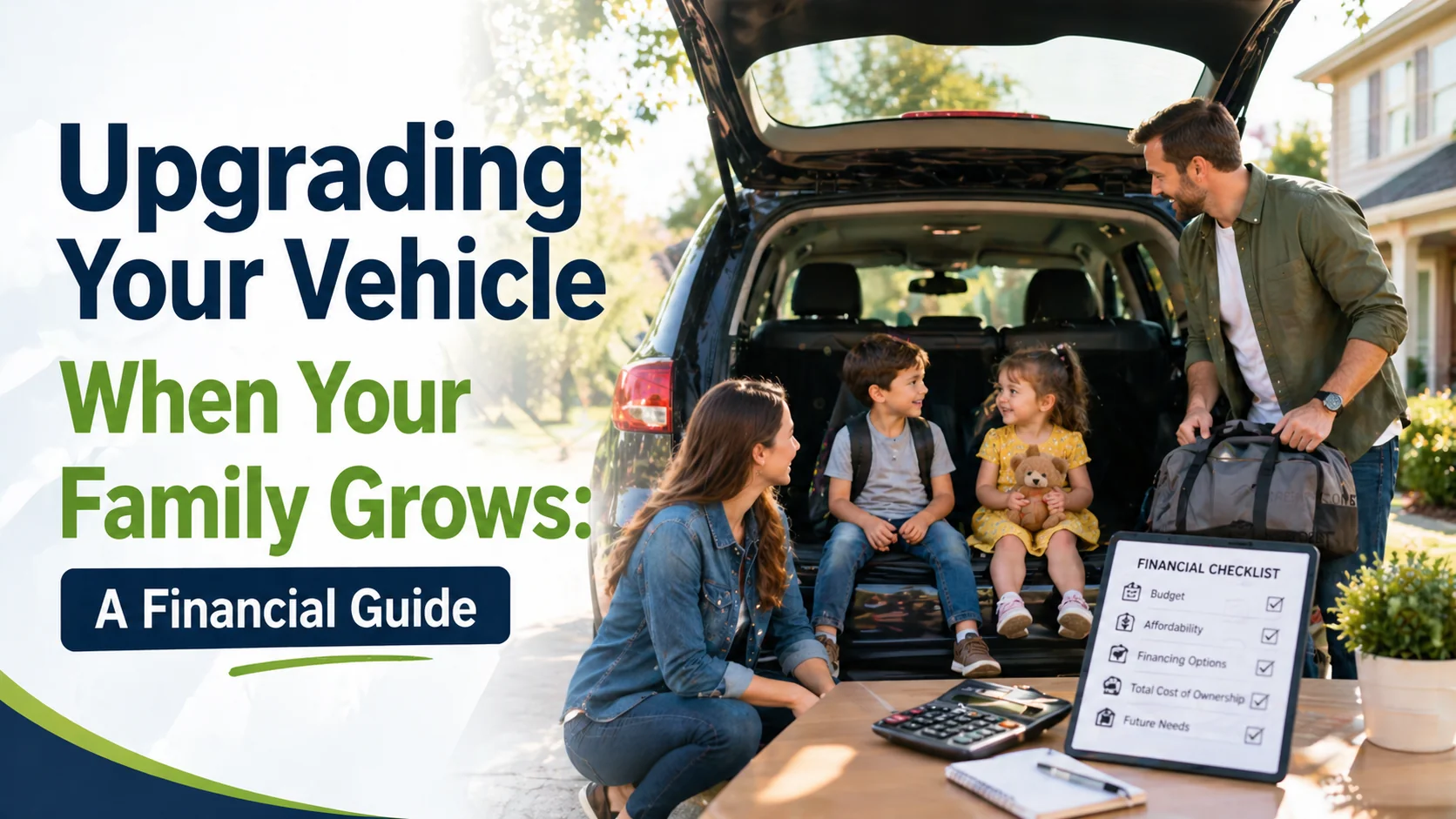
Upgrading Your Vehicle When Your Family Grows: A Financial Guide
In this article
- When Is the Right Time to Upgrade?
- The Pregnancy Window
- The Aging Vehicle Signal
- The Equity Moment
- The Financial Architecture of a Family Vehicle Upgrade
- When You Carry Negative Equity
- Protecting Your Trade-In Value Before You Sell
- Choosing the Right Vehicle by Family Stage
- One Child: The Compact-to-Mid SUV Move
- Two Children: The Mid-Size SUV Tier
- Three or More Children: The Minivan Math
- Safety Features That Matter With Kids in the Vehicle
- Car Seat Compatibility
- How Growing-Family Financing Differs From Your First Loan
- The Hidden Costs of a Family Vehicle Upgrade
- Steps to a Smooth Family Vehicle Upgrade
- Getting Started
- Related Buyer Guides
- Compare and Apply
Check Your Options in 3 Minutes
No credit impact. All credit situations welcome.
★★★★★ 106+ Google Reviews · AMVIC Licensed · Free Delivery 300km
You're staring at a car seat, a stroller frame, two bags of swim gear, a hockey bag that takes up the entire trunk, and you're suddenly very aware that the compact sedan you loved before kids is not going to cut it anymore. Or maybe your second child is on the way, and the mid-size SUV that fit one family perfectly is now doing uncomfortable mental geometry with a second rear-facing seat. Upgrading your vehicle when your family grows is one of the most financially significant purchases you'll make — and the timing, financing strategy, and vehicle choice all matter more than most buyers realize. This guide walks through the whole picture: when to upgrade, how to build the financing, what to look for in each family category, and what hidden costs catch buyers off-guard.
See what you pre-qualify for
Three quick answers — soft check, no commitment.
When Is the Right Time to Upgrade?
The honest answer: earlier than feels comfortable, and later than feels urgent. Here's what that means in practice.
The Pregnancy Window
If you're expecting your first or second child, the ideal time to upgrade is during the second trimester — after the highest-risk period has passed, but before the logistical demands of late pregnancy and newborn care consume your available decision-making bandwidth. Buying a vehicle with an infant in arms is genuinely harder: you're sleep-deprived, you can't test-drive freely, and emotionally driven decisions under stress tend to cost real money. If you know a vehicle upgrade is coming, start the process early.
Pregnancy also tends to coincide with income changes — maternity leave, parental leave, or one parent reducing hours. Applying for financing while both incomes are still active gives you access to better terms than applying after one income has dropped. This single timing insight can save thousands of dollars in interest over the life of the loan, and most families don't think about it until it's too late.
The Aging Vehicle Signal
If your current vehicle has 150,000+ kilometres, a growing repair history, or known issues that are approaching the cost of a major repair, add that to the family-expansion calculus. A breakdown with an infant in the back seat is not just inconvenient — it's a genuine safety situation. Reliability matters more with small passengers than it did when the worst case was you being late to work.
The article on when to trade versus repair your current vehicle walks through the break-even math in detail. The short version: if your annual repair costs are approaching 15-20% of your vehicle's current market value, and the vehicle has documented reliability concerns, trading is usually the better financial decision — especially when your family-size needs are changing anyway. Repairing a vehicle to maintain it for one more year is sometimes the right call; repairing it indefinitely while your family needs grow is usually not.
The Equity Moment
Trade-in timing is a financial decision as much as a practical one. Your current vehicle's equity — what it's worth minus what you owe — is one of the most important inputs in a family upgrade. The more equity you have, the smaller the new loan needs to be, and the lower your biweekly payments over the next 4-6 years.
If you bought your current vehicle two or three years ago at a solid price and used vehicle values remain elevated, you may have meaningful equity to work with. Getting a trade-in estimate before you shop tells you exactly where you stand. Our trade-in valuation form gives you an honest range in minutes — use it before you walk into any dealership so you know your starting position.
The Financial Architecture of a Family Vehicle Upgrade
Let's build the math explicitly, because vague reassurances don't help you plan. Here's a realistic scenario for a two-child Alberta family upgrading from a compact sedan to a mid-size SUV:
| Input | Example Amount |
|---|---|
| New vehicle purchase price | $32,000 |
| Trade-in appraised value | $14,000 |
| Remaining loan balance on trade | $8,000 |
| Net trade-in equity applied | $6,000 |
| Additional cash down payment | $3,000 |
| Amount financed | $23,000 |
| Rate (near-prime, 72 months) | 9.99% |
| Biweekly payment | ~$243 |
That's a real family SUV — mid-size, 3-5 years old, reasonable mileage — for a payment most Alberta households can absorb without restructuring their entire budget. The trade-in equity and down payment together reduce the financed amount by $9,000, which at 9.99% over 72 months saves nearly $3,800 in total interest compared to financing the full $32,000. Every dollar of equity you bring into the deal reduces the cost of ownership over time.
When You Carry Negative Equity
If you owe more on your current vehicle than it's worth — which happens when you financed a high percentage with a long term and the vehicle has depreciated faster than the loan has paid down — you're in a negative equity position. This doesn't block you from upgrading, but it adds complexity. The negative equity amount gets rolled into the new loan, increasing the amount financed and the monthly payment. See the guide on negative equity car financing for the mechanics of when rolling makes sense versus waiting until you've built more equity.
Protecting Your Trade-In Value Before You Sell
In the weeks before trading your vehicle, a few practical steps can add several hundred dollars to your trade-in offer. Clean the vehicle thoroughly inside and out — detailers know that presentation signals maintenance. Fix inexpensive cosmetic issues: a burnt-out marker light is a $5 part that signals neglect, while a freshly detailed interior signals care. Get an oil change if it's overdue. Bring your service records if you have them. Full detail on maximizing what you get from the appraisal is covered in our vehicle maintenance and trade-in resources — the short version is that presentation and documentation both move the number.
Choosing the Right Vehicle by Family Stage
The vehicle that's right for your family depends on where you are in the family-expansion arc. These aren't rigid rules — they're patterns drawn from what actually works for Alberta families at each stage.
One Child: The Compact-to-Mid SUV Move
One child means one rear-facing or forward-facing car seat, one stroller in the trunk, and significantly increased cargo demands compared to your pre-kid life. A compact SUV — Toyota RAV4, Honda CR-V, or Mazda CX-5 — handles one-child families well for several years. These vehicles offer adequate rear legroom for a rear-facing seat with a passenger still comfortable in front, cargo areas large enough for a stroller plus groceries, AWD options for Alberta winters, and strong safety ratings across recent model years.
Compact SUVs in the $22,000-$32,000 used range represent some of the best value-per-dollar for one-child Alberta families. Lower sticker price than three-row SUVs means lower monthly payments and lower insurance premiums — which leaves more budget for the actual costs of raising a child, which are not insignificant.
Two Children: The Mid-Size SUV Tier
Two car seats in the rear changes the spatial equation meaningfully. Compact SUVs can physically fit two car seats, but the middle seat becomes cramped, installation angles get awkward, and passenger comfort in the front row suffers. Mid-size SUVs solve this with wider cabins, longer wheelbases, and available third rows for when grandparents or extra passengers join a trip.
The Toyota Highlander is one of the most requested mid-size family SUVs in Alberta — reliable, strong resale value retention, available third row, and standard AWD on most trims handles Alberta winters well. The Honda Pilot is a genuine competitor with more cargo space, a practical cabin layout, and long-term reliability scores that match the Highlander. Both typically fall in the $28,000-$48,000 range used, depending on year and mileage.
For two-child families, budget for mid-size. The compact SUV compromise that works for a few months often becomes a genuinely frustrating squeeze within the first year of having two rear-facing seats simultaneously installed. Buying for where your family will be in 18 months, not just today, prevents a second vehicle upgrade in a short window.
Three or More Children: The Minivan Math
Three children, or two children plus a frequent additional passenger, puts you firmly in minivan territory. The cultural resistance to minivans is real and largely irrational. Modern minivans are more practical, more fuel-efficient per seat, and better optimized for family use than any SUV at the same price point. Sliding doors in parking lots alone eliminate a category of minor stress that SUV owners accept unnecessarily.
The Toyota Sienna and Honda Odyssey are the top recommendations for reliability and long-term cost of ownership. The Chrysler Pacifica is more affordable at purchase but carries higher long-term reliability concerns in extended ownership data. The guide on best used minivans for large families covers each model in detail — including which years to target and avoid, what to inspect mechanically, and what the Alberta used market is pricing them at.
Safety Features That Matter With Kids in the Vehicle
When children are regular passengers, the stakes of every vehicle safety decision increase. Here's what to prioritize:
- LATCH anchors (Lower Anchors and Tethers for Children). All modern vehicles have them, but check that the rear seat layout gives you workable anchor positions for multiple seats simultaneously — some configurations have anchor locations that interfere with each other when two seats are installed.
- Rear-seat reminders. A feature that alerts when a rear door was opened before a trip but the vehicle is being shut off without the rear being checked. The tragic cases of children forgotten in vehicles are always described as impossible by the families involved — until they happen. This feature costs nothing to look for and has genuine value.
- Automatic emergency braking (AEB). Standard on most new vehicles since 2018-2020, AEB prevents or mitigates front-end collisions. Distracted driving with children in the back is a well-documented risk — AEB mitigates the consequences.
- Blind-spot monitoring. Lane changes while managing noise from the back seat are cognitively demanding. Blind-spot alerts reduce the attention demand of a task that requires more attention than it gets.
- NHTSA and IIHS crash test ratings. Check both for the specific model year you're considering — ratings change by year, not just by nameplate. A 2019 model may have different ratings than a 2021 of the same vehicle.
Car Seat Compatibility
Before finalizing any vehicle purchase, physically test your existing car seat in the vehicle you're considering. Rear-facing infant seats require adequate rear-seat depth from the back of the front seat to the back-seat cushion. Some third-row seats in large SUVs are too shallow for proper rear-facing installation. The Canadian Pediatric Society recommends keeping children rear-facing as long as the car seat weight and height limits allow — which means rear-seat geometry matters more than many buyers anticipate when shopping for a vehicle to carry infants.
Alberta fire halls and some public health units offer free car seat installation checks by certified technicians. If you've changed vehicles and are unsure your seat is correctly installed, this is a resource worth using.
How Growing-Family Financing Differs From Your First Loan
If you already have a vehicle loan history — you've been making payments for 18-36 months — you're in a meaningfully stronger position than when you first financed. Here's why that matters:
- Improved credit score. Consistent installment payments are the most credit-positive tradeline type. Your score has likely moved up since your first loan approval, potentially placing you in a better rate tier — which could mean the difference between 12.99% and 9.99% on your new loan.
- Established payment history. A lender who can see 24+ months of clean payments on a vehicle loan has direct evidence of your reliability. This reduces their risk perception and is reflected in both the approval likelihood and the offered rate.
- Reduced documentation burden. If you've been at the same employer and same address since your last loan, the income and stability verification process is significantly faster.
- Lender loyalty potential. Some lenders offer existing customers with clean payment history preferential terms on upgrade financing. Ask directly — it's not always advertised.
For families where one parent is on or planning maternity or parental leave, timing matters sharply. Some lenders count EI mat leave income as qualifying income; others require the return-to-work income before approving. Knowing which lenders are flexible on this — and presenting your file to them first — is where a multi-lender model creates real value over walking into a single bank and taking what they offer.
For single-parent financing situations, the calculus is different — one income carries the entire qualification burden, and vehicle reliability becomes even more critical because there's no second vehicle in the household as a backup. Our advisors work with single-parent files regularly and know which vehicle categories and lender combinations make the most sense for that income structure.
The Hidden Costs of a Family Vehicle Upgrade
Budget for more than the loan payment. A family vehicle upgrade comes with downstream costs that catch buyers off-guard and create budget pressure that the payment alone doesn't explain.
| Cost Item | Typical Range | Notes |
|---|---|---|
| Insurance change (larger vehicle) | +$30-$100/month | Mid-size SUVs and minivans typically cost more to insure than the compact sedan they replace |
| Fuel increase | +$60-$150/month | Mid-size SUV vs compact: approximately 3-5L/100km difference in combined consumption |
| Winter tire set (if vehicle doesn't come equipped) | $900-$1,700 | Larger diameter tires cost more per unit; budget for a set if the vehicle doesn't come with winters |
| Car seat upgrade (if size change needed) | $200-$600 | A vehicle change sometimes requires moving to a different seat category simultaneously |
| Block heater installation | $150-$300 | Required if the vehicle doesn't have one and you're in Alberta |
These aren't reasons to avoid upgrading — they're line items to include in your planning. A vehicle that adds $180/month in payment while also adding $180/month in fuel and insurance without accounting for it creates budget pressure that shows up as stress rather than numbers. Run the full picture before you commit to a specific vehicle and payment.
Steps to a Smooth Family Vehicle Upgrade
- Get a trade-in estimate before you shop. Know your equity position before you walk into a dealership. It changes your negotiating posture and your loan calculation.
- Decide on the vehicle category that fits your current and near-future family size. Buying for where you'll be in 18-24 months prevents a second upgrade in a short window.
- Use the payment calculator to model the loan. Amount financed, rate range based on your credit tier, term options, biweekly payment. Find the payment range that works before you fall in love with a specific vehicle.
- Test drive with your actual car seat installed. A vehicle that passes a showroom test-drive feels different with a rear-facing seat behind the driver and a toddler in the other rear position.
- Apply for financing — ideally before you're shopping under deadline pressure. Having pre-approval in hand lets you negotiate vehicle price separately from payment amount, which is always the better position.
- Check the full-cost picture before signing. Payment plus insurance change plus fuel difference plus any setup costs (tires, block heater). The monthly impact should fit comfortably, not barely.
Getting Started
Family growth is one of the most legitimate reasons to upgrade a vehicle — the practical need is real, the timeline is clear, and starting the process early gives you the best combination of vehicle selection and financing terms. Our team works with growing families regularly, including those in the middle of mat leave, those rolling equity from a previous loan, and those with credit files that have complexity we know how to navigate.
In Calgary and across the Airdrie area, we help families find the right vehicle at the right payment for where they actually are — not where they were before the family grew. Use the payment calculator to model your scenario, then start your financing application when you're ready. Our lenders work with all credit situations, and we'll find you the best available terms from our full network of 15+ lenders competing for your deal.
Compare and Apply
- Bad Credit Financing — Complete Guide — bad credit car financing in Alberta
Financing Resources
Related Articles


Ready to Find Your Vehicle?
Browse our inventory or apply for financing. All credit situations welcome.
★★★★★ 106+ Google Reviews · AMVIC Licensed · Free Delivery 300km