
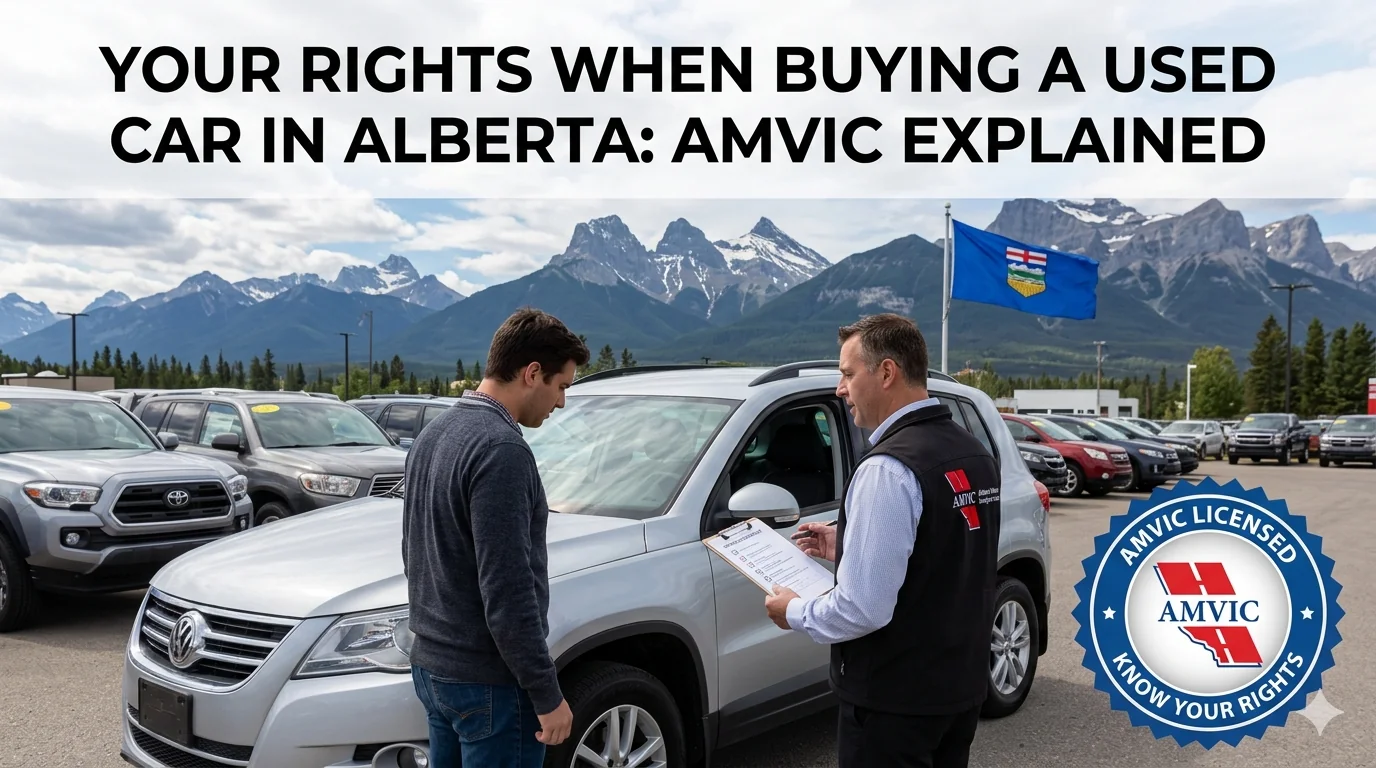
Your Rights When Buying a Used Car in Alberta: AMVIC Explained
In this article
- What Is AMVIC and Why Does It Exist?
- Who AMVIC Regulates (and Who It Doesn't)
- Dealer Disclosure Obligations: What They MUST Tell You
- The 10-Day/1,000 km Rule (Cooling-Off Period Myth — Busted)
- Branded Title Disclosure
- Curbing: The Illegal Practice Buyers Should Know
- Dealer Advertising Rules
- What Happens During an AMVIC Inspection?
- The Consumer Protection Act: Your Broader Rights
- Unfair Practices
- The $100,000 AMVIC Consumer Protection Fund
- Private Sale vs. Dealer Purchase: The Protection Gap
- How to File an AMVIC Complaint
- What AMVIC Cannot Do
- AMVIC and the Financing Process: What Buyers Often Miss
- Understanding Dealer Finance Disclosure Rights
- Certified Pre-Owned vs. Standard Used: What AMVIC Covers Either Way
- Smart Buyer Practices at Any Alberta Dealer
- Financing With Confidence as an Informed Buyer
- Related Buyer Guides
- Compare and Apply
Check Your Options in 3 Minutes
No credit impact. All credit situations welcome.
★★★★★ 114+ Google Reviews · AMVIC Licensed · Free Delivery 300km
Most Alberta car buyers don't know their rights until something goes wrong — the check engine light comes on the day after delivery, the dealer didn't disclose flood damage, or the "certified" vehicle turns out to have a branded title. That's the wrong time to learn what AMVIC does and doesn't protect you from. Whether you're shopping at a dealership or browsing private ads, understanding AMVIC before you sign anything could save you thousands — and a lot of grief.
See what you pre-qualify for
Three quick answers — soft check, no commitment.
What Is AMVIC and Why Does It Exist?
AMVIC — the Alberta Motor Vehicle Industry Council — is the provincial regulatory body that licenses and oversees everyone in Alberta's automotive sector: dealerships, salespeople, automotive lease brokers, registration agents, and damage repair facilities. It's funded by industry licensing fees, not taxpayer money, and it operates under the authority of the Automotive Business Regulation and Alberta's broader Consumer Protection Act.
Think of AMVIC as the professional standards body for car dealers, similar to how RECA regulates real estate agents. It sets rules that licensed dealers must follow, investigates complaints, and can revoke licenses for serious violations. Without it, Alberta's used car market would be a free-for-all — and in some ways it was, before the legislation was tightened in the early 2000s.
AMVIC also administers the Motor Vehicle Accident Claims Fund — a consumer protection fund that can compensate buyers when a licensed dealer commits fraud and can't repay the loss. It's not a blank cheque, but it's real protection that private-sale buyers simply don't have access to.
Who AMVIC Regulates (and Who It Doesn't)
AMVIC only regulates licensed Alberta businesses. If you buy from a registered AMVIC dealership like Shift Happens Auto Sales, you're covered by all the protections below. If you buy from an individual on Facebook Marketplace or Kijiji, you're dealing in private sale territory — a completely different legal landscape with far fewer protections. This is one of the most important distinctions buyers overlook when comparing private sale vs dealer purchase in Alberta.
Dealer Disclosure Obligations: What They MUST Tell You
This is where AMVIC really earns its keep. Licensed Alberta dealers have legal obligations to disclose specific information before a sale is finalized. Failing to disclose is a serious violation — not just a customer service issue.
The 10-Day/1,000 km Rule (Cooling-Off Period Myth — Busted)
Here's one of the most persistent myths in Alberta car buying: there is no automatic cooling-off period on vehicle purchases. Unlike some consumer contracts, you cannot simply change your mind and return a car you bought from a dealer. Once you sign, you own it.
What does exist is a right to cancel if the dealer failed to provide required disclosures before you signed. If a dealer didn't tell you that the vehicle was previously written off, had structural damage repaired, or had the odometer replaced — you may have grounds to unwind the deal. But this is a complaint/legal process, not a simple "I changed my mind" return.
Key takeaway: Never sign a purchase agreement under pressure. Take the contract home, read it, and ask questions. A dealer who won't let you do that is a red flag.
Branded Title Disclosure
Alberta vehicles that have been declared a total loss, stolen and recovered, rebuilt after major damage, or had their odometer replaced carry a branded title. Dealers are legally required to disclose all title brands in writing before the sale. The common brands you'll see:
- Salvage — declared a total loss by an insurer
- Rebuilt/Restored — was salvage, has since passed inspection
- Non-Repairable — cannot be legally driven on Alberta roads
- Odometer Replaced — the odometer was changed at some point
- Out-of-Province — registered in another province/state; may carry different brands
Undisclosed title brands are one of the most common AMVIC complaint categories. A rebuilt vehicle isn't necessarily a bad buy — but you deserve to know, and the price should reflect it. Always run a CARFAX or CarProof report, and consider an independent used car inspection before finalizing any purchase.
Curbing: The Illegal Practice Buyers Should Know
"Curbing" is the term for unlicensed dealers selling vehicles as private sellers to avoid AMVIC regulation. A curber might sell dozens of vehicles a year — often without proper disclosure, sometimes with rolled-back odometers or hidden damage — while technically appearing to be a private individual.
Red flags that a "private" seller may be a curber:
- Multiple vehicles listed at the same time
- Always meeting at a neutral location rather than a home address
- Unable to explain much about the vehicle's history
- New listings appear constantly from the same phone number
- Reluctant to provide their name or ID
Curbing is illegal in Alberta. If you suspect it, you can report it to AMVIC. More importantly — if you buy from a curber, you have none of the consumer protections that apply to dealer transactions.
Dealer Advertising Rules
AMVIC regulates how dealers advertise vehicles. Misleading pricing is a common violation. Specific rules include:
- The advertised price must be the total drive-away price — dealers cannot tack on undisclosed fees afterward
- Any conditions or limitations on a sale price must be prominently disclosed
- Claims about vehicle condition must be accurate
- "As-is" must be clearly disclosed if applicable
If you see a price advertised and then get presented with a contract that includes fees not disclosed in the ad — that's a potential AMVIC violation worth raising.
What Happens During an AMVIC Inspection?
AMVIC conducts both routine and complaint-driven inspections of licensed facilities. They verify things like:
- Proper display of the AMVIC license certificate
- Sales contracts meeting regulatory requirements
- Proper vehicle history disclosure practices
- Accurate advertising
- Compliance with the Automotive Business Regulation
This is separate from the provincial vehicle safety inspection that a vehicle itself must pass — that's a mechanical roadworthiness check, not a business compliance audit.
The Consumer Protection Act: Your Broader Rights
Beyond AMVIC's specific automotive regulations, the Alberta Consumer Protection Act (CPA) applies to all retail transactions in the province, including vehicle purchases from licensed dealers.
Unfair Practices
The CPA prohibits "unfair practices" — a defined legal category that includes:
- Making false or misleading statements about a product
- Creating a false impression about price, quality, or condition
- Taking advantage of a consumer who cannot protect their own interests
- Using aggressive or unconscionable sales tactics
If a dealer told you the vehicle had one owner and it actually had three, or said there was no accident history when there was — that's potentially an unfair practice under the CPA, not just an ethical lapse. You can pursue remedies including cancellation of the contract and refund.
The $100,000 AMVIC Consumer Protection Fund
This is a real, funded protection mechanism. If an AMVIC-licensed dealer defrauds you and cannot reimburse you — through business closure, insolvency, or refusal to comply — you may be eligible to claim compensation from the AMVIC Motor Vehicle Accident Claims Fund, up to certain limits.
Claims must be filed within a specific timeframe and require supporting documentation. The fund is a genuine backstop — but it's not fast, and not all claims are approved. It's there for serious fraud situations, not buyer's remorse.
Private Sale vs. Dealer Purchase: The Protection Gap
This is the critical comparison most buyers don't fully understand before they sign anything.
| Protection | AMVIC-Licensed Dealer | Private Sale |
|---|---|---|
| Title brand disclosure required | Yes — legally required | No — buyer beware |
| Accurate odometer disclosure | Yes — required | No guarantee |
| Advertising price = final price | Yes — regulated | No |
| Consumer Protection Act applies | Yes | Limited |
| AMVIC complaint mechanism | Yes | No |
| Consumer Protection Fund | Yes (fraud cases) | No |
| Licensed salesperson required | Yes — must hold AMVIC license | No |
| Financing options available | Yes — multiple lenders | Limited (private sale financing harder) |
The private sale route can yield good deals, but you're absorbing all the risk yourself. There's no recourse if the seller lied about the vehicle's history, and "as-is" in a private sale genuinely means as-is. For many buyers — especially those financing their purchase — the protections of a dealer transaction are worth the slightly higher price. That said, GAP insurance is worth understanding regardless of where you buy.
How to File an AMVIC Complaint
If you believe an AMVIC-licensed dealer has violated your rights, here's the process:
- Document everything first. Gather your purchase contract, any written communications, photos, your vehicle history report, and the dealer's advertising (screenshot it). AMVIC investigations require evidence.
- Try to resolve it directly. Contact the dealership's management — not the salesperson, but the general manager or owner. Many issues get resolved at this stage.
- File an AMVIC complaint online. Go to amvic.org and submit through their complaint portal. You'll need the dealer's AMVIC license number (which must be displayed in the dealership).
- AMVIC investigates. A compliance officer will contact you and the dealer. Investigations can take weeks to months depending on complexity.
- Outcomes range from dealer warnings and fines to license suspension or revocation in serious cases. AMVIC can also require dealers to provide restitution.
Important: For contract disputes and civil remedies (getting your money back), the AMVIC complaint process may run parallel to a small claims court action. AMVIC handles regulatory violations; civil courts handle financial recovery. You may need both.
What AMVIC Cannot Do
Being realistic about AMVIC's limits helps set proper expectations:
- AMVIC cannot force a dealer to refund your money — it can order it, but enforcement is a separate step
- AMVIC cannot resolve disputes about vehicle quality that don't involve a regulatory violation (e.g., "I just don't like the car")
- AMVIC cannot act as your lawyer — for significant financial disputes, you need legal advice
- AMVIC has no jurisdiction over private sellers — only licensed dealers
- AMVIC does not regulate vehicle pricing itself — only that prices are accurately advertised
AMVIC and the Financing Process: What Buyers Often Miss
One area where buyers are frequently caught off guard is add-on products bundled into financing. Extended warranties, life and disability insurance tied to the loan, and debt protection products are legitimate offerings — but they must be presented as optional, with clear pricing, and you must consent to each individually. A dealer cannot include these products in your financing without your explicit agreement to each one.
If you look at your financing agreement and see charges you don't recognize, ask for a line-by-line explanation before you sign. "Debt cancellation protection" or "creditor life insurance" are common product names that appear without buyers fully understanding what they purchased. These can add $1,500-4,000 to the financed amount over a longer loan term. They may or may not make sense for your situation — the point is that the decision should be informed and deliberate.
AMVIC's position is clear: every product added to a financing agreement requires separate, informed consent. If you felt pressured into something you didn't understand, that's a potential complaint grounds.
Understanding Dealer Finance Disclosure Rights
AMVIC's protections extend beyond the vehicle itself into the financing side of the transaction. When an Alberta dealer arranges financing for you, they're acting as an agent connecting you to a lender — and that relationship comes with its own disclosure obligations.
Specifically, before you sign a financing agreement, a dealer must disclose:
- The annual interest rate (APR) in clear terms
- The total amount you'll pay over the life of the loan (total cost of borrowing)
- Any fees or insurance products added to the financing (extended warranty, GAP coverage, life and disability insurance)
- The payment schedule and term in full
This is important because add-on products — extended warranties, GAP insurance, life insurance tied to the loan — are legitimately valuable in some circumstances, but buyers must be clearly informed about what they're agreeing to and what it costs. A finance agreement you signed without understanding what was in it is still binding, which is why reading every page before you sign matters so much.
Use a payment calculator before you sit down at the finance desk. Knowing what a given vehicle price, rate, and term produces in biweekly payments gives you a baseline — so you can immediately spot if numbers in the contract look different from what you discussed.
Certified Pre-Owned vs. Standard Used: What AMVIC Covers Either Way
A common misconception: many buyers assume "certified pre-owned" means extensive legal protection. In reality, CPO programs are manufacturer-created programs with their own criteria — not government-regulated categories. A vehicle labeled "certified" at a dealership may simply mean it passed the dealer's internal checklist.
AMVIC protections apply equally to any used vehicle sold by a licensed dealer — CPO or not. What matters legally is whether the dealer is AMVIC-licensed and whether they fulfilled their disclosure obligations. We've compared certified pre-owned vs standard used vehicles in detail — the short version is that the AMVIC framework already mandates the most critical disclosures regardless of CPO status.
Smart Buyer Practices at Any Alberta Dealer
Knowing your rights is most useful when combined with habits that prevent problems from arising in the first place:
- Run a CARFAX Canada report on every used vehicle before buying — history reports catch most branded title issues, accidents, and odometer discrepancies
- Get an independent inspection from a mechanic who has no relationship with the dealership — a pre-purchase inspection costs $100-200 and can save thousands
- Read the purchase contract before signing — every line. "All sales final" clauses, deposit terms, and "as-is" conditions are binding
- Verify the dealer's AMVIC license — search the AMVIC public registry at amvic.org to confirm the dealership and your salesperson are currently licensed
- Keep copies of everything — the purchase agreement, any addenda, delivery inspection forms, and financing documents
This is especially important when buying a popular segment like a Toyota RAV4 or Ford Escape — high-demand vehicles occasionally attract less scrupulous sellers who count on buyer enthusiasm to rush the process. Take your time regardless of how competitive the market feels.
Buying from an AMVIC-licensed dealer in Airdrie or the Calgary area means you have a regulatory framework behind you. That's meaningful protection — but informed buyers still get better outcomes than uninformed ones. Understanding these rights before you shop puts you in a much stronger position at the table.
Financing With Confidence as an Informed Buyer
At Shift Happens, we work with 15+ lenders across all credit tiers — from prime borrowers to those who've faced bankruptcy, consumer proposals, or past credit challenges. Our rates range from 4.99% to 29.9% depending on your credit profile, with terms from 12 to 96 months. Whether you're comparing options or ready to move forward, you can explore your financing options without pressure and without surprises in the paperwork.
If you have questions about the purchase process or want to understand what protections apply to your specific situation, our team is straightforward to reach at our Airdrie location. Understanding your rights as an Alberta used car buyer isn't just about avoiding bad dealers — it's about being a confident, informed buyer at any dealer, including ours.
Compare and Apply
- Complete Bad Credit Car Buying Guide (Alberta) — step-by-step guide to getting approved in Alberta
Financing Resources
Related Articles
Ready to Find Your Vehicle?
Browse our inventory or apply for financing. All credit situations welcome.
★★★★★ 114+ Google Reviews · AMVIC Licensed · Free Delivery 300km