
Used Ram Calgary
The only full-size truck with coil-spring rear suspension — smoother ride, better towing stability, and Cummins diesel for serious Alberta work. Financed in Airdrie.
Key Facts
- Rear Suspension Type
- Coil spring, five-link (exclusive in class)
- eTorque Supplemental Torque
- 90 lb-ft (V6 and V8)
- Cummins 6.7L Max Tow Rating
- 20,000 lbs (Ram 3500)
- Cummins 6.7L Torque
- 1,075 lb-ft
- V6 eTorque Highway MPG
- 26 MPG (approx. 9.0 L/100km)
Last reviewed: September 2026
Ram's Coil Spring Rear Suspension — Smoother Than Any Competing Full-Size
162-point Independent Inspection on Every Vehicle
Check Your Options in 3 Minutes
No credit impact. All credit situations welcome.
★★★★★ 106+ Google Reviews · AMVIC Licensed · Free Delivery 300km
About Ram Vehicles
Ram separated from Dodge as a standalone brand in 2009 and has since built one of the strongest product identities in the North American truck market. The strategic focus has been clear: ride quality, interior refinement, and powertrain innovation — areas where Ram has measurably distinguished itself from Ford and GM.
The most technically significant differentiator is the coil-spring rear suspension. The Ram 1500 is the only full-size half-ton truck on the market with coil springs at the rear instead of leaf springs. Every other full-size truck — the F-150, the Sierra, the Silverado, the Tundra — uses leaf springs in the rear. Leaf springs are simpler and cheaper to manufacture at scale, but they transmit road impact directly into the cab and resist independent wheel movement. Coil springs allow independent wheel travel and integrate a five-link rear suspension geometry that absorbs road imperfections before they reach passengers. The result is a measurable reduction in the bounce and "head toss" that drivers notice on highway expansion joints and rough pavement. For Alberta drivers who spend significant time on the QE2 or on northern resource roads, the difference is not subtle.
Ram's eTorque mild hybrid system addresses the traditional tradeoff between truck capability and fuel efficiency. eTorque adds a 48-volt belt-starter-generator to the 3.6L Pentastar V6 and 5.7L Hemi V8, contributing up to 90 lb-ft of additional torque during acceleration and enabling smooth engine stop-start at low speeds. The net result is a highway fuel rating of 26 MPG (approximately 9.0 L/100km) for the V6 eTorque configuration — 4 MPG better than the non-hybrid equivalent at a time when fuel costs in Alberta represent a real operating expense.
The RamBox cargo management system is a factory-integrated dual storage compartment built into the bed rails. Each side is drainable, lockable with the key fob, and LED-lit — designed for tools, recovery gear, or anything that needs to stay with the truck but out of the bed itself. RamBox is Ram-exclusive and particularly practical for trades workers who carry the same equipment on every job.
At the top of the powertrain range, the Cummins 6.7L turbodiesel in the Ram 2500 and 3500 Heavy Duty produces 430 horsepower and 1,075 lb-ft of torque — the highest torque output of any production pickup engine — with a maximum tow rating of 20,000 pounds on the Ram 3500. For Alberta buyers who regularly tow horse trailers, fifth-wheel RVs, or heavy equipment, the Cummins is in a different capability class than any gas V8 half-ton.
Ram has also earned back-to-back JD Power Initial Quality Study awards, and starting with 2026 models, Ram offers a 10-year/160,000 km basic warranty — a structural statement about the brand's confidence in long-term durability. Shift Happens carries inspected Ram 1500 inventory in Airdrie serving Calgary, Cochrane, and the surrounding area.
Popular Ram Models We Carry
The Coil Spring Advantage: Why Ram Rides Better
Suspension architecture has a measurable effect on ride quality, handling behaviour, and passenger comfort over the operating lifetime of a vehicle. The Ram 1500's five-link coil-spring rear suspension is the single biggest engineering differentiator between Ram and every other full-size half-ton on the market, and it is worth understanding in concrete terms before making a comparison purchase decision.
- •Leaf springs (F-150, Sierra, Silverado, Tundra) — Multiple layers of steel banded together. Effective for load-carrying but transmit road surface inputs directly into the chassis and resist independent wheel movement.
- •Coil-spring five-link (Ram) — Five rigid links locate the axle independently of spring compression. The coil absorbs vertical inputs without tying them to lateral forces. Result: quieter cab, more controlled body motion, and a smoother ride at freeway speeds.
- •Head toss — The bounce that full-size truck drivers feel on expansion joints at highway speed. It is a leaf-spring characteristic. Ram's coil-spring geometry eliminates the primary mechanical cause of this behaviour.
- •Towing behaviour — Coil springs do not degrade into axle steer under trailer tongue load the way leaf springs can. Ram's available air suspension actively levels the rear under load, maintaining steering feel and lane stability.
- •Alberta context — The QE2 between Calgary and Red Deer has regular expansion joints. Northern resource roads are rough. The ride difference between leaf-spring and coil-spring full-size trucks becomes apparent within 20 minutes of highway driving.
Ram eTorque Technology: Mild Hybrid That Makes Sense
Most mild hybrid truck systems have delivered marginal real-world gains. Ram's eTorque implementation is the exception. The system is not a full parallel hybrid — it cannot propel the vehicle on electricity alone — but it performs two tasks that meaningfully affect driving experience and fuel economy: it replaces the traditional belt-driven alternator with a 48-volt belt-starter-generator (BSG) that harvests kinetic energy during deceleration, and it injects that stored energy as supplemental torque during acceleration and at low speeds.
The result is a stop-start system that restarts the engine in approximately 300 milliseconds (versus 600ms+ that makes traditional stop-start jarring), and a V6 that delivers V8-feel low-end torque in traffic where the engine would otherwise be working hardest.
- •V6 eTorque — 3.6L Pentastar + 90 lb-ft supplemental torque. Highway: 26 MPG (9.0 L/100km). Best for: daily driving, moderate towing, fuel economy priority.
- •V8 eTorque — 5.7L Hemi + 90 lb-ft supplemental torque. Highway: 22 MPG. Tow rating: up to 12,750 lbs. Best for: regular towing, higher-capacity work, performance feel.
- •Fuel savings — At $1.65/L Alberta pump prices, the 4 MPG difference between V6 eTorque and non-hybrid V6 saves approximately $800–$1,000 per year at 25,000 km annually.
- •System reliability — The 48V BSG is a simpler system than a full parallel hybrid drivetrain with no high-voltage battery to service. The BSG unit itself is the primary wear item, with documented replacement costs well below full hybrid battery service.
Cummins Diesel for Alberta: Towing and Economy
The Cummins 6.7L turbodiesel has been available in Ram Heavy Duty trucks since 1989 — it is one of the most thoroughly proven commercial-grade engines available in a production pickup. The current generation produces 430 horsepower and 1,075 lb-ft of torque through the Aisin AS69RC six-speed automatic, with a maximum tow rating of 20,000 pounds on the Ram 3500 with the fifth-wheel/gooseneck package.
For Alberta buyers, the Cummins is relevant in two specific use cases: serious recreational towing (fifth-wheel RVs and horse trailers in the 15,000–18,000 lb range) and commercial-grade work (heavy equipment, pipe trailers, aggregate hauling). The diesel advantage over gas engines in these scenarios is not marginal — a loaded gas V8 at 100 km/h pulling 14,000 lbs consumes significantly more fuel than a Cummins doing the same work, and the diesel maintains reserve torque that the gas engine does not.
Key used-market considerations: DEF fluid consumption (roughly every 12,000–16,000 km), EGR and DPF maintenance on high-mileage examples, and verified diesel-spec oil change history. A well-maintained Cummins regularly exceeds 400,000 km before major service — which is why high-mileage Cummins Rams retain value on the used market better than comparable gas trucks.
What Our Customers Say
“Luke was awesome to deal with and made the car buying experience enjoyable again for me and my wife after a few very unpleasant interactions in the past. I would highly recommend.”
“The buying experience was handled very professionally. Wes was very attentive and presented everything in an open and honest manner that gave me the reassurance that I made a good purchase.”
“Luke was fantastic with helping us get into a mini van, we are MORE than happy. I highly recommend anyone looking for a vehicle to go check out Shift Happens!”
Get pre-qualified for a Ram
Soft credit check only — no impact on your score.
Frequently Asked Questions
What is the practical difference between coil spring and leaf spring rear suspension on a truck?
Leaf springs use stacked steel bands that compress under load — effective for weight-carrying but they transmit road surface inputs directly into the cab and resist independent wheel movement. Coil springs with a five-link rear axle (Ram's design) allow each rear wheel to move independently over bumps while the links keep the axle properly located. In practice, the difference is most noticeable at highway speeds: the bounce and head toss on expansion joints that is characteristic of leaf-spring trucks is largely absent in a Ram 1500. For Alberta drivers spending significant time on the QE2, this is a tangible quality-of-life difference.
How much fuel does the Ram eTorque system actually save?
The V6 eTorque is EPA-rated at 26 MPG highway (approximately 9.0 L/100km) versus the non-eTorque V6 at 22 MPG. In real-world Alberta driving — mixing highway and city — the eTorque advantage is typically 2–3 L/100km. At current Alberta fuel prices around $1.65/L and 25,000 km annually, that difference represents approximately $825–$1,240 per year in fuel savings. Over a five-year ownership period, the eTorque system pays for itself multiple times over versus the non-hybrid equivalent, particularly for high-mileage drivers.
What is RamBox and who actually benefits from it?
RamBox is a factory-integrated cargo management system built into the bed rail panels on both sides of the truck. Each compartment is approximately 115 litres in volume, fully weather-sealed, drainable via a drain plug, lockable with the key fob, and LED-lit. The RamBox locks with the truck's central locking system and is structural — not an aftermarket add-on. It is most useful for tradespeople and contractors who carry the same tools or equipment on every job: the lockable, weather-sealed compartments keep gear secure without requiring a separate tool chest. It is not ideal for buyers who primarily haul large materials, since the RamBox reduces usable bed width slightly.
How reliable is the Cummins diesel in a used Ram?
The Cummins 6.7L is one of the most durable production pickup engines available, with well-documented longevity past 400,000 km under regular maintenance. Key used-market checks are: DEF system health (DEF injector, SCR catalyst, DPF), EGR valve function on high-mileage examples, and injector condition. A full service history showing regular diesel-spec oil changes is the most important thing to verify. Avoid examples with deleted emissions systems (DEF delete) as this creates legal liability for the new owner in Alberta.
What are the best Ram 1500 years to buy used?
The fifth-generation Ram 1500 (DS/DT platform, 2019+) is the current and most refined generation, featuring the coil-spring rear suspension as standard across all trims. Within this generation, 2021+ models have resolved early eTorque BSG warranty items and carry a broader feature set. For budget buyers, the fourth-generation Ram 1500 (DS, 2013–2018) with the 5.7L Hemi and 8-speed TorqueFlite is well-proven. Avoid 2014 examples with the 3.0L EcoDiesel half-ton, which had documented injector failures; the 2016 refresh addressed most of those issues.
Is Ram's JD Power Initial Quality award meaningful for used buyers?
JD Power Initial Quality measures problems per 100 vehicles in the first 90 days of ownership — it reflects manufacturing quality and early reliability rather than long-term durability. Ram's consecutive top finishes indicate that vehicles leave the factory with fewer assembly defects and first-year issues than most competitors. For used buyers, this translates to fewer early-ownership surprises: electrical gremlins, fit-and-finish issues, and minor mechanical problems that appear in the first few years tend to be less prevalent on Ram trucks than the segment average.
How does Ram financing work for truck buyers with challenged credit?
Truck financing for buyers with challenged credit works the same way as any other vehicle financing through Shift Happens — we submit your application to our network of 21+ lenders and find the best available terms for your situation. Trucks in general, and Ram trucks specifically, are strong collateral assets due to sustained demand and consistent resale values. A well-maintained Ram 1500 holds its value well enough that lenders advance against it confidently, which can improve approval odds compared to lower-demand vehicles. We work with all credit situations — from excellent to rebuilding after bankruptcy or consumer proposal.
Financing Resources
Whether you have great credit or are rebuilding, we work with all credit situations. Explore our financing guides to understand your options before you apply.
Ram in stock now
Browse all inventory →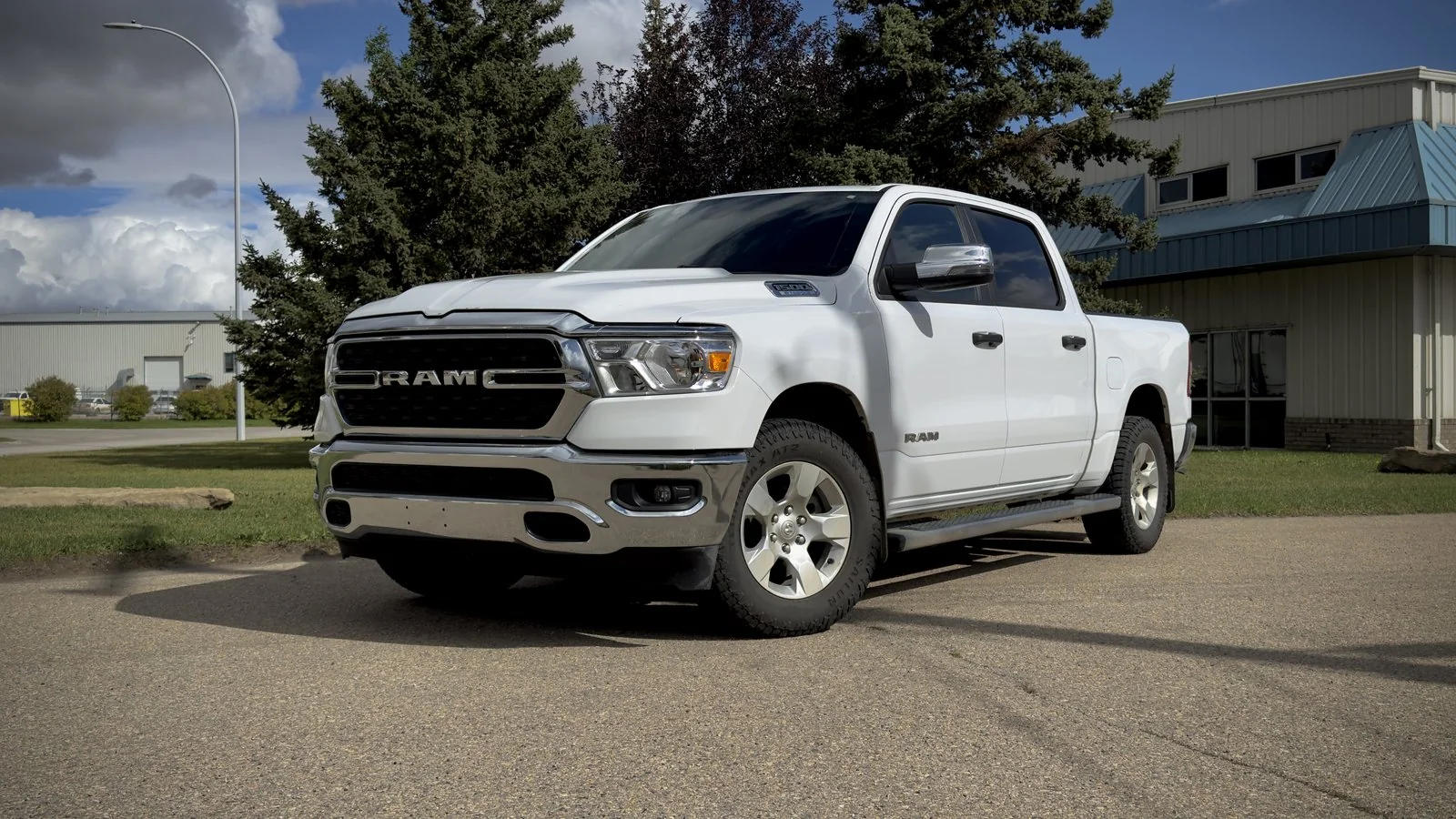
Continue Your Research
These pages cover the closest-adjacent situations to yours.
Financing Options
Latest Buyer Guides for Alberta Shoppers
Research before you buy — practical guides on financing, trade-ins, and finding the right vehicle.
Ready to Get Behind the Wheel?
Apply for financing in 3 minutes. We work with all credit situations — from perfect credit to rebuilding. Decision within 24-48 hours.