
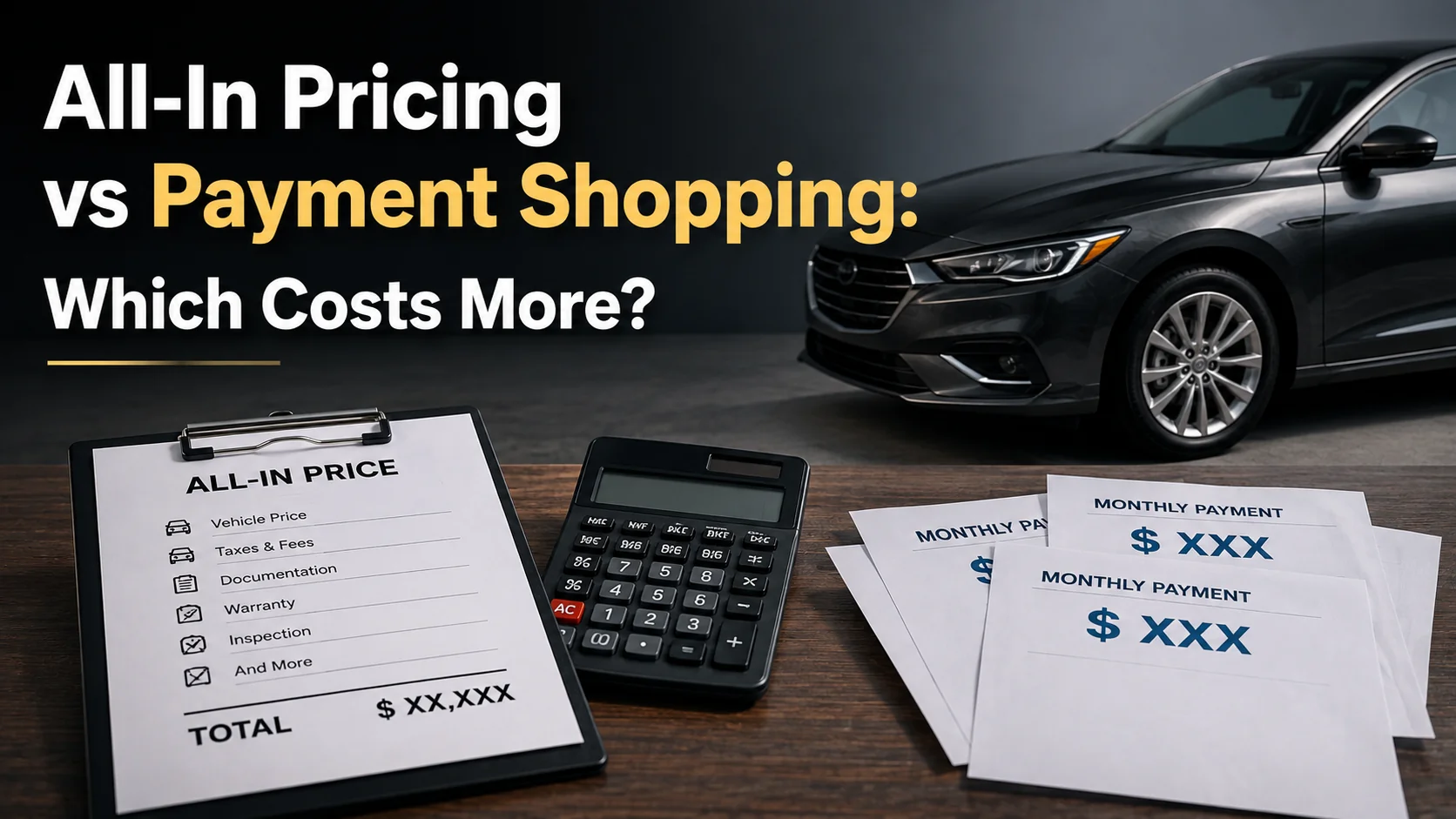
All-In Pricing vs Payment Shopping: Which Costs More?
In this article
- Is Payment Shopping or All-In Pricing the Better Strategy for Alberta Car Buyers?
- How Payment Shopping Sets You Up to Overpay
- What All-In Pricing Actually Means
- The Term Extension Math Alberta Buyers Miss
- Add-Ons and the Payment Fold-In
- How to Apply All-In Pricing in Practice
- When Payment Focus Is Actually Reasonable
- How Multi-Lender Financing Supports All-In Pricing
- Related Guides
- Could Shift Happens Help With This?
- Frequently Asked Questions
- Why do car dealerships always ask about monthly payments instead of total price?
- How do I calculate the total cost of a car loan in Alberta?
- Is a longer loan term always bad for Alberta car buyers?
- What's the maximum loan term available for used vehicles in Alberta?
- Can I negotiate the interest rate on a dealer-arranged car loan in Alberta?
- Compare and Apply
Check Your Options in 3 Minutes
No credit impact. All credit situations welcome.
★★★★★ 118+ Google Reviews · AMVIC Licensed · Free Delivery 300km
Is Payment Shopping or All-In Pricing the Better Strategy for Alberta Car Buyers?
All-in pricing almost always costs less total — but payment shopping is what most buyers actually do. A buyer focused only on fitting a $280 biweekly payment might accept a $24,000 vehicle at 22.99% over 84 months, paying $13,200 in interest. The same $280 biweekly payment at 14.99% over 60 months supports a $15,000 vehicle — but with only $4,800 in interest. Payment shopping locks you into a number without controlling the variables that determine total cost. All-in pricing controls what matters: vehicle price, interest rate, and term.
Walk into any dealership in Alberta — or respond to any online financing ad — and you'll immediately be asked: "What are you looking to spend per month?" It feels like a helpful question. It is not. The monthly payment framing is one of the most effective tools in automotive retail because it decouples the decision to buy from the cost of buying. Once you've agreed on a payment, the vehicle price, interest rate, and term become the salesperson's variables to optimize — not yours.
This post is about why payment shopping is structurally disadvantageous for buyers, what all-in pricing looks like as an alternative, and the specific math that illustrates how identical monthly payments can produce wildly different total costs depending on how the financing is structured.
How Payment Shopping Sets You Up to Overpay
Payment shopping works like this: you tell a salesperson you want to keep payments at $300 biweekly. The salesperson's goal then becomes finding a deal structure where your payment is $300 biweekly — not necessarily minimizing your total cost. Three completely different deals can produce the same $300 biweekly payment:
| Scenario | Vehicle Price | Rate | Term | Biweekly Payment | Total Interest |
|---|---|---|---|---|---|
| A (good deal) | $18,000 | 11.99% | 60 months | $299 | $3,980 |
| B (medium deal) | $22,000 | 18.99% | 84 months | $302 | $11,550 |
| C (bad deal) | $26,000 | 24.99% | 96 months | $297 | $21,500 |
Every one of these scenarios produces essentially the same payment. But Scenario C costs $17,520 more in total interest than Scenario A. The buyer focused on payment is choosing between these three deals based on nothing — because the only variable they're tracking is the one that's been held constant. The vehicle price, rate, and term are completely unconstrained by the payment target alone.
The payment shopping trap is particularly acute in subprime financing because subprime buyers are often more payment-sensitive (budget constraints are tighter) and because lenders in the subprime space have more term flexibility — 84 and 96 month loans are common, which creates more room for payment manipulation.
What All-In Pricing Actually Means
All-in pricing is a negotiation framework where you anchor to the vehicle price and understand the total cost — not the payment. The sequence:
- Establish the vehicle price first. What is the out-the-door price of this vehicle, including all fees (documentation, AMVIC levy, registration)? This number should be agreed upon before financing is ever introduced. In Alberta, a dealership is required to disclose all fees — the "all-in" price is a legitimate request.
- Know your interest rate before agreeing to a term. What is the APR on this loan? Not the "rate equivalent" or "financing cost" — the annual percentage rate. At what rate is this being financed?
- Calculate total interest at different terms. Once you have the vehicle price and rate, use the biweekly payment calculator to compare what 60, 72, and 84 months actually cost in total interest. The payment difference between terms is visible; the total interest difference is usually surprising.
- Choose the shortest term your budget can sustain. Every extra month of term is extra interest paid. The question isn't "what's the lowest payment?" — it's "what's the shortest term I can afford without straining my monthly budget?"
This framework puts you in the driver's seat on every variable that determines total cost. Payment is an output of those variables, not an input you negotiate around.
The Term Extension Math Alberta Buyers Miss
The most common payment manipulation tool is extending the loan term. A salesperson who needs to get your payment from $350 biweekly to $280 biweekly has one easy lever: add 12-24 months to the term. Here's what that actually costs on a $22,000 loan at 18.99%:
- 60 months: biweekly $362, total interest $9,720
- 72 months: biweekly $313, total interest $12,544
- 84 months: biweekly $280, total interest $15,680
- 96 months: biweekly $257, total interest $18,912
Going from 60 to 84 months saves $82 biweekly — but costs $5,960 in additional interest over the life of the loan. Going from 60 to 96 months saves $105 biweekly and costs $9,192 more in total interest. That's not a financing convenience — that's a decision to pay nearly $10,000 extra for the flexibility of a lower payment.
Whether that trade-off makes sense depends on your situation. If the 60-month payment genuinely strains your budget to the point of risk, a longer term with the intention to pay it off early (and no prepayment penalty) might be the right call. But making that decision explicitly — as a conscious trade-off — is completely different from having a term extended on you without understanding the cost.
The 20% rule for term decisions: A useful heuristic for Alberta buyers evaluating term extensions: if extending the term saves you less than 20% on the biweekly payment, the total interest cost almost certainly makes the shorter term worth the budget stretch. On a $20,000 loan at 19.99%, the jump from 72 to 84 months saves about $35 biweekly (roughly 13%) but costs approximately $3,200 in additional interest. That's a poor exchange. A 20%+ payment reduction from a term extension starts to represent meaningful budget relief — but the total interest still needs to be on the table when you decide.Add-Ons and the Payment Fold-In
Extended warranties, GAP insurance, and other add-on products are often presented as "just a few dollars more per payment." This framing is specifically designed to obscure the cost. A $2,500 extended warranty folded into an 84-month loan at 19.99% doesn't cost $2,500 — it costs approximately $3,900 by the time financing charges are included. The $30/biweekly "cost" of the warranty sounds trivial because it's been amortized over 84 months. The all-in cost is three times larger.
This doesn't mean extended warranties aren't worth it — on specific high-risk vehicles with limited warranty history, they can be. But the decision should be made on the full cost, not the payment impact. The correct question is: "What is the total price of this warranty, and what does it cover?" — not "How much more per payment?"
If you want to understand whether an extended warranty makes financial sense for a specific vehicle, our team can walk through that with you during the financing conversation. The extended warranty analysis is also worth reading before you sit down at the F&I desk.
How to Apply All-In Pricing in Practice
Knowing the framework and applying it under dealership pressure are two different things. Here's what the conversation looks like in practice:
Salesperson: "What are you looking to spend per payment?"
You: "Let's start with the vehicle price. What's the all-in price on this one, including all fees?"
This single redirect keeps you on all-in pricing territory. Once the vehicle price is established, you can calculate payments at different rate/term combinations yourself using the calculator before agreeing to anything. When financing terms are presented, the question is: "What is the APR on this loan, and what is the total interest over the term?"
Dealers are required to disclose APR in Canada — it's not optional. If you're quoted a rate that sounds like "the financing cost is 2.9% per annum equivalent" or similar non-standard language, ask for the APR directly. The APR is the number that makes comparison possible across different loan structures.
If you want to understand what you'd realistically qualify for before walking into a dealership, the affordability calculator works backward from your budget to show what vehicle price and term combination fits sustainably — rather than starting with a payment and working forward into an unknown deal structure.
When Payment Focus Is Actually Reasonable
All-in pricing is the better framework for minimizing total cost — but payment focus is rational in one specific scenario: when you have a genuinely hard budget constraint and any overage creates real risk of missed payments. A buyer who genuinely cannot sustain more than $280 biweekly should communicate that constraint clearly, then evaluate which combination of vehicle price, rate, and term produces a $280 biweekly payment with the lowest total cost. That's not payment shopping — that's constrained optimization.
The difference: payment shopping treats the payment as the only variable and lets everything else float. Constrained optimization treats the payment as a ceiling and then minimizes total cost within that constraint. The second approach still requires knowing the all-in price, the rate, and the term — it just adds a payment ceiling to the optimization criteria.
For buyers with bad credit who are working with rates in the 18-26% range, total interest costs are high enough that these distinctions are material. On a $20,000 loan at 22.99%, the difference between 60 and 84 months is over $6,000 in total interest. Understanding that number and choosing your term deliberately is worth the extra five minutes of calculator work. Use the payment calculator to run your specific scenarios before committing to any deal structure.
How Multi-Lender Financing Supports All-In Pricing
One reason all-in pricing is hard to execute at single-lender dealerships: the rate isn't negotiable when there's only one offer. You accept it or you don't. The vehicle price is the only variable on the table. In a multi-lender model — where 15+ lenders compete for your loan — the rate itself becomes a variable. A lower rate changes the total interest calculation and may allow you to shorten the term without changing the payment, or lower the payment at the same term.
This is how dealer multi-lender financing at Shift Happens works: we submit your application to our full lender network, and the competing offers give us the ability to present you with rate options rather than a single take-it-or-leave-it quote. You can then run the all-in pricing calculation on multiple rate scenarios to find the combination that minimizes total cost within your payment ceiling. The lender overview gives context on who's in that network and what they specialize in.
Buyers in Calgary, Airdrie, and across Alberta can access our full lender network entirely online — no dealership visit required until delivery. The financing application is the starting point for that process.
Related Guides
If this post was useful, these directly-related guides will help you go deeper:
- Transmission Flush: When It Helps vs When It Kills Your Gearbox
- Owner-Operators vs Employee Truckers: Different Car Loan Rules
- Side-by-Side UTV vs ATV: Which Should You Finance First
- $0 Down vs $5,000 Down: How Your Deposit Affects Rate and Approval
- Open-End vs Closed-End Lease vs Finance: Which Suits Used Buyers
- Dealer Warranty vs Third-Party Extended Warranty: Real Differences
Could Shift Happens Help With This?
We're likely a fit if you: (1) want to make a fully-informed, all-in pricing decision rather than being managed by payment framing, (2) want 15+ lenders competing for your deal so the rate itself is a variable in your favour, (3) are in Alberta with any credit situation from prime to subprime. Not a fit if: you need new vehicles only, lease-only inventory, or are buying outside western Canada.
If your situation matches the description above, the next move is short: see your approval likelihood (60 seconds) or open a financing application. Neither one touches your credit score until you formally apply.
Frequently Asked Questions
Why do car dealerships always ask about monthly payments instead of total price?
Because payment framing decouples the decision to buy from the total cost of buying. Once a buyer anchors to a payment number, the salesperson controls all the variables that determine total cost: vehicle price, interest rate, and loan term. Payment focus benefits the seller; all-in pricing benefits the buyer.
How do I calculate the total cost of a car loan in Alberta?
Multiply your biweekly payment by the number of payment periods (term in months × 26 biweekly payments / 12). Subtract the vehicle price from that total — the difference is your total interest paid. A $300 biweekly payment over 84 months = 182 payments × $300 = $54,600 total paid. If the vehicle was $20,000, you paid $34,600 in interest. Running this calculation before you sign is the most important financial step in the car purchase process.
Is a longer loan term always bad for Alberta car buyers?
Not always — but it's rarely free. If you have a genuine budget constraint and the shorter-term payment creates real financial strain, a longer term may be necessary. The key is making that decision with full knowledge of what it costs in additional interest, not because the payment sounds better. Intent to pay off early (in a loan with no prepayment penalty) also changes the calculus.
What's the maximum loan term available for used vehicles in Alberta?
Most Alberta lenders offer up to 84-96 months on used vehicles, depending on the vehicle age and mileage. Older vehicles (10+ years) often cap at 60-72 months. Specialty subprime lenders sometimes offer 96-month terms to make payments work on larger loan amounts, though the total interest cost at those terms is substantial.
Can I negotiate the interest rate on a dealer-arranged car loan in Alberta?
You can negotiate the vehicle price (which affects the financed amount) and shop among multiple lenders (which affects the rate). The rate itself comes from lenders competing for your application — you're not haggling a rate at the table, but you can create rate competition by using a multi-lender dealership rather than a single-source lender. That competition is what the multi-lender model produces.
Compare and Apply
- Bad Credit Financing — Complete Guide — Alberta's subprime auto financing guide
See what you pre-qualify for
Three quick answers — soft check, no commitment.
Financing Resources
Related Articles

Ready to Find Your Vehicle?
Browse our inventory or apply for financing. All credit situations welcome.
★★★★★ 118+ Google Reviews · AMVIC Licensed · Free Delivery 300km