
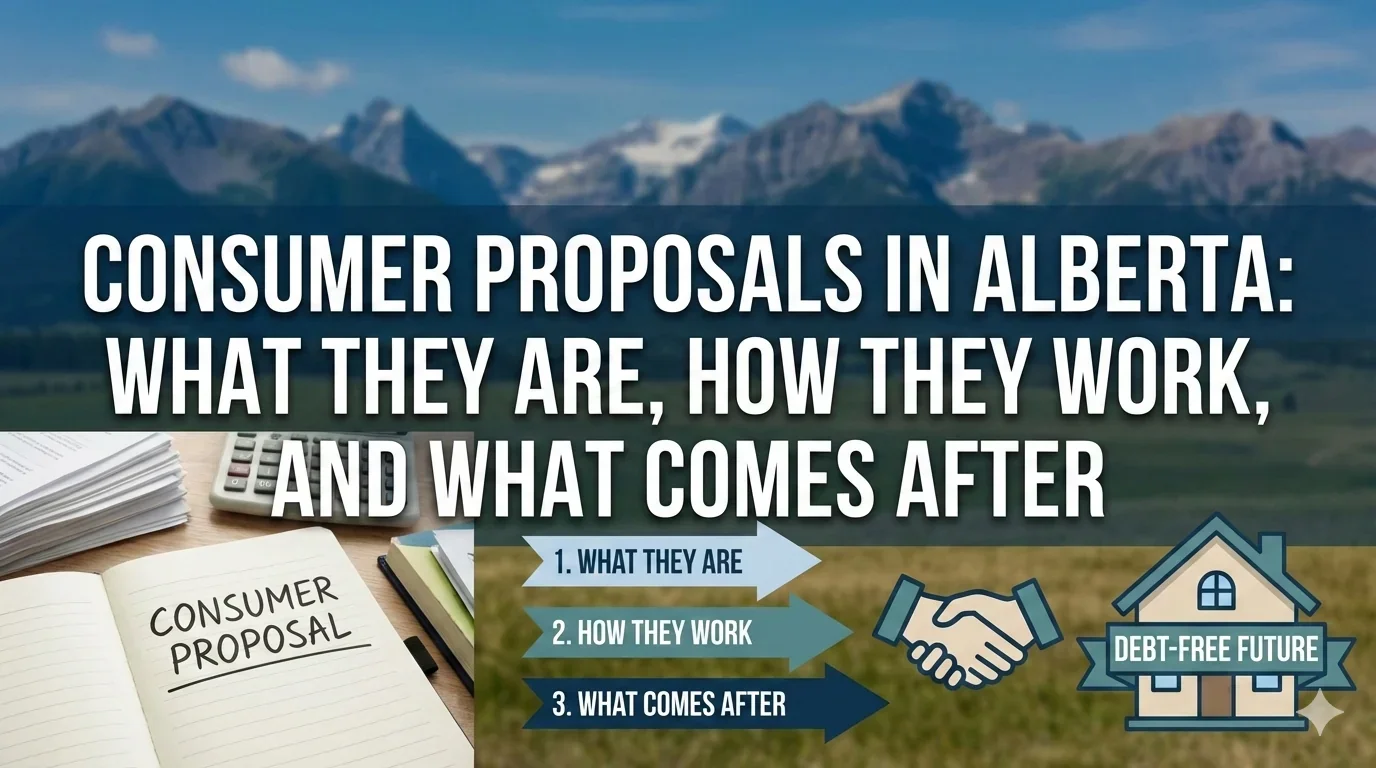
Consumer Proposals in Alberta: What They Are, How They Work, and What Comes After
In this article
- What Is a Consumer Proposal?
- How a Consumer Proposal Works
- What Debts Are Included (and What Aren't)
- What It Costs
- How a Consumer Proposal Affects Your Credit
- Consumer Proposal vs. Bankruptcy: Key Differences
- Life During a Consumer Proposal
- After Your Consumer Proposal: Rebuilding
- Finding Help in Alberta
- Related Buyer Guides
- Compare and Apply
Check Your Options in 3 Minutes
No credit impact. All credit situations welcome.
5.0118+ Google ReviewsAMVIC LicensedFree Delivery 300km
What Is a Consumer Proposal?
A consumer proposal is a formal, legally binding process filed through a Licensed Insolvency Trustee (LIT) that allows you to settle your debts for less than you owe. It's governed by the Bankruptcy and Insolvency Act of Canada and is one of the most common debt relief options used by Albertans — more common than bankruptcy in recent years.
If you're drowning in debt in Calgary, facing collection calls in Edmonton, or simply can't keep up with minimum payments in Airdrie or anywhere else in the province, a consumer proposal might be the structured path forward you've been looking for. This guide breaks down exactly how the process works, what it costs, who qualifies, and what happens to your credit and your life afterward.
How a Consumer Proposal Works
The Basic Concept
You offer your creditors a portion of what you owe — typically 20-50 cents on the dollar — paid over a period of up to five years in fixed monthly payments. If your creditors accept the proposal, all interest stops immediately and collection activity must cease. You pay the agreed amount, and the remaining debt is forgiven.
Who Qualifies
To file a consumer proposal in Alberta, you must:
- Owe between $1,000 and $250,000 in unsecured debt (excluding your mortgage)
- Be unable to pay your debts in full as they come due
- Be a Canadian resident or have property/business in Canada
Most people who file consumer proposals in Alberta have between $20,000 and $80,000 in unsecured debt. Common sources include credit cards, lines of credit, personal loans, tax debt, payday loans, and medical bills.
The Filing Process
Step 1: Consultation with a Licensed Insolvency Trustee. This initial meeting is free and confidential. The LIT reviews your finances — income, expenses, assets, debts — and advises whether a consumer proposal is the right option. In Alberta, there are LIT offices in Calgary, Edmonton, Red Deer, Lethbridge, and other major centres. Many now offer virtual consultations as well.
Step 2: Building the Proposal. Your LIT calculates what you can realistically afford to pay each month and structures a proposal that creditors are likely to accept. The proposal must offer creditors more than they would receive if you filed for bankruptcy — otherwise, they have no incentive to accept.
Step 3: Filing. Your LIT files the proposal with the Office of the Superintendent of Bankruptcy. Once filed, a "stay of proceedings" takes effect immediately. This means: all collection calls must stop, wage garnishments are halted, lawsuits related to your debts are paused, and interest stops accumulating on included debts.
Step 4: Creditor Vote. Creditors have 45 days to vote on your proposal. Each creditor's vote is weighted by the dollar amount they're owed. The proposal is accepted if a simple majority (by dollar value) votes in favour — or if creditors don't respond at all (no response counts as acceptance). In practice, most consumer proposals in Canada are accepted.
Step 5: Making Payments. Once accepted by creditors and approved by the court, you make your fixed monthly payments to your LIT, who distributes the funds to creditors. Payments are fixed — they don't change if your income goes up or down.
Step 6: Completion and Certificate. After making all your payments, you receive a Certificate of Full Performance. Your included debts are legally discharged. You're done.
What Debts Are Included (and What Aren't)
Typically Included
- Credit card balances
- Personal lines of credit
- Unsecured personal loans
- CRA tax debt (income tax, GST, HST)
- Payday loans
- Student loans (if you've been out of school for 7+ years)
- Medical bills
- Utility arrears
Not Included
- Secured debts (mortgage, car loan — you keep these and keep paying)
- Student loans (if you've been out of school for less than 7 years)
- Child support and alimony obligations
- Court fines and penalties
- Debts arising from fraud
Important: your car loan and mortgage are not affected by a consumer proposal. If you're making payments on your vehicle, you keep making those payments and you keep the vehicle. The proposal only deals with unsecured debts.
What It Costs
There is no upfront fee to file a consumer proposal in Alberta. Your LIT's fees are built into the proposal payments — they're paid from the funds you contribute each month. This is regulated by the federal government, so the fee structure is standardized across all LITs.
The total amount you pay depends on your debt level, income, assets, and what creditors will accept. As a rough guideline, most people pay 20-50% of their total unsecured debt over 3-5 years. On $50,000 of debt, that might look like $300-500/month for 48-60 months.
How a Consumer Proposal Affects Your Credit
A consumer proposal is recorded on your credit report with a rating of R7 (the scale goes from R1/best to R9/worst — bankruptcy is R9). This notation remains on your report for three years after you complete the proposal, or six years from the filing date, whichever comes first.
During the proposal period and for a period after, your credit score will be significantly lower than average. Most people in an active consumer proposal have scores in the 450-550 range. This affects your ability to get new credit — but it's temporary, and there are things you can do to start rebuilding even while you're still in the proposal.
Consumer Proposal vs. Bankruptcy: Key Differences
Both are formal insolvency processes, but they differ in important ways:
- Assets: In a consumer proposal, you keep all your assets. In bankruptcy, non-exempt assets may be surrendered.
- Surplus income: In a consumer proposal, your payments are fixed regardless of income changes. In bankruptcy, increased income triggers higher payments (surplus income rules).
- Duration on credit report: Consumer proposal: removed "3 years after you've paid off all the debts included in the proposal, or 6 years after you sign the proposal (whichever comes first)". Bankruptcy: 6 years after discharge (first time).
- Credit rating: Consumer proposal: R7. Bankruptcy: R9.
- Professional implications: Certain professions are affected by bankruptcy (financial services, some licensed professions). A consumer proposal typically doesn't trigger the same professional consequences.
For most Albertans with a steady income, a consumer proposal is the preferred option because you keep your assets, your payments are predictable, and the credit impact is shorter.
Life During a Consumer Proposal
Your Day-to-Day Doesn't Change Much
You keep your job, your home, your vehicle, your bank accounts. You make one fixed monthly payment instead of juggling multiple creditor payments. For many people, the stress reduction alone is life-changing. No more collection calls. No more threatening letters. No more anxiety about which bill to pay first.
Getting New Credit During a Proposal
You're not prohibited from getting credit during a consumer proposal, but you are required to disclose the proposal to any new lender. In practice, most traditional lenders won't extend credit during an active proposal. However, some subprime lenders and specialist dealerships work with people in active proposals — particularly for essential needs like a vehicle for getting to work. For a closer look, this page on car loans during and after a consumer proposal explains how lenders view an active or completed proposal in Alberta.
What If Your Income Changes?
If your income goes up, your proposal payments stay the same — this is one of the key advantages over bankruptcy. If your income drops and you can't make payments, talk to your LIT immediately. Missing three payments causes your proposal to be annulled, which can lead to bankruptcy. Your LIT may be able to amend the proposal terms.
After Your Consumer Proposal: Rebuilding
Once you receive your Certificate of Full Performance, the rebuilding process begins in earnest. Here's the practical playbook:
Secured Credit Card
Apply for a secured credit card immediately after completion. Deposit $500-$1,000 as collateral, use the card for one or two small purchases per month (gas, groceries), and pay the full balance every month. This builds a positive payment history on your credit report.
Car Loan
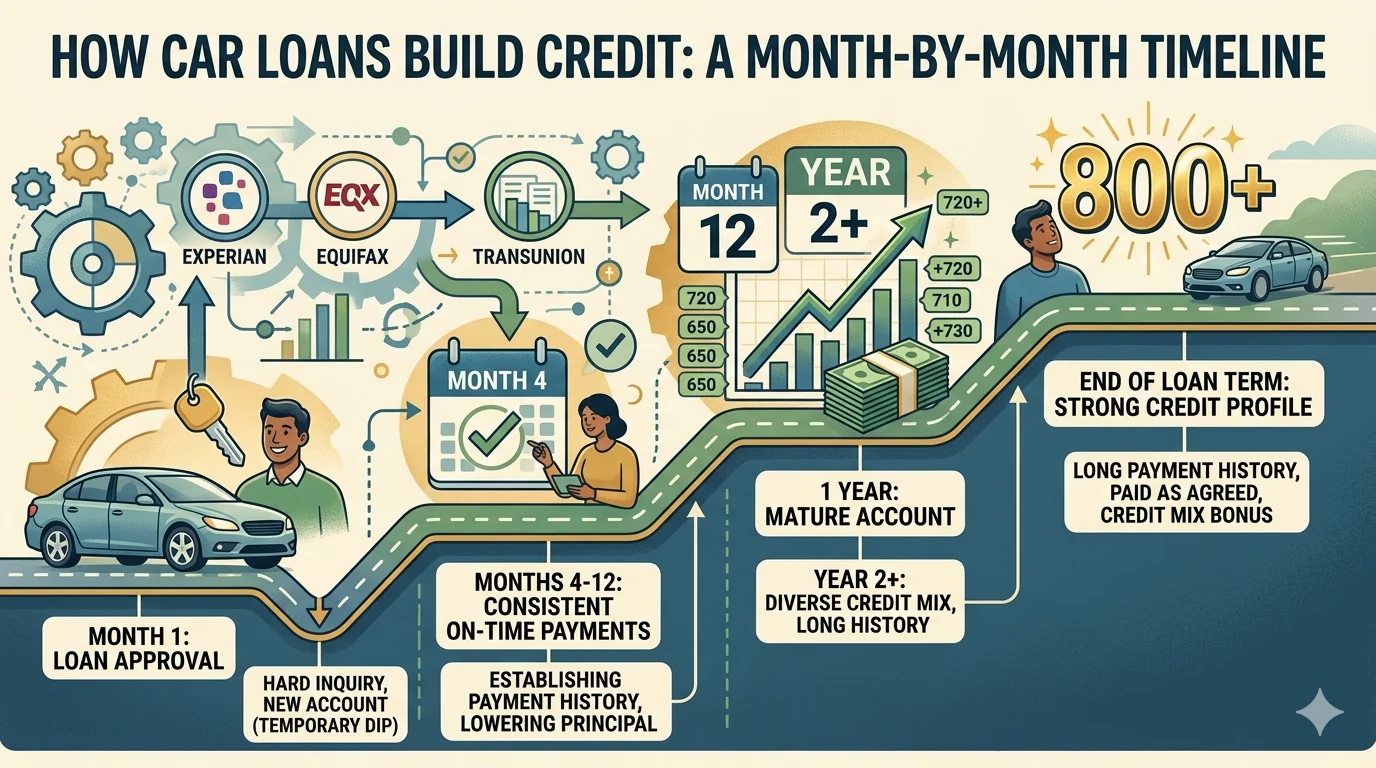
A car loan is one of the most effective credit rebuilders because it's an installment loan with regular monthly payments reported to both bureaus. Many people finance a vehicle shortly after completing their proposal — or even during it if a specialist lender is available. Each on-time payment is a positive data point.
Timeline
With consistent effort — secured credit card plus car loan, all payments on time — most people see their credit score improve to the 600-650 range within 18-24 months of completing their proposal. Within 3-4 years of completion, many people qualify for conventional credit products including mortgages.
Finding Help in Alberta
If you're considering a consumer proposal, start with a free consultation from a Licensed Insolvency Trustee. Look for an LIT who is a member of the Canadian Association of Insolvency and Restructuring Professionals (CAIRP). Initial consultations are always free and confidential.
If you need reliable transportation during or after your proposal, dealerships that specialize in challenged credit situations can help. At Shift Happens Auto Sales, we work with lenders who understand consumer proposals and can get you behind the wheel of a quality vehicle — whether you're in the middle of your proposal or just completed it. Serving Calgary, Edmonton, Airdrie, Red Deer, and all of Alberta with free delivery within 300km.
Compare and Apply
- Bad Credit Car Loans — Complete Guide — financing for low credit scores
Financing Resources
Cars you could drive home
See all inventory
2023 Mitsubishi Outlander ES PHEV

2021 Land Rover Range Rover Evoque R-Dynamic HSE

2019 Ford Explorer XLT
Not seeing it? We'll find it.
We source through our dealer partner network across Western Canada: 25,000+ vehicles to choose from. Tell us what you want and what works for your budget.
Find my car3 min · no credit impactOAC = on approved credit. Payments are examples at 6.49% APR over 84 months with $0 down, based on each vehicle's advertised price; GST extra. Your rate depends on your credit (4.99%–29.9% APR).
Related Articles
Ready to Find Your Vehicle?
Browse our inventory or apply for financing. All credit situations welcome.
5.0118+ Google ReviewsAMVIC LicensedFree Delivery 300km