
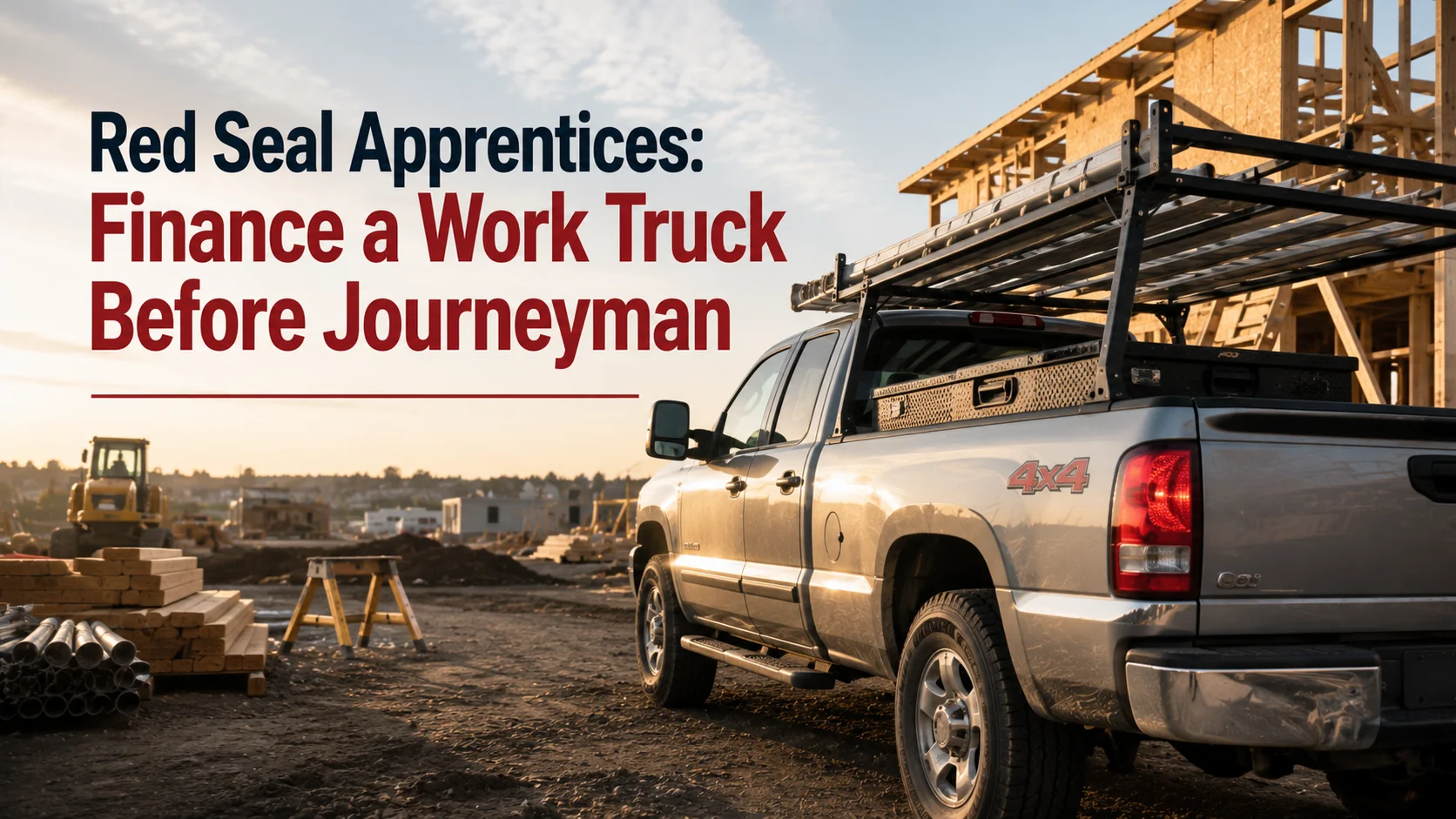
Red Seal Apprentices: Finance a Work Truck Before Journeyman
In this article
- Can apprentices get a car loan or work truck financing in Alberta?
- Why Apprentice Income Is More Bankable Than You Think
- What Documents You'll Need (And Why Each One Matters)
- Work Trucks: What Your Budget Can Actually Buy
- Credit Score Reality Check for Apprentices
- The Union Dispatch Scenario
- Should You Finance Now or Wait for Your Ticket?
- Maintenance: Keeping Your Work Truck on the Road
- How the Application Process Works: Step by Step
- Protecting Your Investment: Insurance for Tradespeople
- Related Guides
- Could Shift Happens Help With This?
- FAQ: Work Truck Financing for Apprentices
- Do I need my journeyman certificate to get a car loan in Alberta?
- How much of my income can I use toward a truck payment?
- What if I work for multiple contractors throughout the year?
- Can I finance a truck with no credit history?
- Is the financing rate better if I wait until after my raise?
- Compare and Apply
Check Your Options in 3 Minutes
No credit impact. All credit situations welcome.
★★★★★ 106+ Google Reviews · AMVIC Licensed · Free Delivery 300km
You're two years into your electrical apprenticeship, earning $28/hour, and your 2009 Silverado just threw a transmission code that'll cost more to fix than the truck is worth. Your journeyman ticket is still 18 months away — but your tools, your commute to job sites, and your income are very real right now. So why does every lender seem to treat apprentices like they're still in high school?
See what you pre-qualify for
Three quick answers — soft check, no commitment.
Can apprentices get a car loan or work truck financing in Alberta?
Yes — Alberta apprentices with a registered employer, verifiable T4 or pay stubs, and a minimum $2,500–$4,000 monthly income routinely qualify for $20,000–$40,000 in vehicle financing. Lenders approve on current documented income, not on ticket status. Rates typically run 7.99–18.99% depending on credit, with 60–84 month terms available.
Why Apprentice Income Is More Bankable Than You Think
The misconception is that lenders wait for your journeyman ticket before they'll lend to you. That's not how subprime auto lending works. What lenders actually care about is three things: stable employment with a registered company, consistent documented income, and a debt-to-income ratio that shows you can carry the payment.
If you're a third-year plumber earning $26–$31/hour on a 40-hour week, that's roughly $4,160–$4,960/month gross before overtime. That income — backed by your T4 or three months of pay stubs — is what gets underwritten. The lender isn't waiting for Alberta Apprenticeship and Industry Training to stamp your Red Seal certificate. They're looking at your bank account and your employer's letterhead.
The one wrinkle: apprentices who hop between employers during slow seasons can look unstable on paper. If you've been with the same company for 12+ months, you're in strong shape. If you've had two or three employers in the past year, be ready to explain the pattern — a union dispatch or contractor rotation is different from random job-hopping.
What Documents You'll Need (And Why Each One Matters)
Subprime lenders working with tradespeople want to see a complete income picture. Here's what to pull together before you apply:
- Last two T4s: Shows income stability year-over-year. Lenders average these to smooth out any one-time overtime spikes.
- Three most recent pay stubs: Confirms current employer and current wage. Especially important if your rate went up at the start of a new apprenticeship year.
- Apprenticeship registration or employer letter: Confirms you're in a formal program — some lenders use this to distinguish you from casual labour.
- Bank statements (90 days): Shows money actually landing in your account. For self-employed or cash-paid jobs this is critical; for W2-style T4 earners it's a secondary check.
- Government-issued ID: Driver's licence plus a utility bill or lease agreement for address confirmation.
Don't wait until you're in the dealership to collect these. A lender who sees a complete file on day one moves faster and often returns better terms than one who's waiting on you to email documents piecemeal.
Work Trucks: What Your Budget Can Actually Buy
Let's run the numbers on a realistic scenario. Say you're a third-year electrician earning $4,200/month net, credit score around 620, and you've got $2,500 saved for a down payment. That profile — near-prime credit, strong income, modest down — typically qualifies for a truck loan in the $28,000–$35,000 range.
At $30,000 financed over 72 months at 12.99%, your biweekly payment lands around $229. That's roughly 13% of your monthly net — well inside the 15–20% threshold most lenders want. If you can push the down payment to $4,000–$5,000, you open up more inventory and lower the payment further.
What does $28,000–$35,000 buy you in the current Alberta used truck market? A 2019–2021 Ford F-150 with 80,000–120,000 km is realistic. So is a 2018–2020 Chevrolet Silverado 1500 or a Ram 1500 if you prefer the longer wheelbase. All of these are credible work trucks with enough payload capacity for tools and enough reliability to get you to the job site in -30°C.
Apprentice financing sweet spot: A third-year Red Seal apprentice in Alberta earning $4,200/month net with a 620 credit score and $3,000 down typically qualifies for $28,000–$35,000 in truck financing at 11.99–15.99% over 72 months — roughly $210–$240 biweekly. That's enough budget for a reliable 2019–2021 half-ton with room to spare. Multi-lender competition through Shift Happens can drop that rate 2–3 points vs. a single bank application.Credit Score Reality Check for Apprentices
Many tradespeople in their mid-20s have thin credit files — not bad credit, just not enough history. If you've had one credit card for two years and nothing else, your score might sit in the 580–640 range despite never missing a payment. That's actually easier to work with than a damaged credit file.
Thin credit means a lender might ask for a slightly larger down payment (10–15% of the vehicle price vs. 5–10%) or offer a rate that's 2–4 points higher than prime. The tradeoff is that your first auto loan — paid on time — accelerates your credit file dramatically. Car payments build credit because they add an installment account, which is weighted differently than credit card revolving balances. Many tradespeople who finance a truck at 16% in year one refinance at 9–10% two years later once their score crosses 680.
If your credit file has actual negative marks — a missed cell phone payment that went to collections, an old credit card you ignored — that's a different situation. A collection under $500 that's being paid can often be explained away with a letter of explanation. Multiple collections or an account in active default requires a lender that specifically works second-chance auto financing.
At this decision point in your financing journey, the most useful move is to check your approval likelihood before you walk into any dealership — it takes 60 seconds and doesn't affect your credit score.
The Union Dispatch Scenario
Some Red Seal apprentices — particularly in electrical, pipefitting, and ironwork — work through union dispatch. That means your employer changes every few months as you move from project to project. Lenders who don't understand trades often see this as job instability. The fix is to get a letter from your union local confirming continuous membership and dispatch frequency.
A letter on union letterhead that says "Member since [date], dispatched an average of 44 weeks per year at a journeyman-level wage" reframes your employment from "constantly changing jobs" to "steady union tradesperson in a project-based industry." Subprime lenders who specialize in Alberta workers understand this distinction — not all lenders do, which is one reason a multi-lender model that matches your file to the right underwriter matters more than going to a single bank.
Should You Finance Now or Wait for Your Ticket?
The argument for waiting: once you have your journeyman ticket, your hourly rate jumps — sometimes by $8–$12/hour — and you become easier to underwrite. Your credit file also has two more years of history on it. That's a real improvement in your financing position.
The argument for financing now: you need a reliable vehicle today. A breakdown that costs you a day's wages or forces you to borrow a coworker's truck is a real economic problem. And the truck you finance now and drive carefully for two years can be traded or sold once your income increases — often with positive equity if you put a solid down payment in.
The honest answer is that the "wait" math only wins if your current vehicle can plausibly last 18–24 more months without a major repair. If it can't, financing now is the economically rational call. You can also use the payment calculator to model what different loan amounts and terms look like at various rate scenarios before you commit.
Compare your options against Alberta's first-time car buyer guide for a broader look at the full decision framework.
Maintenance: Keeping Your Work Truck on the Road
A used work truck in Alberta needs a bit more attention than a commuter car. The combination of cold starts, heavy loads, and gravel roads accelerates wear on specific components. Here's what to budget:
- Oil changes: Every 5,000–8,000 km if you're doing a lot of idling on job sites. Synthetic oil at $120–$160/change.
- Tires: A set of four winter tires plus rims runs $1,200–$1,800. Non-negotiable in Alberta — the tire care guide explains why switching pays for itself in fuel economy and safety.
- Brake pads and rotors: Budget $400–$600 every 40,000–50,000 km on a half-ton if you're loading it regularly.
- Battery: Cold-climate batteries last 3–5 years. A block heater plug for $15 extends battery life and guarantees cold starts.
Financing a newer truck (2018+) reduces your maintenance risk significantly compared to a $10,000 beater that might eat one major repair per year. The predictability of a reliable payment beats the unpredictability of repair bills when you're trying to build a professional reputation and show up on time.
How the Application Process Works: Step by Step
For a tradesperson who's used to banks treating you like a question mark, the subprime dealer process is refreshingly fast. Here's what actually happens when you apply through a multi-lender dealership:
- Pre-application (15 minutes online): You submit your name, address, income, and employment. No credit pull yet at this stage — it's information gathering.
- Document collection (same day or next day): You provide your pay stubs, T4, ID, and any other requested documents. A complete file speeds every subsequent step.
- Lender matching (1–4 hours): Your file goes to multiple lenders simultaneously. They evaluate your income, credit profile, and the specific vehicle. The multi-lender model means you're not waiting for one bank to say yes or no — you're waiting for the best offer from 15+ underwriters.
- Conditional approval (same day in most cases): You receive an approval with a rate, term, and qualifying amount. Conditions might include a specific down payment or proof of insurance at pickup.
- Vehicle selection and deal finalization: With approval in hand, you pick the specific vehicle and complete the purchase paperwork. The financing is already arranged — you're not negotiating the loan at the signing table.
The entire process from first call to driving away can be done in 48–72 hours with a complete document package. If you've spent weekends visiting multiple dealerships and getting runs on your credit with nothing to show for it, this approach is a significant upgrade in efficiency.
Protecting Your Investment: Insurance for Tradespeople
A work truck that's occasionally used to haul tools or materials needs the right insurance coverage. In Alberta, standard personal auto insurance covers commuting and personal use. If you're regularly hauling for a business — even your own small operation — you need to confirm with your insurer that your use is covered.
Key insurance questions for apprentices financing a work truck:
- Am I covered if I have tools in the truck and there's a theft? Tools are typically not covered under standard auto insurance — they fall under commercial property or contents insurance.
- What if I'm dispatched and in an accident on the way to a job site? Commuting to a job site (even a shifting one) is typically covered. Hauling materials as part of your employment may require an endorsement.
- Does my employer's insurance cover me? If you drive a company truck, possibly. Your personal truck is not covered by your employer's policy.
A 15-minute call with an Alberta broker before you finalize the vehicle purchase is worth it. Know your coverage before you drive off the lot, not after an incident.
Related Guides
The questions this post raises usually lead to the topics below — pick the angle that fits your scenario:
- Best Used Trucks Under 150,000 km for Alberta Tradespeople
- Best Used GMC Sierras for Alberta Oilfield Workers
- Strathmore, Brooks, and Drumheller: Farm Corridor Truck Guide
- Owner-Operators vs Employee Truckers: Different Car Loan Rules
- Fall Hunting Season Truck and Trailer Setup in Alberta
- Construction PMs: T4 vs T4A Income and What Lenders Make of It
Could Shift Happens Help With This?
We're likely a fit if you: (1) are a registered apprentice or journeyman tradesperson in Alberta, (2) have verifiable T4 or pay stub income, (3) need a reliable work truck or commuter vehicle and want 15+ lenders competing for your deal. Not a fit if: you need new-only inventory, lease financing, or you're buying outside western Canada.
If this describes you, the fastest next steps are: check your approval likelihood (60 seconds, no credit impact) or start a full financing application. Our team understands trades income — bring your pay stubs and we'll tell you exactly what you qualify for before you waste a hard inquiry at a bank that doesn't understand apprenticeship.
FAQ: Work Truck Financing for Apprentices
Do I need my journeyman certificate to get a car loan in Alberta?
No. Lenders underwrite on current documented income, not ticket status. A registered apprentice with T4 income and a stable employer is approvable today. Your Red Seal certificate improves your income (and future borrowing power) but is not a prerequisite for financing.
How much of my income can I use toward a truck payment?
Most lenders want your total debt obligations — car payment, any student loans, credit cards, rent — to stay under 40–45% of your gross monthly income. Your vehicle payment alone should ideally be 15–20% of your net monthly take-home. On $4,200/month net, that's $630–$840/month or roughly $315–$420 biweekly as a comfortable ceiling.
What if I work for multiple contractors throughout the year?
Explain the pattern upfront with a union letter or a written statement of your dispatch history. Two or three T4s from different employers in the same tax year is common in trades — lenders who work in Alberta understand this. Bring documentation from each employer and your two most recent T4s.
Can I finance a truck with no credit history?
Yes, but expect to put 15–20% down and accept a slightly higher rate (18–22% range) on your first loan. A thin credit file is not the same as bad credit. After 12 months of on-time payments, your score typically crosses the 650 threshold, which opens up much better rates on a refinance.
Is the financing rate better if I wait until after my raise?
Marginally — a higher wage-to-payment ratio gives lenders more comfort, which can improve rate offers by 1–2 points. But if you need the truck now, the cost of waiting (vehicle unreliability, missed work) typically outweighs the interest savings from a slightly better rate later.
Compare and Apply
- Bad Credit Financing — Complete Guide — financing for low credit scores
Financing Resources
Related Articles


Ready to Find Your Vehicle?
Browse our inventory or apply for financing. All credit situations welcome.
★★★★★ 106+ Google Reviews · AMVIC Licensed · Free Delivery 300km