
When Downsizing Your Vehicle Makes Financial Sense
In this article
- Life Events That Make Downsizing Worth Doing the Math
- Empty Nest
- Retirement or Reduced Income
- Moving to the City
- Income Change or Financial Pressure
- The Concrete Math: How Much Can You Actually Save?
- How to Calculate Your Actual Vehicle Costs Right Now
- Trade-In Value: Why Right Now Might Be a Good Time to Sell a Truck
- The Emotional vs. Financial Decision Framework
- Best Downsizing Choices by Lifestyle
- Truck → Midsize SUV or Crossover
- Large SUV or Minivan → Compact Crossover
- Crossover → Sedan
- How Downsizing Can Eliminate Negative Equity
- The Insurance Savings Nobody Talks About
- Addressing the Winter Capability Concern
- When Downsizing Doesn't Make Sense
- Making the Move: The Practical Process
- Related Buyer Guides
- Compare and Apply
Check Your Options in 3 Minutes
No credit impact. All credit situations welcome.
5.0118+ Google ReviewsAMVIC LicensedFree Delivery 300km
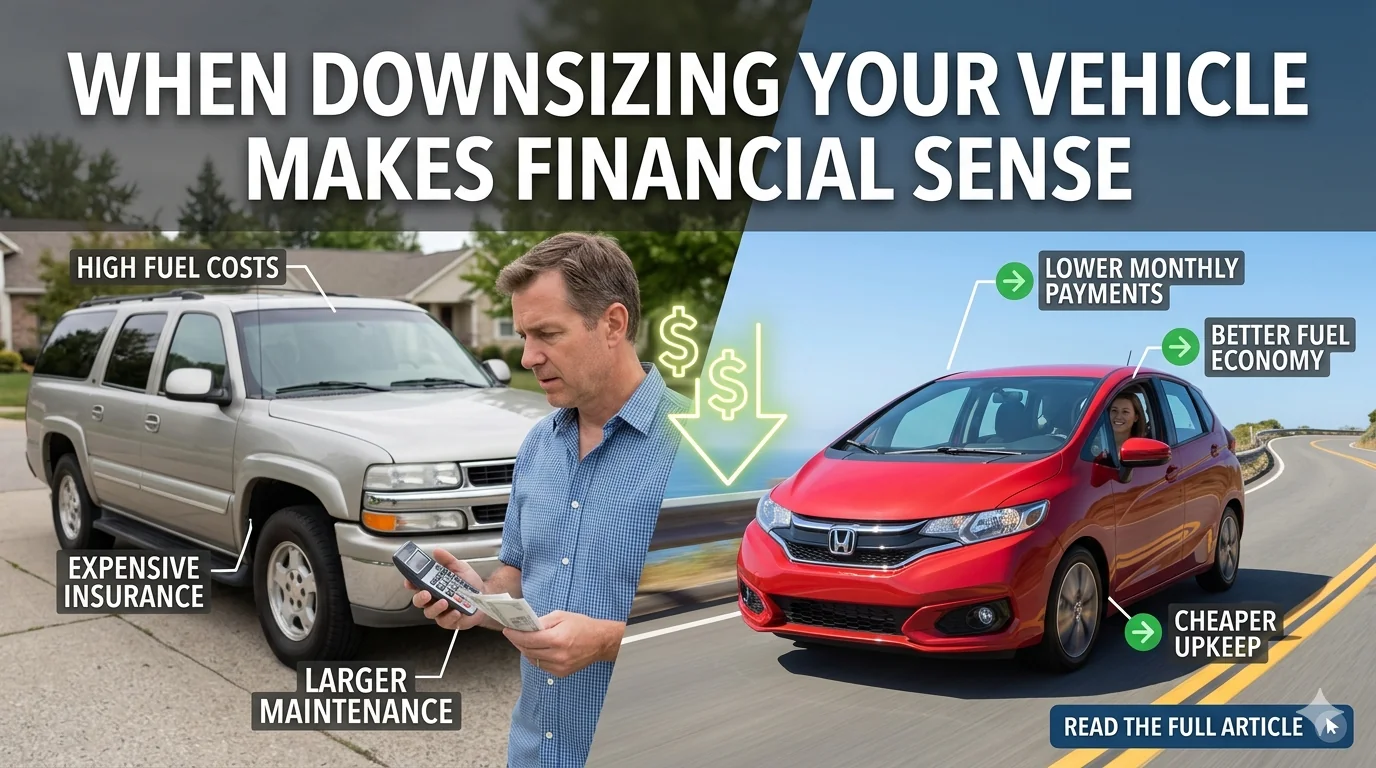
The truck that made perfect sense five years ago — when you were hauling equipment, shuttling kids to three different activities, and needing all-terrain clearance for camping trips every summer — might now be costing you $400 a month more than it needs to. Life changes, and vehicles that fit one chapter can become financial anchors in the next. Knowing when the math actually favors going smaller is a skill most people never develop, because nobody talks about downsizing until they're already feeling the squeeze.
Life Events That Make Downsizing Worth Doing the Math
There are four situations where the case for a smaller vehicle becomes genuinely compelling, and they share a common thread: your driving patterns or financial situation have changed materially, but your vehicle hasn't.
Empty Nest
The three-row SUV or full-size minivan that was practically mandatory when you had four kids and a dog has become a lot of vehicle for two people making weekend trips to Costco. The ongoing costs — fuel, insurance, maintenance — don't scale down because you're using 60% less of the vehicle's capacity. You're paying for utility you no longer need.
This is often the most emotionally difficult downsizing decision, because the vehicle holds memories. A rational look at the numbers tends to make the decision clearer. If an Explorer is costing you $380/month on the loan plus $180/month in fuel plus $160/month in insurance, that's $720/month for a vehicle that seats seven when there are now reliably two of you in it. A smaller crossover might run $280/month on financing, $110/month in fuel, and $120/month in insurance — $510/month total, saving $210/month or $2,520/year.
Retirement or Reduced Income
Transitioning from employment income to retirement income — whether that's CPP, OAS, RRSPs, or a combination — typically means a meaningful income reduction. The vehicle payment that fit comfortably on a $95,000 salary may eat a much larger slice of a $60,000 retirement income. What felt like a reasonable 12% of take-home becomes 19%, and that's before insurance and fuel. Financing a vehicle on a fixed retirement income is entirely possible, but right-sizing the vehicle makes the math work better from the start.
Moving to the City
Albertans moving from rural or acreage properties to Calgary or Edmonton often find that the four-wheel-drive truck that was genuinely necessary for unpaved roads, hauling firewood, and navigating farm equipment tracks is now mostly being parked in a city parkade. Urban driving favors smaller, more maneuverable vehicles. Parking costs for oversized vehicles in downtown Calgary can run $400-$600/month more than standard stalls. Fuel consumption on stop-and-go city streets with a half-ton truck is significantly worse than highway figures suggest.
Income Change or Financial Pressure
Job changes, business slowdowns, or major life expenses can shift your financial picture quickly. If your vehicle payment has gone from comfortable to stressful, downsizing isn't a retreat — it's smart resource allocation. A vehicle that fits your actual financial situation is worth more to your long-term stability than a vehicle that strains it.
The Concrete Math: How Much Can You Actually Save?
Let's run three realistic scenarios with Alberta-specific numbers.
| Scenario | Current Vehicle | Downsized To | Monthly Savings | Annual Savings |
|---|---|---|---|---|
| Truck → Midsize SUV | F-150 (V8): $320 loan + $240 fuel + $190 insurance = $750 | Mazda CX-5: $230 loan + $140 fuel + $140 insurance = $510 | $240 | $2,880 |
| 3-Row SUV → Crossover | Highlander: $380 loan + $180 fuel + $160 insurance = $720 | Honda CR-V: $260 loan + $120 fuel + $130 insurance = $510 | $210 | $2,520 |
| Crossover → Sedan | RAV4: $290 loan + $150 fuel + $145 insurance = $585 | Toyota Corolla: $190 loan + $90 fuel + $105 insurance = $385 | $200 | $2,400 |
These numbers are estimates based on typical Alberta fuel prices, insurance rates, and used vehicle loan payments in the $20,000-$35,000 range. Your specific situation will vary, but the direction is consistent: smaller vehicles cost less across all three major categories simultaneously.
How to Calculate Your Actual Vehicle Costs Right Now
Most people know their loan payment but dramatically underestimate total vehicle cost. Here's how to get the real number:
- Loan payment — Your biweekly payment × 2.17 (average biweekly periods per month)
- Insurance — Monthly premium (not annual divided by 12 from memory — pull the actual current amount)
- Fuel — Fill-ups per month × typical fill amount. Or: km driven per month ÷ fuel economy (L/100km) × current fuel price
- Maintenance — Annual spend divided by 12. Include oil changes, tires, unexpected repairs averaged over 3 years
- Registration and licensing — Annual Alberta registration fees divided by 12
Add those five numbers together. That's what your vehicle actually costs you monthly. Most people are surprised — the loan payment is usually only 50-60% of the true total. A truck that "costs $350/month" often actually costs $650-$800/month when everything is included.
Once you have that number, run the same calculation on potential downsized vehicles using our payment calculator for the financing piece, then estimate the other costs. The gap is usually larger than expected.
Trade-In Value: Why Right Now Might Be a Good Time to Sell a Truck
Used truck and larger SUV values have remained elevated relative to pre-pandemic levels, though the market has softened from its 2021-2022 peaks. This matters for two reasons:
First, you're likely to get a better trade-in value for a truck today than you would have five or six years ago. A 2019-2021 half-ton in good condition is still commanding strong appraisals. If you're going to make the switch anyway, doing it while truck values are relatively healthy rather than waiting until the market normalizes further works in your favor.
Second, the equity differential between your current vehicle and your downsized target is your starting position. If your truck is worth $42,000 and you owe $28,000, you have $14,000 in equity to apply to the next vehicle — which could mean buying a $22,000 sedan outright, or putting a significant down payment on a well-equipped crossover and having a very manageable payment. Understanding the factors that affect trade-in appraisals before you walk into a dealership puts you in a better negotiating position.
To maintain your vehicle's trade-in value in the months before a planned trade, check out strategies for protecting your vehicle's value. Regular maintenance records, clean presentation, and addressing known mechanical issues before appraisal can meaningfully affect the number you're offered.
The Emotional vs. Financial Decision Framework
Downsizing feels like giving something up. That feeling is real, and it's worth acknowledging — but it's worth separating it from the financial analysis.
A useful framework: list the reasons you actually use the current vehicle's capabilities, and honestly estimate how often. If you have a truck and you haul things four times a year, you're paying truck operating costs 365 days a year for four days of actual truck utility. You can rent a truck for $100/day when you actually need one, and do the math on how that compares to the annual premium you're paying to own one full-time.
Similarly, if you have a three-row SUV and the third row gets used twice a year for airport runs when relatives visit, that utility doesn't justify the monthly cost differential. Rent a larger vehicle for those occasions, or simply make two trips.
The test: If a trusted friend showed you your exact vehicle costs and said "you're spending $240/month more than you need to — what would you do with that money?" — what would your answer be? That $240/month is $2,880/year. Over five years, it's $14,400 in after-tax dollars. That number usually reframes the decision quickly.
The emotional attachment to a vehicle is legitimate. But it's worth being clear-eyed about whether you're paying a premium for capability you use, or paying a premium for capability you feel like you might need someday. The latter is expensive reassurance.
Best Downsizing Choices by Lifestyle
Truck → Midsize SUV or Crossover
For former truck drivers who've moved to the city or whose hauling needs have reduced, a midsize SUV or crossover captures most of the utility (cargo space, higher ride height, AWD) without the fuel penalty of a full-size truck. The Mazda CX-5 is consistently one of the most praised options in this category — genuinely car-like fuel economy, AWD standard on most trims, and exceptional reliability for Alberta's seasons. The Kia Sportage offers similar utility at a more accessible price point.
If you still occasionally need towing capability, a midsize truck (Ford Ranger, Chevy Colorado) splits the difference — better fuel economy than a full-size while maintaining a real bed.
Large SUV or Minivan → Compact Crossover
Empty nesters moving out of three-row SUVs often find that a compact crossover gives them everything they actually use — comfortable seating for two or four, adequate cargo for weekend trips, AWD for Alberta winters — at significantly lower cost. The Honda CR-V in particular is a perennial favorite for this transition, with a spacious interior despite its smaller footprint and strong reliability record that keeps long-term ownership costs predictable.
Crossover → Sedan
For city dwellers, retirees, or anyone whose driving is primarily commuting and errands, dropping to a sedan produces the maximum savings while still providing comfortable, reliable transportation. The Toyota Corolla is the archetype here: genuinely bulletproof reliability, excellent fuel economy for Calgary's stop-and-go, low insurance rates, and minimal maintenance costs. The Honda Civic is a close competitor with similarly strong ownership economics and slightly more engaging driving character if that matters to you.
Winter capability concerns are legitimate in Alberta, but modern front-wheel-drive sedans with proper winter tires handle remarkably well in most conditions. The quality of your tires matters far more than the drivetrain configuration in day-to-day winter driving. Check out which vehicles carry the lowest insurance costs in Alberta — sedans and smaller crossovers typically rate significantly better than trucks and large SUVs.
How Downsizing Can Eliminate Negative Equity
One underappreciated benefit of downsizing is its effect on negative equity situations. If you're currently underwater on a larger vehicle — owing more than it's worth — trading down to a less expensive vehicle can actually close the gap or eliminate it entirely.
Here's how: suppose you owe $36,000 on a truck worth $30,000 — $6,000 in negative equity. You want to downsize to a crossover priced at $24,000. The dealer appraises your truck at $30,000, leaving $6,000 in negative equity that would typically get rolled into the new loan. But the total new financing would be $30,000 ($24,000 vehicle + $6,000 rolled equity), which is $6,000 less than what you currently owe. Your monthly payment drops, and you're in a more manageable position — without the original negative equity continuing to compound.
The math doesn't always work this cleanly, and rolling negative equity into a new loan always extends the period before you're in a positive equity position. But for people trapped in expensive vehicles they can no longer comfortably afford, downsizing is often the most practical exit path. Understanding when trading makes more sense than repairing is part of the same calculation — at some point, the economics of a vehicle clearly favor moving on.
The Insurance Savings Nobody Talks About
The monthly loan payment gets all the attention in downsizing discussions, but insurance is often where the biggest hidden savings are. Alberta vehicle insurance rates vary dramatically by vehicle type, and the difference between a full-size truck and a compact sedan can be substantial — in some cases $100-$150/month.
Several factors drive this differential:
- Replacement cost. A newer, more expensive truck costs the insurer more to replace if written off. Lower vehicle value = lower collision and comprehensive premiums.
- Repair costs. Trucks and larger SUVs have more expensive parts and more complex repair requirements. Insurers price this in.
- Safety ratings. Many modern crossovers and sedans have excellent IIHS and NHTSA safety ratings that qualify for insurance discounts. Advanced safety features (automatic emergency braking, lane-keeping assist) on newer vehicles can reduce premiums further.
- Theft rates. Full-size trucks are among the most frequently stolen vehicles in Alberta. This is reflected in insurance rates. A Honda Civic or Toyota Corolla sits at the opposite end of the theft frequency spectrum and is priced accordingly.
When you're modeling the cost comparison between your current vehicle and a downsized option, get actual insurance quotes before finalizing the decision — don't estimate. The real numbers often reveal that insurance savings alone justify the switch even before factoring in fuel and financing savings. Understanding which vehicles cost the least to insure in Alberta can meaningfully shape which specific model you target in your search.
Addressing the Winter Capability Concern
For Albertans, the first objection to downsizing is almost always: "But what about winter driving?" It's a legitimate concern — our winters are real, Highway 2 gets genuinely dangerous in January, and nobody wants to be in a vehicle that can't handle it.
Here's the honest breakdown: the most important winter safety factor is tires, not drivetrain. A front-wheel-drive sedan on dedicated winter tires outperforms an AWD vehicle on all-seasons in virtually every real-world winter driving scenario. AWD helps you accelerate in slippery conditions; it does nothing to help you brake or corner, which is where most winter accidents happen. Proper winter tires address all three.
That said, AWD does provide a genuine psychological comfort margin and some real-world benefit in deep snow and steep hills. If you live in the mountains near Canmore or regularly drive mountain passes, AWD is worth keeping. If you live in Calgary or Airdrie and drive paved roads, you can almost certainly give up AWD without meaningful safety compromise — as long as you have quality winter tires.
Most modern front-wheel-drive crossovers and sedans also have sophisticated traction control and stability systems that dramatically improve handling in slippery conditions compared to vehicles from 10-15 years ago. The gap between FWD and AWD has narrowed considerably. A newer FWD sedan with good tires and modern stability control is a safer winter vehicle than an older AWD truck on worn all-seasons.
For most Alberta drivers making a downsize decision, the right answer is: choose a vehicle with modern safety features, buy proper winter tires on a dedicated set of rims, and save the AWD premium for situations where it's genuinely necessary to your specific driving circumstances.
When Downsizing Doesn't Make Sense
To be fair about this: there are situations where downsizing would be a mistake. If your work genuinely requires a truck — you're in trades, construction, or agriculture and you use the bed, towing capacity, and durability regularly — the truck isn't lifestyle overhead, it's a working tool. The math changes entirely when the vehicle is income-generating.
Similarly, if you're early in a long loan term on a vehicle you're currently underwater on, the negative equity you'd be rolling forward might negate the monthly savings for several years. Running the full numbers — not just the monthly payment comparison — is essential before deciding. Use a payment calculator to model the full cost of your current payoff versus a downsized scenario.
And if you live rurally and genuinely need the clearance, towing, and all-terrain capability for daily life in Alberta's winters and back roads, keep the truck. The goal isn't to downsize for its own sake — it's to match your vehicle to your actual life, which in some cases means the larger vehicle is still the right answer. If the truck is a working tool for your own business, see car loans for self-employed and contract workers in Alberta.
Making the Move: The Practical Process
If the numbers point toward downsizing, here's the sequence that works best:
- Get a current appraisal of your vehicle. Know what it's actually worth before you start shopping. This prevents you from making decisions based on an optimistic number in your head.
- Calculate your current payoff amount. Call your lender or check your online banking for the exact amount. The difference between the appraisal and the payoff is your equity (or negative equity) position.
- Define your actual needs in the next vehicle. Seating, cargo, AWD, towing capacity — be honest about what you'll actually use versus what feels nice to have.
- Calculate what the new payment should be. Use the payment calculator to find a target vehicle price that produces a comfortable payment for your current income.
- Shop with a clear target range. Knowing "I'm looking for a crossover in the $22,000-$28,000 range, I have X in equity/negative equity" keeps the process efficient.
The team at Shift Happens in Airdrie works with people making exactly this kind of transition regularly — it's not a complicated situation, and most people come out the other side wondering why they waited. Whether you're simplifying post-retirement, adjusting to a changed income situation, or just doing the math and realizing the truck is costing you $300/month you'd rather have back — we can help you find the right vehicle and the right financing for where you actually are right now. Start with a trade-in appraisal or apply for financing — the process is faster than most people expect, and the numbers will tell you clearly whether the move makes sense.
Compare and Apply
- Bad Credit Car Loans — Complete Guide — financing for low credit scores
Financing Resources
Cars you could drive home
See all inventory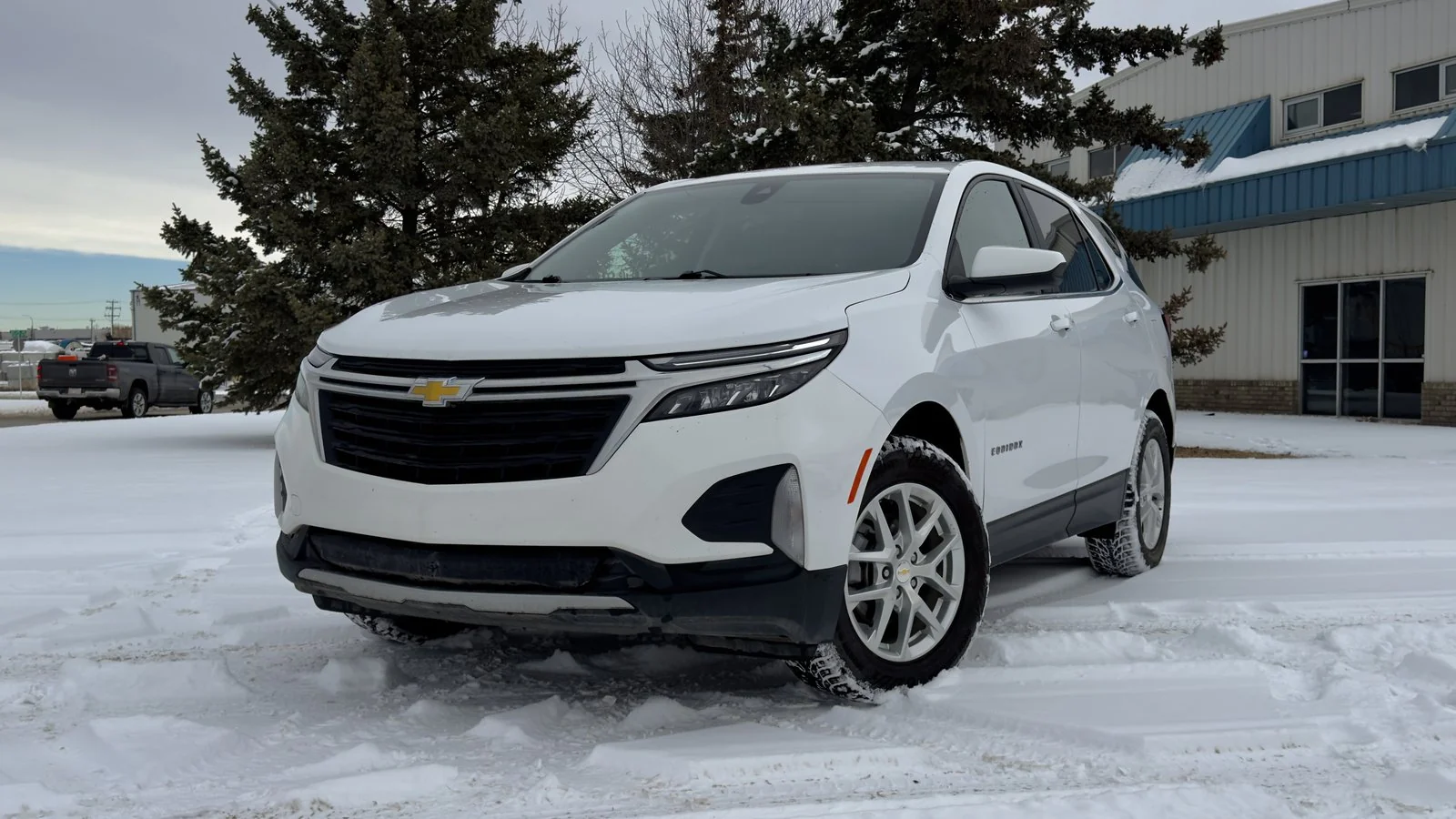
2022 Chevrolet Equinox LT
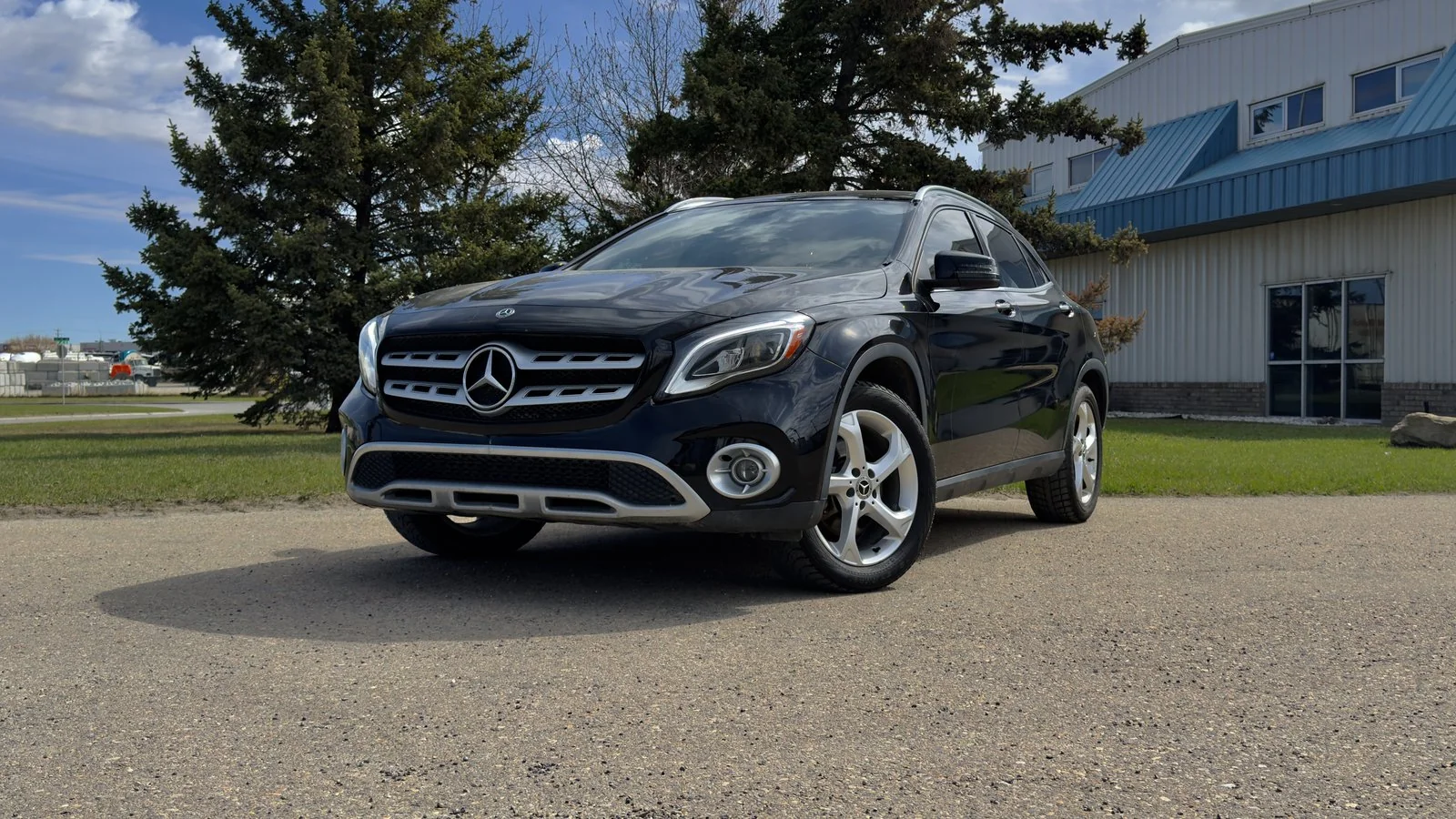
2020 Mercedes-Benz GLA250 4Matic
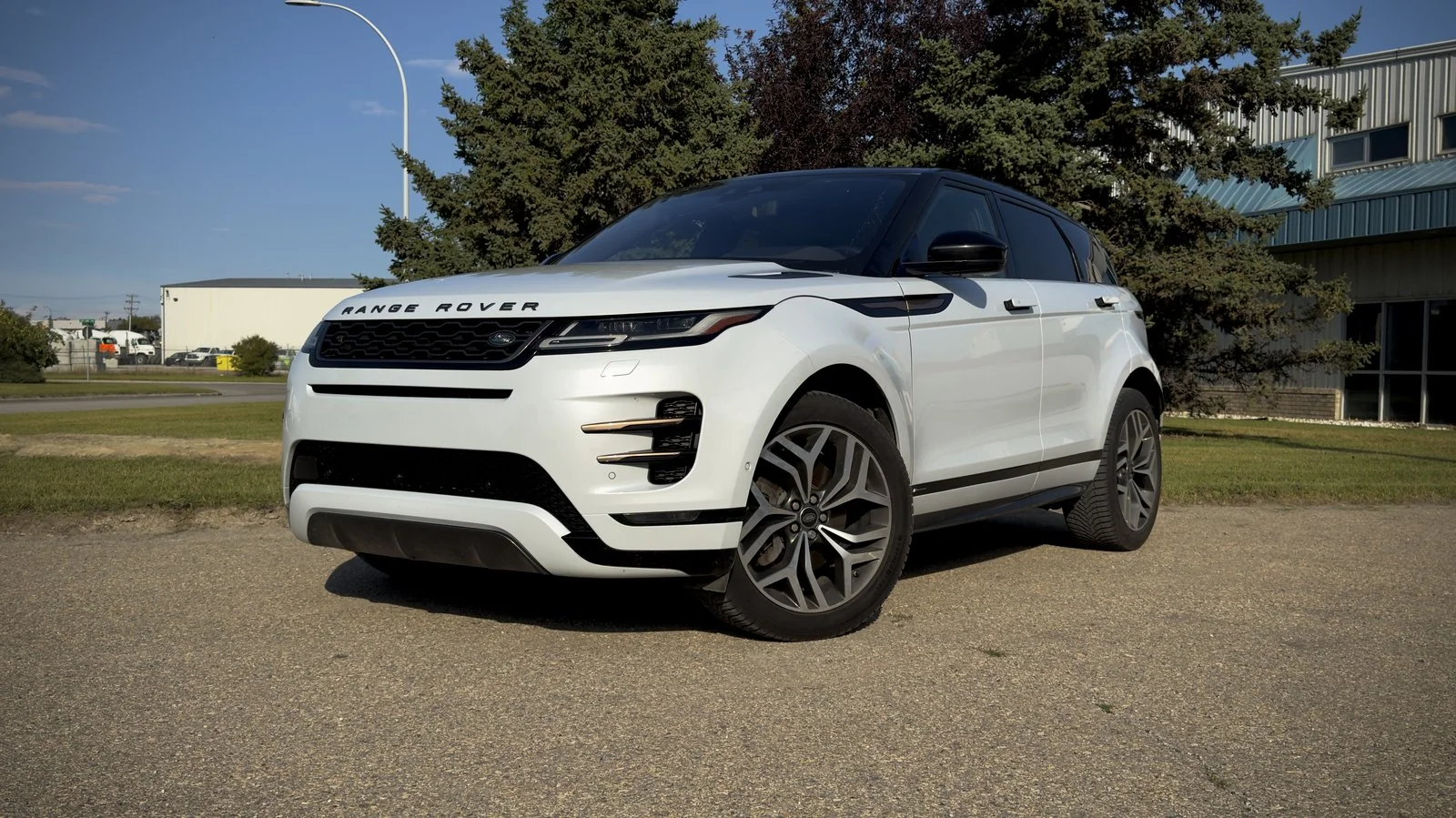
2020 Land Rover Range Rover Evoque P250 First Edition
Not seeing it? We'll find it.
We source through our dealer partner network across Western Canada: 25,000+ vehicles to choose from. Tell us what you want and what works for your budget.
Find my car3 min · no credit impactOAC = on approved credit. Payments are examples at 6.49% APR over 84 months with $0 down, based on each vehicle's advertised price; GST extra. Your rate depends on your credit (4.99%–29.9% APR).
Related Articles
Ready to Find Your Vehicle?
Browse our inventory or apply for financing. All credit situations welcome.
5.0118+ Google ReviewsAMVIC LicensedFree Delivery 300km