
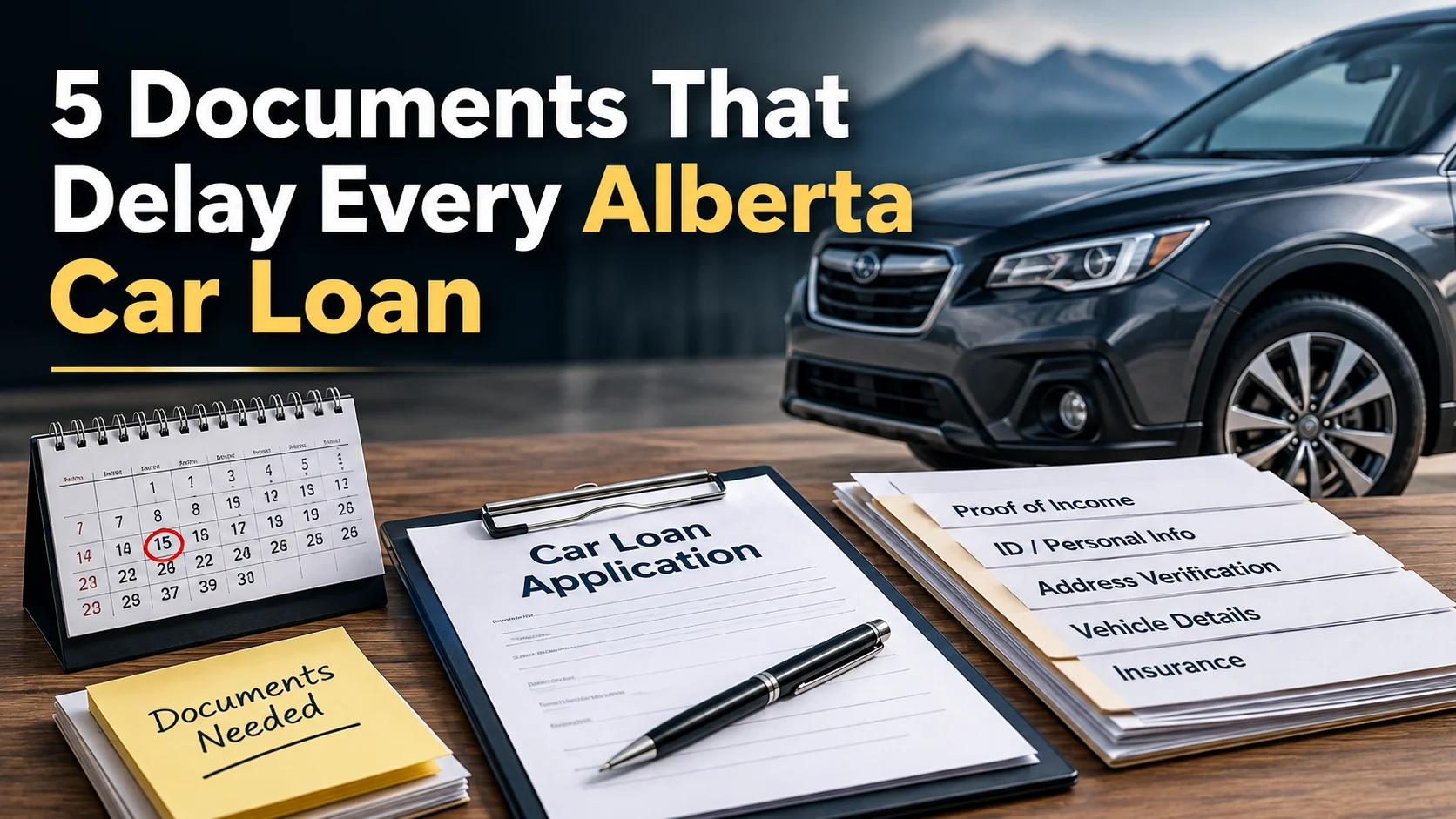
5 Documents That Delay Every Alberta Car Loan
In this article
- What Documents Cause the Most Car Loan Delays in Alberta?
- Document 1: Proof of Income
- Document 2: Proof of Residence
- Document 3: Government-Issued Photo ID
- Document 4: Void Cheque or Pre-Authorized Debit Form
- Document 5: Insurance Binder with Correct Lienholder
- Alberta-Specific Documentation Wrinkles
- How to Prepare Your Document Package
- Related Guides
- Is This a Job for Shift Happens?
- Frequently Asked Questions
- How long does it take to get approved for a car loan in Alberta once I submit my documents?
- Can I get approved with digital copies of documents instead of originals?
- What if my address on my driver's licence doesn't match my current address?
- Do I need to provide employment verification in addition to pay stubs?
- What if I'm self-employed and my tax returns show less income than I actually make?
- Compare and Apply
Check Your Options in 3 Minutes
No credit impact. All credit situations welcome.
★★★★★ 118+ Google Reviews · AMVIC Licensed · Free Delivery 300km
What Documents Cause the Most Car Loan Delays in Alberta?
Five documents cause the vast majority of Alberta car loan delays: proof of income (especially for self-employed or gig workers), proof of residence that matches your credit bureau address, a valid government ID with current address, a void cheque or pre-authorized debit form for the correct bank account, and proof of insurance with the correct lienholder listed. Any one of these missing, expired, mismatched, or incorrectly formatted can delay funding by 24-72 hours — or longer if corrections require re-submitting to the lender for re-approval.
The approval came through. You've picked your vehicle. You show up to sign the paperwork and someone asks for your last three pay stubs. You have one — the others were delivered to an old email address. Or your driver's licence still shows your parents' address from two years ago. Or the void cheque you brought is from a joint account that's not on your application. Any of these — entirely predictable, entirely avoidable — delays your delivery by anywhere from a few hours to several days while the lender waits for corrected documentation.
This happens constantly in Alberta dealerships, and it happens not because buyers are disorganized but because nobody told them specifically which documents, in what format, needed to reflect what information. This post is that briefing — the five specific document categories that cause the most delays, what lenders actually need, and how to prepare before your appointment rather than scrambling during it.
Document 1: Proof of Income
Proof of income is the most frequently problematic document category because what counts as acceptable proof varies by employment type, and what lenders want is more specific than most buyers expect.
For salaried/hourly employees: Most Alberta lenders want the most recent 2-3 pay stubs showing year-to-date earnings, employer name, and pay frequency. A single recent pay stub is often accepted for strong applications but may not be enough for conditional approvals or lenders who need to verify income stability. The stubs must show your full legal name (matching your ID), your employer's name, and the pay date. A printout from an HR portal is typically accepted if it shows all these fields.
For self-employed applicants: This is where delays spike dramatically. Lenders typically need 2 years of T1 General tax returns (the full return, not just the summary), plus the Notice of Assessment for each year. Some lenders also want 3-6 months of business bank statements. If your tax returns show lower income than what you actually earn (common in small business ownership), you may need a letter from your accountant — which takes time to request and receive. Self-employed income documentation is the single biggest cause of multi-day loan delays in our market.
For gig/contract workers: Recent T4A slips, plus bank statements showing regular deposits, plus a letter from the contracting company confirming your ongoing engagement. Lenders want to see income is both real and likely to continue — not just that you received a large payment 8 months ago.
Start pulling your income documents before your first dealership visit. Digital copies on your phone are fine as long as they're clearly legible and show all required fields. If you're self-employed and your documents are complicated, talk to our team first — we can tell you which lenders have more flexible income verification requirements for your situation.
Document 2: Proof of Residence
Lenders require proof that you live where you say you live — specifically, at the address you put on your application. The problem is that many Alberta buyers have a current address that doesn't match their credit bureau records (often because they recently moved) and don't think to flag this.
What lenders want for proof of residence: a recent utility bill (within 60-90 days), bank statement, government correspondence, or lease agreement showing your name and current address. A cell phone bill often doesn't qualify — lenders want something tied to your physical dwelling. A driver's licence showing your address is sometimes accepted but creates a different problem: if it still shows your old address, it creates a contradiction between your ID and your residence documentation.
The matching requirement is strict: your application, your proof of residence, and your credit bureau address should all align. If you moved recently, your credit bureau may still show your old address for 3-6 months. Lenders deal with this regularly — but they need documentation explaining the discrepancy, not just two different addresses on two different documents with no context.
The fix: before applying, pull your own credit report (free via Borrowell or Credit Karma — no impact to score) and verify what address appears. If it differs from your current address, note that on your application and bring both a proof of current residence AND a document showing the old address (like a previous lease or utility bill). Proactive disclosure is far better than a lender discovering the discrepancy mid-underwriting.
Document 3: Government-Issued Photo ID
This sounds trivial, but expired ID is one of the most common delays — particularly for buyers who have moved provinces, renewed recently, or have a licence with a previous address. Alberta lenders need:
- A valid (non-expired) government-issued photo ID
- Typically a driver's licence — Alberta or other Canadian province
- Second ID is sometimes required: SIN card, passport, or health card
The address mismatch problem is the most common. If your Alberta driver's licence still shows your Edmonton address but you've been living in Airdrie for 18 months, the lender will flag the discrepancy. You can't get an exception on your driver's licence the day of signing — the Service Alberta renewal process takes time. If your licence is due for renewal or shows an old address, update it before your purchase appointment.
Out-of-province buyers are particularly affected here. If you recently moved to Alberta from BC or Ontario and your licence still shows your former province's address, you're technically in violation of Alberta's 90-day licence exchange requirement anyway — and the lender won't love underwriting a loan to someone whose ID shows they don't live in Alberta. Exchanging your licence before purchasing is worth the trip to a registry.
Document 4: Void Cheque or Pre-Authorized Debit Form
Lenders set up automatic biweekly payments via PAD (Pre-Authorized Debit) from your bank account. To do this, they need either a void cheque from your chequing account or a completed PAD authorization form with your account and routing numbers. This sounds simple — and it is, once you know the specific requirements.
Common delays here:
- Savings account cheque instead of chequing: Savings accounts with different transit numbers than your chequing account cause PAD processing failures. Always bring a cheque from the primary chequing account you want payments drawn from.
- Joint account not on the application: If payments will be drawn from a joint account but only one applicant is on the loan, some lenders require both account holders to be present or sign the PAD authorization.
- Online-only bank accounts: Buyers using EQ Bank, Tangerine, or Simplii often don't have physical cheques. Most lenders accept a printed void cheque image from your online banking portal, but verify this with your dealership before assuming digital is fine.
- Starter cheques without pre-printed name/address: New account starter cheques are not accepted by most lenders — the name and address need to be pre-printed on the cheque, not handwritten.
The simplest solution: get a void cheque from your chequing account the day before your appointment. Write "VOID" in large letters across the face. Take a clear photo as backup. If you're using an online bank, download the void cheque image from your banking portal and confirm with the dealership in advance that it will be accepted.
The document pre-clearance move: Three days before your delivery appointment, send your dealership copies of all five documents by email or photo — income proof, residence proof, ID, void cheque, and insurance binder. Ask them to confirm each is acceptable before you arrive. This single step eliminates 90% of same-day documentation delays and gives you time to fix issues without holding up your delivery date.Document 5: Insurance Binder with Correct Lienholder
Covered in detail in our companion post on insurance proof requirements before loan funding, but worth flagging here because it's the most common last-minute surprise. The insurance binder must show: (1) your name as the insured, (2) the vehicle VIN, (3) comprehensive and collision coverage active on the funding date, and (4) the lender's legal name and address as additional loss payee.
The last requirement is the one that causes delays. Buyers who call their insurer and set up coverage without providing the lienholder information receive a binder that's missing the loss payee designation. When the dealership reviews it, they can't submit to the lender. The buyer calls their insurer to add the lienholder, the insurer issues a new binder, it needs to be re-reviewed — and what could have been handled in one phone call the day before becomes a 2-4 hour delay on delivery day.
The fix: get the lienholder name and address from your dealership before calling your insurer. Give it to the insurer at the start of that call. Ask specifically: "Please include [lender name and address] as additional loss payee on the binder." Verify you received a binder — not just a confirmation of coverage — before your appointment.
Alberta-Specific Documentation Wrinkles
Alberta has some documentation quirks that affect vehicle financing more than other provinces:
- AISH and disability income: Recipients of Assured Income for the Severely Handicapped often have difficulty documenting income in the format lenders prefer. Award letters and bank statements showing regular deposits are typically required. Our team works with lenders who have specific programs for AISH recipients — the AISH car loan guide covers documentation specifics.
- Oil and gas/oilfield income: Many northern Alberta workers have irregular pay schedules (rotational shift bonuses, day-rate pay) that don't fit standard pay stub formats. Lenders who specialize in this demographic (and some do) want to see 3-6 months of bank statements alongside pay stubs to verify income pattern stability.
- Out-of-province vehicle registration: If you're purchasing a vehicle currently registered in BC or Saskatchewan, additional documentation confirming the vehicle's clear title status may be required before the Alberta lender will fund.
If your situation includes any of these wrinkles, raise them with our team early — before documentation is assembled, not after. The financing process overview covers the full sequence of what happens between application and delivery in Alberta, which helps set timeline expectations if your documentation situation is more complex than average.
How to Prepare Your Document Package
The most effective approach is assembling your document package as a single folder — digital or physical — before your first dealership appointment. Here's the checklist:
- Most recent 2-3 pay stubs (or tax returns + NOA if self-employed)
- One recent utility bill or bank statement showing current address
- Valid Alberta driver's licence (or provincial equivalent with current address)
- Second ID: SIN card, passport, or health card
- Void cheque from primary chequing account (name pre-printed)
- Insurance binder with lienholder listed (obtained after lender approval)
Items 1-5 can be assembled before you apply. Item 6 comes after approval, because you need the lienholder name — which you won't know until the approval comes back. The sequencing matters: don't wait until delivery day to start the insurance conversation. The moment you receive your approval and lender details, call your insurer and start that process immediately so the binder is ready before your delivery appointment.
If you're ready to start the process, the financing application is the first step. Our team will tell you exactly which documents your specific lender needs — some have additional requirements (employment verification calls, bank statements) that vary from the standard list above.
Related Guides
If this post was useful, these directly-related guides will help you go deeper:
- Alberta Has No Car Cooling-Off Period: What Buyers Must Know
- Catalytic Converter Theft Prevention for Alberta Urban Drivers
- Boating Season: Tow Vehicle Setup and Trailer Wiring in Alberta
- Hail Season Vehicle Prep: May to September in Alberta
- Harley-Davidson Resale Value by Model: Alberta Guide
- Alberta Lemon Law Reality: What the Sale of Goods Act Covers
- Personal Loan to Buy a Used Car: Real Cost Compared
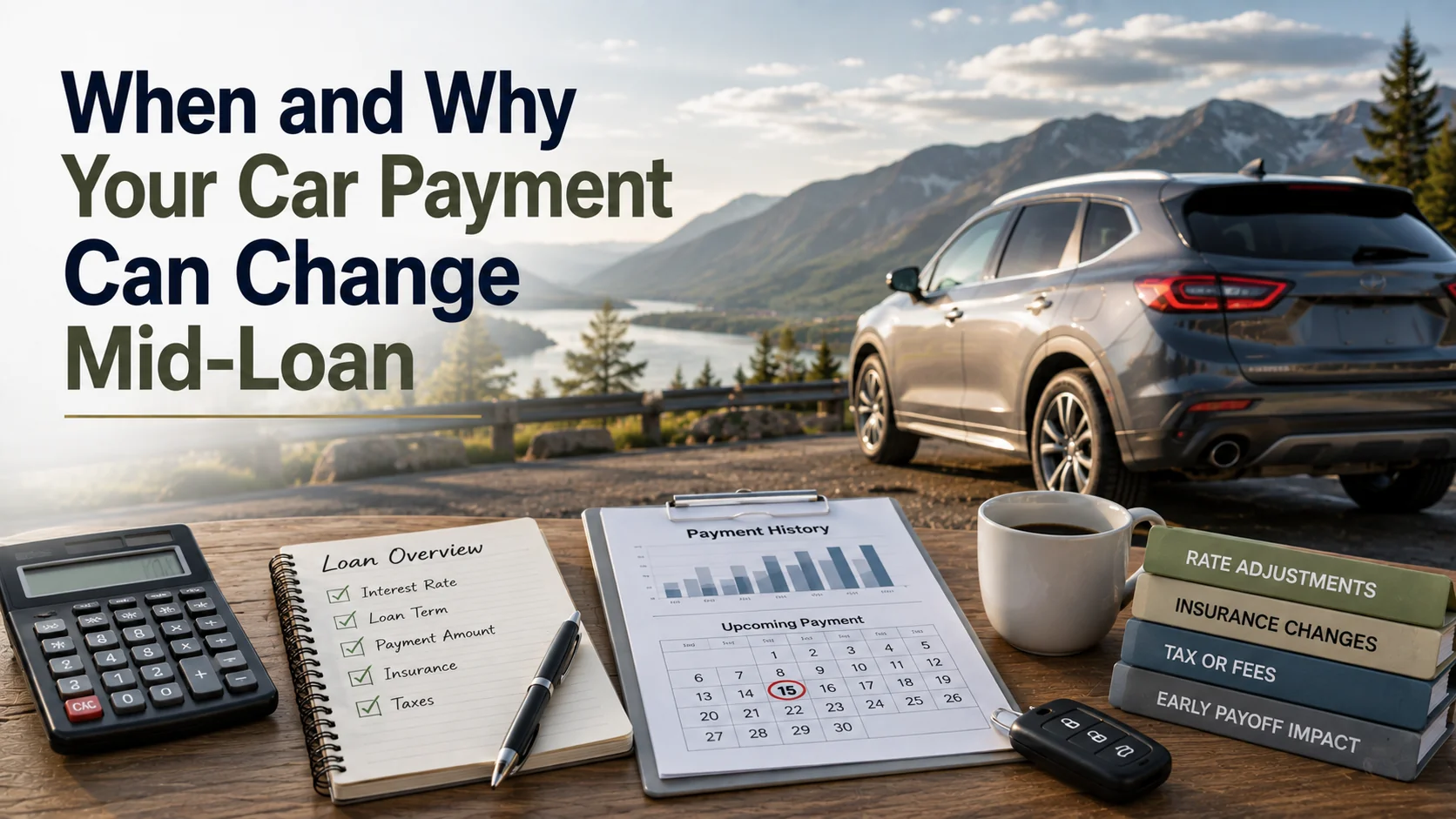
- When and Why Your Car Payment Can Change Mid-Loan
Is This a Job for Shift Happens?
Shift Happens works well when you: (1) want a financing team that tells you exactly what documents you need before you arrive — not after, (2) are in Calgary, Airdrie, or anywhere in Alberta with any credit situation, (3) want 15+ lenders competing for your deal and a team that knows which lenders have more flexible documentation requirements for your specific situation. Not a fit if: you need new vehicles only, lease-only inventory, or are buying outside western Canada.
If that sounds like you, two soft next steps: run an approval check (60 seconds) or begin a financing application. Both stay credit-soft until you decide to submit a formal application.
Frequently Asked Questions
How long does it take to get approved for a car loan in Alberta once I submit my documents?
With a complete document package, most Alberta dealer-arranged approvals come back within 2-4 hours during business hours. Same-day approval is common for straightforward applications. Applications with incomplete documentation, non-traditional income, or credit complications can take 1-3 business days as lenders request additional information.
Can I get approved with digital copies of documents instead of originals?
Yes — most Alberta lenders and dealerships accept clear digital copies (photos or PDFs) for the initial application. Physical originals may be required for verification at signing, but the process doesn't need to wait for paper. Clear, legible photos sent by email or messaging are standard practice.
What if my address on my driver's licence doesn't match my current address?
Bring both a document showing your current address (utility bill, bank statement) and be prepared to explain the discrepancy on your application. Lenders deal with address changes regularly. The key is proactive disclosure — don't let them discover the mismatch mid-underwriting. Update your licence at Service Alberta when possible.
Do I need to provide employment verification in addition to pay stubs?
Sometimes. Some lenders perform employment verification calls (to your employer's main HR line, not your personal contact number) as a standard step for subprime applications. If this happens, it's normal — let your employer's HR department know to expect a verification call. It doesn't affect the approval itself; it's a fraud prevention step.
What if I'm self-employed and my tax returns show less income than I actually make?
This is a common challenge for self-employed buyers in Alberta. Some lenders use "stated income" programs that look at bank deposit history rather than tax returns. Others require an accountant's letter. Our team works with lenders who have experience underwriting self-employed applicants — raise this in your initial conversation so we can route your application to the most appropriate lender.
Compare and Apply
- Complete Bad Credit Car Buying Guide (Alberta) — your complete Alberta subprime buyer guide
See what you pre-qualify for
Three quick answers — soft check, no commitment.
Financing Resources
Related Articles
Ready to Find Your Vehicle?
Browse our inventory or apply for financing. All credit situations welcome.
★★★★★ 118+ Google Reviews · AMVIC Licensed · Free Delivery 300km