
60 vs 72 vs 84 vs 96 Month Loans: Real Cost Comparison
In this article
- How Much More Does an 84-Month Car Loan Cost Than 60 Months?
- The Complete Cost Table: $22,000 Loan Across All Terms
- The Negative Equity Time Bomb
- When a Longer Term Is the Right Call
- 96-Month Loans: The Edge of the Market
- What Term Do Subprime Buyers Actually Get Approved For?
- Accelerated Payments: Taking Back Control of Your Term
- Continue Reading
- Could Shift Happens Help With This?
- Frequently Asked Questions
- Is it possible to pay off a 72-month car loan in 48 months?
- Why do dealerships push longer terms?
- What's the maximum car loan term in Canada?
- Does a shorter loan term improve your credit score faster?
- Can I change my loan term after signing in Alberta?
- Compare and Apply
Check Your Options in 3 Minutes
No credit impact. All credit situations welcome.
★★★★★ 118+ Google Reviews · AMVIC Licensed · Free Delivery 300km
The finance manager asks: "Would you prefer a 72-month or 84-month term?" Most buyers pick 84 because the payment is lower. That logic is understandable — and it costs the average Albertan between $2,400 and $5,600 in additional interest over the life of their loan. Here's the full cost breakdown across every common loan term, with real numbers you can use.
See what you pre-qualify for
Three quick answers — soft check, no commitment.
How Much More Does an 84-Month Car Loan Cost Than 60 Months?
On a $22,000 used vehicle loan at 14.99% interest, a 60-month term costs $9,310 total interest while an 84-month term costs $13,890 — a difference of $4,580 in additional interest for a biweekly payment reduction of only $37. At higher subprime rates (21.99%), that same term extension adds $7,040 in total interest while saving $49 biweekly. The biweekly payment savings from extending terms are modest; the total interest costs are substantial.
The Complete Cost Table: $22,000 Loan Across All Terms
Let's run the numbers on a $22,000 used vehicle loan — a realistic price point for a reliable used Toyota Corolla or Honda Civic in the Calgary market — across four interest rate scenarios and four term lengths. All payments are biweekly (the standard in Alberta dealership financing).
| Rate | 60 mo | 72 mo | 84 mo | 96 mo |
|---|---|---|---|---|
| Biweekly Payment | ||||
| 7.49% (Tier 1) | $242 | $208 | $184 | $165 |
| 13.99% (Tier 2) | $272 | $239 | $217 | $200 |
| 19.99% (Tier 3) | $303 | $273 | $254 | $240 |
| 24.99% (Tier 4) | $330 | $302 | $285 | $274 |
| Total Interest Paid | ||||
| 7.49% | $4,280 | $5,180 | $6,130 | $7,120 |
| 13.99% | $9,310 | $11,470 | $13,890 | $16,540 |
| 19.99% | $14,580 | $18,420 | $22,710 | $27,240 |
| 24.99% | $19,760 | $25,750 | $32,380 | $39,580 |
Two observations jump out immediately. First, the payment difference between 60 and 96 months is modest — $77/biweekly at Tier 1, $56 at Tier 4. Second, the total interest difference is enormous — $2,840 additional at Tier 1 for going 60→96 months, and $19,820 additional at Tier 4. The higher your interest rate, the more devastating a longer term becomes.
The Negative Equity Time Bomb
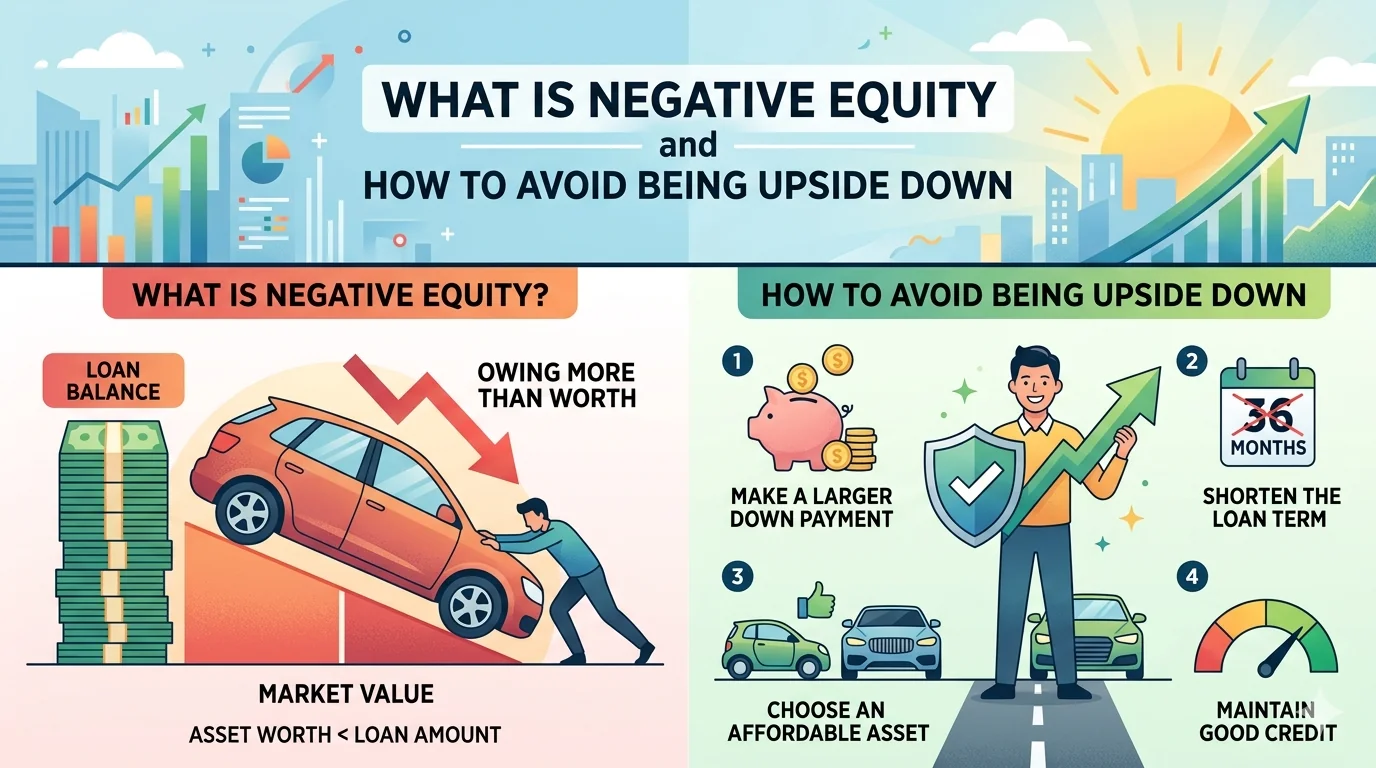
Total interest cost is the most obvious downside of long loan terms. But there's a second problem that hits buyers hard before the loan is halfway done: negative equity.
A new vehicle loses roughly 15–20% of its value in the first year and approximately 10–15% per year after that. A used vehicle depreciates more slowly — but it still depreciates. Meanwhile, loan amortization in the early months is heavily interest-weighted. In the first 24 months of a $22,000 loan at 19.99% over 84 months, you pay approximately $8,320 in payments — but only $2,180 goes to principal reduction. You still owe $19,820 on a vehicle that may now be worth $15,500.
That's $4,320 of negative equity after two years of faithfully making every payment. If your vehicle is written off, stolen, or you need to trade it, you're short. GAP insurance exists specifically to cover this scenario — it's particularly important on high-rate, long-term loans where negative equity persists for 36–60 months.
The 96-month loan makes this problem severe. On the same $22,000 loan at 19.99% over 96 months, you'll be underwater (owing more than the vehicle's market value) for approximately the first 54 months. That's four and a half years of owning a depreciating asset that you can't sell, trade, or exit without bringing cash to the table.
When a Longer Term Is the Right Call
Longer loan terms aren't universally wrong — they're the wrong choice for the wrong reasons. There are legitimate scenarios where extending the term makes sense:
- Income certainty and investment opportunity cost: If your investment return rate genuinely exceeds your loan interest rate (very rare at 19.99%+), keeping the payment low and deploying the difference makes mathematical sense.
- Short-term income constraint with strong outlook: A 72 or 84-month term with a plan to make accelerated payments when income increases can be rational. The key is actually making those extra payments when the income arrives — most people don't.
- Approval threshold situation: At a strict income-to-payment ratio, a shorter term may push the payment above what the lender will approve. If 60 months doesn't fit the lender's DTI criteria but 72 months does, the longer term may be the only option available — not a choice.
96-Month Loans: The Edge of the Market
96-month (8-year) car loans exist in the Canadian market but are rare and carry significant strings. Most lenders who offer them require: vehicles under 5 years old at origination, credit scores in the near-prime to prime range (typically 620+), and lower loan-to-value ratios. They're also more expensive in ways beyond the raw interest calculation — some carry higher base rates than 72-month products to compensate the lender for the extended credit exposure.
At a typical Tier 2 rate of 13.99%, an 84-month loan on $22,000 costs $13,890 in interest while a 96-month loan costs $16,540 — $2,650 more for a $17/biweekly payment reduction. The math is almost never compelling. If you're being pitched a 96-month term, it's worth asking why 84 months won't work — the answer often reveals a payment-to-income squeeze that signals the vehicle is simply too expensive for your budget.
Use the payment calculator to model 84 vs 96 months on your specific loan amount and rate before your dealership visit — and model 60 and 72 months while you're at it.
What Term Do Subprime Buyers Actually Get Approved For?
Credit score constrains term availability as well as rate. Most subprime lenders in Canada don't offer 96-month terms — that product is a prime-lending feature. For buyers in the 500–599 range, available terms typically cap at 72 or 84 months depending on vehicle age and lender. For deep subprime (below 500), terms are often capped at 60–72 months to limit lender exposure duration.
This means the "longer term to lower payment" strategy is often not as available to subprime buyers as finance managers sometimes imply. A 60-month approval at 23.99% may not come with an 84-month option at the same lender — and if it does, the vehicle age restriction (e.g., no more than 8 years old at the end of term) may eliminate most of the qualifying inventory.
If you're a first-time buyer in Alberta trying to understand how car financing works — including term availability by credit profile — starting with that overview before visiting dealerships is worth 20 minutes of your time.
Accelerated Payments: Taking Back Control of Your Term
Here's the move most finance managers don't suggest: take the 72-month term (if a 60-month payment doesn't fit comfortably), then make one extra payment per year. One extra $200 biweekly payment annually reduces a 72-month loan to approximately 64 months. Two extra payments per year reduces it to approximately 57 months. You get the approval flexibility of a longer term with the interest savings of a shorter one — as long as you actually make the extra payments.
Most Alberta auto loans have no prepayment penalty, meaning every extra dollar of principal you pay down reduces your outstanding balance and the interest calculated against it. This is particularly powerful in the first 24 months, when the ratio of interest to principal in each payment is highest. How accelerated payments work explains the mechanics and shows you exactly how much each extra payment saves.
Continue Reading
If this post was useful, these directly-related guides will help you go deeper:
- Open-End vs Closed-End Lease vs Finance: Which Suits Used Buyers
- Conditional Sales Contract vs Loan vs Lease: Legal Differences
- Rebuilt vs Salvage vs Clean Title: How Brands Affect Car Financing
- Refinancing Math: When It Actually Saves You Money
- Skip-a-Pay Options: The Hidden Interest Cost
- Origination, Admin, Doc Fees on Car Loans: What's Legit
Could Shift Happens Help With This?
We're likely a fit if you: (1) are financing a used vehicle in Airdrie, Calgary, or anywhere in Alberta and want transparent term-by-term cost comparisons before signing, (2) want lender options across all credit tiers where term lengths are optimized for your income and credit profile, (3) want help modeling the total interest cost of different term options. Not a fit if you need a new vehicle from a manufacturer franchise or require a lease product.
If you want to see what terms you'd actually qualify for — and compare the total cost across term options — check your approval likelihood first (no credit impact), then start a full application and let our team show you the numbers before you commit to anything.
Frequently Asked Questions
Is it possible to pay off a 72-month car loan in 48 months?
Yes — most Canadian auto loans allow unlimited prepayment without penalty. Making extra payments reduces your principal balance, which reduces interest accrual on all future payments. There's no requirement to hold the loan to its full term. The amortization schedule adjusts automatically as you pay down principal faster.
Why do dealerships push longer terms?
Finance managers are often compensated partly on total finance income, including interest over the life of the deal. A longer term also lowers the payment, making it easier for the buyer to say yes — and potentially easier to sell add-on products (warranty, GAP, protection packages) by keeping the monthly payment within comfort range despite adding those costs.
What's the maximum car loan term in Canada?
96 months (8 years) is the practical ceiling for most Canadian auto lenders. Some specialty lenders have offered 100-month terms, but these are rare and typically require prime credit, low LTV, and newer vehicles. The standard maximum for subprime lenders in Alberta is typically 72–84 months.
Does a shorter loan term improve your credit score faster?
Not directly — the scoring benefit from an auto loan comes from consistent on-time payments, which builds positive payment history regardless of term length. However, a shorter term means the loan closes sooner, which can have mixed effects on credit (closing accounts reduces average account age). The biggest credit benefit of a shorter term is indirect: you exit negative equity faster, reducing the risk of default that would damage your score catastrophically.
Can I change my loan term after signing in Alberta?
You cannot modify an existing loan agreement's term unilaterally. Options: refinancing with a new lender (new term, new contract), negotiating a loan modification with your current lender (rare for standard retail loans), or simply making extra payments to functionally shorten the term without changing the contract.
Compare and Apply
- Bad Credit Financing — Complete Guide — get approved despite bad credit
Financing Resources
Related Articles


Ready to Find Your Vehicle?
Browse our inventory or apply for financing. All credit situations welcome.
★★★★★ 118+ Google Reviews · AMVIC Licensed · Free Delivery 300km