
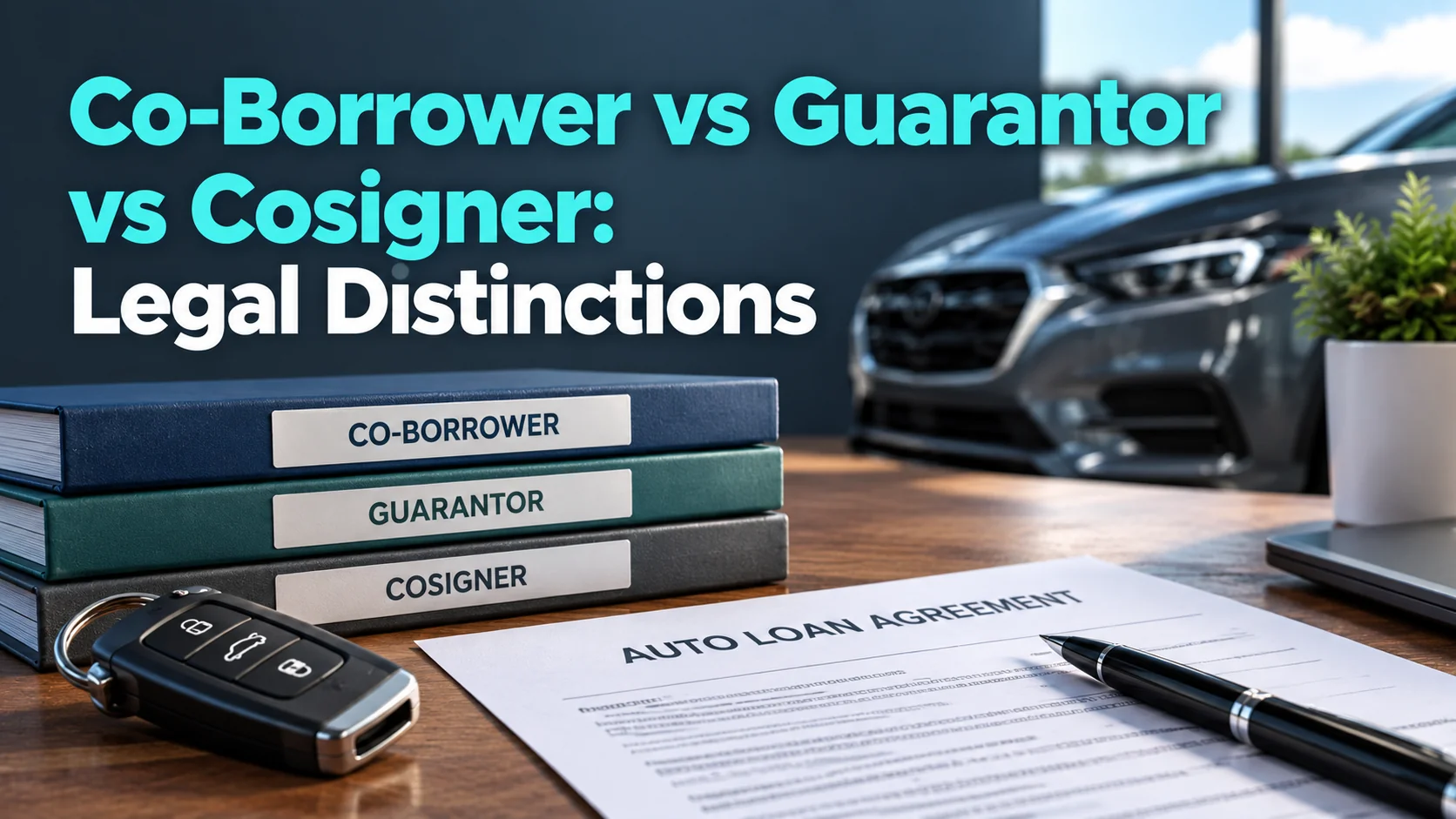
Co-Borrower vs Guarantor vs Cosigner: Legal Distinctions
In this article
- What Is the Difference Between a Co-Borrower and a Cosigner on a Car Loan?
- Co-Borrower: Joint Ownership, Joint Liability
- Cosigner: Secondary Liability That Often Isn't Secondary
- Guarantor: True Secondary Obligation
- How Each Structure Affects the Approval Decision
- Removing a Cosigner or Co-Borrower: Can It Be Done?
- What Happens to the Co-Borrower or Cosigner If You Default?
- Alberta-Specific: What AMVIC and the Consumer Protection Act Require
- Adjacent Situations
- Is This a Job for Shift Happens?
- Frequently Asked Questions
- Does co-signing a car loan affect my ability to get a mortgage in Alberta?
- Can a cosigner be removed from a car loan if the primary borrower pays on time for 12 months?
- Does the co-borrower need to live in the same province in Alberta?
- What happens to the cosigner if the primary borrower dies?
- Can two people with bad credit co-borrow to get approved?
- Compare and Apply
Check Your Options in 3 Minutes
No credit impact. All credit situations welcome.
★★★★★ 114+ Google Reviews · AMVIC Licensed · Free Delivery 300km
Three people can help you get approved for a car loan in Canada, but they take on fundamentally different legal obligations. A co-borrower owns the vehicle and shares equal debt responsibility from day one. A cosigner promises to cover the debt if you default but typically has no ownership stake. A guarantor is a step removed further still — their obligation triggers only after the primary borrower has definitively failed to pay. Getting these terms mixed up, or not fully understanding which one you're signing, has cost Albertans thousands of dollars and serious credit damage.
See what you pre-qualify for
Three quick answers — soft check, no commitment.
What Is the Difference Between a Co-Borrower and a Cosigner on a Car Loan?
A co-borrower is a joint applicant who shares equal ownership of the vehicle and equal primary responsibility for the debt — their name is on both the loan and the vehicle registration. A cosigner is a secondary party whose obligation is triggered only if the primary borrower defaults; in most Canadian auto loan structures, the lender can pursue the cosigner immediately upon default without first exhausting remedies against the primary borrower. A guarantor is a third structure where the guarantor's obligation is truly secondary — the lender must first attempt full collection from the primary borrower before the guarantor's liability is triggered. In practice, most Canadian auto lenders use "cosigner" when they mean "joint applicant" or "co-borrower," so always read the actual contract language.
Co-Borrower: Joint Ownership, Joint Liability
A co-borrower (also called a joint applicant or joint borrower) enters into the loan agreement on equal footing with the primary applicant. Both incomes are typically used in qualification, both parties appear on the loan agreement as primary obligors, and — in most Alberta conditional sales contracts — both names appear on the vehicle registration.
The key implication: a co-borrower cannot be passively helpful. They are equally responsible for every payment from the first payment to the last. If the primary applicant misses three payments, the lender will pursue both parties simultaneously — not sequentially. A co-borrower's credit bureau will show the loan (positive or negative, depending on payment history) just as prominently as the primary applicant's.
Co-borrowing is typically used in two scenarios: spouses buying a vehicle together (both names on registration, shared transportation asset) and parents who want genuine ownership interest alongside their child rather than merely lending their credit profile. Before agreeing to be a co-borrower, understand that you are not a helper — you are an equal owner and equal debtor.
Cosigner: Secondary Liability That Often Isn't Secondary
The word "cosigner" is used loosely across the Canadian auto industry, and this creates significant misunderstanding. In legal theory, a true cosigner's obligation is secondary — the primary borrower must first default and the creditor must first make demand before the cosigner is obligated. In practice, most auto loan agreements labeled "cosigner" contain language that makes the cosigner a joint primary obligor — the lender can pursue either party immediately upon any default without distinction.
What this means practically: when you cosign a car loan, assume you are equally on the hook. The label "cosigner" provides less protection than it implies. Read the actual obligation language in the agreement — look for phrases like "jointly and severally liable," which means the lender can come to you first, not second.
The credit impact is also significant: the full loan amount appears on the cosigner's credit bureau as an active debt, affecting their debt-to-income ratio for all future credit applications. If you're planning to apply for a mortgage in the next 2–3 years, cosigning an auto loan adds a liability that lenders will count against your qualifying capacity. The cosigner guide walks through the credit implications in detail before you commit.
Guarantor: True Secondary Obligation
A guarantee is a distinct legal instrument in which the guarantor's obligation is explicitly contingent on the primary borrower's failure to pay after the lender has exhausted or formally declined to pursue the primary borrower. In theory, a guarantor has more protection than a cosigner — the lender must first try to collect from the primary borrower before calling on the guarantee.
In practice, guarantees in Canadian auto lending are rare. Most auto lenders don't offer a formal guarantee structure — they use cosigner language (which typically equates to joint primary liability). Where guarantees do appear is in commercial vehicle financing or lease arrangements. If a finance manager offers you a "guarantor" position, ask for the specific clause in the agreement that defines the sequencing of the lender's collection rights. If it says "jointly and severally liable," it's functionally a cosign, not a guarantee.
How Each Structure Affects the Approval Decision
Lenders evaluate all three structures differently when making the approval decision:
- Co-borrower: Both incomes and both credit profiles are assessed. The stronger income/credit profile improves the application materially. However, both sets of debts are also counted — if the co-borrower has $2,000/month in existing obligations, those are added to the debt-to-income calculation.
- Cosigner (joint primary): The cosigner's income may or may not be used in qualification depending on the lender's policy. Some lenders use only the primary applicant's income and treat the cosigner purely as a credit backstop. Others blend both incomes. Ask your lender which approach they use.
- Guarantor: Typically assessed for net worth and credit strength rather than income, since the obligation is triggered only after primary failure. Used less in retail auto lending, more in commercial contexts.
For subprime applicants in Alberta, a co-borrower with strong income and credit (700+) can shift a declined application to approved, and can shift a Tier 3 application to Tier 2 pricing — potentially saving thousands in total interest. But both parties need to enter the arrangement with full awareness of what they're agreeing to. The cosigner versus joint applicant comparison goes deeper on the qualification dynamics.
Read the actual contract clause: The label on a Canadian auto finance agreement ("cosigner," "guarantor," "co-applicant") often doesn't match the legal obligation inside the contract. Look for the phrase "jointly and severally liable" — if present, both parties are equally primary obligors, regardless of what the form header says. This distinction matters if one party's credit is damaged or they need to exit the obligation later.Removing a Cosigner or Co-Borrower: Can It Be Done?
One of the most common questions after a co-signed or co-borrowed auto loan is funded: can we remove the other person's name? The answer depends on the lender, but the path is usually one of three options:
- Refinancing: The primary borrower refinances the loan in their name alone, discharging the original agreement and the other party's obligation entirely. This requires the primary borrower to qualify independently — meaning their credit and income must support the refinance on their own. After 18–24 months of on-time payments, this is often achievable. See how refinancing works in Alberta for the mechanics.
- Lender modification: Some lenders will administratively remove a cosigner or co-borrower if the primary borrower can demonstrate sufficient standalone creditworthiness, typically after 12–24 months of perfect payment history. This is not universally available — call your lender directly to ask.
- Payoff: Paying the loan off in full discharges everyone. If the primary borrower comes into funds (tax refund, bonus, inheritance), paying the loan out eliminates the obligation for all parties.
The no-cosigner car loan options in Alberta provide alternatives for buyers who want to build credit independently from the outset — it's worth reviewing if you're considering asking someone to co-sign rather than starting without them.
What Happens to the Co-Borrower or Cosigner If You Default?
If the primary borrower misses payments, both the primary borrower's and the co-borrower/cosigner's credit bureaus are affected — immediately and identically. A 60-day late payment showing on the primary borrower's bureau appears on the cosigner's bureau the same day. The lender can pursue both parties simultaneously for the outstanding balance, regardless of which party "owns" the vehicle or was supposed to make payments.
After default and repossession, the lender will apply the vehicle's auction proceeds against the outstanding balance. Any deficiency — the gap between what the vehicle sold for and what was owed — becomes a judgment debt that can be pursued against either party. In a default on a 72-month loan at 22.99% where payments stopped at month 36, the deficiency balance can easily exceed $8,000–$12,000.
If you're the co-borrower or cosigner and you become aware the primary borrower is in financial difficulty, the most protective move is to make the payments yourself and pursue reimbursement from the primary borrower — not to wait and watch the late payments accumulate. Every missed payment accrues on your credit bureau, and the damage is the same as if you'd missed it yourself.
Alberta-Specific: What AMVIC and the Consumer Protection Act Require
AMVIC-licensed dealers in Alberta are required to provide a copy of all financing agreements — including any cosigner or co-borrower agreements — to all signing parties before or at the time of signing. You cannot be rushed through a co-borrower agreement at the same time as the primary applicant signs the purchase contract. All parties have the right to read the full document.
Alberta's Consumer Protection Act requires full disclosure of the cost of borrowing, including the interest rate and total interest payable, in language that's clear to both parties. If you're co-borrowing or cosigning, you're entitled to and should request your own copy of the full loan disclosure, including the payment schedule and total cost of credit.
There is no automatic cooling-off period on car purchase agreements signed at an Alberta AMVIC-licensed dealership — once you've signed, you've signed. Take the time to read and understand what you're agreeing to before the pen touches paper. Understanding how car financing works is the baseline before any of these agreements make full sense.
Adjacent Situations
Continue down the path — these guides walk through the specific situations most similar to yours:
- Transmission Flush: When It Helps vs When It Kills Your Gearbox
- Owner-Operators vs Employee Truckers: Different Car Loan Rules
- Side-by-Side UTV vs ATV: Which Should You Finance First
- $0 Down vs $5,000 Down: How Your Deposit Affects Rate and Approval
- Open-End vs Closed-End Lease vs Finance: Which Suits Used Buyers
- Dealer Warranty vs Third-Party Extended Warranty: Real Differences
Is This a Job for Shift Happens?
Shift Happens works well when you: (1) need a co-borrower or cosigner to qualify and want to understand exactly what each party is agreeing to before signing, (2) are in Alberta and want to explore whether you can qualify without a cosigner before adding someone to your agreement, (3) want to compare multiple lenders' policies on cosigner qualification before committing. Not a fit if your only option is a private party loan arrangement or a lease.
If you're trying to figure out whether you need a cosigner, check your approval likelihood first — you may qualify independently. If you do need one, start an application and our team will walk through which lender structures best protect both parties.
Frequently Asked Questions
Does co-signing a car loan affect my ability to get a mortgage in Alberta?
Yes. The full loan balance appears as a liability on your credit bureau and reduces your effective qualifying capacity for future credit, including a mortgage. Most mortgage lenders add the full co-signed payment to your debt obligations when calculating your GDS and TDS ratios. If you're planning a home purchase within 3–5 years, co-signing a car loan can reduce your maximum mortgage qualification by $40,000–$80,000 or more, depending on the car loan balance and your income.
Can a cosigner be removed from a car loan if the primary borrower pays on time for 12 months?
Some lenders offer cosigner release programs after a specified period of perfect payment history — typically 12–24 consecutive on-time payments. This is not universal across all auto lenders in Canada. You must request it explicitly, and the primary borrower typically needs to demonstrate standalone creditworthiness at the time of the release request.
Does the co-borrower need to live in the same province in Alberta?
Not necessarily, but most Alberta-based lenders prefer both parties to be Alberta residents for administrative simplicity. Some lenders will accept co-borrowers from other provinces, but the underwriting process may take longer and the lender's enforcement rights in the event of default become more complex across jurisdictions.
What happens to the cosigner if the primary borrower dies?
The loan obligation does not disappear on the primary borrower's death. The estate is typically first in line for the debt, but if the estate lacks sufficient assets, the cosigner or co-borrower remains fully liable for the outstanding balance. Life insurance can address this scenario — some lenders offer creditor life insurance that discharges the loan balance on the borrower's death.
Can two people with bad credit co-borrow to get approved?
Two subprime applicants co-borrowing creates a combined credit profile that reflects both sets of negative factors. The benefit (combined income) may not outweigh the risk (combined derogatory history), depending on lender policy. Some subprime lenders focus primarily on the strongest credit profile in a co-borrow arrangement; others take a blended approach. The outcome is application-specific and lender-dependent — there is no universal rule.
Compare and Apply
- Bad Credit Financing — Complete Guide — get approved despite bad credit
Financing Resources
Related Articles


Ready to Find Your Vehicle?
Browse our inventory or apply for financing. All credit situations welcome.
★★★★★ 114+ Google Reviews · AMVIC Licensed · Free Delivery 300km