
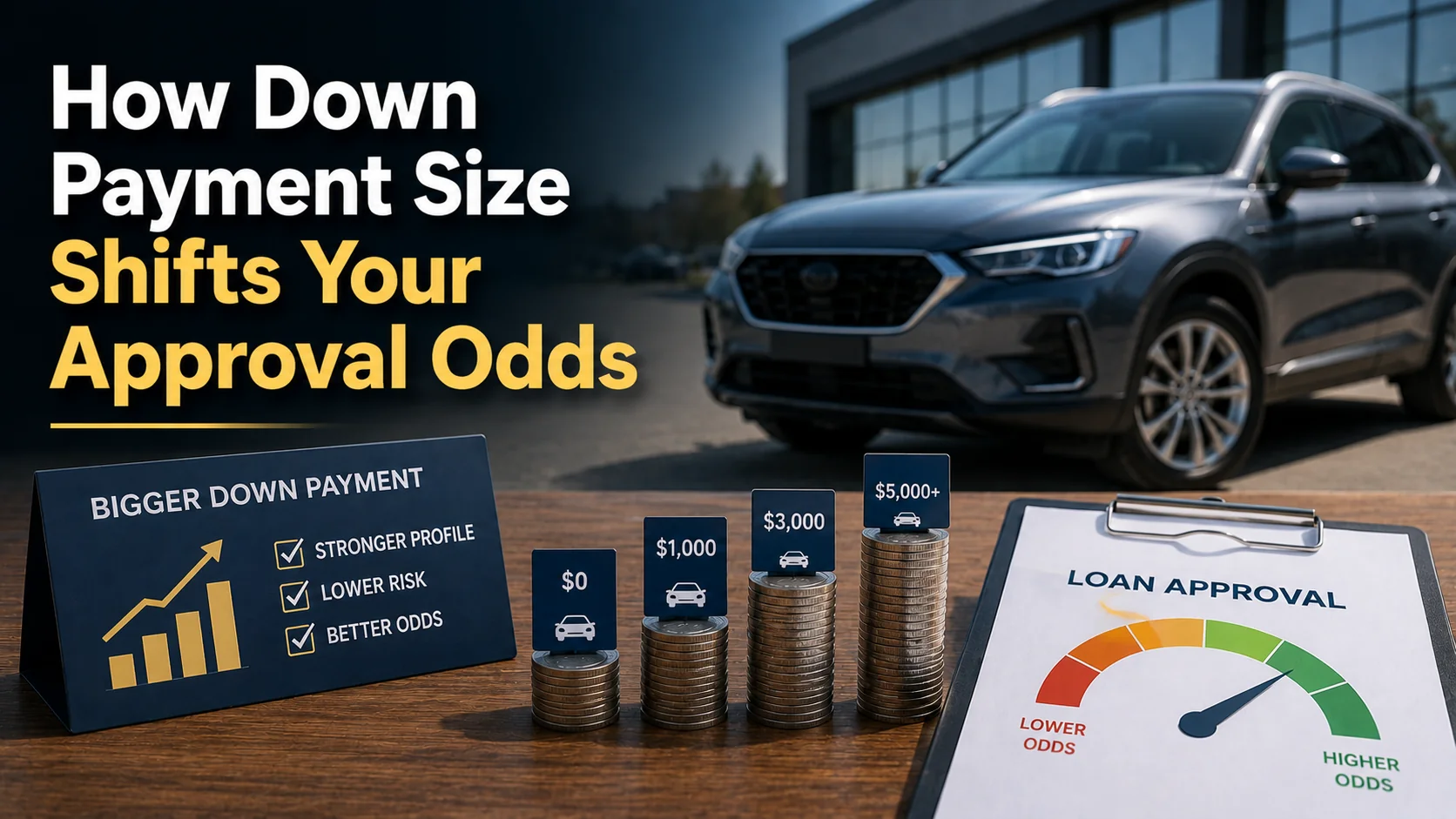
How Down Payment Size Shifts Your Approval Odds
In this article
- How Much Does Down Payment Size Actually Affect Car Loan Approval in Alberta?
- What Down Payment Actually Signals to a Lender
- The Approval Threshold by Credit Tier
- The Rate Impact: Dollars Over the Loan Life
- Where Does Down Payment Money Come From in Alberta?
- When Waiting to Save More Down Payment Backfires
- Down Payment vs Co-Signer: Which Helps More?
- Down Payment Strategy for Credit Rebuilding
- When Shift Happens Makes Sense for You
- Frequently Asked Questions
- How much down payment do I need to get approved for a car loan in Alberta with bad credit?
- Does a larger down payment always get me a better interest rate?
- Can my trade-in count as my down payment?
- What if I can only put $500-1,000 down? Am I wasting time applying?
- Should I wait to save more down payment or apply now?
- Compare and Apply
Check Your Options in 3 Minutes
No credit impact. All credit situations welcome.
★★★★★ 118+ Google Reviews · AMVIC Licensed · Free Delivery 300km
How Much Does Down Payment Size Actually Affect Car Loan Approval in Alberta?
Down payment size directly shifts both your approval odds and your interest rate in Alberta auto financing. A subprime buyer (score 500-599) with zero down may face outright decline or a 26-29% rate, while the same buyer with $3,000-5,000 down often secures approval at 18-22% — a difference worth $4,000-7,000 over 72 months on a $20,000 loan. The down payment reduces lender risk, improves your loan-to-value ratio, and signals financial discipline that offsets credit score weakness.
Every car buyer in Alberta has heard "just put more money down" as advice. What almost nobody explains is the exact mechanism behind that advice — why lenders respond to down payment the way they do, how much is enough to move the needle at each credit tier, and when putting more down stops generating returns. This is the specific math that separates buyers who get approved at reasonable rates from those who either get declined or accept the first number they're handed.
The down payment conversation also intersects with timing: whether you wait and save more versus act now with what you have depends on how much your credit profile improves over that waiting period. Sometimes the right answer is to put $2,000 down today on a $14,000 vehicle rather than wait 8 months for $5,000 down on a $22,000 one. The math on that decision is worth running explicitly.
What Down Payment Actually Signals to a Lender
From a lender's perspective, your down payment does three distinct things simultaneously. First, it reduces the loan-to-value (LTV) ratio — the ratio of what you're borrowing to what the vehicle is worth. At 100% LTV (zero down), the lender is fully exposed if you default and the vehicle depreciates. At 80% LTV ($4,000 down on a $20,000 vehicle), they have a meaningful equity cushion. Second, it reduces the absolute loss exposure if the loan goes bad. A $20,000 loan defaulting in month 6 leaves more exposure than a $16,000 loan defaulting at the same point. Third — and this is often underestimated — it signals financial discipline. A buyer who has managed to save $3,000-5,000 is demonstrating behaviour that predicts loan performance better than a credit score alone.
Alberta lenders in the subprime space have explicit LTV thresholds baked into their credit policies. Many subprime lenders cap at 120-130% LTV on older vehicles (accounting for dealer markup and fees) but tighten to 100-110% on vehicles over 10 years or over 150,000 km. Bringing your own down payment moves you closer to their comfort zone — and sometimes into the approval band when you'd otherwise be declined.
The Approval Threshold by Credit Tier
Down payment requirements aren't uniform. They vary dramatically by credit score tier, vehicle age, and the specific lender's risk appetite. Here's how it generally breaks down for Alberta buyers:
| Credit Score Range | Zero Down | $2,000-3,000 Down | $5,000+ Down |
|---|---|---|---|
| Prime (660+) | Typically approved, rate 6.99-12% | Better rate, lower LTV concern | Minimal incremental benefit |
| Near-prime (600-659) | May approve, rate 12-18% | Rate may drop 2-4 points | Strong approval confidence |
| Subprime (500-599) | Often declined or rate 24-29% | Approval likely, rate 18-24% | Approval high confidence, rate 16-20% |
| Deep subprime (below 500) | Decline likely except specialty lenders | Opens some specialty lenders | Meaningful approval odds improvement |
The numbers above are directional — actual outcomes depend on income, employment stability, time at address, and the specific lender. What the table illustrates is that down payment has the most leverage in the subprime and near-prime bands. Prime buyers can often go zero down without meaningful rate penalty. Deep subprime buyers need down payment just to access the approval conversation — but even $2,000-3,000 can be the difference between locked out and conditionally approved.
The Rate Impact: Dollars Over the Loan Life
Rate differences that sound small per-percentage-point translate to substantial dollar differences over 60-84 month loan terms. Let's use a concrete Alberta example: a 2019 Toyota RAV4 priced at $22,000, buyer with a 555 credit score.
- Zero down, rate 26.99%, 72 months: biweekly payment $316, total interest paid $10,248
- $3,000 down ($19,000 financed), rate 22.99%, 72 months: biweekly payment $257, total interest paid $7,992
- $5,000 down ($17,000 financed), rate 19.99%, 72 months: biweekly payment $218, total interest paid $6,744
Moving from zero down to $5,000 down on this deal saves $98 biweekly and $3,504 in total interest — while requiring only $5,000 invested upfront. That's a 70% return on the incremental $5,000 over 72 months, just in interest savings alone. The lender likes it because their risk dropped. You win because your cost dropped.
Run your own scenarios with our biweekly payment calculator — plug in different down payment amounts at your expected rate to see exactly how much each dollar of down payment saves you over your loan term.
Where Does Down Payment Money Come From in Alberta?
The source of down payment money matters less than having it and documenting it. Common sources Alberta buyers use successfully:
- Tax refund: The average Alberta federal tax refund runs $1,400-2,200 for middle-income earners. Timing a vehicle purchase to coincide with tax season is a deliberate strategy — read our full breakdown at using your tax refund as a car down payment.
- Trade-in equity: Your current vehicle's trade-in value applies directly as down payment. Even a 2012 vehicle with 180,000 km might appraise at $3,000-6,000, effectively funding your down payment without requiring cash savings.
- Savings installments: Setting up a dedicated savings account for 4-6 months before vehicle shopping is the disciplined approach. Even $500/month for 5 months generates $2,500 — meaningful in the subprime tier.
- Gift funds: Gifts from family members are accepted by most lenders. Documentation (a simple gift letter) is typically required to confirm it's not a loan that adds to your debt obligations.
If you're relying on a trade-in as your primary down payment source, our team handles trade-in appraisals at the same time as financing — so you know the exact value going in rather than discovering it mid-deal.
The $2,000 floor for subprime buyers: In Alberta's subprime lending environment, $2,000 is approximately the minimum down payment that meaningfully shifts approval odds for buyers with scores in the 500-599 range. Below $2,000, most lenders treat the deal as near-zero-down and price the rate accordingly. Above $2,000, you begin accessing lower rate tiers. Every additional $1,000 above that baseline tends to generate progressively smaller incremental rate improvements — so the biggest wins come from getting above $2,000, not from maximizing to $10,000.When Waiting to Save More Down Payment Backfires
The instinct to wait and save a larger down payment is understandable but can be counterproductive in specific scenarios. If your credit score is actively recovering — you've discharged a bankruptcy, completed a consumer proposal, or simply started paying on time after a rough period — time in the bureau matters. Each month of positive payment history after a derrogatory event improves your score and potentially drops your rate tier.
Waiting 8 months to save an extra $3,000 while your score climbs from 520 to 580 might shift you from a 26% rate to a 21% rate — saving more than the $3,000 in interest you were trying to save by waiting. The right calculation is: (monthly credit improvement rate) × (months waiting) × (rate reduction value) versus (savings accumulation) × (payment reduction). That math is specific to your situation and worth running before you assume "save more = better outcome."
This connects directly to the bad credit car loan strategy conversation — sometimes financing now at a higher rate while building history, then refinancing at 18-24 months when your score has improved, beats waiting and saving.
Down Payment vs Co-Signer: Which Helps More?
A co-signer with strong credit (660+) can unlock better rates without any down payment, because the lender is now underwriting against two incomes and two credit profiles. But co-signers carry real risk for the co-signing party — they're equally liable for the loan, and a missed payment affects both credit reports. Down payment has no such complication.
The practical hierarchy for most subprime buyers in Alberta: (1) Down payment first — it's clean, effective, and has no relationship strings attached. (2) Co-signer if you can't source adequate down payment and have a willing family member with strong credit. (3) Both combined if you're deep subprime with limited income and need maximum lender comfort. The co-signer decision guide covers the trade-offs in more detail if you're weighing this specifically.
There's also a hybrid path worth considering: a modest down payment ($2,000-3,000) combined with a co-signer can sometimes unlock approval and rate tiers that neither lever achieves alone. For a 490 credit score buyer with a parent co-signing at 720, the lender prices primarily off the stronger credit profile — but the down payment still reduces their collateral exposure and can tip a conditional approval to a clean one. This combination is most useful for deep subprime buyers who have access to a willing co-signer but limited savings.
If you're at the point of evaluating your options and ready to see what you'd qualify for with your current down payment, the fastest path is to check your approval likelihood — the tool gives you a realistic read in under 60 seconds, no credit impact, before you commit to anything. The process is the same for both single and co-signed applications.
Down Payment Strategy for Credit Rebuilding
For buyers who are specifically using a car loan as a credit rebuilding tool — not just transportation — down payment strategy has an additional dimension. A larger down payment reduces the loan balance, which means the on-time payment history you're building applies to a smaller principal. This isn't necessarily worse for your score (on-time payments are on-time payments regardless of balance), but it does mean you're paying interest on less principal while building the same credit history.
The credit rebuilding math sometimes favours a lower down payment and more disciplined payment behaviour: keep more cash in your pocket, finance a slightly higher balance, make every payment on time (or accelerate payments), and use the 18-24 months of positive payment history to push your score up before refinancing. The guide on how car payments build credit covers the scoring mechanics in detail. The key insight: your score responds to payment consistency, not down payment size. Down payment affects your rate and approval odds — your payment history affects your score.
If this post was useful, these directly-related guides will help you go deeper:
- $0 Down vs $5,000 Down: How Your Deposit Affects Rate and Approval
- Save for Down Payment or Pay Off a Card: Which Actually Helps Approval
When Shift Happens Makes Sense for You
Reach out to us if you: (1) are shopping for a used vehicle in Alberta with any down payment amount — including zero — and want honest advice on how it affects your approval, (2) want 15+ lenders competing for your deal so you get the best available rate given your down payment and credit profile, (3) are in Airdrie, Calgary, or anywhere in Alberta and want to understand your real options before you commit. Not a fit if: you need new vehicles only, lease-only inventory, or are buying outside western Canada.
If you're in this spot, take the lighter first step: run an approval check (60 seconds) or start a financing application. Each one is a no-hit-to-credit query until you formally proceed.
Frequently Asked Questions
How much down payment do I need to get approved for a car loan in Alberta with bad credit?
There's no universal minimum, but $2,000 is the practical floor where down payment starts meaningfully improving approval odds for subprime buyers (score 500-599). Below that, most lenders treat the deal as near-zero-down and price accordingly. Some specialty lenders will approve zero-down for subprime buyers, but rates will be at or near the top of their range (24-29.99%).
Does a larger down payment always get me a better interest rate?
Generally yes, but with diminishing returns above certain thresholds. For subprime buyers, the biggest rate improvements happen in the $0 to $5,000 down payment range. Beyond $5,000-7,000 on a $20,000-25,000 vehicle, incremental rate improvements become smaller because you've already addressed the lender's core LTV concerns.
Can my trade-in count as my down payment?
Yes. Trade-in equity is the most common form of down payment in Alberta. If your current vehicle appraises at $5,000 and you owe $2,000 on it, you have $3,000 in net equity that applies directly to your new vehicle purchase. Your dealer will handle this in a single transaction — you don't need to sell privately first.
What if I can only put $500-1,000 down? Am I wasting time applying?
Not necessarily. Some subprime lenders work with minimal down payment on specific vehicle types and income profiles. $500-1,000 won't dramatically change your rate, but it may be the difference between a conditional approval and an outright decline on the thin-margin deals. Apply and let the lenders tell you — a decline costs you nothing except a hard inquiry on your credit file.
Should I wait to save more down payment or apply now?
It depends on your credit trajectory. If your score is actively improving month-over-month, waiting 3-6 months while saving down payment may get you a better rate through score improvement alone. If your score is stable or stagnant, saving more down payment is likely the better lever. We can help you model both scenarios — call or apply online and we'll walk through the math specific to your situation.
Compare and Apply
- Complete Bad Credit Car Buying Guide (Alberta) — complete bad credit car buying guide
See what you pre-qualify for
Three quick answers — soft check, no commitment.
Financing Resources
Related Articles
Ready to Find Your Vehicle?
Browse our inventory or apply for financing. All credit situations welcome.
★★★★★ 118+ Google Reviews · AMVIC Licensed · Free Delivery 300km