
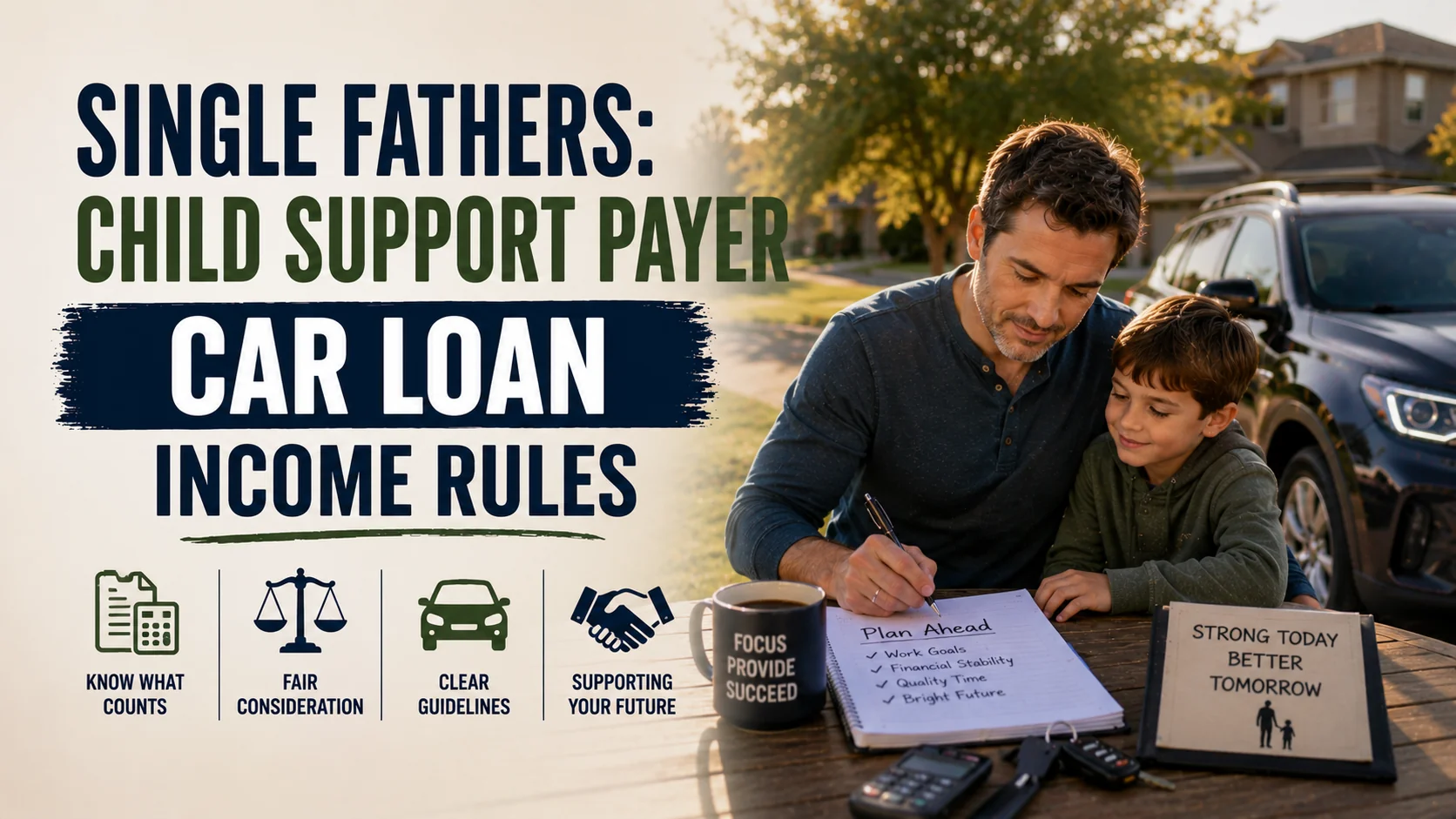
Single Fathers: Child Support Payer Car Loan Income Rules
In this article
- How does paying child support affect car loan qualification in Alberta?
- How Lenders Treat Child Support as a Debt Obligation
- The Three Levers You Control
- Lever 1: Down Payment
- Lever 2: Shorter Loan Term
- Lever 3: Vehicle Price
- When Child Support Isn't on Your Credit Bureau
- Documentation That Helps Your Application
- Shared Custody Scenarios
- Credit Damage From Separation: The Common Story
- Vehicle Choices That Fit a Single Dad's Reality
- Parenting Time and Vehicle Practicality
- The Refinance Play After 18–24 Months
- Is Shift Happens Right for Your Situation?
- FAQ: Child Support Payers and Car Loan Qualification
- Does paying child support show up on my credit bureau and hurt my score?
- Can I use the fact that my support obligation ends in 3 years to qualify for a bigger loan?
- My ex and I have a verbal arrangement and I pay cash — does that create a problem?
- Do I qualify for any single-parent specific programs or rates?
- Can a new common-law partner's income help my application?
- Compare and Apply
Check Your Options in 3 Minutes
No credit impact. All credit situations welcome.
★★★★★ 106+ Google Reviews · AMVIC Licensed · Free Delivery 300km
You're a single dad paying $1,200/month in child support, working a solid job in the trades or oil patch, and you need to replace the truck you've been limping along in for two years. When you ran the numbers with a bank, they applied your full gross income to the debt-service ratio — but then deducted child support as a recurring obligation. Suddenly your "good income" left you qualifying for something disappointing. If that scenario sounds familiar, you need to understand the specific income rules that apply to child support payers in the auto financing world.
See what you pre-qualify for
Three quick answers — soft check, no commitment.
How does paying child support affect car loan qualification in Alberta?
Child support payments reduce your effective qualifying income for auto loan purposes. Most lenders deduct 100% of documented monthly child support from your gross income before calculating debt-service ratio. On a $1,200/month support obligation, a buyer earning $6,000/month gross effectively qualifies as a $4,800/month income earner. Strategy: maximize down payment and target shorter loan terms to hit debt-service ratio thresholds despite the reduction.
How Lenders Treat Child Support as a Debt Obligation
Child support in Alberta is typically calculated under the federal Child Support Guidelines, which set payment amounts based on the payer's gross income and the number of children. When you apply for a car loan, lenders pull your credit bureau, see the support obligation (if it appears as a monthly payment line), and include it in your total monthly debt load.
The debt-service ratio most lenders use is Total Debt Service (TDS): all monthly debt obligations divided by gross monthly income. Most lenders want TDS under 40–45%. If your gross income is $6,000/month and your obligations are $1,200 child support + $1,400 rent/housing + $200 credit card minimum, your TDS is already at 46.7% before adding any car payment. That's why even well-paid fathers sometimes get approved for less than they expect.
The calculation is straightforward math, not a value judgment. Lenders aren't penalizing you for being a responsible parent — they're applying a formulaic debt-load assessment. Understanding the formula lets you optimize around it.
The Three Levers You Control
When child support reduces your qualifying income, you have three levers to adjust:
Lever 1: Down Payment
Every dollar of down payment reduces the loan amount and therefore the required monthly payment. On a $32,000 vehicle, going from $2,000 down to $6,000 down reduces your financed amount by $4,000 — that's roughly $58–$75 less per month in payment at 14.99% over 72 months. In a tight debt-service calculation, that difference can be the gap between approved and declined.
It's also worth noting that a larger down payment signals lower risk to the lender. With a meaningful equity stake in the vehicle, the loan-to-value ratio improves, and some lenders will adjust their rate offer by 1–2 points for strong down payments. That's meaningful: at $28,000 financed, the difference between 14.99% and 12.99% over 72 months is approximately $1,680 in total interest paid.
Lever 2: Shorter Loan Term
A 72-month loan at 14.99% on $28,000 runs approximately $210/biweekly ($420/month). A 48-month loan on the same amount runs approximately $285/biweekly ($570/month). Shorter terms have higher payments — which seems counterproductive. But some lenders use the vehicle's loan-to-value ratio as an approval factor, and a shorter-term loan that keeps the vehicle's value above the loan balance throughout the term reduces their risk. If your income is strong enough to support the higher payment, a 60-month term sometimes gets better approval conditions than a 72-month stretch.
Lever 3: Vehicle Price
The most straightforward lever: buy a less expensive vehicle. A $22,000 vehicle at 14.99% over 72 months is $165/biweekly vs. $210 for a $28,000 vehicle. If the TDS ratio is tight, targeting a vehicle that keeps your payment under a specific threshold — say, $175/biweekly — gives you a clear price ceiling to shop within. Use the payment calculator to work backwards from your payment ceiling to a vehicle price ceiling before you start shopping.
Child support payer qualifying math: Single father in Alberta earning $6,500/month gross. Child support obligation: $1,100/month. Effective qualifying income: $5,400/month (lender deducts support). At 40% TDS with $1,500/month in housing costs, remaining capacity for car payment: $660/month or $330/biweekly. That supports approximately $38,000–$44,000 in financing at 14.99–17.99% over 72 months — a solid budget for a reliable truck or SUV. Down payment of $4,000+ further strengthens approval odds and may improve rate by 1–2 points.When Child Support Isn't on Your Credit Bureau
Not all child support orders appear on your credit bureau. If your obligation was established through a private separation agreement and isn't MEP-registered, it may not show up on your Equifax or TransUnion report. In that case, lenders who pull your bureau don't automatically know about the obligation.
This creates a disclosure question: do you have to disclose child support you pay if it's not on your bureau? The honest answer is yes — most financing applications ask about all monthly financial obligations. Failing to disclose a known recurring obligation is misrepresentation on a credit application. More practically, if your finances are reviewed during an audit or the loan defaults, undisclosed obligations become a larger problem.
The right approach: disclose the child support, present it with documentation (separation agreement or court order), and let the lender underwrite with accurate information. The TDS math that follows may reduce your qualifying amount, but it's the honest position and protects you downstream.
Documentation That Helps Your Application
For single fathers applying for auto financing, the strongest application package includes:
- T4 (last 2 years): Establishes your gross employment income — the foundation of the TDS calculation
- Three recent pay stubs: Confirms current employer and current wage rate
- Court order or separation agreement: Shows the child support amount formally — lenders can confirm the legal obligation and its duration
- MEP registration (if applicable): Confirms the order is enforcement-registered, which some lenders treat as evidence of compliance and stability
- Proof of compliance: Bank statements or payment history from MEP showing consistent payments. A lender who sees 18 consecutive on-time support payments has evidence of financial discipline — that's actually a positive signal for loan repayment behavior
- Government-issued ID and proof of address
One thing that often helps: an explanation of the support end date. If your youngest child turns 18 in 3 years and support terminates, a lender writing a 72-month loan knows that support drops off in year 3, improving your debt-service ratio significantly at that point. That information can affect how an underwriter views the risk over the full loan term.
Shared Custody Scenarios
Shared custody (roughly equal parenting time, typically 40–60% each) changes the child support calculation under federal guidelines. With shared custody, neither parent necessarily pays full table-rate support — instead, an offset calculation applies, and in many cases, the higher-earning parent pays a reduced amount or nothing. If you have shared custody of your children:
- Your support obligation may be lower than table rates suggest
- You may also incur direct child-related expenses (clothing, activities, extracurriculars) that aren't captured in support payments
- Some lenders — understanding shared custody math — will look at the actual net cash payment rather than assuming full table-rate obligations
Bring your separation agreement or court order that specifies the custody arrangement alongside the support amount. The documentation of shared custody directly affects how your debt load is calculated and may improve your qualifying position meaningfully.
Also relevant if you're rebuilding after separation: the buy here pay here vs subprime financing comparison explains why BHPH is almost always the wrong choice for a single parent with income — the subprime lender network offers far better rates and terms than in-house dealer financing.
Credit Damage From Separation: The Common Story
Separation and divorce frequently create credit damage for both parties. Joint accounts in arrears, a mortgage that went through a power of sale, a vehicle that got repossessed during the chaotic financial period — all of these land on your credit file. If your score is in the 550–620 range today because of events that happened during a separation 2–3 years ago, and your recent 18 months are clean, you're in better shape than you think.
Subprime lenders weight recent payment behavior heavily. The last 18–24 months of your credit file matter more than what happened 36+ months ago. A lender who sees a messy period from 2022–2023 followed by 18 months of on-time payments and a clean current balance is seeing a recovery story — and that's approvable at reasonable rates. The credit rebuild car loan guide explains how auto loans specifically accelerate credit recovery after a major life event.
If you're not sure where your credit stands today, check your credit score for free before you apply. Knowing your starting point lets you set realistic expectations and choose the right lender tier.
Vehicle Choices That Fit a Single Dad's Reality
Single fathers typically need: enough space for kids (and gear), reliability across Alberta winters, a vehicle they can maintain without constant dealer visits, and a price point that fits within a TDS-constrained budget. Here's what works at different price points:
| Budget Range | Best Options | Why It Works |
|---|---|---|
| $16,000–$22,000 | Hyundai Tucson, Ford Escape, Nissan Rogue | AWD for winter, family-friendly, lower payment = better TDS ratio |
| $22,000–$30,000 | Toyota RAV4, Honda CR-V, Kia Sportage | Excellent reliability, strong resale if life changes again |
| $30,000–$40,000 | Ford Explorer, Toyota Highlander, GMC Sierra | Third-row seating or truck utility if needed; strong Alberta market resale |
If you have the kids on weekends with activities, or if you're also using the vehicle for work purposes in the trades, the utility argument for a truck gets stronger. A used half-ton at $28,000–$35,000 covers both kids-on-weekends and tool-hauling-on-weekdays if your budget allows.
The vehicle maintenance guide is worth reading before you commit to a specific model — understanding what each vehicle costs per year in oil changes, brakes, and tires helps you pick the right vehicle at the right price point given everything else your budget is covering.
Parenting Time and Vehicle Practicality
Single fathers with standard parenting schedules — alternating weekends, school holiday time — need a vehicle that accommodates children periodically without being sized (and costed) for daily family use. That's a different calculus than a single parent with primary custody who needs maximum child-accommodation capacity every day.
If you have kids every other weekend and a few weeks in summer, a compact SUV or even a sedan with a good backseat works perfectly well. The savings over a full-size SUV or minivan — in purchase price, insurance, and fuel — are real. A 2018 Nissan Rogue at $22,000 serves alternate-weekend parenting just as well as a $36,000 Highlander, and the $14,000 gap is a meaningful TDS improvement on a tight child-support-impacted application.
If you have your kids 50% of the time or more, the calculus shifts. Car seat capacity, cargo space, and three-row seating (for carpooling or multiple children) matter more. In that case, the right vehicle size earns its keep in practical daily use.
The Refinance Play After 18–24 Months
If you're approved at 18.99% today because of a damaged post-separation credit file, that doesn't have to be your rate for the full 72 months. After 18–24 months of on-time payments, your credit score typically crosses 650–680, at which point refinancing becomes viable. A refinance at 10.99% on a remaining balance of $22,000 over 42 remaining months saves approximately $2,800 in total interest compared to staying at 18.99%.
The refinance process: apply with a new lender (or the same one) once your score hits the target tier. They pull your current bureau, verify your income is still solid, and offer a new rate on the remaining balance. The main cost is a new hard inquiry (minor) and any prepayment penalty on the original loan (check your contract — most subprime lenders have no prepayment penalty after 12 months). The Alberta car loan refinancing guide covers the full process and when to trigger it. Set a calendar reminder for month 18 to pull your free credit report and evaluate.
Also worth reviewing at month 12–18: the credit-building timeline from car payments — understanding exactly how your score is improving helps you time the refinance application correctly.
The questions this post raises usually lead to the topics below — pick the angle that fits your scenario:
- Single Mothers: How Child Support and CCB Count in Car Loans
- Best Used Compact SUVs for Alberta Single Parents
Is Shift Happens Right for Your Situation?
Shift Happens Auto Sales is a fit if you: (1) are a single father in Alberta with employment income and documented child support obligations, (2) want lenders who understand the TDS impact of child support and will look at the full financial picture, (3) want 15+ lenders competing for your deal including subprime and near-prime specialists. Not a fit if: you need new vehicle inventory, lease-only options, or you're buying outside western Canada.
The fastest next steps: check your approval likelihood (60 seconds, no credit impact) or start a full financing application. Bring your T4, pay stubs, separation agreement or court order, and we'll match your file to the lenders most likely to approve you at the best available rate.
FAQ: Child Support Payers and Car Loan Qualification
Does paying child support show up on my credit bureau and hurt my score?
Not directly — child support payments aren't a credit product, so they don't appear as a "payment" on your bureau the way a car loan or credit card does. However, if you miss support payments and the MEP takes enforcement action, that can indirectly affect your credit (e.g., bank account seizure could affect other obligations). The support obligation itself may appear in some lender's searches, but it's not a scored item on Equifax or TransUnion.
Can I use the fact that my support obligation ends in 3 years to qualify for a bigger loan?
Some lenders will factor in future income improvement — particularly when the support end date is clearly documented and within the loan term. Not all lenders do this; it depends on the underwriter. Worth raising if the math is tight and the end date is within 24–36 months.
My ex and I have a verbal arrangement and I pay cash — does that create a problem?
For financing purposes, an informal cash arrangement is nearly undocumentable from the lender's perspective. If it's not on your bureau and not in a court order, the lender may not know about it — but you should still disclose it. For your ex's benefit and yours, formalizing the arrangement through a written separation agreement (or MEP registration) protects both of you.
Do I qualify for any single-parent specific programs or rates?
There are no government-subsidized rate programs specifically for single fathers in Canada for auto financing. However, lenders who specialize in life-situation financing — including single parent financing in Calgary — have underwriting experience with the income profile and may offer more nuanced approvals than mainstream banks.
Can a new common-law partner's income help my application?
Yes, if they're added as a co-applicant. A joint application includes both incomes and both credit profiles — which helps if your partner has strong credit and additional income. It also means the loan appears on both credit files. If the relationship is relatively new, discuss this carefully — co-signing a loan is a significant financial commitment for both parties. The co-signer guide covers the mechanics and risks in detail.
Compare and Apply
- Bad Credit Financing — Complete Guide — Alberta's subprime auto financing guide
Financing Resources
Related Articles


Ready to Find Your Vehicle?
Browse our inventory or apply for financing. All credit situations welcome.
★★★★★ 106+ Google Reviews · AMVIC Licensed · Free Delivery 300km