
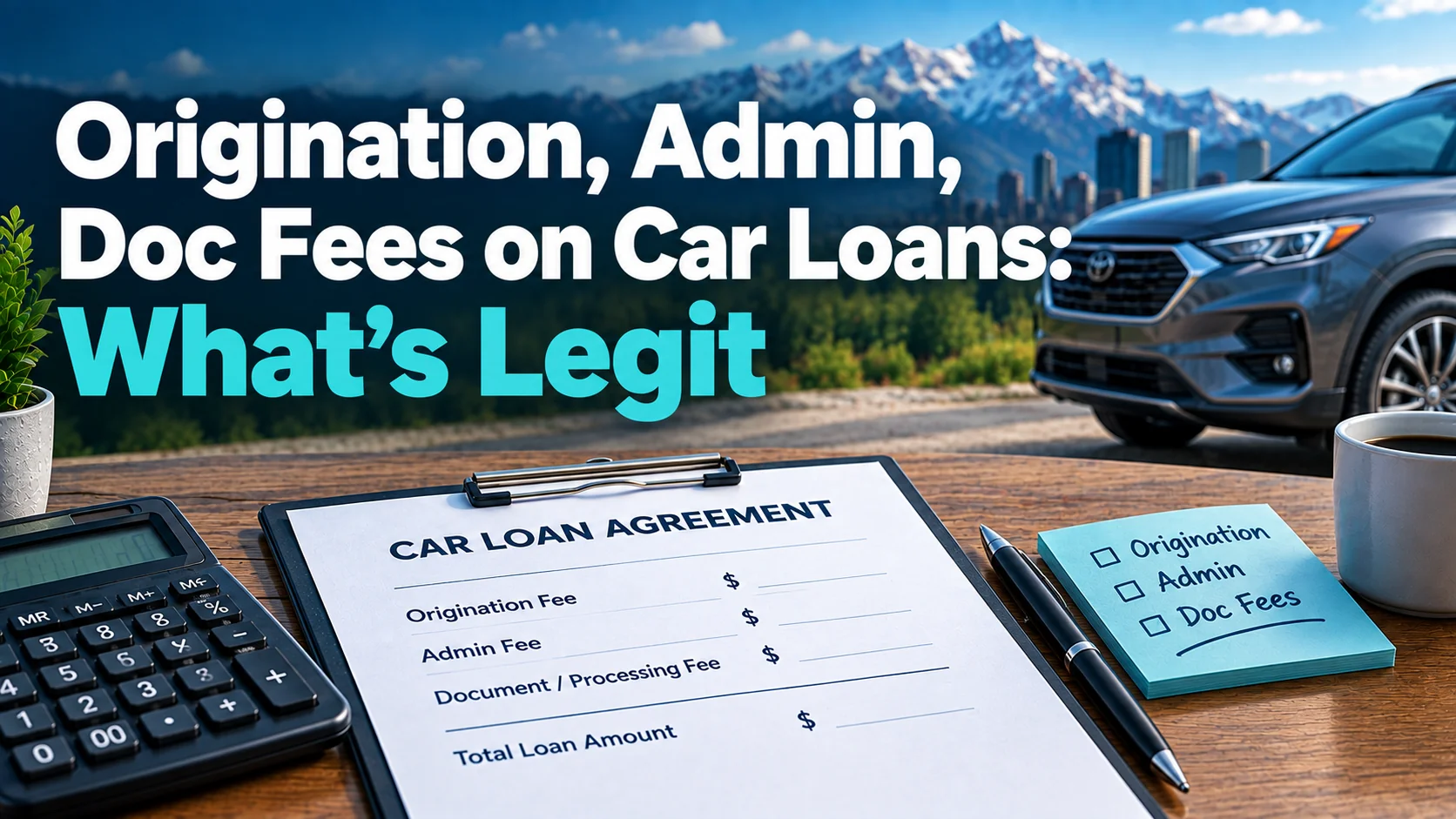
Origination, Admin, Doc Fees on Car Loans: What's Legit
In this article
- What Are Origination, Admin, and Doc Fees on a Car Loan?
- The Three Fee Types Explained
- Origination Fee
- Administration Fee (Dealer Fee)
- Documentation Fee
- What Makes a Fee Legitimate vs. Inflated
- How Fees Roll Into Your Loan (and Why It Matters)
- Fee Negotiation Tactics That Actually Work
- Comparing Lender Fee Structures
- What Alberta Law Requires Dealers to Disclose
- GAP Insurance, Extended Warranties, and Other Add-Ons
- Is This a Job for Shift Happens?
- Frequently Asked Questions
- Is it legal for a dealer to charge both an origination fee and an admin fee in Alberta?
- Can I negotiate dealer admin fees in Alberta?
- What total fees should I expect on a $25,000 used vehicle loan in Alberta?
- Do PPSA registration fees go to the dealer or the government?
- If I pay my loan off early, do I get any of the origination fee back?
- Compare and Apply
Check Your Options in 3 Minutes
No credit impact. All credit situations welcome.
★★★★★ 114+ Google Reviews · AMVIC Licensed · Free Delivery 300km
What Are Origination, Admin, and Doc Fees on a Car Loan?
Origination fees, admin fees, and documentation fees are one-time charges added to your car loan at signing. In Alberta, legitimate fees typically range from $399 to $999 and cover lender underwriting, dealer processing, and document registration costs. They are legal and standard — but some dealers inflate them well beyond industry norms, costing you hundreds extra in interest over your loan term.
You're staring at a financing disclosure form and you see three separate line items: a $595 "origination fee," a $299 "administration fee," and a $149 "documentation fee." Together they add $1,043 to the price of your vehicle before you've even discussed the interest rate. Are these legitimate? Are you being taken advantage of? Knowing the difference between standard industry costs and dealership markup is money in your pocket — sometimes $1,500 or more over a 72-month loan.
The Three Fee Types Explained
Origination Fee
An origination fee is charged by the lender — not the dealer — to cover the cost of underwriting and funding your loan. Think of it as the lender's administrative cost for reviewing your application, pulling your credit bureau, verifying income, and setting up your account. In Canada, origination fees on subprime auto loans typically run $300 to $750 depending on the lender and loan size.
Some lenders fold this into the interest rate instead of charging a separate fee. Others charge it explicitly. When comparing dealership financing vs. bank loans, check whether the bank's "no fee" loan actually has a higher rate that costs more over time — often it does.
Administration Fee (Dealer Fee)
The admin fee is charged by the dealership, not the lender. It covers the dealer's cost of preparing your deal — title searches, insurance verification, registration processing, and coordinating with the lender. In Alberta, a reasonable admin fee is $399 to $699. Fees above $799 warrant a direct question: "What specifically does this cover?"
Unlike the origination fee, the admin fee goes to the dealership's bottom line. Some dealers negotiate it; others won't. Understanding how car financing works end-to-end helps you spot when a fee is genuinely compensating for dealer overhead versus padding profit.
Documentation Fee
The doc fee covers physical and digital paperwork: the bill of sale, lien registration with Alberta's PPSA (Personal Property Security Act), and government registration transfers. Legitimate doc fees in Alberta run $75 to $200. If you see a "documentation fee" of $400+, ask for an itemized breakdown — it may be a padded admin fee wearing a different name.
What Makes a Fee Legitimate vs. Inflated
Legitimate fees share three characteristics: they're disclosed in writing before you sign, they correspond to an actual service, and they're within the range peers charge in your market. AMVIC (Alberta Motor Vehicle Industry Council) requires dealers to disclose all charges in writing before contract execution — this is non-negotiable.
Red flags for inflated or invented fees include:
- Fee stacking — charging origination, admin, AND doc fees separately when one covers what the others claim to cover
- Vague names — "processing fee," "finance fee," "service fee" without a clear description
- Post-negotiation additions — fees that appear on the final contract but weren't mentioned during price negotiation
- Percentage-based fees — any fee calculated as a percentage of loan amount (e.g., "2% origination") rather than a flat charge
- Fees above $1,200 combined — total legitimate fees on a standard used vehicle purchase in Alberta should rarely exceed $900–$1,000 combined
How Fees Roll Into Your Loan (and Why It Matters)
Most buyers don't pay fees in cash — they roll them into the loan. Here's why this costs more than the stated fee amount: every dollar of fee that rolls in gets charged your full loan interest rate for the entire term.
Example: You're financing a $20,000 Honda CR-V at 14.99% over 72 months. The dealer adds $800 in combined fees. You now owe $20,800. Over 72 months at 14.99%, the interest cost on that extra $800 is approximately $350 — so the $800 fee actually costs you $1,150 in real dollars. Multiply this across higher-fee scenarios and you see why scrutinizing fees matters at the front end of your deal.
Use the payment calculator to model how fees change your biweekly payment. The difference between rolling in $500 vs. $1,500 in fees on a 72-month loan at 14.99% is about $24/biweekly — real money across 156 payments.
Fee Negotiation Tactics That Actually Work
Admin fees are the most negotiable because they go directly to the dealer. Start by asking: "Is this fee mandatory or negotiable?" Many dealers will confirm it's negotiable once asked directly. If they resist, offer to negotiate elsewhere — "I'll accept the admin fee as-is if you can get the rate down 0.5% instead." This trades dealer profit for lender buy-down and you end up in a similar spot financially.
Document fees are harder to negotiate because they partially reflect real third-party costs (Alberta PPSA registration runs $10–$15 per registration). Origination fees are the least negotiable because they're set by the lender, not the dealer — but competing lenders have different origination structures, which is why working with a multi-lender dealer matters. If you're rebuilding your credit, read more about using a car loan to rebuild credit and how fee structure affects your total cost of credit.
Comparing Lender Fee Structures
| Lender Type | Typical Origination Fee | Where It Appears | Negotiable? |
|---|---|---|---|
| Prime bank (TD, RBC, BMO) | $0 (built into rate) | Rate spread | Rate only |
| Credit union | $0–$250 | Loan setup fee | Sometimes |
| Captive finance (Toyota FS, GMAC) | $0–$395 | Finance agreement | Rarely |
| Subprime specialist (Rifco, Westlake) | $395–$750 | Loan agreement | No |
| High-risk lender | $500–$999 | Pre-computed in APR | No |
This is why a multi-lender model matters: different lenders have meaningfully different fee structures, and the lender with the lowest stated rate doesn't always produce the lowest total cost of borrowing when fees are factored in. At Shift Happens, we work with 15+ lenders and can show you the all-in cost comparison — rate plus fees — before you decide.
What Alberta Law Requires Dealers to Disclose
Under Alberta's AMVIC licensing requirements and the Consumer Protection Act, dealers must provide a written disclosure of all fees and charges before you sign any binding agreement. The disclosure must be itemized — a single line reading "fees: $1,000" does not satisfy the requirement. If a dealer won't break down their fees in writing, that's a compliance flag worth taking seriously.
If you're shopping in Calgary or surrounding areas and encounter a dealer unwilling to itemize fees, you can file a complaint directly with AMVIC. The complaint process is free and dealers take it seriously. Knowing your rights here costs nothing and protects hundreds to thousands of dollars per purchase.
At the mid-point of your fee evaluation, if your total finance cost looks higher than expected after factoring in fees, that's the right moment to check your approval options with a dealer who transparently discloses all-in costs upfront.
GAP Insurance, Extended Warranties, and Other Add-Ons
Separate from loan fees, dealers often present GAP insurance, extended warranties, and paint protection in the finance office. These are distinct from origination/admin/doc fees — they're optional products with their own cost-benefit analysis. A $2,500 extended warranty rolled into a 72-month subprime loan at 19.99% adds roughly $1,100 in interest, making the real cost closer to $3,600. That's worth knowing before you agree.
The relevant question for each add-on: "Can I buy this independently after taking delivery, and what would it cost?" If the dealer won't answer or won't allow it, that tells you something about the pricing. For a deeper look at one common add-on, see GAP insurance explained.
The questions this post raises usually lead to the topics below — pick the angle that fits your scenario:
- Refinancing Math: When It Actually Saves You Money
- Skip-a-Pay Options: The Hidden Interest Cost
- Open-End vs Closed-End Lease vs Finance: Which Suits Used Buyers
- Conditional Sales Contract vs Loan vs Lease: Legal Differences
- 60 vs 72 vs 84 vs 96 Month Loans: Real Cost Comparison
- Bump-Up Financing: When Dealers Use It and How to Push Back
Is This a Job for Shift Happens?
Shift Happens works well when you: (1) are buying a used vehicle in Alberta and want fee transparency before you sign, (2) have any credit situation from prime to deep subprime, (3) want to compare all-in financing costs — rate plus fees — across 15+ lenders in one application. Not a fit if: new vehicles only, lease-only, or buying outside western Canada.
If that sounds like you, two soft next steps: run an approval check (60 seconds) or begin a financing application. Both stay credit-soft until you decide to submit a formal application.
Frequently Asked Questions
Is it legal for a dealer to charge both an origination fee and an admin fee in Alberta?
Yes, it is legal as long as both fees are disclosed in writing before you sign and each covers a distinct service. AMVIC requires itemized fee disclosure — a combined fee line is insufficient. You have the right to ask for a written breakdown of exactly what each fee covers.
Can I negotiate dealer admin fees in Alberta?
In most cases, yes. Admin fees are set by the dealership and typically range from $399 to $699 at reputable Alberta dealers. Unlike lender origination fees, admin fees go directly to the dealer and are frequently negotiable — especially if you're prepared to walk or negotiating against competing offers.
What total fees should I expect on a $25,000 used vehicle loan in Alberta?
Expect combined origination, admin, and documentation fees of $650 to $950 on a $25,000 used vehicle purchase. If the total exceeds $1,200, ask for a line-by-line justification. Any amount above $1,500 in combined fees is unusual and worth questioning before signing.
Do PPSA registration fees go to the dealer or the government?
PPSA (Personal Property Security Act) lien registration fees are paid to the Alberta government through the Land Titles Office. The fee is $10–$15 per registration. Some dealers pass this through at cost; others mark it up inside their documentation fee. Ask specifically whether the doc fee includes a government charge passthrough or is entirely dealer-set.
If I pay my loan off early, do I get any of the origination fee back?
No. Origination fees are earned at loan inception — they compensate the lender for underwriting costs incurred at funding. They are not refunded upon early payoff. However, prepaying your loan does save you interest on the remaining principal, which typically far outweighs the one-time origination cost if you held the loan to term.
Compare and Apply
- Bad Credit Financing — Complete Guide — get approved despite bad credit
See what you pre-qualify for
Three quick answers — soft check, no commitment.
Financing Resources
Related Articles

Ready to Find Your Vehicle?
Browse our inventory or apply for financing. All credit situations welcome.
★★★★★ 114+ Google Reviews · AMVIC Licensed · Free Delivery 300km