
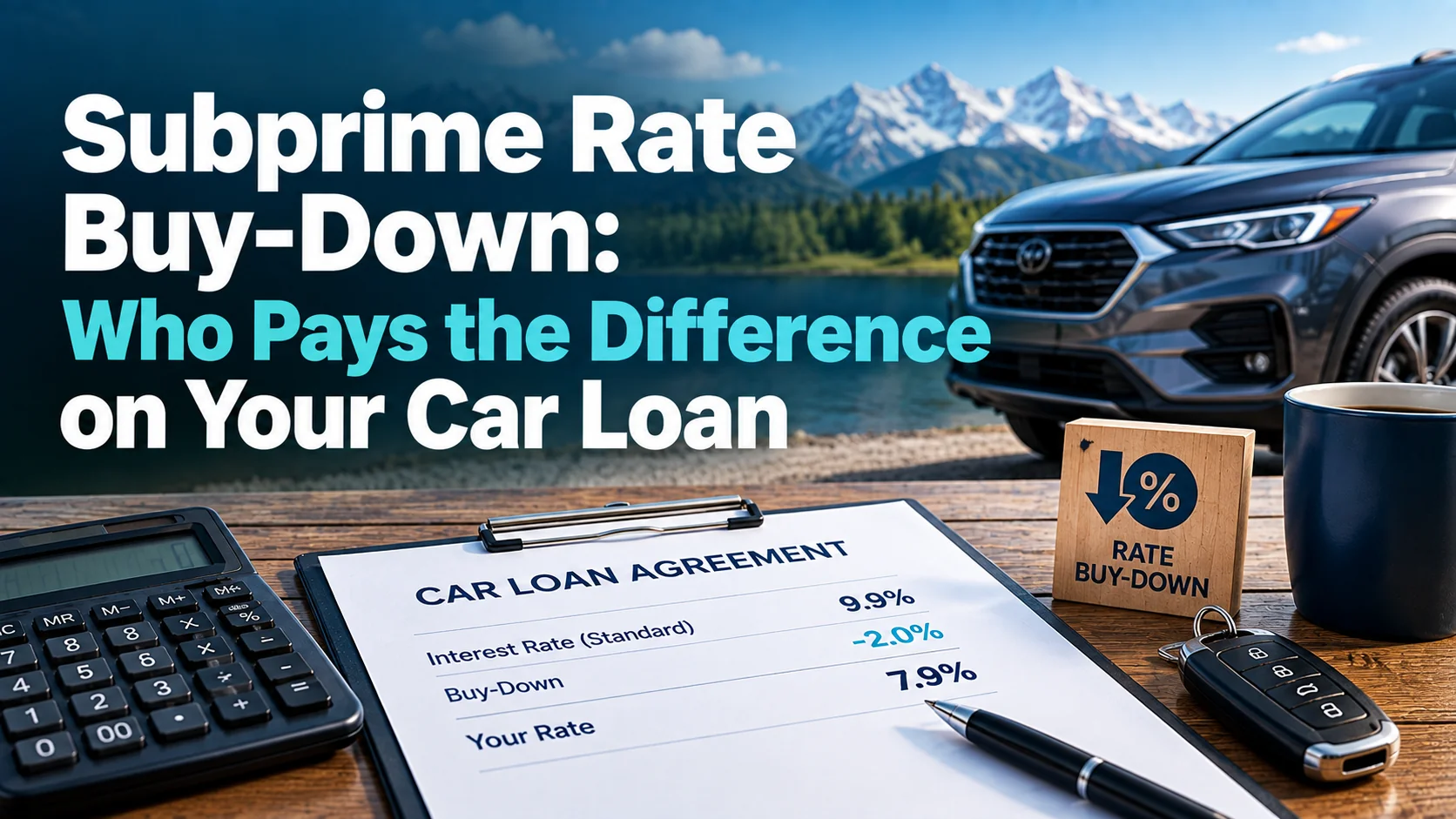
Subprime Rate Buy-Down: Who Pays the Difference on Your Car Loan
In this article
- What Is a Subprime Rate Buy-Down on a Car Loan?
- How Rate Buy-Downs Work Mechanically
- The Three Parties in a Subprime Buy-Down Deal
- The Lender
- The Dealer
- You
- Spotting Rate Buy-Downs in Practice
- Rate Buy-Downs vs. Rate Markups: Two Sides of the Same Lever
- When Rate Buy-Downs Genuinely Help Subprime Buyers
- How Multi-Lender Competition Affects Your Rate
- Rate Buy-Downs and Your Loan Term Interaction
- Questions to Ask at the Finance Desk
- Related Guides
- Is Shift Happens Right for Your Situation?
- Frequently Asked Questions
- Can I ask a dealer what the lender's actual buy-rate is on my car loan?
- Is rate markup (dealer reserve) legal in Alberta?
- Does a rate buy-down affect my credit score?
- If the dealer bought down my rate, can they take it back later?
- Is a higher rate with no add-ons better than a lower rate with a warranty package?
- Compare and Apply
Check Your Options in 3 Minutes
No credit impact. All credit situations welcome.
★★★★★ 114+ Google Reviews · AMVIC Licensed · Free Delivery 300km
What Is a Subprime Rate Buy-Down on a Car Loan?
A subprime rate buy-down is when a dealer pays the lender a cash subsidy upfront to reduce the interest rate on your car loan — typically dropping the rate by 1 to 4 percentage points. This cost comes out of dealer profit or vehicle markup. When a dealer advertises a lower-than-market rate on a used vehicle, someone is paying to bridge the gap between the lender's required yield and the rate you see.
You've seen the ads: "Rate as low as 5.99% on approved credit." Your credit score is 540. The lender's standard rate for a 540 score is 19.99%. So who's bridging that 14-point gap, and what does it cost you — directly or indirectly? Understanding how rate buy-downs work in subprime auto lending is one of the most underrated skills a used car buyer in Alberta can have. It changes how you read every offer on the table.
How Rate Buy-Downs Work Mechanically
Lenders in the subprime auto space set a required yield — the minimum return they need on a loan given the risk profile of the borrower. For a buyer with a 520 credit score, limited credit history, and $1,500 down on a $16,000 vehicle, that yield might be 22%. If the dealer wants to offer you 18%, they need to compensate the lender for that 4-point shortfall.
The dealer does this by paying a "participation fee" or "rate buy-down subsidy" — a lump sum to the lender at funding. The amount is calculated as a present value of the spread across the loan term. On a $16,000 loan over 60 months, buying down 4 points costs the dealer approximately $800 to $1,400 depending on the lender's buy-rate table. That's real money coming out of somewhere.
The question is: where does it come from? Three sources are common. First, the vehicle markup — the dealer priced the vehicle high enough to absorb the buy-down cost. Second, reduced dealer profit on the deal — the dealer takes a thinner margin to win your business. Third, backend products — GAP insurance, extended warranties, or other add-ons that generate enough profit to subsidize the rate. Understanding the difference between subprime and prime financing helps you see why rate structures differ so dramatically between buyer tiers.
The Three Parties in a Subprime Buy-Down Deal
The Lender
Subprime lenders like those in the Shift Happens lender network publish "buy-rate tables" — confidential sheets showing what rate they require for each risk tier, plus how much it costs per point to buy the rate down. The lender's goal is hitting their required yield; they're indifferent whether it comes from the borrower's rate or a dealer subsidy, as long as the math works.
The Dealer
The dealer controls whether to buy down the rate and by how much. If buying down 3 points wins a deal they'd otherwise lose, and the profit from the vehicle sale covers it, it's a rational business decision. Dealers can also earn "participation income" — income from marking the rate UP from buy-rate — which is the flip side of the same mechanism. A lender's buy-rate might be 16%; the dealer marks it to 19.99% and keeps the spread. This is legal and standard, but worth understanding.
You
As the buyer, you're the end payer — one way or another. If the rate is bought down but the vehicle is priced $1,500 higher to compensate, you've paid for the buy-down through vehicle price. If the rate is marked up from buy-rate, you're paying extra interest throughout the loan. The only scenario where a buy-down genuinely benefits you is when it comes out of the dealer's genuine margin and isn't recovered elsewhere.
Spotting Rate Buy-Downs in Practice
You won't see "rate buy-down: $850" on a disclosure form — that's an internal dealer-lender transaction. But you can infer when one is happening:
- The offered rate seems below-market for your credit profile. If you know your credit score is in the 500–599 range and the quoted rate is 10.99%, ask specifically: "Is this rate from the lender's standard table or is there a dealer subsidy involved?"
- The vehicle price is firm to an unusual degree. Dealers recovering a buy-down cost through vehicle price can't negotiate much on price. If every other negotiating lever is locked, the vehicle price may be carrying the buy-down cost.
- The finance office pushes hard on add-ons. When backend products are the source of buy-down funding, the finance manager needs to sell them to break even. Unusual pressure on GAP, warranties, or paint protection is a signal.
Rate Buy-Downs vs. Rate Markups: Two Sides of the Same Lever
The same mechanism that allows dealers to buy rates down also allows them to mark rates up. A lender might fund a loan at 16% (buy-rate) and the dealer presents it to you at 21.99% — earning the spread as participation income. This is sometimes called "dealer reserve" or "finance reserve" and it's how many finance offices generate significant revenue.
It's legal in Canada, but there's been increasing regulatory scrutiny. The key protection for you: always ask "what is the lender's base rate for my application?" Dealers aren't always obligated to reveal buy-rate, but asking the question signals you understand the structure and often motivates them to offer closer to buy-rate.
For buyers rebuilding credit — particularly those with scores in the 500–599 range — even a 2-point markup on a $15,000 loan over 60 months adds nearly $1,000 in extra interest. That's material when you're trying to get your financial footing back. Review what your credit situation actually means for rate eligibility at bad credit car loans.
When Rate Buy-Downs Genuinely Help Subprime Buyers
Manufacturers run buy-down programs specifically to move inventory. Toyota Financial Services, GM Financial, and Ford Credit all periodically subsidize rates on specific models — including used certified pre-owned inventory. These manufacturer buy-downs are genuinely consumer-beneficial because the subsidy comes from the OEM's marketing budget, not from vehicle markup or dealer backend.
Even on a used Toyota RAV4 or used Ford Explorer that qualifies for a manufacturer rate program, your credit score still needs to meet the program's threshold. Most manufacturer rate programs require 660+ credit scores. Subprime buyers typically can't access these programs directly — but understanding they exist helps you see why a prime buyer sitting next to you at the same dealership got a wildly different rate on a similar vehicle.
How Multi-Lender Competition Affects Your Rate
When a dealer works with 15+ lenders, each lender has its own buy-rate table. Lender A might require 22% for your profile; Lender B might do 18% because your employment history is stronger than your score suggests. The dealer submits your application to multiple lenders and the competitive tension between them naturally drives the rate toward the lower end of what the market will support.
This is the structural advantage of working with a multi-lender dealer over going directly to one institution. A direct bank application gives you one lender's decision at one rate. Multi-lender competition surfaces the best available rate your profile can command today. If your credit is in the 500–599 range, see what you'd qualify for with our full lender network before accepting any single-lender offer.
Rate Buy-Downs and Your Loan Term Interaction
Loan term affects how much a buy-down is worth. A 2-point rate reduction on a 36-month loan saves much less than the same reduction on an 84-month loan because there are fewer months of interest to save. Alberta financing terms run 12 to 96 months. For subprime buyers, 60 to 84 months is common because it lowers the monthly payment enough to meet lender debt-service ratios. At 84 months, a 2-point rate reduction saves approximately $1,800 on a $20,000 loan — genuinely significant. At 36 months, the same reduction saves about $620. Term matters to buy-down math. See how the numbers compare using the affordability calculator.
Questions to Ask at the Finance Desk
When you sit down with a finance manager to finalize your deal, these questions cut through the opacity around rate buy-downs:
- "Is this the lender's standard rate for my credit tier, or has any rate adjustment been made?"
- "Which lender is funding this loan and what is their general rate range for subprime applicants?"
- "If I put an additional $1,000 down, does that change the lender's rate offer?"
- "What would this loan look like at the lender's base rate with no buy-down?"
- "Are any of the backend products (GAP, warranty) factored into how this rate was structured?"
You won't always get full transparency on buy-rate tables — that's confidential lender-dealer information. But asking shows sophistication and often moves the conversation toward a more transparent structure. For more on navigating the credit rebuilding process, see how to rebuild credit with a car loan in Alberta.
If you're at the point where you have an offer on the table but aren't sure whether the rate reflects your best option, start a financing application with Shift Happens and see what our full lender network produces — no obligation until you decide to proceed.
Related Guides
Want the next layer of detail? These guides cover the closest-adjacent situations to this one:
- High Income, Low Credit Score: Financing the Paradox
- The 5-Document Bundle That Gets Bad-Credit Car Loans Approved
- Subprime Powersports Financing: What Is Actually Possible
- Bad-Credit Car Loans Calgary: Same-Day Approval Process Explained
- Subprime Collection Practices in Alberta: Know Your Rights
- Subprime Lender vs Credit Union vs Bank: Bad Credit Showdown
Is Shift Happens Right for Your Situation?
Shift Happens Auto Sales is a fit if you: (1) want rate transparency across multiple lenders rather than a single institution's take-it-or-leave-it offer, (2) have any credit situation from prime to deep subprime, (3) want to compare both rate and total cost of borrowing before deciding. Not a fit if: you need a new vehicle, lease-only product, or you're outside western Canada.
The fastest next steps: check your approval likelihood (60 seconds) or start a financing application. No impact on your credit score until you formally proceed.
Frequently Asked Questions
Can I ask a dealer what the lender's actual buy-rate is on my car loan?
You can ask, but dealers are not obligated to disclose buy-rate — it's a confidential dealer-lender arrangement. However, asking signals financial sophistication and often motivates dealers to offer you a rate closer to their actual buy-rate. The more informed you appear, the less room there is for markup.
Is rate markup (dealer reserve) legal in Alberta?
Yes. Dealers can legally mark up the lender's buy-rate and keep the spread as income. This practice is legal across Canada, though it's subject to increasing regulatory attention. The best protection for consumers is multi-lender competition — when multiple lenders bid on your deal, natural market forces drive the rate toward the lender's actual floor.
Does a rate buy-down affect my credit score?
No. A rate buy-down is a financial arrangement between the dealer and the lender — it does not appear on your credit report, does not affect your score, and does not change the loan terms you're responsible for. What appears on your bureau is the loan balance, payment history, and whether payments are made on time.
If the dealer bought down my rate, can they take it back later?
No. Once a loan is funded at an agreed rate, that rate is locked for the life of the loan (on a fixed-rate loan). Rate buy-downs are irrevocable upon funding — the dealer pays the lender at closing and the rate you signed is the rate you have for the full term.
Is a higher rate with no add-ons better than a lower rate with a warranty package?
It depends on the numbers. If a dealer offers 16.99% with a $2,200 warranty vs. 19.99% with no warranty on a $18,000 loan over 60 months — the 3-point rate difference saves roughly $1,500 in interest. The warranty costs $2,200. So the warranty plus lower rate combination costs you about $700 more in total. Run the real math before deciding.
Compare and Apply
- Bad Credit Financing — Complete Guide — get approved despite bad credit
- Complete Bad Credit Car Buying Guide (Alberta) — complete bad credit car buying guide
- Subprime Auto Financing Explained — car loan rates by credit tier
See what you pre-qualify for
Three quick answers — soft check, no commitment.
Financing Resources
Related Articles

Ready to Find Your Vehicle?
Browse our inventory or apply for financing. All credit situations welcome.
★★★★★ 114+ Google Reviews · AMVIC Licensed · Free Delivery 300km