
Bump-Up Financing: When Dealers Use It and How to Push Back
In this article
- What Is Bump-Up Financing at a Car Dealership?
- How Dealer Reserve Actually Works
- Legitimate Rate Changes vs. Bumps: How to Tell Them Apart
- The Dollar Cost of a Rate Bump
- How to Push Back: A Practical Script
- Why Multi-Lender Models Reduce Bump Exposure
- Bump-Up on Subprime Deals: The Specific Context
- What You're Entitled to See Before Signing
- Continue Reading
- When Shift Happens Makes Sense for You
- Frequently Asked Questions
- Is dealer reserve (rate bump) legal in Alberta?
- How do I know if I was bumped up on my car loan?
- Can I negotiate a rate bump after signing a car loan in Alberta?
- Does dealer reserve apply when I use my own bank financing?
- What is the maximum rate bump allowed in Canada?
- Compare and Apply
Check Your Options in 3 Minutes
No credit impact. All credit situations welcome.
★★★★★ 114+ Google Reviews · AMVIC Licensed · Free Delivery 300km
You walked in with an 8.99% pre-approval from your credit union. Somewhere between the test drive and the finance office, that number became 11.49%. The finance manager explains that the lender "needed a little more" given the vehicle's age, or that your credit file "came back a bit different." What you just experienced might be a legitimate adjustment — or it might be a bump. Here's how to tell the difference, and what to do about it.
See what you pre-qualify for
Three quick answers — soft check, no commitment.
What Is Bump-Up Financing at a Car Dealership?
Bump-up financing (also called a rate bump or dealer rate markup) is the practice of presenting buyers with a higher interest rate than the lender's actual buy rate — the minimum rate at which the lender will fund the deal. The difference, typically 1–4 percentage points, is dealer reserve: additional profit paid to the dealership by the lender on each funded deal. On a $22,000 loan at 19.99% vs. a 17.99% buy rate over 72 months, the 2-point bump generates approximately $1,820 in additional interest that flows to the dealer, not the lender. This practice is legal in Canada but not always disclosed.
How Dealer Reserve Actually Works
When a lender approves a car loan, they set a "buy rate" — the interest floor at which they'll fund the deal and make their required return. Lenders then allow dealerships to mark up this rate, typically by 1–4 percentage points, and keep the resulting spread as additional compensation called dealer reserve (sometimes called dealer participation or the finance reserve).
The mechanics: a lender approves your file at 15.99%. The dealer presents you with 18.99%. The dealer submits the deal to the lender at 18.99%. The lender funds it and pays the dealer a lump sum (often 1–2% of the financed amount, representing the net present value of the rate spread) as the reserve payment. You never know 15.99% was available — you see only the presented rate.
This is fundamentally different from how your rate moves for legitimate reasons (vehicle age, mileage, loan-to-value ratio changes). Legitimate rate adjustments reflect the lender's risk assessment changing. A bump reflects the dealer's profit optimization. They are not always distinguishable from the buyer's chair — which is exactly why knowing the system matters.
Legitimate Rate Changes vs. Bumps: How to Tell Them Apart
Not every rate adjustment from your original expectation is a bump. Lenders legitimately adjust rates from any pre-qualification or pre-approval based on:
- Specific vehicle assessment: A pre-approval is based on your credit profile alone. When the lender sees the actual vehicle — its year, mileage, PPSA history, condition — they may adjust the rate. A 180,000 km vehicle on a 72-month loan carries more lender risk than a 90,000 km vehicle. A higher rate for a higher-mileage vehicle can be legitimate.
- Loan-to-value calculation: If the vehicle's book value (Black Book, Canadian Black Book, or lender's own valuation) is lower than the purchase price, the lender faces a higher LTV and may price that risk into the rate.
- Term length: Rates are often higher for longer terms. If you requested 72 months on a pre-approval and the dealer is submitting an 84-month deal, the rate increase may reflect the longer term, not a bump.
- Credit pull timing: A pre-approval runs a soft pull. The hard pull at the dealership may reveal new information (a recent missed payment, a collections account that updated) that moves your file into a different tier.
A bump, by contrast, happens when none of the above apply — the vehicle is appropriate for the term, the LTV is fine, the hard pull matched the soft pull, and the rate still came back higher than expected. In that scenario, you're likely looking at dealer reserve at work.
The Dollar Cost of a Rate Bump
Rate bumps sound abstract. Here's what they cost in concrete dollars on a $22,000 used vehicle — a typical price for a reliable used Ford Escape or Mazda CX-5 in the Calgary market — over 72 months:
| Scenario | Rate | Biweekly Payment | Total Interest |
|---|---|---|---|
| Lender buy rate | 16.99% | $228 | $9,670 |
| 1-point bump | 17.99% | $234 | $10,320 |
| 2-point bump | 18.99% | $240 | $10,990 |
| 3-point bump | 19.99% | $246 | $11,670 |
| 4-point bump | 20.99% | $252 | $12,360 |
A 4-point bump on a $22,000 loan over 72 months costs you $2,690 in additional interest — transferred directly from your pocket to the dealer as reserve income. That's the real price of not knowing this conversation is happening.
The bump number to ask for: Before finalizing any finance agreement at an Alberta dealership, ask: "What is the lender's buy rate on this deal, and what is the reserve markup?" Dealers are not legally required to disclose the buy rate in Alberta, but they are required to disclose the final rate and total cost of borrowing. If the finance manager responds to this question with confusion or deflection, it's informative. Reputable dealers will engage this question honestly.How to Push Back: A Practical Script
Pushing back on a rate bump doesn't require confrontation — it requires information and a credible alternative. Here's the practical approach:
- Arrive with a reference rate: Before visiting the dealership, know your credit score and have a sense of what rate your profile should command. The current rate benchmarks in Alberta give you a calibration point.
- State your expectation explicitly before entering the finance office: "Based on my credit profile, I'm expecting a rate in the X range. If the lender comes back higher, I'd like to understand specifically why." This signals that you know the process and makes a bump less comfortable for the finance manager.
- Ask for the lender's approval letter or rate confirmation: Some lenders send deal approval letters that state the rate. Request to see this document. Finance managers don't always volunteer it.
- Reference your alternative: If you have a pre-approval from a credit union or bank, hold it visible. "I have a pre-approval at X.XX% from [institution]. If your lender can't match or beat that, I'll use mine." This is your strongest negotiating position — you don't need their financing, and they know it.
- Negotiate the rate explicitly: "I understand there's dealer reserve built into this rate. I'm comfortable with a 0.5-point markup — can we work from there?" Some finance managers will reduce the bump when confronted directly with knowledge of the practice.
The most powerful position is entering with your own financing already arranged. Dealership financing versus a bank loan compares when each option comes out ahead — but for bump prevention, arriving with an approved alternative financing source is the clearest leverage you have.
Why Multi-Lender Models Reduce Bump Exposure
A fundamental protection against excessive dealer reserve is the multi-lender model. When a dealer sends your application to 8–15 lenders simultaneously, the competition among lenders constrains the spread. If Lender A's buy rate is 17.99% and Lender B's buy rate is 15.99%, there's far less room for a 4-point bump without pricing the deal above competitive offers the dealer could submit instead.
Shift Happens operates on a multi-lender model with 15+ lenders. Our lender network creates competitive pressure that aligns more closely with your interests — lenders compete for the deal, which generally produces rates closer to the buy rate floor. It doesn't eliminate dealer reserve (no model does entirely), but it constrains it meaningfully compared to single-lender arrangements.
If you're financing through a single-franchise dealership (a Ford dealer using Ford Motor Credit, for example), the lender has no competitor at that dealer. The reserve spread is constrained only by the lender's internal policy cap — typically 2 points on prime deals, up to 4 points on subprime. In a multi-lender environment, competition effectively caps the bump at a much lower level.
Bump-Up on Subprime Deals: The Specific Context
Rate bumps on subprime deals (credit scores below 600) work slightly differently because the lender's buy rate is already high. If the lender buy rate is 21.99% for a Tier 3 borrower, a 2-point bump produces a presented rate of 23.99% — within the normal-seeming range for subprime, so buyers rarely question it.
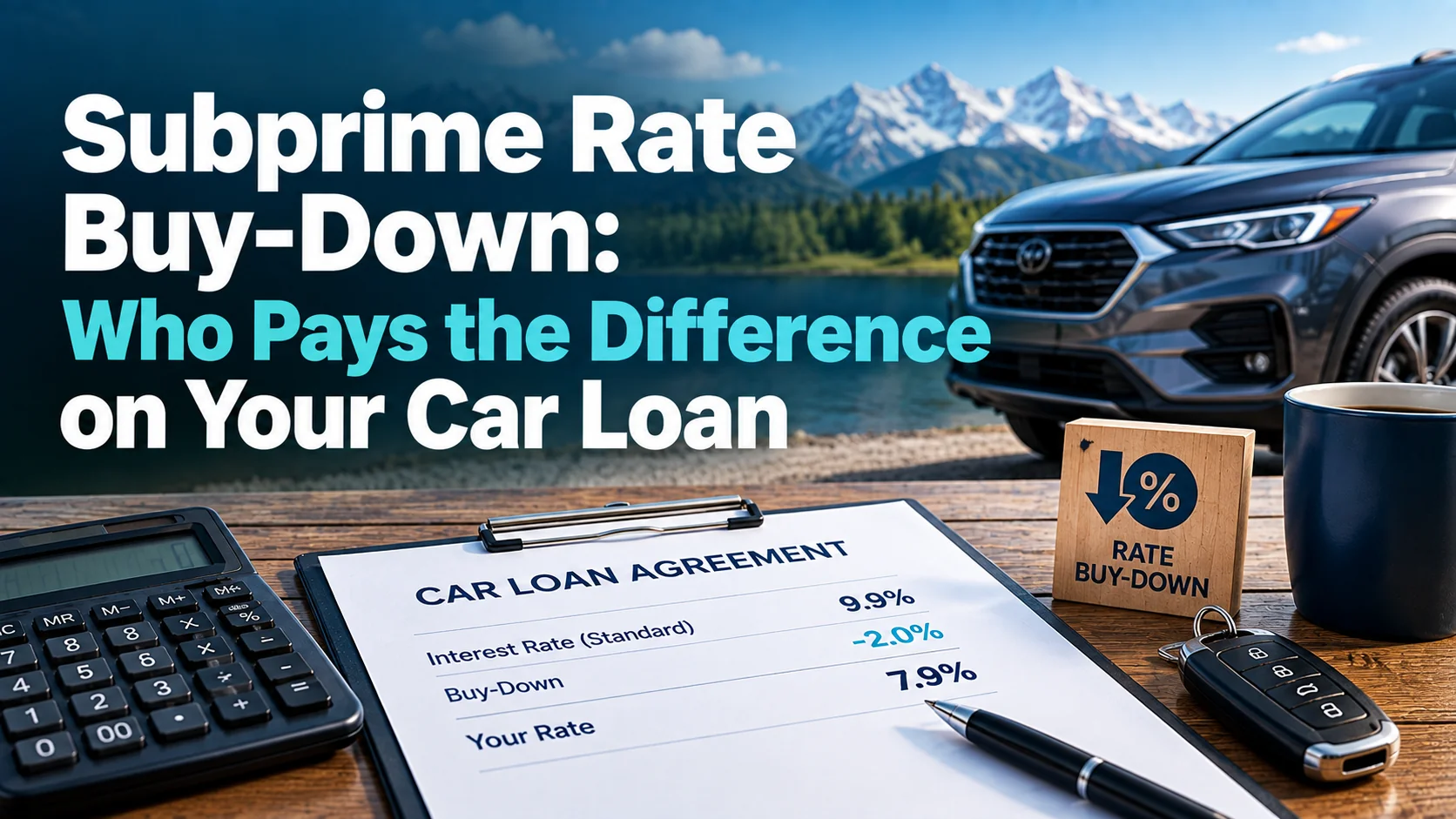
On subprime deals, the bump is often partially offset by rate buy-down — where the dealer uses some of the reserve income to reduce the rate below the buy rate for specific deals (typically when they want to close quickly or the buyer is hesitating). This is the same mechanism in reverse: the dealer is paying the lender to reduce the rate rather than the lender paying the dealer to increase it.
For subprime buyers, the most important protection isn't negotiating individual bumps (which are harder to identify) — it's making sure your application goes to multiple lenders with competing buy rates. Bad credit car loan options in Alberta explains how subprime applications work across different lenders and why the lender selection matters as much as the rate negotiation.
What You're Entitled to See Before Signing
Under Alberta's Consumer Protection Act and federal disclosure requirements, you are entitled to — and must be provided with — the following before signing any financing agreement:
- The Annual Percentage Rate (APR) of the loan
- The total cost of borrowing (total interest payable over the term)
- The payment amount and frequency
- The total amount payable (principal plus all interest and fees)
- Any fees or charges included in the loan
You are not entitled to the lender's buy rate under current disclosure law — that remains a dealer-lender relationship matter. But you are entitled to full clarity on what you're paying, which gives you the basis to evaluate the presented rate against your own research. If a finance manager rushes you through signing without giving you time to read the full disclosure, slow down — that's your legal right.
If you want to understand the full financing agreement structure before signing anything, how car financing works covers the key documents and what to review in each.
Continue Reading
Want the next layer of detail? These guides cover the closest-adjacent situations to this one:
- What to Say When the Dealer Says Your Car Is Worth Less
- Refinancing Math: When It Actually Saves You Money
- Skip-a-Pay Options: The Hidden Interest Cost
- Origination, Admin, Doc Fees on Car Loans: What's Legit
- Does a $200 Detail Job Actually Raise Your Trade-In Value?
- Selling a Car with Mechanical Problems: Dealer, Private, or Scrap?
When Shift Happens Makes Sense for You
Reach out to us if you: (1) are financing a used vehicle in Calgary, Airdrie, or anywhere in Alberta and want transparent rate disclosure from our finance team, (2) want multiple lenders competing for your deal to minimize reserve spread, (3) want to understand exactly what you're signing before the pen touches paper. Not a fit if you need manufacturer-captive lease financing, new vehicles only, or dealer financing for a private purchase.
If you want to understand what rate your credit profile should command before you walk into any dealership, check your approval likelihood (no credit impact) or start an application and let our team lay out all the lender offers side by side.
Frequently Asked Questions
Is dealer reserve (rate bump) legal in Alberta?
Yes. Dealer reserve is legal in Alberta and across Canada. Lenders set policies on maximum reserve spreads (typically 1–4 points), and dealers can markup within those limits. The final rate and total cost of borrowing must be disclosed, but the buy rate and reserve spread are not required disclosures under current provincial or federal law.
How do I know if I was bumped up on my car loan?
Without access to the lender's buy rate, you can't know for certain. Indicators: (a) your rate is significantly higher than what your credit profile should command based on published rate ranges; (b) the finance manager couldn't explain the rate specifically (vehicle age, LTV, term) when asked; (c) you later discover the same lender offered a lower rate through a different channel for a similar application profile. If you suspect it, ask for an explanation in writing and contact the lender directly (not through the dealer) for rate verification.
Can I negotiate a rate bump after signing a car loan in Alberta?
After signing, you generally cannot renegotiate the rate on the existing loan without the lender's consent. Your options are: refinancing with a new lender at a lower rate (requires qualifying independently), or filing a complaint with the lender if you believe the disclosure was inaccurate. Prevention — arriving with a competitive pre-approval — is substantially more effective than post-signing recourse.
Does dealer reserve apply when I use my own bank financing?
No. If you arrive at the dealership with your own bank or credit union financing (a cheque in hand or a confirmed pre-approval), the dealer has no role in the rate-setting. They're acting as a seller, not a finance intermediary. There is no dealer reserve in this structure — though the dealer may try to sell you their financing instead if they believe they can offer competitive terms.
What is the maximum rate bump allowed in Canada?
Lender policy (not law) sets the ceiling. Most major Canadian auto lenders cap reserve spreads at 2 points for prime deals and 3–4 points for subprime deals. Some lenders have moved toward flat-fee dealer compensation models (no rate spread) as part of fairness initiatives, though this remains a minority practice in the Canadian market as of 2026.
Compare and Apply
- Bad Credit Financing — Complete Guide — Alberta's subprime auto financing guide
Financing Resources
Related Articles

Ready to Find Your Vehicle?
Browse our inventory or apply for financing. All credit situations welcome.
★★★★★ 114+ Google Reviews · AMVIC Licensed · Free Delivery 300km