
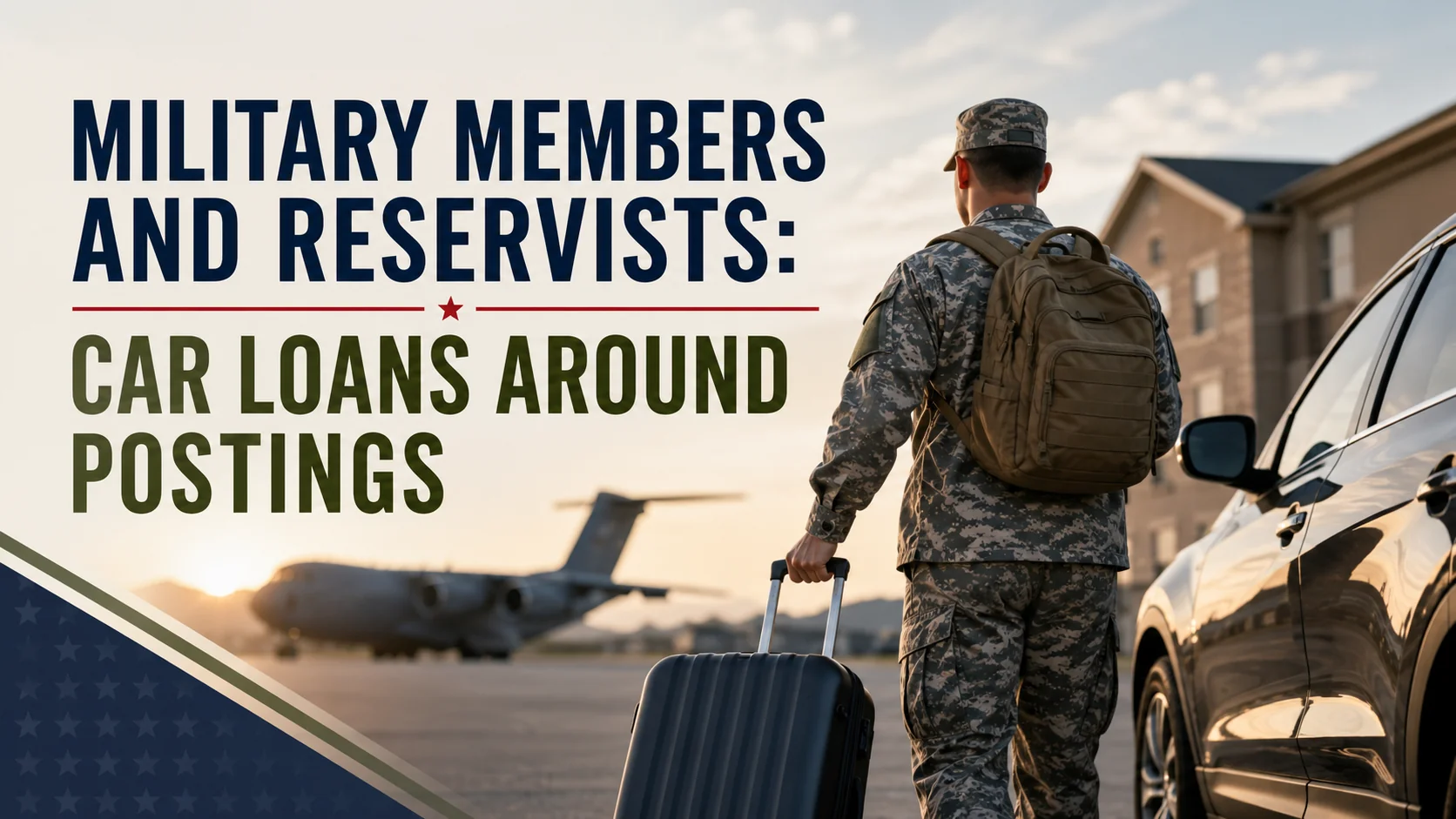
Military Members and Reservists: Car Loans Around Postings
In this article
- Can Canadian military members get a car loan during a posting or deployment?
- Regular Force vs. Reservist: The Financing Distinction
- Posting Allowances and Mission Pay: Do They Count?
- The Posting Problem: Car Loans Across Provincial Lines
- Flexible Payment Options for Deployment Windows
- Buying a Vehicle at a New Posting Location
- Vehicles That Work for Military Families Across Canada
- Trade-In Strategy Around a Posting Move
- Credit Management Across Multiple Provinces
- Adjacent Situations
- Is Shift Happens Right for Your Situation?
- FAQ: Military Car Loans and Posting Financing
- Can I get a car loan while deployed overseas?
- Does my posting message affect my credit score?
- Can a reservist on Class A get a car loan?
- What happens to my car loan if I release from the CAF?
- Can I use my posting moving allowance as a down payment?
- Compare and Apply
Check Your Options in 3 Minutes
No credit impact. All credit situations welcome.
★★★★★ 106+ Google Reviews · AMVIC Licensed · Free Delivery 300km
Canadian Armed Forces members — whether Regular Force or Primary Reserve — face a financing landscape that civilian lenders often misread. Frequent postings move you across the country. Deployment creates income spikes and gaps. A posting message can arrive with 90 days' notice and land you somewhere with no public transit. If you've been told your situation "doesn't fit our standard product," the problem wasn't your application — it was the lender's understanding of military life.
See what you pre-qualify for
Three quick answers — soft check, no commitment.
Can Canadian military members get a car loan during a posting or deployment?
Yes. Regular Force and Reserve members with documented CAF income qualify for auto financing during postings and between deployments. Lenders count Posting Allowance, Isolated Post Allowance, and Regular Force pay as stable income. Reservists on Class B or C service with 12+ months of continuous engagement qualify on that income. Rates typically run 6.99–16.99% for Regular Force with clean credit.
Regular Force vs. Reservist: The Financing Distinction
Regular Force (full-time) CAF members are among the most straightforward borrowers for subprime lenders to underwrite. Federal employer, guaranteed pay deposits, stable employment letter from the unit — these elements check every box a lender looks for. Regular Force members with decent credit should be accessing near-prime rates (8.99–13.99%) from mainstream lenders or subprime specialists.
Reservists are more complex. The Reserve Force includes Class A (part-time weekend and occasional training), Class B (full-time temporary employment), and Class C (full-time operational — including deployments). For financing purposes:
- Class A only: Income is highly variable and typically not suitable as a primary income source for a vehicle loan. Most lenders don't accept Class A Reserve income alone — you'd need a civilian job as the primary income.
- Class B (12+ month contract): If you have a continuous Class B engagement — say, working full-time at a unit for 18 months — lenders can treat this similar to employment income. You need documentation: your Class B contract, pay stubs, and ideally a letter from your unit confirming the contract duration.
- Class C (operational deployment): Class C pay is often higher than regular Class B due to mission allowances, but it ends when the deployment ends. Lenders look at what your income will be post-deployment when the loan term extends beyond the deployment window.
For reservists with mixed Class A and civilian employment, the civilian T4 becomes the primary income document. Class A Reserve income can supplement but typically isn't the base.
Posting Allowances and Mission Pay: Do They Count?
This is where CAF income gets complicated for lenders who don't understand the pay structure. Regular Force postings typically come with:
- Posting Allowance: One-time payment of $3,000–$4,000+ to offset relocation costs. Not counted as income — it's a reimbursement, not recurring.
- Isolated Post Allowance (IPA): Monthly cash allowance for postings to remote locations (Wainwright, Cold Lake, etc.). This IS recurring monthly income and most lenders count it at face value — it shows on every pay stub while you're at the isolated post.
- Foreign Service Premium and Deployment Allowances: Significant income during international deployments. Lenders who understand CAF know these are finite — they'll underwrite on your base pay, not the deployed pay, when the loan extends past the mission end date.
The practical implication: when applying for a car loan before or during a deployment, bring documentation of both your base pay rate (your pay envelope baseline) and your current deployment allowances. A good underwriter will verify what your income looks like at the end of the deployment and model the loan accordingly.
For Regular Force members, the military car financing guide has additional detail on CAF-specific lender programs.
The Posting Problem: Car Loans Across Provincial Lines
Regular Force postings move members to a different province roughly every 2–3 years. When you get a posting message, your car loan doesn't move with you — but the vehicle does. Here's what that means practically:
Your loan stays exactly as it is regardless of province. The vehicle gets re-registered in the new province. In most provinces, that means a vehicle transfer tax or registration fee at the time of re-registration. Alberta to Ontario: roughly $13/100 of vehicle value (retail) in Ontario transfer tax. Alberta to BC: 12% PST on assessed value. These can be $2,000–$5,000 costs that take military families by surprise.
The out-of-province vehicle registration guide covers the Alberta side of this — what happens when you arrive in Alberta with plates from another province, and what the inspection and registration timeline looks like. If you're posting INTO Alberta, this applies directly to you.
One practical note: if you're buying a vehicle knowing you'll post in 18 months, consider buying something that's easy to sell privately or trade in at any dealership anywhere in Canada. The Toyota RAV4, Honda CR-V, and Ford F-150 hold value well coast to coast and have deep dealer networks for trade-ins. Niche vehicles with limited resale markets are harder to move during a posting crunch.
Military financing rule of thumb: A Regular Force private or corporal earning $55,000–$65,000/year base (Master Corporal range in 2026) with a 660+ credit score and $3,000 down typically qualifies for $28,000–$38,000 in used vehicle financing at 10.99–15.99% — roughly $195–$260 biweekly over 72 months. Isolated Post Allowance of $400–$800/month (for Cold Lake or Wainwright postings) can push the qualifying amount another $5,000–$8,000 if counted at the lender's discretion.Flexible Payment Options for Deployment Windows
CAF deployments create predictable cash flow changes: income spikes during the mission (due to allowances), then drops when you return to base pay. Standard bi-weekly payment schedules don't automatically adjust to that rhythm, but there are tools that help:
- Accelerated payments during deployment: Most lenders allow you to make additional payments during high-income periods with no penalty. Aggressively paying down principal during a high-allowance deployment reduces the balance for the lower-income return period. The accelerated car payments guide explains how this works.
- Payment deferral programs: Some lenders offer one or two payment deferrals per year without penalty. If your return from deployment lands in a financial reset month, a one-payment deferral can bridge the gap. Ask about this before you sign — it's much harder to negotiate after the fact.
- Allotment-matched payment schedules: CAF members can set up pay allotments — automatic deductions from military pay. If your lender accepts allotment-matched payments, this eliminates the banking complexity of managing payments during deployment when you may have limited internet access.
The flexible payment options page covers what options are typically available and how to request them. Not every lender offers every option — it's worth comparing lenders specifically on this criterion if deployment is imminent.
Buying a Vehicle at a New Posting Location
If you've just received a posting message to Edmonton, Cold Lake, Shilo, or Suffield — and you need a vehicle in Alberta — the 90-day posting window creates time pressure. Here's what to line up first:
- Confirm your start date and unit address. Your employment letter needs to reference a specific Canadian Armed Forces unit in Alberta — this becomes your proof of employment and local address.
- Get pre-approved before you arrive. Start the financing application online before your posting starts. Most lenders pre-approve based on your pay stubs and employment documents without requiring you to be physically in the province yet.
- Use your old address temporarily. Credit checks and lender approvals use your address on file. You can update your address with the dealership at the time of vehicle registration in Alberta — the financing approval doesn't have to wait for your new address to propagate through systems.
- Budget for the vehicle inspection. Any vehicle from outside Alberta needs an out-of-province inspection ($150–$250 at an AMVIC-approved facility) before registration. If you're buying a vehicle that was previously registered elsewhere, this cost is yours — factor it in.
If your timeline is compressed and you need the vehicle quickly after arriving, same-day financing is available for buyers with a complete document package. Military employment letters from your unit CO typically satisfy the income verification requirement within hours.
Vehicles That Work for Military Families Across Canada
The ideal military family vehicle handles multiple climate zones (you might post from Halifax to Cold Lake to Victoria), has decent towing for long-distance posting moves, and is reliable enough for the km load that constant relocation creates. The top picks:
- Ford F-150: Ubiquitous across Canada, every dealer can service it, tows a trailer with household goods if needed. Downsides: fuel cost is real in Alberta.
- Toyota Highlander: Family SUV with enough space for a long posting move, strong resale coast to coast.
- Chevrolet Silverado: If you need the truck bed for equipment or recreation, the Silverado is well-supported nationwide.
- Subaru Outback: Excels in winter and handles well in every province. More fuel-efficient than a truck or large SUV. Ideal if you don't need truck payload.
Consider winter tires a non-negotiable if you're posting to Alberta from a milder province — the tire changeover cost ($1,200–$1,800 for a set with rims) should be in your posting budget. The Alberta winter car care guide covers what you need to prepare for if you're arriving from a warmer posting.
Trade-In Strategy Around a Posting Move
When a posting message arrives, many CAF members need to decide what to do with an existing vehicle. The options:
Trade it in at destination: If you're posting to Alberta, bring the vehicle and trade it in here. Alberta's used vehicle market is strong for trucks and SUVs, and you'll likely get fair trade value. The trade-in becomes your down payment on the next vehicle at the Alberta dealership.
Sell privately before posting: Private sale typically nets 10–15% more than a dealer trade. If you have time (posting messages usually give 60–90 days), selling privately before you move and buying fresh at the destination is financially optimal. The sell your car guide covers how to value and list a private sale in Alberta.
Keep it and manage two vehicles: Occasionally a family keeps a vehicle at the originating location (with a family member) while the posted member uses a different vehicle at the new location. This is financially complicated — two sets of insurance, two loans — but it happens. Lenders who see two car loans on your bureau will include both in your TDS calculation.
The cleanest scenario: trade or sell at origin, buy fresh at destination, use trade proceeds as down payment. With a well-maintained 2018–2021 truck, a CAF member can typically get $18,000–$28,000 in trade value — a substantial down payment on a replacement vehicle in Alberta.
Credit Management Across Multiple Provinces
Frequent moves across provinces don't fragment your credit file — Equifax and TransUnion track you nationally. However, address history matters for identity verification. If you've had 4 addresses in 6 years (common for Regular Force), bring a military ID (your CF-1 card) and a posting history letter from your unit — it explains the address pattern and prevents flagging during credit review.
One area where multiple postings create friction: some lenders' fraud-detection algorithms flag frequent address changes. A letter from your unit CO confirming CAF service and posting history typically resolves this immediately. Request this letter before you begin vehicle shopping — it's a 5-minute ask that can prevent significant delays in the approval process.
Once you've purchased in Alberta and established a local address for 6+ months, your credit bureau will settle and future applications will process without the address-change friction. CAF members who use a consistent mailing address (often a parent's home or a permanent personal address) throughout their career can sidestep this entirely — the posting addresses for each unit appear as secondary addresses, not primary ones, which raises fewer flags during bureau review.
Adjacent Situations
If this post was useful, these directly-related guides will help you go deeper:
- Best Used Vehicles for Alberta Military Families Who Relocate
Is Shift Happens Right for Your Situation?
Shift Happens Auto Sales is a fit if you: (1) are a Regular Force or Reserve member posted to or based near Alberta, (2) have CAF income documentation and want lenders who understand military pay structures, (3) need 15+ lenders competing on your deal. Not a fit if: you need new vehicle inventory, lease financing, or you're buying outside western Canada.
The fastest next steps: check your approval likelihood (60 seconds, no credit impact) or start a financing application. Military employment letters, T4s, and recent pay stubs are what you need — we'll handle the rest.
FAQ: Military Car Loans and Posting Financing
Can I get a car loan while deployed overseas?
Yes, with some complexity. Power of attorney arrangements allow a spouse or family member to sign on your behalf if you're physically unavailable. Some lenders will work directly with a spouse who is co-applicant. Income documentation from your deployment orders and recent pay stubs is required. Start this process at least 60 days before deployment if possible.
Does my posting message affect my credit score?
No. A posting message and the resulting address change don't affect your credit score directly. However, if you're closing accounts or opening new accounts in a new province during a posting, multiple hard inquiries in a short window can temporarily lower your score by 5–10 points.
Can a reservist on Class A get a car loan?
Class A income alone typically isn't sufficient because it's highly variable. You'd need a civilian primary income. Class A Reserve income can be listed as secondary income. Some credit unions familiar with Reserve service will consider it more favorably than mainstream lenders.
What happens to my car loan if I release from the CAF?
The loan terms don't change upon release — you're still responsible for payments based on your contract. If your income changes significantly after release, contact your lender before missing a payment. Many have hardship deferral options. Voluntary release with employment planned doesn't typically trigger any loan review.
Can I use my posting moving allowance as a down payment?
The Posting Allowance ($3,000–$4,000) is deposited in your account and can be used for anything, including a down payment. Some families use it for vehicle purchase during posting transitions. Just confirm the allowance is deposited before you complete the vehicle purchase — lenders want your down payment funds to already be in your account, not "coming soon."
Compare and Apply
- Bad Credit Financing — Complete Guide — get approved despite bad credit
Financing Resources
Related Articles

Ready to Find Your Vehicle?
Browse our inventory or apply for financing. All credit situations welcome.
★★★★★ 106+ Google Reviews · AMVIC Licensed · Free Delivery 300km