
Front-End vs Back-End DTI: How Alberta Lenders Calculate Risk
In this article
- What Is Front-End vs Back-End DTI for a Car Loan in Alberta?
- Why Lenders Use Two Different DTI Calculations
- The Math on a Real Alberta Scenario
- How Lenders Verify Income in Alberta
- Front-End DTI: When It Actually Matters for Car Loans
- How Down Payment Changes the DTI Equation
- Compensating Factors That Allow Higher DTI
- What to Do If Your DTI Is Too High Right Now
- Related Guides
- Is This a Job for Shift Happens?
- Frequently Asked Questions
- What is the maximum DTI for a car loan in Alberta?
- Does rent count toward DTI for a car loan?
- Can I get a car loan in Alberta if my DTI is 50%?
- How does a cosigner affect DTI on a car loan?
- Is DTI or credit score more important for a car loan in Alberta?
- Compare and Apply
Check Your Options in 3 Minutes
No credit impact. All credit situations welcome.
★★★★★ 114+ Google Reviews · AMVIC Licensed · Free Delivery 300km
You make $5,200 a month gross. Your rent is $1,600. You've got a student loan at $280/month and a credit card minimum of $120. A lender looks at your car loan application and sees a very different picture than you do — they're running two debt-to-income calculations most borrowers have never heard of, and one of them is much more important than your credit score for the size of loan you'll qualify for.
See what you pre-qualify for
Three quick answers — soft check, no commitment.
What Is Front-End vs Back-End DTI for a Car Loan in Alberta?
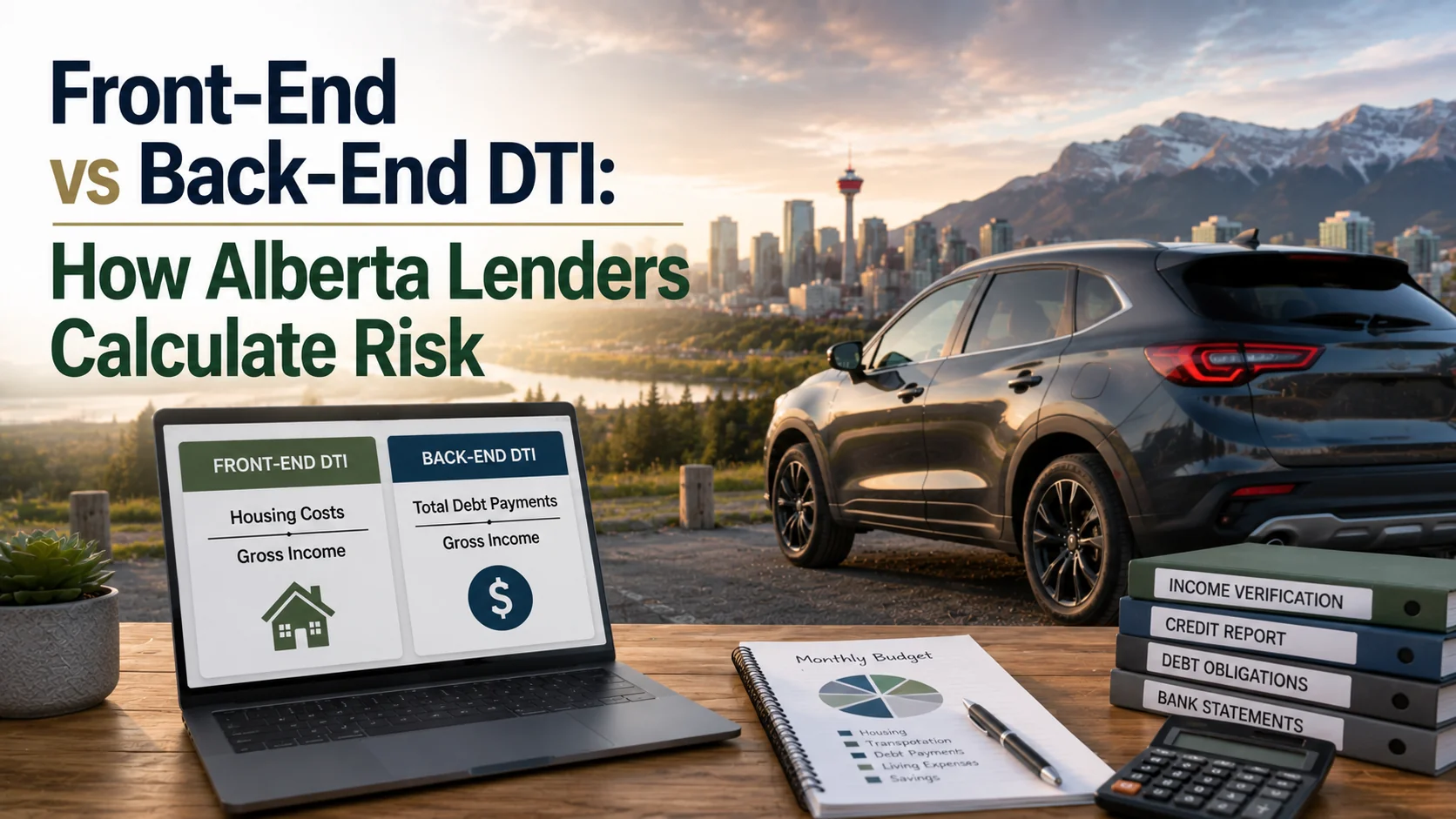
Front-end DTI is your housing costs divided by gross monthly income. Back-end DTI is ALL monthly debt payments (housing + car + student loans + credit cards) divided by gross income. Alberta auto lenders primarily use back-end DTI, targeting a maximum of 44–50%. On a $5,200/month gross income, that ceiling is $2,288–$2,600 in total monthly debt — including the proposed car payment.
Why Lenders Use Two Different DTI Calculations
The front-end ratio — also called the "housing ratio" — measures how much of your income goes to shelter costs: rent or mortgage principal, interest, taxes, and insurance (PITI for homeowners). Mortgage lenders use this intensively because housing is the largest expense for most borrowers and the most dangerous default scenario. Auto lenders use it too, but as a secondary check — they're more focused on your total debt burden.
The back-end ratio is the one that matters most for car loan approval in Alberta. It adds up every monthly debt obligation you have: housing costs, auto payments (existing and proposed), student loans, personal loans, credit card minimums, child support/alimony if applicable, and any other regular debt commitment. Divide by gross monthly income, and you get back-end DTI expressed as a percentage.
Most prime auto lenders in Canada target a back-end DTI under 44%. Subprime lenders — who price risk into the rate rather than declining the application — will stretch to 50% or sometimes higher, particularly when compensating factors exist (strong down payment, long employment tenure, owned housing with equity).
The Math on a Real Alberta Scenario
Let's run the numbers for a buyer in Calgary with a $5,200 gross monthly income:
| Expense | Monthly Amount |
|---|---|
| Rent | $1,600 |
| Student loan | $280 |
| Credit card minimum | $120 |
| Subtotal (existing debts) | $2,000 |
| Current DTI (no car) | 38.5% |
| Maximum DTI target (44%) | $2,288/month |
| Room for car payment | $288/month |
| Biweekly equivalent | ~$133 biweekly |
At $133 biweekly, a 72-month loan at 12.99% supports a vehicle price of approximately $14,800. At 24.99% (subprime rate), the same payment supports only $11,200. That gap is why the rate you qualify for directly affects which vehicles are in play — and why using the affordability calculator with your actual rate changes the picture significantly.
How Lenders Verify Income in Alberta
DTI is only as accurate as the income number going into the denominator. Different income types get treated differently by Alberta auto lenders:
- T4 employment income: Most straightforward — lenders use your most recent T4 plus a current pay stub. If you've had a raise, the pay stub income (annualized) is often used instead of the T4
- Self-employment/T4A: Most lenders use Line 15000 (total income) from your most recent 2 years of T1 tax returns, averaged. Some use only the lower of the two years. Self-employed car financing in Alberta has specific document requirements that differ from employed buyers
- Employment Insurance: Typically counted at 100% of the benefit amount. Alberta lenders generally require at least 90 days remaining on the EI claim
- AISH and disability benefits: Counted at 100% if documented. AISH financing has specific lender programs
- Child support/spousal support: Counted when documented by court order, not just informal agreement. Most subprime lenders require 12+ months of consistent receipt history shown on bank statements
For a deep dive on non-standard income documentation, how non-traditional income qualifies for car loans in Alberta covers the specific document sets for each income type.
The DTI ceiling lenders use matters more than your credit score for loan size. A 650 credit score with a 52% back-end DTI will get a smaller loan than a 580 score with a 38% DTI, all else equal. Before applying, add up every minimum monthly payment from your credit report, add your housing cost, and divide by gross monthly income. If you're above 44%, reducing one existing debt balance before applying can meaningfully increase the vehicle you'll qualify for.Front-End DTI: When It Actually Matters for Car Loans
Front-end DTI becomes a specific concern in two scenarios. First, if you're a homeowner with a large mortgage — Alberta's real estate markets in Calgary and Edmonton have pushed mortgage payments for mid-range homes to $2,200–$3,200/month depending on when you bought. If your mortgage alone consumes 45%+ of gross income, even a small car payment can push back-end DTI to levels where only the highest-rate subprime lenders will touch the file.
Second, if you have no housing cost at all — living with family, in an employer-provided housing situation, or recently moved and waiting to settle — some lenders normalize a theoretical housing cost into the front-end calculation even if you're not currently paying rent. This is lender-specific but not uncommon in subprime underwriting.
How Down Payment Changes the DTI Equation
A larger down payment reduces the loan amount, which reduces the proposed monthly payment, which reduces back-end DTI. This is the mathematical link between having a down payment and qualifying for a larger (or any) vehicle. On a $20,000 vehicle:
- $0 down at 19.99% / 72 months = $272/month ($126 biweekly)
- $3,000 down at 19.99% / 72 months = $231/month ($107 biweekly)
- $5,000 down at 19.99% / 72 months = $204/month ($94 biweekly)
The $5,000 down payment saves $68/month on the payment — but the more important impact is on DTI. A buyer at 47% DTI with no down payment might drop to 44% with $3,000 down, crossing the threshold where a prime-leaning lender picks up the file. That rate difference alone — 19.99% down to 12.99% — saves over $4,200 in total interest on a 72-month $17,000 loan.
Compensating Factors That Allow Higher DTI
Subprime lenders don't apply DTI as a hard cutoff the way prime mortgage lenders do. They weigh it against compensating factors:
- Long employment tenure: 4+ years at the same employer signals income stability even at high DTI
- Strong housing stability: 2+ years at the same address reduces the lender's behavioral risk assessment
- Owned real estate: Homeowners with equity are statistically less likely to default on a car loan
- Down payment percentage: 15%+ down on a subprime loan can push DTI tolerance to 52–55% at some lenders
- Improving credit trend: A score trending from 530 to 580 over 12 months, with no new derogatory marks, signals positive behavioural change
The 15+ lenders that receive your application through Shift Happens each weigh these compensating factors differently. One lender's 50% DTI ceiling has exceptions for 4-year employees. Another penalizes high DTI but ignores employment tenure entirely. The competitive multi-lender model finds which lender's underwriting model fits your specific combination of strengths and challenges. That's why you'd get different decisions shopping one lender at a time versus through a multi-lender financing application.
What to Do If Your DTI Is Too High Right Now
If you run the numbers and find your back-end DTI is 55%+, you have three realistic options before applying:
- Pay down a revolving balance: Credit card minimum payments drop when balances drop. Paying $1,500 off a card with a $2,500 balance eliminates roughly $50–75/month from the DTI calculation — and improves your credit score at the same time
- Increase down payment: Every additional $1,000 down reduces the proposed car payment, lowering DTI directly
- Target a lower-priced vehicle: If the vehicle price drops by $4,000, the monthly payment drops roughly $55–80 depending on rate — enough to shift DTI meaningfully
The debt-to-income ratio guide has a full walkthrough for calculating and improving your DTI before applying. Taking 60–90 days to address a DTI problem before applying is almost always better than applying at peak DTI and getting a rate 4–5 points higher than you'd get after paying down one balance.
Related Guides
If this post was useful, these directly-related guides will help you go deeper:
- Buying Out of Province vs Alberta: Real Cost Breakdown
- CARFAX vs CarProof vs Lien Search: What Each Shows
- Why Your Approved Amount Differs From Your Max Budget
- Lease vs Loan in Alberta: Real Numbers Side by Side
- Pre-Approval vs Full Car Loan Approval: Trade-offs Explained
- Gas vs Hybrid vs Diesel: 5-Year Alberta Cost Comparison
Is This a Job for Shift Happens?
Shift Happens works well when you: (1) are looking for a used vehicle in Alberta, (2) want 15+ lenders to weigh your specific DTI and compensating factors rather than getting a single binary decision, (3) have any credit situation from prime to deep subprime. Not a fit if: new vehicles only, lease-only inventory, or buying outside western Canada.
If that sounds like you, two soft next steps: run an approval check (60 seconds) or begin a financing application. Both stay credit-soft until you decide to submit a formal application.
Frequently Asked Questions
What is the maximum DTI for a car loan in Alberta?
Prime lenders typically cap back-end DTI at 44%. Near-prime lenders stretch to 48–50%. Subprime lenders with specialized programs may approve at 52–55% DTI when compensating factors exist, such as a down payment of 15%+ or 4+ years of stable employment at the same company.
Does rent count toward DTI for a car loan?
Yes — rent is a housing cost and is included in back-end DTI calculations. Unlike mortgage DTI analysis, auto lenders typically accept a rental verification letter or bank statement showing rent payments — you don't need a lease agreement. Own your home? The full PITI (principal, interest, taxes, insurance) counts.
Can I get a car loan in Alberta if my DTI is 50%?
Potentially, yes. Subprime lenders and some near-prime lenders will approve at 50% DTI — especially with a down payment, stable employment, and a vehicle priced conservatively relative to your income. The rate will typically reflect the higher risk: expect 19.99–24.99% rather than 12.99–14.99%.
How does a cosigner affect DTI on a car loan?
A cosigner's income can be added to the denominator — effectively doubling (or increasing) the income base and therefore reducing the DTI percentage. However, the cosigner's existing debts are also added to the numerator. If your cosigner has low debt and good income, they significantly improve the DTI picture.
Is DTI or credit score more important for a car loan in Alberta?
Depends on the lender. For prime lenders, credit score determines rate eligibility and DTI determines loan amount. For subprime lenders, income stability and DTI often matter more than score — a borrower with a 540 score and a clean employment history at 38% DTI can get a better deal than a 600-score borrower with a chaotic income picture at 52% DTI.
Compare and Apply
- Complete Bad Credit Car Buying Guide (Alberta) — step-by-step guide to getting approved in Alberta
Financing Resources
Related Articles


Ready to Find Your Vehicle?
Browse our inventory or apply for financing. All credit situations welcome.
★★★★★ 114+ Google Reviews · AMVIC Licensed · Free Delivery 300km