
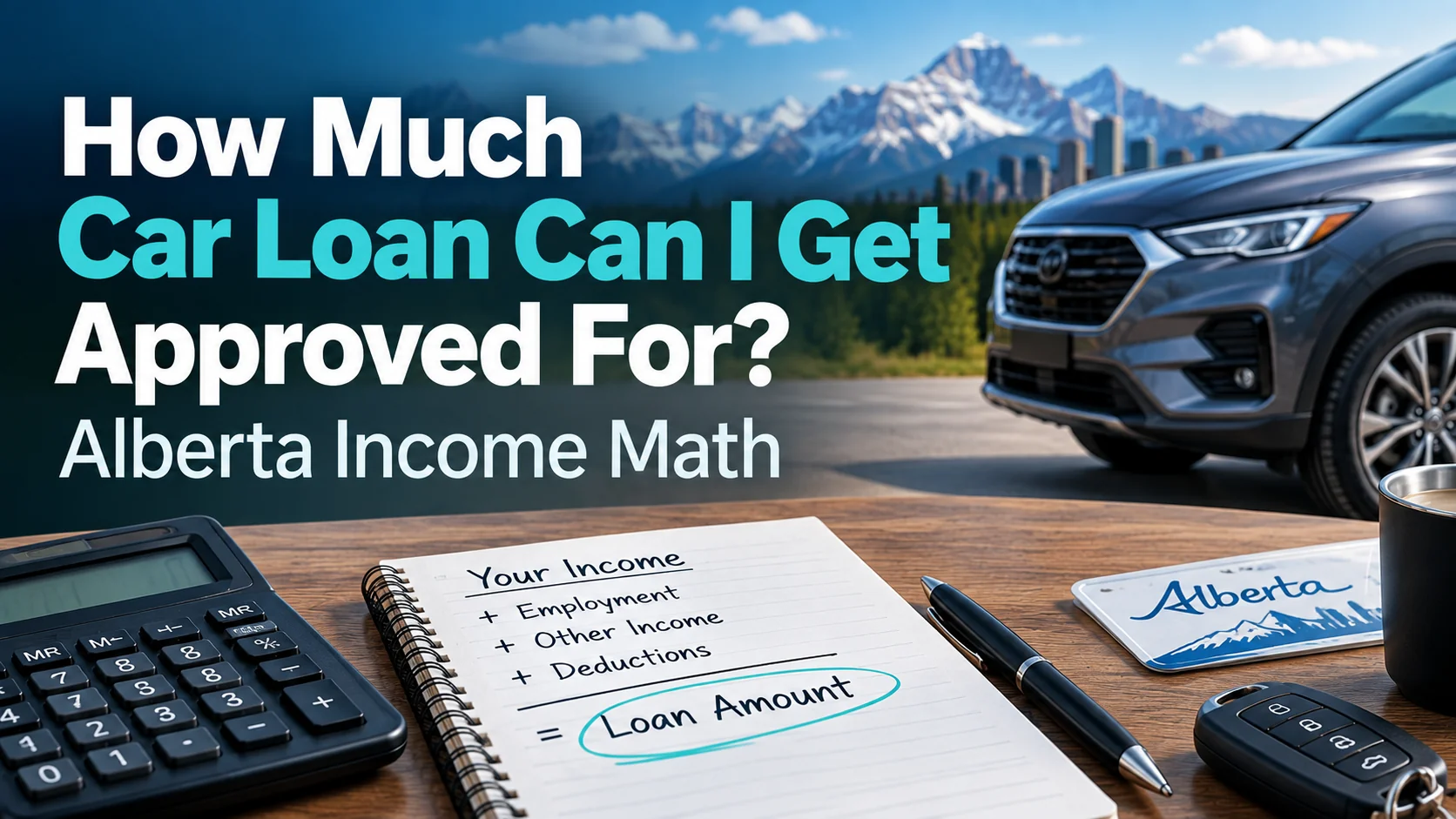
How Much Car Loan Can I Get Approved For? Alberta Income Math
In this article
- How Much Car Loan Can I Get Approved For in Alberta?
- The TDS Ratio: The Core of Lender Eligibility Math
- How Credit Score Adjusts the Equation
- Down Payment's Effect on Maximum Loan Size
- Income Types and How Lenders Verify Each
- T4 Employment Income
- Self-Employment Income
- Government Transfers and Benefits
- Rental Income
- The Loan-to-Value Cap: What Vehicle Values Mean for Approval
- Running Your Own Pre-Approval Estimate
- Could Shift Happens Help With This?
- Frequently Asked Questions
- What is the minimum income to qualify for a $20,000 car loan in Alberta?
- Can I get a car loan in Alberta if I just started a new job?
- Do Alberta lenders use gross or net income to calculate car loan eligibility?
- How does a co-applicant increase my car loan eligibility in Alberta?
- What happens if the vehicle I want costs more than my eligible loan amount in Alberta?
- Compare and Apply
Check Your Options in 3 Minutes
No credit impact. All credit situations welcome.
★★★★★ 106+ Google Reviews · AMVIC Licensed · Free Delivery 300km
How Much Car Loan Can I Get Approved For in Alberta?
In Alberta, most lenders use a Total Debt Service (TDS) ratio of 40–44% of gross monthly income to determine maximum loan eligibility. For a buyer earning $4,500/month gross with no other debts, that means maximum debt payments of $1,800/month — or roughly $72/biweekly on a 72-month loan at 14.99%, supporting approximately $22,000–$25,000 in vehicle financing. Credit score, down payment, and existing debts all adjust this ceiling up or down.
Your income is $52,000 a year. You have a car in mind at $28,000. You have a 580 credit score. Can you get approved for that vehicle? The honest answer depends on a specific calculation that most people have never run — and that most dealerships won't walk you through in advance. Understanding how lenders calculate maximum loan eligibility in Alberta takes about 10 minutes and saves you from showing up to a dealership expecting $28,000 and qualifying for $18,000.
The TDS Ratio: The Core of Lender Eligibility Math
The central calculation lenders use is called the Total Debt Service (TDS) ratio — the percentage of your gross monthly income that goes toward all debt payments combined. This includes your car payment, rent or mortgage, credit card minimum payments, personal loan payments, and any other regular debt obligations.
Alberta subprime lenders typically approve TDS ratios of 40–44% of gross monthly income. Prime lenders are stricter, often capping at 36–40% TDS. For a preliminary estimate of where you land, the math is:
- Take your gross monthly income (before tax)
- Multiply by 0.42 (a conservative TDS mid-point)
- Subtract all existing monthly debt payments (mortgage/rent, credit cards, personal loans)
- The remaining amount is the maximum monthly car payment a lender will consider
Example: $4,800 gross/month x 0.42 = $2,016. Existing rent $1,200 + credit card minimum $50 = $1,250 in existing obligations. Maximum car payment: $2,016 - $1,250 = $766/month (or roughly $383/biweekly). At 14.99% over 72 months, $383/biweekly supports approximately $42,000 in loan amount. At 22.99% over 72 months, the same $383/biweekly supports roughly $33,000. Your rate tier matters enormously for what you can actually buy.
How Credit Score Adjusts the Equation
Credit score doesn't directly change the TDS ratio calculation — it changes the interest rate, which then changes how much vehicle a given payment can support. Two buyers with identical income and debts but different credit scores will qualify for meaningfully different loan amounts because they're paying different rates.
| Credit Score Tier | Typical Rate Range | Monthly Payment on $25K / 72mo | Max Loan at $400/mo |
|---|---|---|---|
| Prime (660+) | 6.99–9.99% | $223–$236/biweekly | ~$42,000–$44,000 |
| Near-prime (600–659) | 9.99–14.99% | $234–$257/biweekly | ~$38,000–$42,000 |
| Subprime (500–599) | 14.99–22.99% | $257–$300/biweekly | ~$32,000–$38,000 |
| Deep subprime (below 500) | 22.99–29.99% | $300–$342/biweekly | ~$27,000–$32,000 |
The practical implication: a 580 credit score buyer and a 680 credit score buyer with identical incomes and debts might qualify for a $10,000 difference in vehicle — not because of income, but because of the rate they're being charged. This is why improving your credit score before financing, even by 30–40 points, has a significant effect on what you can actually buy. Review how credit scores affect car financing for the full framework.
Down Payment's Effect on Maximum Loan Size
Down payment directly reduces the loan amount needed, which reduces the required payment, which can change whether you fit inside a lender's TDS limit. But down payment also signals financial stability to the lender and can unlock better rate tiers — meaning it affects both the numerator and denominator of the affordability calculation.
On a $25,000 vehicle with a $2,000 down payment, you need $23,000 financed. At 19.99% over 72 months, that's $267/biweekly. Put $5,000 down instead and you need $20,000 financed — at 19.99%, $233/biweekly. But the $5,000 down also signals better risk management to the lender, which might unlock 17.99% instead of 19.99%, dropping the payment further. The compounding effect of down payment on both loan size and rate is why lenders consistently ask for more down from riskier borrowers.
Use the payment calculator to model different down payment scenarios against your income number. The tool shows biweekly payments at different rates and terms so you can find the combination that fits your TDS window.
Alberta income-to-loan quick reference: As a rough rule of thumb, Alberta subprime lenders will approve approximately 4–5x your gross monthly income in vehicle financing when you have minimal other debts. So $4,000/month gross with no other obligations → roughly $16,000–$20,000 in vehicle financing eligibility (assuming a 22% subprime rate). At prime rates (7%), the same income supports $22,000–$25,000. Every $500/month in existing debt obligations reduces your vehicle eligibility by approximately $3,000–$4,500 depending on your rate tier. Run the math before you shop — it takes 5 minutes and saves a lot of disappointment. Check your eligibility here.Income Types and How Lenders Verify Each
T4 Employment Income
Standard T4 employment is the most straightforward income type. Lenders typically verify with 2 recent pay stubs and the most recent T4 (or Notice of Assessment). If you've been at your current employer for less than 6 months, some lenders require more documentation. New job income is generally accepted if you've completed probation and can show consistent hours.
Self-Employment Income
Self-employment income is verified through 2 years of NOAs (Notices of Assessment) from CRA. Lenders use the lower of the two years or an average, not the most recent year alone — this is important if your income has grown recently. For self-employed financing, lenders generally want to see $3,500–$4,000/month net (after tax) to support a $20,000 vehicle loan, depending on rate tier and other debts.
Government Transfers and Benefits
Alberta Works, AISH, CPP, EI, maternity/parental benefits, and disability payments are all includable income in most lender calculations. The key requirement is that the income must be stable and ongoing (not temporary or conditional). EI is accepted but lenders prefer to see recent active employment history alongside it. For specific scenarios like car loans while on EI, documentation requirements vary by lender.
Rental Income
Rental income is includable but lenders typically use 50–70% of gross rental income (not 100%) to account for vacancy and maintenance. If your rental property has an associated mortgage, that mortgage payment is also included in your existing debt obligations — potentially offsetting the rental income benefit significantly.
The Loan-to-Value Cap: What Vehicle Values Mean for Approval
Even if your income supports a $30,000 payment, lenders cap loan amounts based on vehicle value (loan-to-value or LTV ratio). Most Alberta lenders for used vehicles cap at 100–130% of vehicle book value. If the vehicle you want is book-valued at $20,000 (regardless of asking price), the lender won't advance more than $20,000–$26,000 against it — even if your income could support a higher payment.
This is particularly relevant for older vehicles (7+ years) or high-mileage vehicles (150,000+ km), which have lower book values. A $15,000 asking price on a 2015 vehicle with 200,000 km might only book at $9,000–$11,000, capping the available financing at $9,000–$14,300 regardless of your income strength. For high-mileage vehicle financing specifically, see high-mileage car financing in Alberta.
Running Your Own Pre-Approval Estimate
Before visiting any dealership in the Airdrie or Calgary area, run this five-step self-assessment:
- Gross monthly income: Your take-home before taxes. Include all stable, verifiable income sources.
- TDS ceiling: Multiply gross monthly income by 0.42.
- Existing monthly obligations: Rent/mortgage + credit card minimums + personal loans + any other regular payments.
- Available monthly car payment: TDS ceiling minus existing obligations.
- Estimated loan amount: Use the payment calculator with your estimated rate tier and a 72-month term to find what loan amount your available payment supports.
This gives you a realistic shopping budget before you sit down with a finance manager. If your self-assessment shows $18,000 and you're looking at $28,000 vehicles, you need to either increase income documentation, reduce other debts before applying, add a co-applicant, or adjust your vehicle target. Better to know this at step one than after a credit pull at step ten.
If you're uncertain after running the math, the affordability calculator lets you input your actual numbers and get a more precise estimate. And if you're ready for a lender's actual assessment, check your approval likelihood here — it takes 60 seconds and doesn't affect your credit score until you formally proceed.
If this post was useful, these directly-related guides will help you go deeper:
- Alberta Has No Car Cooling-Off Period: What Buyers Must Know
- Catalytic Converter Theft Prevention for Alberta Urban Drivers
- Boating Season: Tow Vehicle Setup and Trailer Wiring in Alberta
- Hail Season Vehicle Prep: May to September in Alberta
- Harley-Davidson Resale Value by Model: Alberta Guide
- Alberta Lemon Law Reality: What the Sale of Goods Act Covers
- What Income Counts for Car Loan Approval in Alberta: Full List
- How Lender Pricing Tiers Work: Tier 1 Through Tier 4
Could Shift Happens Help With This?
We're likely a fit if you: (1) want to understand your real loan eligibility before shopping, (2) have any credit situation from prime to deep subprime, (3) are in Alberta and want multi-lender competition to maximize your eligibility and rate. Not a fit if: new vehicles only, lease-only, or buying outside western Canada.
The fastest next steps: check your approval likelihood (60 seconds) or start a financing application. No impact on your credit score until you formally proceed.
Frequently Asked Questions
What is the minimum income to qualify for a $20,000 car loan in Alberta?
With no other debts, a conservative minimum income for a $20,000 car loan at a subprime rate (19.99% over 72 months, roughly $230/biweekly) is approximately $3,200–$3,500 gross monthly income ($38,400–$42,000 annualized). This assumes no rent, no credit card debt, and no other loan payments — a realistic floor. With existing obligations, minimum income requirements increase proportionally. Most Alberta subprime lenders want to see a minimum of $2,800–$3,200/month gross for any vehicle financing approval.
Can I get a car loan in Alberta if I just started a new job?
Yes, but some lenders require 3–6 months at your new employer before approving, particularly if you're in a probationary period. Other lenders accept new job income from day one if you've completed probation and can show consistent hours. The key is verifiable, ongoing income — a job offer letter and 2 pay stubs showing the income amount typically satisfy most lenders. If you switched careers, lenders may want prior employment history in the same field.
Do Alberta lenders use gross or net income to calculate car loan eligibility?
Most Alberta lenders calculate TDS ratios using gross income (before-tax), not net (take-home). This is consistent with Canadian mortgage qualification standards. However, some lenders — particularly for self-employed applicants — focus more on net income since self-employed tax situations are more variable. When in doubt, bring documentation for both your gross and net income figures.
How does a co-applicant increase my car loan eligibility in Alberta?
A co-applicant's income is added to yours for TDS calculation purposes, which directly increases your maximum eligible loan amount. If your income alone supports a $18,000 vehicle and your co-applicant's income supports $15,000, the combined application can support $25,000–$30,000 depending on the lender. However, both applicants' debts and both credit profiles are included — a co-applicant with significant existing debts or poor credit can reduce your eligibility or rate rather than improving it. Learn more about co-signers vs. co-applicants.
What happens if the vehicle I want costs more than my eligible loan amount in Alberta?
You have several options: (1) increase your down payment to reduce the required loan to within your eligibility, (2) extend the loan term from 60 to 84 months to lower the required payment (though this increases total interest cost), (3) find a less expensive vehicle that fits your eligibility window, or (4) add a co-applicant to increase the combined income used in TDS calculation. A lender-approved amount is a ceiling, not a floor — you can always borrow less than the maximum.
Compare and Apply
- Complete Bad Credit Car Buying Guide (Alberta) — Alberta car buying guide for all credit situations
See what you pre-qualify for
Three quick answers — soft check, no commitment.
Financing Resources
Related Articles
Ready to Find Your Vehicle?
Browse our inventory or apply for financing. All credit situations welcome.
★★★★★ 106+ Google Reviews · AMVIC Licensed · Free Delivery 300km