
High Income, Low Credit Score: How Car Financing Works
In this article
- Can a High Earner With Bad Credit Get a Car Loan in Alberta?
- Why Doesn't a High Income Fix a Low Credit Score?
- How Do Lenders Weigh a High Income Against a Low Score?
- How Big a Loan Can a High Income Carry?
- What Does a Low Score Cost, and What Shrinks the Bill?
- A shorter term
- A bigger down payment
- How Does a Car Loan Fit Into Rebuilding Your Credit?
- What Can I Do Before I Apply?
- Frequently Asked Questions
- Why does my bank keep rejecting me for a car loan even though I earn good money?
- Can I finance a truck or large SUV with bad credit and a high income, or am I limited to economy cars?
- How long before I can refinance my subprime car loan at a better rate?
- Will a large down payment lower my interest rate when I have bad credit?
Check Your Options in 3 Minutes
No credit impact. All credit situations welcome.
5.0121+ Google ReviewsAMVIC LicensedFree Delivery 300km
Picture a paycheque that covers everything without a second thought, and a credit score of 530 that tells a different story. Maybe a business debt went to collections, or a consumer proposal from a few years back is still on your report. The income is real. So is the damage. Neither cancels the other, and a lender reads both.
Can a High Earner With Bad Credit Get a Car Loan in Alberta?
It depends on the whole file, not just the income. In our experience, income you can prove is the strongest part of a file where credit took a hit, and it sets how big a payment you can carry. Lenders use your score to set the rate, which runs 4.99%–29.9% APR by credit tier. Every lender decides each file, so nobody can promise a result. We review every application and call you back.
This post is part of our guide to good income, bad credit car loans in Alberta. It looks at what changes when your pay is high: what the income does for you, what it cannot fix, and what the numbers look like.
Why Doesn't a High Income Fix a Low Credit Score?
Because a credit score is built from your credit history, not your pay. The Financial Consumer Agency of Canada (FCAC) says a credit report is “a summary of how you’ve used credit in the past” and that a score “comes from your credit report”. The report includes details about “your credit cards, loans and mortgages”, “how much you owe” and “if you make payments on time or not”. It may also show “current and previous employers” and “current and previous job titles”. Income is not on its list. Equifax Canada's list of what its reports contain (identifying details, credit accounts, inquiries, and public records and collections) does not include income either.
Equifax gives a general breakdown of what scoring models weigh: payment history about 35%, the credit you use compared to your limits about 30%, the length of your credit history about 15%, credit mix about 10% and recent inquiries about 10%. It adds that a score is “only one of several pieces of information an organization will use to determine your creditworthiness”, and its example is a mortgage lender, who also wants to know your income.
That is why a high income can still meet a flat no. In our experience, some lenders let the score decide first, and a collection or a run of late payments can end the conversation before anyone looks at your pay. Others read the whole file, and for them your income carries real weight.
FCAC says lenders and bureaus use different formulas and “don’t share the exact details”, and that “a lender may give more weight to certain information”. So which lender sees your file matters as much as the file. We review your application, match it to lenders that fit your situation, and call you back.
How Do Lenders Weigh a High Income Against a Low Score?
In our experience, every lender sets its own rules, and these are the things that move a file:
- Income you can prove. Recent pay stubs, or your latest Notice of Assessment and a few months of bank statements if you work for yourself. Proof counts for more than the size of the number. Our guide to how lenders check income in Alberta covers what to bring.
- The payment next to your pay. A common rule of thumb is a payment near 15% of your gross monthly pay, which is your pay before tax. It is a guide, not a lender rule, and it moves with your other debts.
- What you already owe. A mortgage, other loans and card payments use up room before the car payment does.
- How old the problems are. FCAC says information about late or unpaid credit cards and loans can stay on a report for up to 6 years, and that a consumer proposal comes off 3 years after it is paid off or 6 years after you sign it, whichever comes first. In our experience, lenders look at how recent a problem is and whether it is still happening.
- Your down payment. A bigger one means a smaller loan. The examples below show what that does.
- How long you have been in your job or business. In our experience, a longer stretch helps.
How Big a Loan Can a High Income Carry?
Take $10,000 a month before tax. At the 15% rule of thumb, a payment near $1,500 a month fits. This table shows what three loan sizes cost over 72 months at 16.9%, an example rate inside the 500–549 band (14.9–24.9%).
| Loan | Monthly payment | Share of $10,000 | Total interest |
|---|---|---|---|
| $30,000 | $666 | 6.7% | $17,930 |
| $45,000 | $999 | 10.0% | $26,900 |
| $60,000 | $1,331 | 13.3% | $35,860 |
Example, not an offer. Interest is rounded to the nearest ten dollars.
All three sit under the rule of thumb. That is what a high income really does: it gives you room for the payment. In our experience, it can move you toward the lower end of your rate range, but it cannot always move you into a different one. Your own numbers will differ, and the payment calculator lets you try them.
What Does a Low Score Cost, and What Shrinks the Bill?
A low score shows up in the rate. Here is the same $45,000 over 72 months at an example rate for the Prime tier and at the example rate above.
| Example rate | Monthly payment | Total interest |
|---|---|---|
| Prime tier, 6.9% | $765 | $10,080 |
| 500–549 band, 16.9% | $999 | $26,900 |
Example, not an offer. The gap is about $234 a month and about $16,800 in interest. Two things you control can shrink it.
A shorter term
FCAC puts it plainly: “The longer the loan term, the lower your payments. You’ll end up paying more in interest with a longer loan term.” On the same $45,000 at 16.9%, 60 months costs $1,116 a month (11.2% of $10,000) against $999 over 72 months, and cuts the interest by about $4,940. FCAC's tip is to “choose the shortest term loan you’re able to afford”. A high income may let you take the shorter term. Example, not an offer.
A bigger down payment
On a $40,000 vehicle at 16.9% over 72 months, $3,000 down means borrowing $37,000, which is $821 a month. $8,000 down means borrowing $32,000, which is $710 a month and about $2,990 less interest. A bigger down payment always lowers the payment. In our experience it can also help the file, because a smaller loan next to the car's value looks like less risk. It is not a promise of a lower rate.
Example, not an offer.
The rate is set when you sign. If your credit recovers, a later loan or a refinance can price lower, and nobody can promise when. Our refinancing math shows when switching actually saves money.
How Does a Car Loan Fit Into Rebuilding Your Credit?
FCAC says: “Your payment history shows how often you pay your bills on time. It’s the most important part of your credit score.” A car loan paid on time can be part of that record, but only if the lender reports it.
FCAC counts a car loan as a personal loan, and says: “Some lenders will send information about your personal loan payments to the credit bureaus.” Equifax adds that lenders may report to both bureaus, just one, or none at all. So ask before you sign. For the month-by-month picture, read how a car loan rebuilds credit in Alberta and our guide to rebuilding credit with a car loan.
What Can I Do Before I Apply?
- Get your own credit report from both bureaus. FCAC says you can get it online for free from Equifax and TransUnion. Look for accounts you forgot and for mistakes. FCAC adds: “You have the right to dispute any information on your credit report that you believe is wrong. Credit bureaus must correct errors for free.”
- Write down what happened. One short paragraph for each major mark on your file: what happened, when, and what has changed since. A lender will not always ask for it. In our experience it helps when a person reads your file as a story and not only as a number.
- Pick a payment you are comfortable with, not the biggest one a lender will allow. A smaller loan next to your income is easier for lenders to work with, and easier on your budget.
- Put down what you can. The examples above show what a bigger down payment does to the payment and the interest.
If a bank has already said no, read what a decline usually means and what to check first. For a wider look at how lenders read a bruised file, see bad credit car loans in Alberta.
Frequently Asked Questions
Why does my bank keep rejecting me for a car loan even though I earn good money?
In our experience, the reason is often the score or what is on the file, not your pay. Some lenders let the score decide first. Equifax says a score is only one piece of information, and FCAC says one lender may give more weight to certain information than another does. A no from one lender is not a no from every lender, and every lender decides each file.
Can I finance a truck or large SUV with bad credit and a high income, or am I limited to economy cars?
Income changes the size of the payment you can carry. In our experience, it can move you toward the lower end of your rate range, but it cannot always move you into a different one. In the example above, a $60,000 loan is $1,331 a month, which is 13.3% of $10,000, under the rule of thumb. Whether a lender agrees depends on the vehicle, your other debts and the rest of the file.
How long before I can refinance my subprime car loan at a better rate?
There is no set wait we can point to. Each lender sets its own minimum, and in our experience many want to see on-time payments first. FCAC says some lenders let you pay a loan off early without a penalty and some charge a fee, so check your contract. Our post on when a refinance pays for itself shows how to work it out.
Will a large down payment lower my interest rate when I have bad credit?
It can help, but it is not a promise. A bigger down payment always lowers the payment and the interest, because you borrow less. Some lenders may also price a smaller loan better. Ask each lender whether more money down changes the rate or only the decision.
When you are ready, you can start the online application. We review every application and call you back, and every lender decides each file.
Sources (pages opened 2026-10-06): Financial Consumer Agency of Canada: Credit report and score basics; How long information stays on your credit report; Shopping around for auto-financing; Financial risks when buying a car; Improving your credit score; Car financing options; Personal loans; Getting your credit report and credit score; Checking your credit report for errors and fraud. Equifax Canada: What Information Is in a Credit Report?; How Are Credit Scores Calculated?.
Financing Resources
Cars you could drive home
See all inventory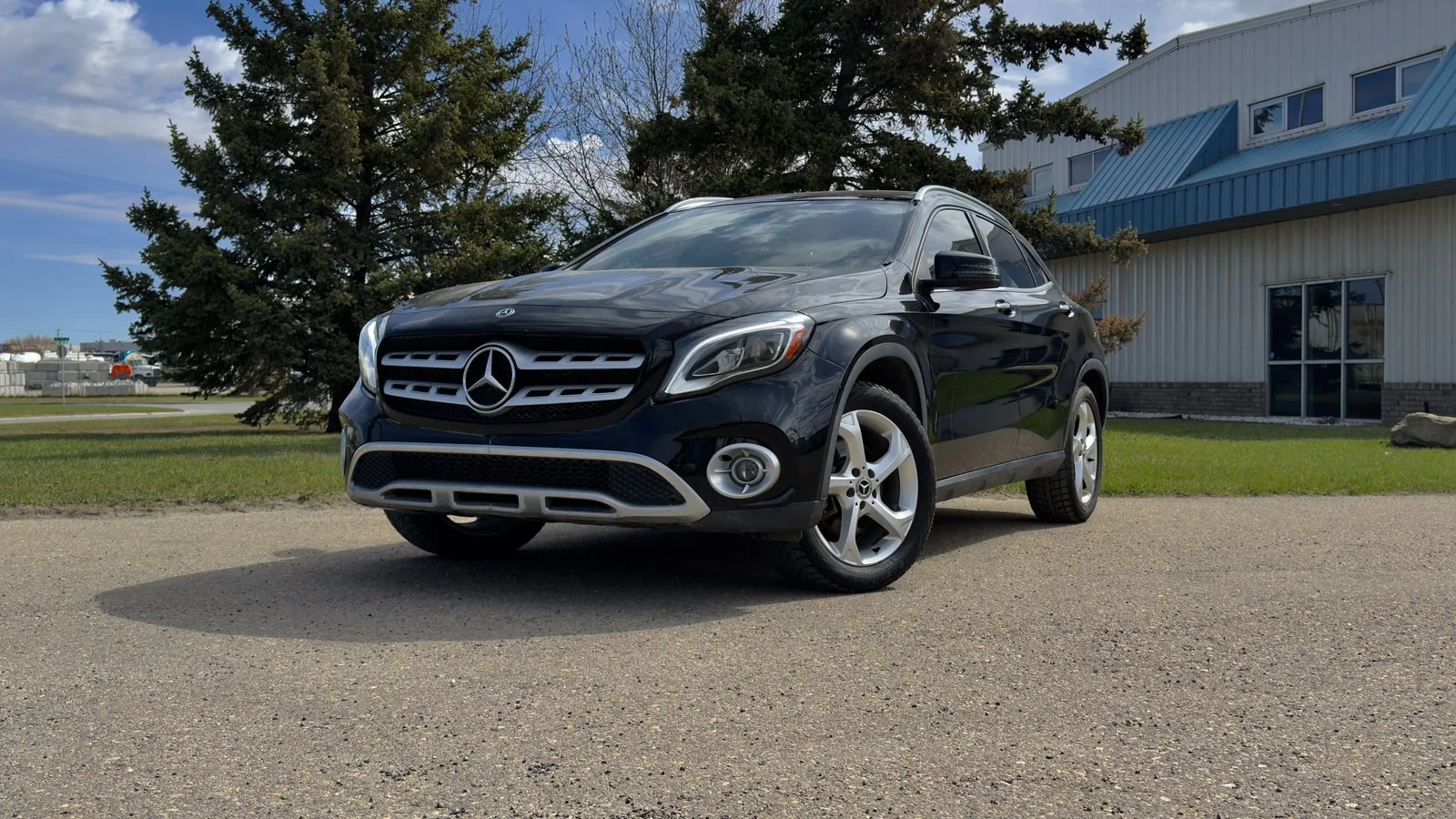
2020 Mercedes-Benz GLA250 4Matic

2020 Land Rover Range Rover Evoque P250 First Edition

2023 Mitsubishi Outlander ES PHEV
Not seeing it? We'll find it.
We source through our dealer partner network across Western Canada: 25,000+ vehicles to choose from. Tell us what you want and what works for your budget.
Find my car3 min · no credit impactOAC = on approved credit. Payments are examples at 6.49% APR over 84 months with $0 down, based on each vehicle's advertised price; GST extra. Your rate depends on your credit (4.99%–29.9% APR).
Related Articles
Ready to Find Your Vehicle?
Browse our inventory or apply for financing. All credit situations welcome.
5.0121+ Google ReviewsAMVIC LicensedFree Delivery 300km