
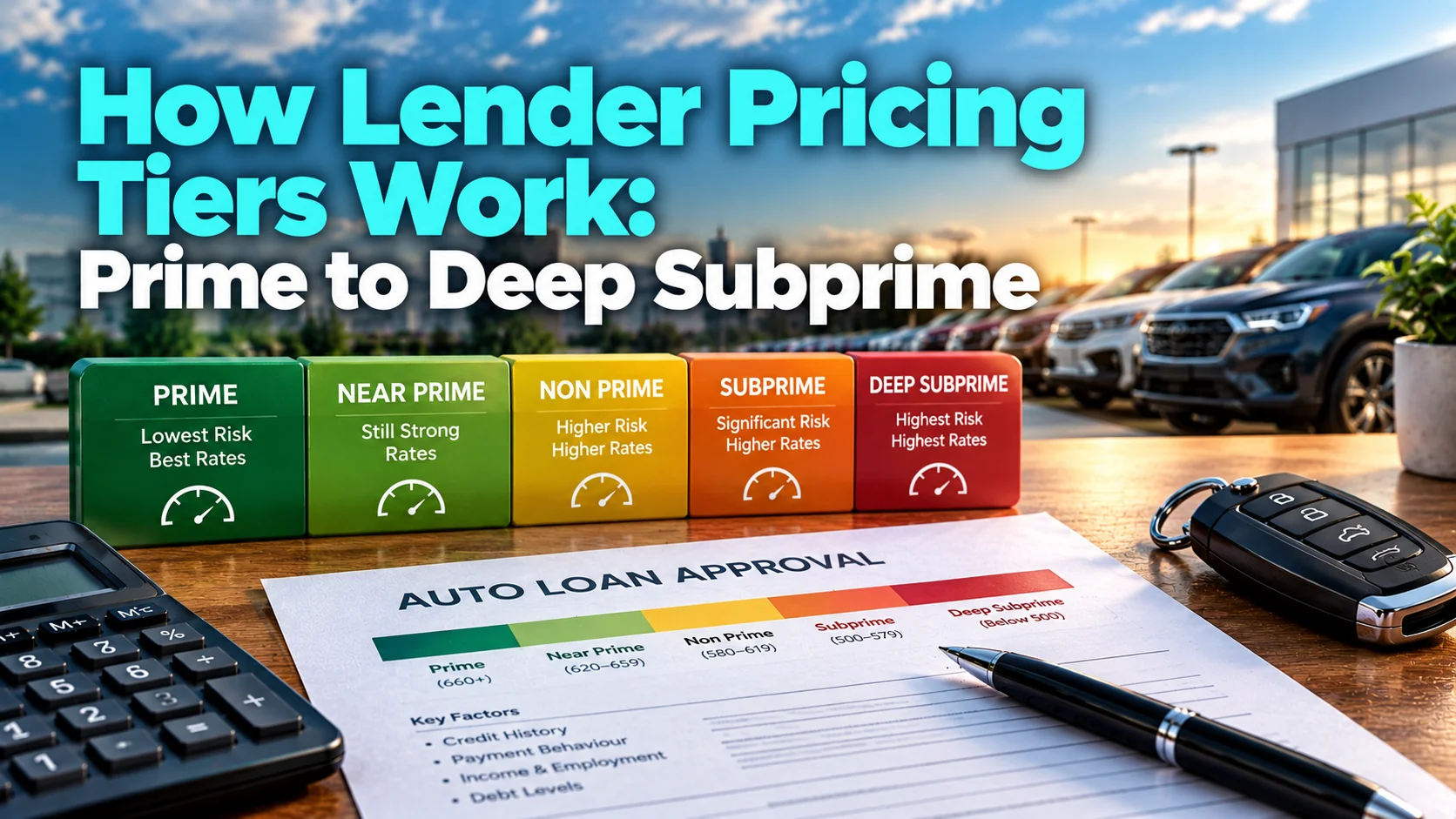
How Lender Pricing Tiers Work: Prime to Deep Subprime
In this article
- How Do Lender Pricing Tiers Work for Car Loans in Alberta?
- What Are the Four Tiers, and What Do They Cost?
- What Do Lenders Look at Besides the Score?
- Can the Same File Get Two Different Prices?
- Will the Dealer Give Me the Lowest Rate?
- What Moves a File Up a Tier?
- What Does a Loan Look Like in the Deep Subprime Tier?
- Frequently Asked Questions
- Can I find out what tier I'm in before applying for a car loan in Alberta?
- Do all lenders use the same four-tier system?
- Does applying at more than one dealership hurt my credit score?
- How long does it take to move up a tier?
- What is the maximum rate a lender can charge on a car loan in Canada?
- Keep Reading
Check Your Options in 3 Minutes
No credit impact. All credit situations welcome.
★★★★★ 118+ Google Reviews · AMVIC Licensed · Free Delivery 300km
Say you applied for a car loan and the rate came back at 16.9%. Say a friend with a stronger credit file applied the same week for a similar vehicle and got 6.9%. You earn about the same. The difference is not luck or the dealership's mood. In our experience, lenders sort applications into pricing tiers, and the tier your file lands in sets the rate.
See what you pre-qualify for
Three quick answers — soft check, no commitment.
How Do Lender Pricing Tiers Work for Car Loans in Alberta?
Lenders price the risk they see in a file, and in our experience they group files into pricing tiers, each with a rate range. On this site we use four: Prime (750+, 4.99–8.9%), Near-Prime (650–749, 6.9–12.9%), Subprime (500–649, 7.9–24.9%) and Deep Subprime (under 500, 19.9–29.9%). Other lenders draw the lines in different places. On a $20,000 loan over 72 months, an example rate in the Prime tier costs about $4,480 in interest and one in the Subprime tier about $11,950. Every lender decides each file.
This post explains the system behind the numbers on our car loan rates in Alberta page, which shows every score band and what a loan costs.
What Are the Four Tiers, and What Do They Cost?
FCAC says: “Lenders use your credit report and score to decide if they’ll lend you money and at what interest rate.” Here are the four tiers on this site, with what the same $20,000 loan over 72 months costs at an example rate in each.
| Tier | Score | Rate range | Example rate | Monthly payment | Total interest |
|---|---|---|---|---|---|
| Prime | 750+ | 4.99–8.9% | 6.9% | $340 | $4,480 |
| Near-Prime | 650–749 | 6.9–12.9% | 9.9% | $370 | $6,600 |
| Subprime | 500–649 | 7.9–24.9% | 16.9% | $444 | $11,950 |
| Deep Subprime | Under 500 | 19.9–29.9% | 24.9% | $538 | $18,700 |
Example, not an offer. Interest is rounded to the nearest ten dollars. Loan lengths run 60–96 months in the first three tiers and 60–84 months in Deep Subprime. FCAC says: “The longer the loan term, the lower your payments. You’ll end up paying more in interest with a longer loan term.”
The Subprime tier is wide, so it helps to see the score bands inside it: 600–649 runs 7.9–14.9%, 550–599 runs 9.9–19.9% and 500–549 runs 14.9–24.9%.
These lines are ours, and other lenders draw theirs elsewhere. FCAC says bureaus and lenders “use different formulas to calculate your score, but they don’t share the exact details”. In our experience, some lenders call their grades Tier 1 to Tier 4 or A to D, and one file can land in a different grade at each lender.
Equifax gives an example: “One bank might interpret a score of 620 (on the version they use) the way another bank interprets a score of 670 (on their specific score version).” It adds that “it’s normal to see differences of 100 points or more” between a person's scores from different scoring algorithms.
What Do Lenders Look at Besides the Score?
The tier is not a lookup of one number. In our experience, lenders also weigh these:
- Down payment. A bigger one means you borrow less. On a $20,000 vehicle, 20% down is $4,000, so the loan is $16,000. In our experience, lenders read a smaller loan next to the car's value as lower risk. It is not a promise of a better tier.
- Debt next to income. Lenders compare your monthly debt payments, including the new one, with your gross monthly income. Each sets its own limit. With an example limit of 40%, a gross income of $4,500 a month and $1,500 of existing debt payments leave $300 of room. The limit is an assumption for the example, not a lender's rule.
- Job history. In our experience, longer at the same employer or in the same business helps.
- The loan next to the vehicle's value. FCAC says you have negative equity when “your car is worth less than the amount you owe on your car loan”. In our experience, a loan that is bigger than the car's value looks like more risk to a lender.
- How recent the problems are. FCAC says information about late or unpaid credit cards and loans can stay on a report for up to 6 years. In our experience, lenders weigh a recent problem more than an old one.
For the difference between the two ends of the scale, see how subprime and prime financing differ.
Can the Same File Get Two Different Prices?
Yes, because lenders use different score versions and different models. Say your score is 640, inside the 600–649 band (7.9–14.9%). One lender prices the file at 14.9% and another at 9.9%. Both are inside the band. On $20,000 over 72 months the first is $422 a month and about $10,370 in interest, and the second is $370 and about $6,600. The gap is about $50 a month and about $3,800 in interest. Example, not an offer.
When you apply to one bank, you see one lender's price. We review your application, match it to lenders that fit your situation, and call you back. See how our lender network works. Every lender decides each file.
Will the Dealer Give Me the Lowest Rate?
Not necessarily. FCAC says: “Most dealerships make car loan arrangements for you with a lender.” It adds: “A dealer doesn’t have to offer you the lowest interest rate when showing you different financing options. Ask the dealer to show you multiple offers from different lenders if possible. Compare them to see who offers the lowest interest rate.” The Alberta Motor Vehicle Industry Council (AMVIC), which calls itself “Alberta’s Automotive Regulator”, says: “Remember that not all places that offer financing charge the same interest rates. Check out financing options with various financial institutions and the seller.”
AMVIC also says Alberta's Consumer Protection Act requires lenders to disclose, among other things, “the credit charge, written out in dollars” and “the annual percentage rate of interest you’ll pay”. FCAC says your lender or dealer must give you a disclosure statement before the agreement is final: “Read it carefully before signing it. Make sure you ask for a copy.” Compare the rate, the loan length and the total cost in writing, whoever you borrow from. Our guides to the subprime rate buy-down and to negotiating your car loan rate go further.
What Moves a File Up a Tier?
Tier placement is not fixed on the day you apply. If you have time before you buy, these are the levers you control:
- Put more down. In our experience, the smaller the loan next to the car's value, the less risk a lender sees. A bigger down payment always lowers the payment, and it is not a promise of a better tier.
- Pay down card balances. FCAC says: “Try to use less than 30% of your total credit limit.” It adds that “If you regularly use a lot of your available credit, they may see you as a higher risk.”
- Hold off on new applications. FCAC says too many credit inquiries made too close together may make lenders think you are “urgently seeking credit”. Equifax says hard inquiries “remain on Equifax credit reports for a period of three years”.
- Deal with collections. In our experience, lenders look at whether an account is open or paid as well as at the score. Our guide to a car loan while in collections goes through it.
- Check your report for mistakes. FCAC says you can get your credit report online for free from Equifax and TransUnion. It adds: “You have the right to dispute any information on your credit report that you believe is wrong. Credit bureaus must correct errors for free.”
Our guide to how credit scores affect your car loan gives the wider picture.
What Does a Loan Look Like in the Deep Subprime Tier?
Under 500 the rate range is 19.9–29.9% and the longest loan is 84 months. Here is a $15,000 loan over 72 months at an example rate of 24.9%: $403 a month and about $14,030 in interest, close to the size of the loan itself. Example, not an offer.
That is expensive credit. A smaller loan, a bigger down payment or time to rebuild the file can change it a lot. Our guide to bad credit car loans in Alberta covers what to expect.
Frequently Asked Questions
Can I find out what tier I'm in before applying for a car loan in Alberta?
Not exactly, because each lender has its own scale. You can get a rough idea. FCAC says you can get your credit report online for free from Equifax and TransUnion, and that an Equifax score is “free in all provinces and territories”. Find your score in the table above to see the range your rate is likely to fall in. Every lender decides each file.
Do all lenders use the same four-tier system?
No. FCAC says bureaus and lenders use different formulas and do not share the details, and Equifax says “various banks and lenders don’t all use the same score version”. The four tiers here are the ones we use on this site. In our experience, other lenders name and cut their tiers differently.
Does applying at more than one dealership hurt my credit score?
Each credit application is a hard inquiry, and FCAC says hard inquiries “affect your credit score”. FCAC also advises: “when shopping for a car loan or mortgage, get quotes from different lenders within a 2-week period. Credit bureaus treat these as 1 inquiry”. Equifax says the timeframes “range from 14 days to 45 days, depending on the credit scoring model being used”, that all inquiries still show on your report, and that generally only one inside the window affects your score. So keep your shopping inside two weeks.
How long does it take to move up a tier?
There is no set time. Payment history is what FCAC calls “the most important part of your credit score”, so it comes down to months of on-time payments. FCAC says late or unpaid accounts can stay on a report for up to 6 years, and a consumer proposal comes off 3 years after it is paid off or 6 years after you sign it, whichever comes first. Nobody can promise how many points or how soon.
What is the maximum rate a lender can charge on a car loan in Canada?
Section 347 of the Criminal Code makes it an offence for a person who “enters or offers to enter into an agreement or arrangement to receive interest at a criminal rate”. It defines a criminal rate as an annual percentage rate that “exceeds 35 per cent on the credit advanced”. Rates in our lender programs run 4.99%–29.9% APR. AMVIC adds that Alberta's Consumer Protection Act requires the lender to show you the annual percentage rate and the credit charge in dollars.
Keep Reading
- How down payment size changes a car loan file
- 60 vs 72 vs 84 vs 96 month loans: the real cost
- How dealership financing works behind the scenes
- What income counts for a car loan in Alberta
When you are ready, you can start the online application. We review every application and call you back, and every lender decides each file.
Sources (pages opened 2026-10-06): Financial Consumer Agency of Canada: Credit report and score basics; Shopping around for auto-financing; Financial risks when buying a car; How long information stays on your credit report; Car financing options; How you're protected when buying a car; Improving your credit score; Getting your credit report and credit score; Checking your credit report for errors and fraud. Equifax Canada: 4 Credit Score Myths Explained; Understanding Hard Inquiries on Your Credit Report. Alberta Motor Vehicle Industry Council (AMVIC): Home page; Setting a budget. Justice Laws Website (Government of Canada): Criminal Code, section 347.
Financing Resources
Cars you could drive home
Browse all inventory →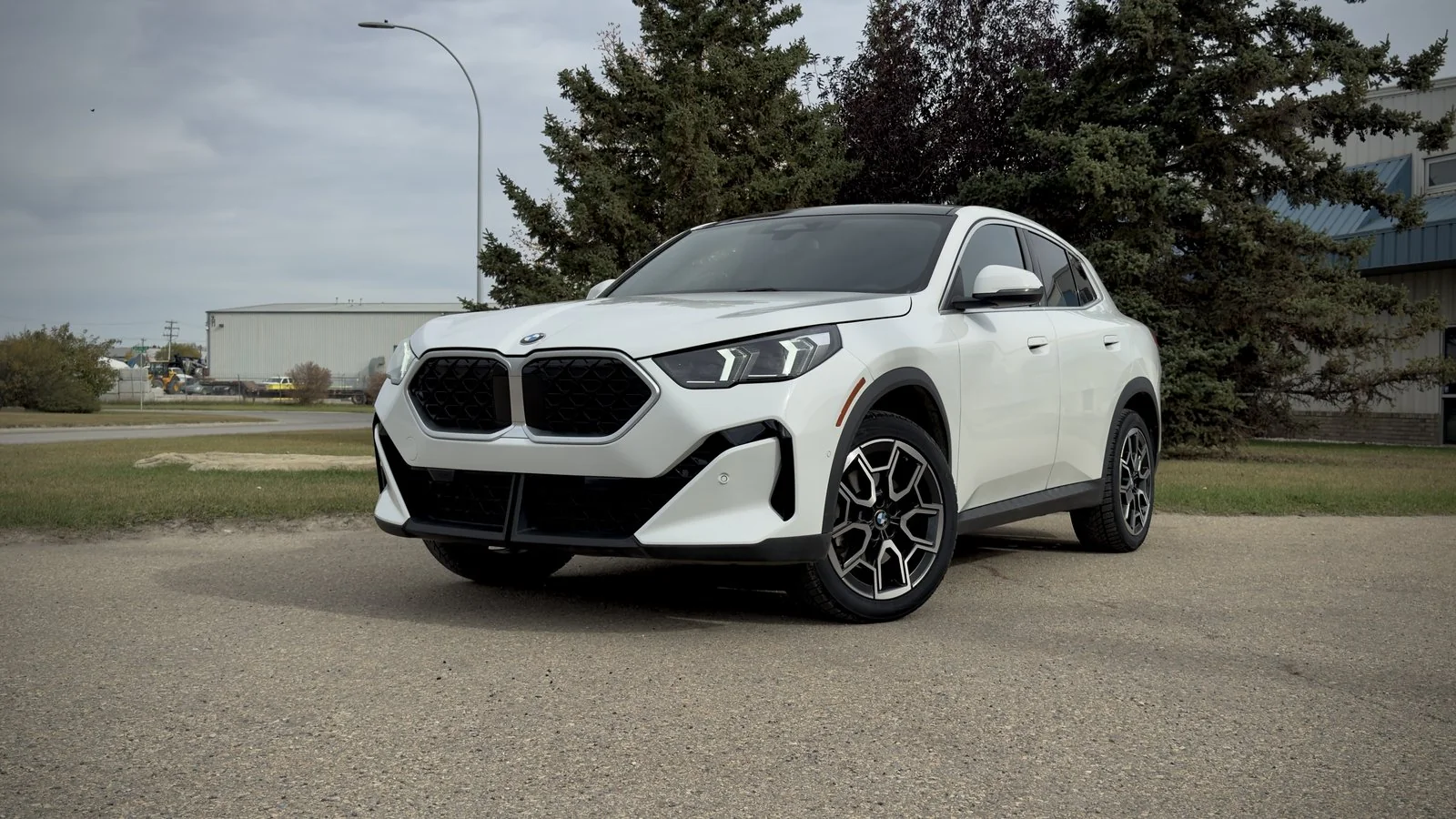
2025 BMW X2 xDrive28i
$246 bi-weekly OAC
6.49% APR · 84 months · $0 down · cost of borrowing $8,835
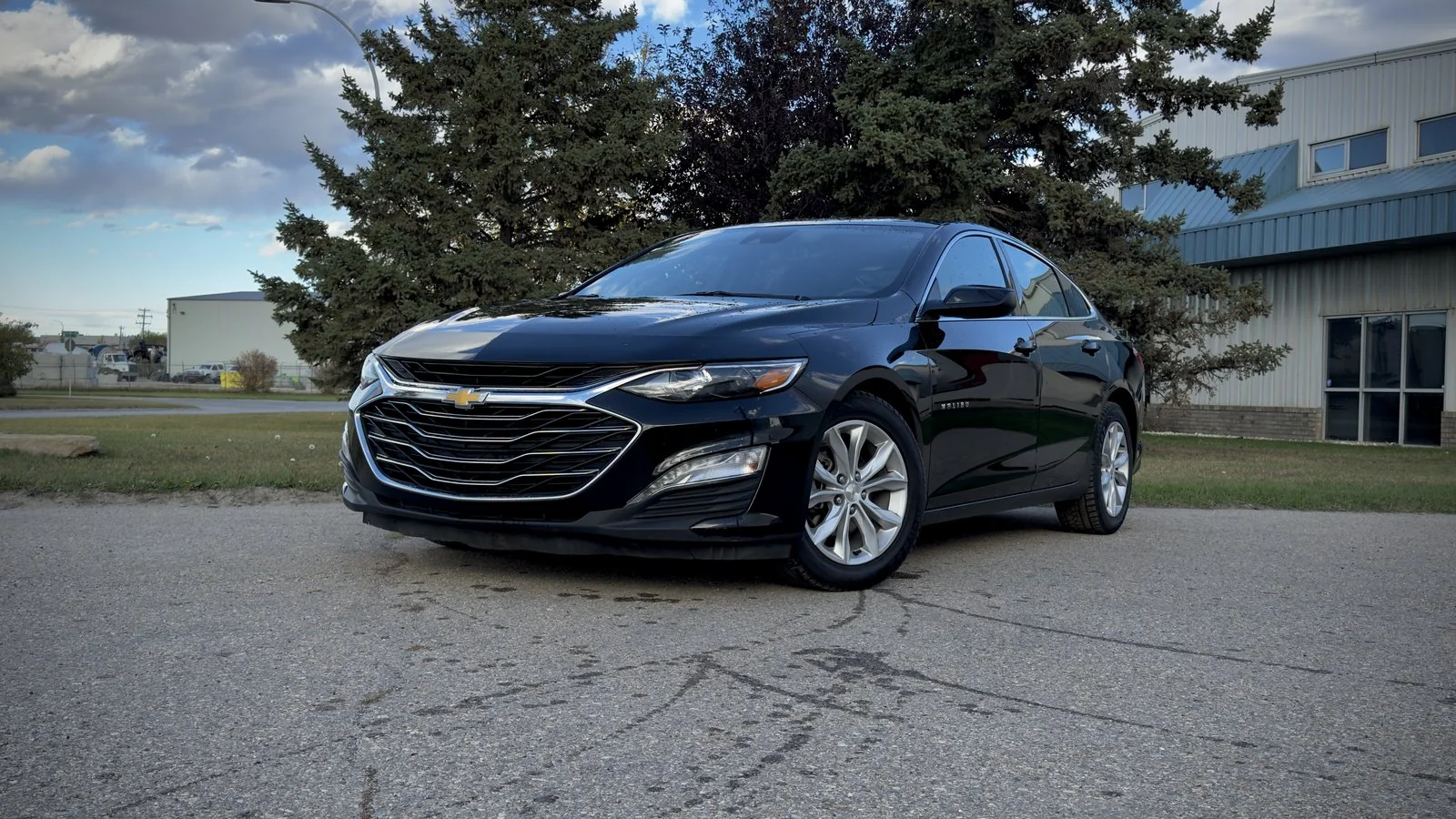
2025 Chevrolet Malibu 1LT
$164 bi-weekly OAC
6.49% APR · 84 months · $0 down · cost of borrowing $5,889
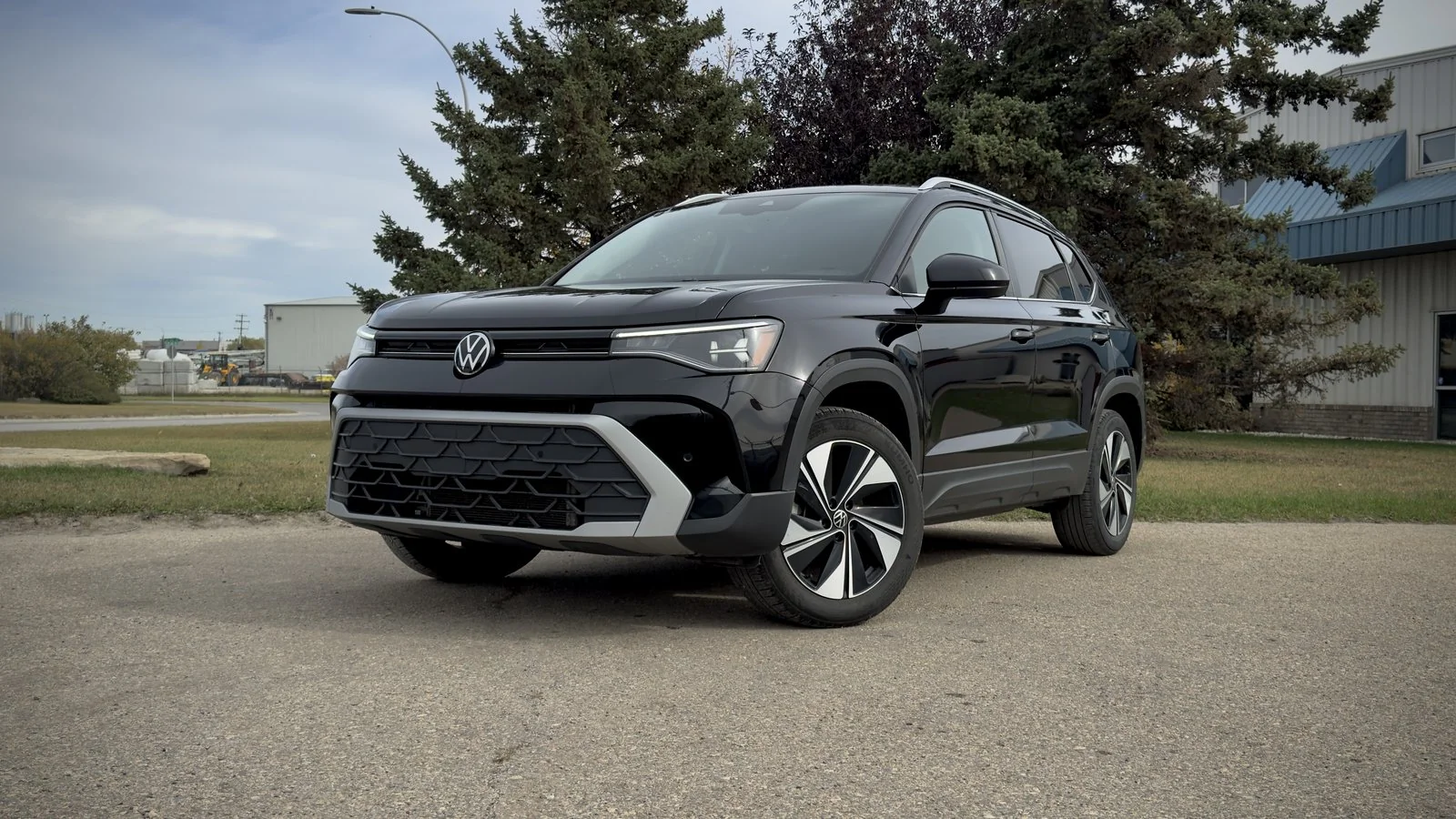
2025 Volkswagen Taos Comfortline
$185 bi-weekly OAC
6.49% APR · 84 months · $0 down · cost of borrowing $6,626
OAC = on approved credit. Payments are examples at 6.49% APR over 84 months with $0 down, based on each vehicle's advertised price; GST extra. Your rate depends on your credit (4.99%–29.9% APR).
Related Articles
Ready to Find Your Vehicle?
Browse our inventory or apply for financing. All credit situations welcome.
★★★★★ 118+ Google Reviews · AMVIC Licensed · Free Delivery 300km